Lease Accounting (ASC 842 / IFRS 16)
Corporate Finance Financial Model (Free Excel Download)
Calculate right-of-use assets, lease liabilities, interest, amortisation, and operating or finance lease expense under ASC 842 and IFRS 16.



professionals from Deloitte
Used by professionals from






About this model
A lease accounting model under ASC 842 (US GAAP) and IFRS 16 (international) translates a panel of leases into right-of-use (ROU) asset and lease liability balances on the balance sheet, classifies each lease as finance or operating using the five bright-line tests in 842-10-25-2, and routes the P&L expense through the matching recognition pattern. This template models eight leases - HQ office, satellite office, warehouse, fleet vehicles, forklift equipment, data centre, retail store, and IT hardware - across a five-year horizon with annual periodicity for readability.
The Assumptions sheet holds per-lease term, annual payment, payment escalator, incremental borrowing rate, underlying-asset useful life, fair value, and three classification flags (ownership transfer, purchase option, specialised asset). The Classification sheet runs all five bright-line tests and computes the Day-1 PV of payments as SUMPRODUCT over escalated annual payments discounted at the lease's IBR. Each lease gets a Finance or Operating tag; the Liability Schedule rolls forward opening, interest accretion, cash payment, and closing balance across Y1–Y5; the ROU Asset Schedule does the same for opening, amortisation, and closing.
The P&L Impact sheet routes each lease through the right expense path: finance leases recognise interest plus amortisation (front-loaded total), operating leases recognise a single straight-line lease cost (constant total). The Dashboard rolls up Day-1 totals, Y1 lease expense, Y5 closing balances, classification mix, weighted-average remaining term, and weighted-average discount rate - exactly the disclosure metrics required under ASC 842 / IFRS 16 footnotes.
CFOs, controllers, technical accounting teams, and auditors use this template for footnote disclosure preparation, lease-vs-buy decisions, and audit support. The bright-line tests are exposed as one-cell IF formulas with thresholds on Assumptions, so an operator can flex any test threshold or any per-lease input and watch the Day-1 balances, expense path, and dashboard recompute immediately.
What every model includes
Live formulas, no hardcoded values
Outputs are driven by live formulas, so the workbook updates from its assumptions instead of relying on hardcoded results.
All assumptions in one tab
Inputs are clearly marked in the Assumptions tab and separated from calculations, making it clear what to change and what to leave intact.
Statements always balancing
For integrated-statement models, the balance sheet, cash flow, and supporting schedules tie through properly.
Distinct schedules for clarity
Debt, working capital, taxes, and cash flow can get messy quickly. We group calculations in clear schedules, not across disconnected tabs.
No hidden macros or external links
There are no unexplained external workbook links or macros to undermine auditability or portability.
Changes flow through the model
Update a key driver and see the impact carry through the forecast, financing, and return outputs. We never use hardcoded numbers in formulas.
What's inside the Lease Accounting (ASC 842 / IFRS 16)
- Eight-lease panel spanning real estate, equipment, vehicles, and IT
- Per-lease term (years), annual payment, escalator, IBR, useful life, fair value, and three flags (ownership transfer, purchase option, specialised asset)
- Bright-line thresholds (75% term, 90% fair value) as named-range inputs
- Classification sheet with Day-1 PV of payments, term ratio, FV ratio, and all five ASC 842 tests resolved to Finance or Operating
- Liability Schedule: per-lease Y1–Y5 opening, interest, payment, closing roll-forward
- ROU Asset Schedule: per-lease Y1–Y5 opening, amortisation, closing roll-forward
- P&L Impact: finance lease = interest + amortisation (front-loaded), operating lease = single straight-line cost
- Dashboard with Day-1 ROU, Day-1 liability, Y1 expense, Y5 closing, classification mix, weighted-average term, weighted-average discount rate, plus traffic-light status
Lease Accounting Model: How the ASC 842 / IFRS 16 Template Works
This lease accounting model provides a 10-year right-of-use asset and lease liability schedule for up to eight leases under ASC 842 and IFRS 16. It covers Day-1 measurement, annual roll-forward, classification tests, P&L and cash flow splits, and disclosures.
This explanation helps you evaluate its mechanics and operating drivers without needing the full file.
What Drives the Lease Accounting Model
The lease accounting model runs on a small set of lease-level inputs. Each lease has a term, annual base payment, escalator rate, incremental borrowing rate, useful life, fair value, and payment timing (advance or arrears).
- There are also flags for ownership transfer, purchase option, and specialised asset, plus initial direct costs, prepaid rent, lease incentive, and variable payment percentage. These inputs feed every downstream calculation, so changing one lease flows through Day-1 measurement, classification, schedules, and the P&L.
- A standard toggle switches between ASC 842 and IFRS 16, and a scenario selector applies shifts to IBR, escalator, and short-term cutoff.
How Day-1 Liability and ROU Asset Are Calculated
Day-1 lease liability equals the present value of all future lease payments, discounted at the lease's effective incremental borrowing rate. Payment timing matters: advance leases discount from period zero, while arrears leases discount one period later.
- The initial right-of-use asset then builds from that liability plus initial direct costs and prepaid rent, minus any lease incentive. Exempt leases—those meeting short-term or low-value criteria—are excluded and produce no ROU asset or liability.
- Classification tests compare term to useful life, Day-1 liability to fair value, and check ownership transfer, purchase option, and specialised asset flags to decide finance versus operating treatment under ASC 842, while IFRS 16 treats all non-exempt leases as finance-style.
Year-by-Year Roll-Forward and P&L Patterns
Each year, the liability schedule opens with the prior closing balance, adds interest accretion, and subtracts the cash payment. For advance leases, payment is deducted before interest accrues; for arrears, interest is calculated on the opening balance.
- There is no floor at zero, so any residual naturally surfaces and should reach zero by the end of the term. The ROU asset schedule amortises the asset differently by class: operating leases use a single-lease-cost approach where amortisation equals the straight-line cost minus interest, while finance leases use straight-line amortisation of the Day-1 ROU asset.
- Operating amortisation can be negative in early years when interest exceeds the straight-line cost, which reflects the deferred rent mechanism. Impairment is available as a per-lease input, defaulting to zero.
Outputs, Practical Use, and Business Relationships
The template produces a dashboard with headline metrics including Day-1 ROU, Day-1 liability, first-year cost split, closing balances at year five and year ten, classification counts and shares, weighted-average remaining term, weighted-average discount rate, and ratios such as ROU to total assets and lease liability to total debt.
- A P&L sheet separates operating lease cost, finance interest, finance ROU amortisation, variable lease cost, short-term lease cost, and impairment, with a deferred-rent roll-forward for operating leases. Cash flow splits payments into operating, financing interest, and principal.
- A disclosure sheet provides a maturity analysis, reconciliation to Day-1 liability, and weighted-average terms and rates by class. Sensitivity tables show how Day-1 liability responds to IBR and escalator shifts, supporting practical evaluation of discount rate and escalation assumptions.
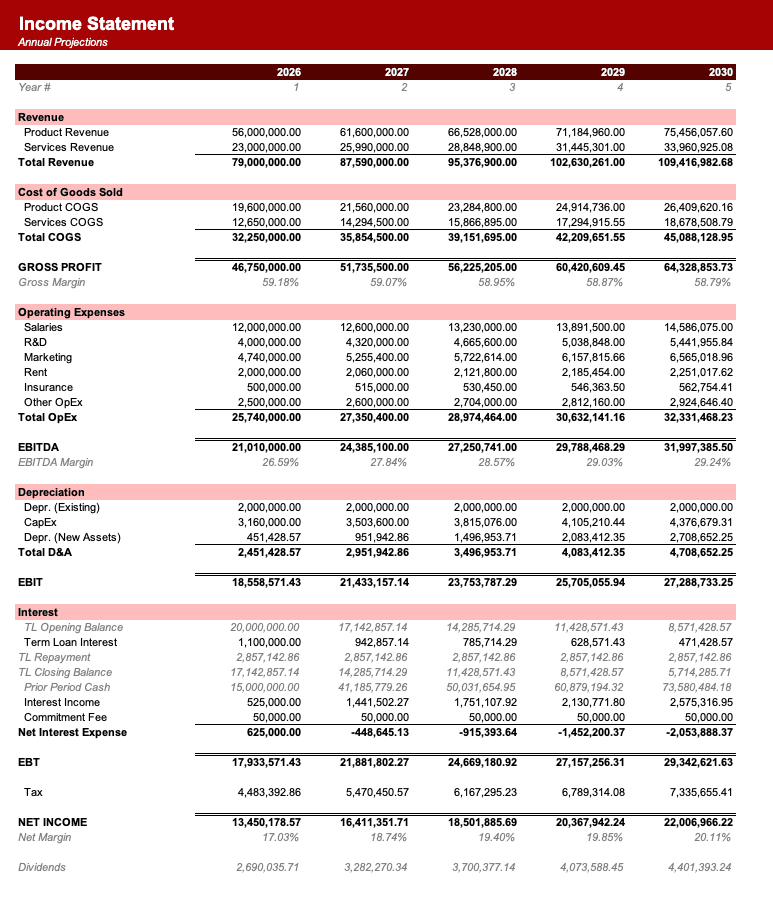
Formatted to IB standards
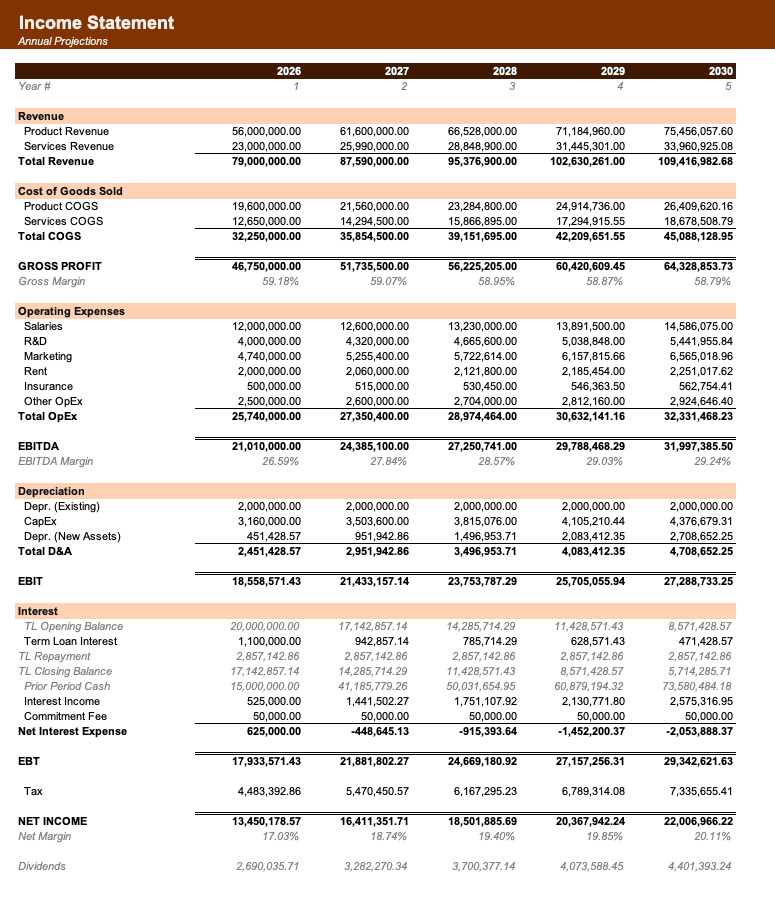
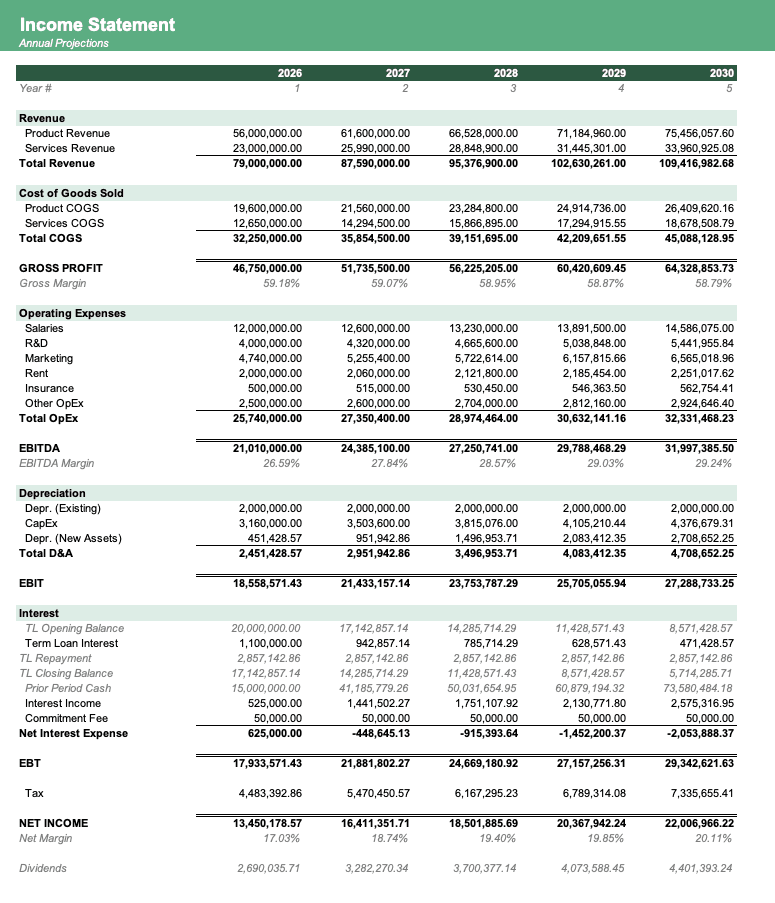
Named theme colors repaint the whole workbook in one click, on top of an investment-banking structure with clear input, output, and cross-sheet reference styling - brand-ready, institutional-grade, and fully auditable.

Created by ex-finance professionals
Hey, I’m Alex and I created Finamodel.
Over my years in the finance industry I kept building the same models over and over again. Same structure, same assumptions, different logo. So I started building frameworks to turn them into clean, reusable templates.
Every model here is one I’d actually use for a client, and I personally vet each one before it goes up.
I’m not an expert in every industry, but I’ve built enough models to know what belongs in one. And when something is completely foreign to me, I reach out to my network for experts to work on our models with us.
Having a template library on hand cuts a first build from hours to minutes.
Need help finding your model? You’ll find me in the Finamodel app!
Frequently asked
What is ASC 842 / IFRS 16?+
ASC 842 (US GAAP) and IFRS 16 (international) are the lease accounting standards that require lessees to recognise a right-of-use asset and lease liability on the balance sheet for substantially all leases. They replaced the older operating-vs-capital framework with a single on-balance-sheet model with a finance / operating split that still matters for P&L recognition under US GAAP.
How is Day-1 liability computed?+
Per lease, the SUMPRODUCT over each term year of the annual payment escalated forward and discounted back at the lease's incremental borrowing rate. The template uses annual periodicity for readability; production models often use monthly periodicity for finer payment timing.
How do you decide finance vs operating?+
Five ASC 842 bright-line tests: ownership transfer at end of term, bargain purchase option, lease term ≥ 75% of useful life, PV of payments ≥ 90% of fair value, specialised asset. Any TRUE makes the lease finance; all FALSE makes it operating. Thresholds (75% and 90%) live on Assumptions and can be flexed.
Why is the operating lease expense flat but finance lease expense front-loaded?+
Under ASC 842, an operating lease has a single straight-line lease cost: total payments over term divided by term. A finance lease splits the cost into interest (declining as the liability amortises) plus ROU amortisation (straight-line), and the total is front-loaded because interest is highest in early years.
Can I extend it beyond five years?+
Yes. The builder is parameterised by N_YEARS - bump it and rerun. The PV formula, payment escalator, and roll-forward all extend automatically. Leases with terms longer than the horizon will show non-zero Y_end closing balances, which the dashboard reports.
Have more financial modelling questions? Contact us
Related templates
Depreciation
12-month fixed-asset register with capex schedule and straight-line depreciation across an asset panel.
3 Statement Model
Integrated income statement, balance sheet, and cash flow forecasts.
Equipment Leasing Model
Financial model for equipment leasing cash flows, accounting treatment, and lessor/lessee analysis.
M&A Modeling & Valuation
Comprehensive M&A valuation with DCF, comparable companies, and precedent transactions analysis.