Bank Capital Adequacy Model
Banking Financial Model (Free Excel Download)
Forecast risk-weighted assets, capital ratios, earnings, dividends, and stress scenarios to test a bank’s regulatory buffer and capital planning options.



professionals from Deloitte
Used by professionals from






About this model
A bank capital adequacy model calculates regulatory capital ratios (CET1, Tier 1, Tier 2, leverage ratio) across a base-case forecast and stress scenarios to determine whether a bank maintains sufficient regulatory capital as it grows its loan book and manages net interest margin compression from rising deposit costs. The model answers whether the bank can support dividend payments while meeting Basel III capital requirements and how much loan growth is sustainable given retained earnings and capital constraints.
Revenue is driven by net interest income (interest earned on loans and securities less interest paid on deposits and wholesale funding), scaled by average balance methodology to avoid circular references, plus non-interest income from fees and services. Cost of credit is modelled as provision for credit losses (PCL) on gross loans, scaled by a through-the-cycle expected loss rate (0.3–0.6% of loans). Operating expenses include staff costs (typically 50–60% of opex), IT and technology, premises, and professional fees, with efficiency ratio (OpEx/Revenue) a key metric (target 50–65%). Risk-weighted assets (RWA) are calculated by applying Basel III risk weights to each asset category (cash 0%, securities 20%, loans 75%, PP&E 100%), and capital ratios are derived as CET1/RWA.
Bank investors, regulators, rating agencies, and depositors use bank models to confirm the institution maintains adequate capital buffers for loan losses, assess ROAE (return on average equity) vs. cost of capital, benchmark efficiency ratios against peers, and project dividend capacity constrained by target CET1 ratio maintenance.
What every model includes
Live formulas, no hardcoded values
Outputs are driven by live formulas, so the workbook updates from its assumptions instead of relying on hardcoded results.
All assumptions in one tab
Inputs are clearly marked in the Assumptions tab and separated from calculations, making it clear what to change and what to leave intact.
Statements always balancing
For integrated-statement models, the balance sheet, cash flow, and supporting schedules tie through properly.
Distinct schedules for clarity
Debt, working capital, taxes, and cash flow can get messy quickly. We group calculations in clear schedules, not across disconnected tabs.
No hidden macros or external links
There are no unexplained external workbook links or macros to undermine auditability or portability.
Changes flow through the model
Update a key driver and see the impact carry through the forecast, financing, and return outputs. We never use hardcoded numbers in formulas.
What's inside the Bank Capital Adequacy Model
- Asset risk weighting by Basel III category
- RWA calculation and RWA-to-asset ratio tracking
- CET1, Tier 1, Tier 2, and leverage ratios with regulatory minimums
- Stress loss modelling across baseline, adverse, and severe scenarios
- Capital generation from earnings and impact of dividends, buybacks, and issuance
- Asset risk weighting by regulatory category (retail, corporate, sovereign, etc.)
- Tier 1 capital (common equity, retained earnings) and Tier 2 (subordinated debt, hybrids)
- Capital ratios: Tier 1, Tier 2, Common Equity Tier 1 (CET1), and leverage ratio
Bank Capital Adequacy Model: A Tool for Regulatory Capital Projection
This bank capital adequacy model projects regulatory capital ratios for a commercial bank under Basel III, using realistic risk-weighted assets by category and stress losses by scenario. It captures loan growth, net interest margin, asset quality, and capital planning, making it suitable for evaluating investments, acquisitions, or capital injections based on projected financial performance and regulatory compliance.
Key Operating Drivers
The model's foundation is a set of assumptions covering balance sheet composition, interest rates, growth rates, asset quality, operating efficiency, and capital targets. For example, loan growth is tied to nominal GDP, while deposit growth typically lags.
- Net interest margin emerges from the spread between asset yields and funding costs, with loan yields often set as a spread over a base rate. Non-interest income is driven by account fees and transaction volumes, and operating expenses are managed to an efficiency ratio target.
- These drivers interact to shape profitability and capital generation, allowing users to assess sensitivity to changes in the operating environment.
Calculation Flow and Key Relationships
The model follows a logical sequence, beginning with the balance sheet build from opening balances and growth assumptions. Interest income and expense are calculated on average balances, producing net interest income.
- Non-interest income and operating expenses are then combined to yield pre-provision operating profit. Provisions for credit losses are derived from the loan book and asset quality assumptions.
- The income statement integrates these elements to produce net income, which feeds into the capital adequacy calculations. Risk-weighted assets are computed by applying regulatory risk weights to each asset class, and CET1 capital is accumulated from share capital and retained earnings.
Dividend capacity is constrained by the need to maintain the target CET1 ratio, and actual dividends are set as the minimum of dividend capacity and the payout ratio.
Outputs and Validation Checks
The model outputs a full set of financial statements, key ratios, and capital metrics. The balance sheet, income statement, and capital adequacy schedule are interconnected, with validation checks ensuring internal consistency.
- Key outputs include CET1 ratio, risk-weighted assets, efficiency ratio, net interest margin, and return on average equity. Checks verify that the balance sheet balances, the CET1 ratio meets or exceeds the target, and that ratios like NIM and efficiency fall within expected ranges.
- These checks help identify implausible results, such as an excessively high loan-to-deposit ratio or dividends exceeding capacity. The model also includes a dividend discount valuation, providing an implied equity value based on projected dividends and terminal growth.
Practical Use and Considerations
This template is designed for evaluating a commercial bank's capital adequacy under Basel III, making it useful for investment, acquisition, or capital injection decisions. It helps users understand how loan growth, margin pressure, and credit losses affect regulatory capital ratios and dividend sustainability.
- The model addresses common pitfalls, such as the circularity between average balances and retained earnings, by using opening balances for interest calculations. It also enforces that dividends are limited by capital requirements.
- While the public download is a values-only preview, the underlying model captures the complex interplay between balance sheet management, profitability, and regulatory compliance, providing a robust framework for bank analysis.
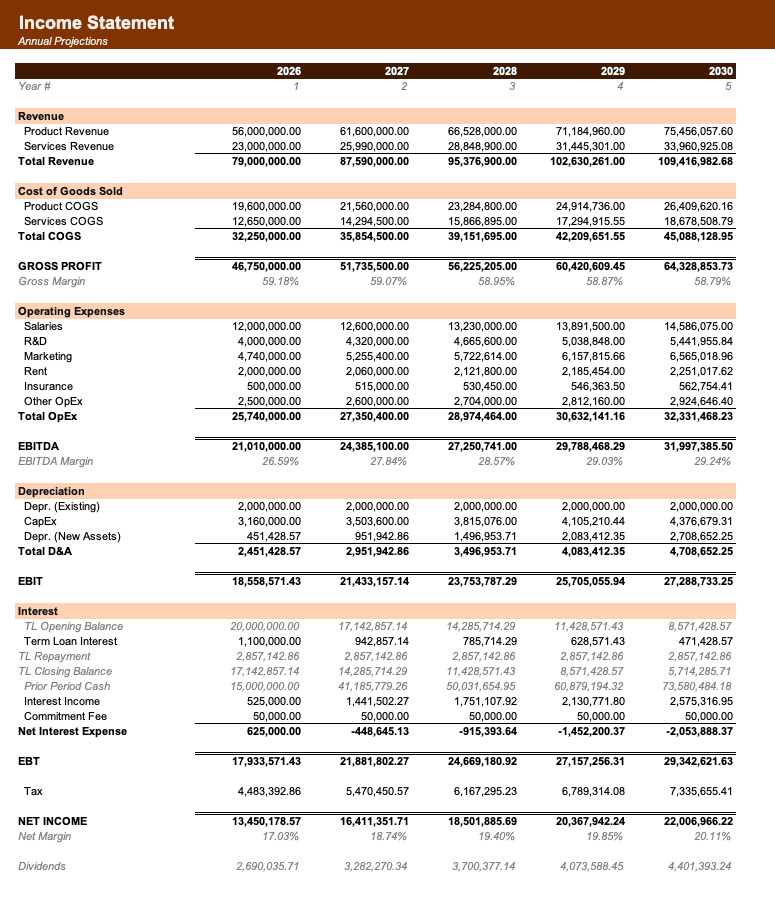
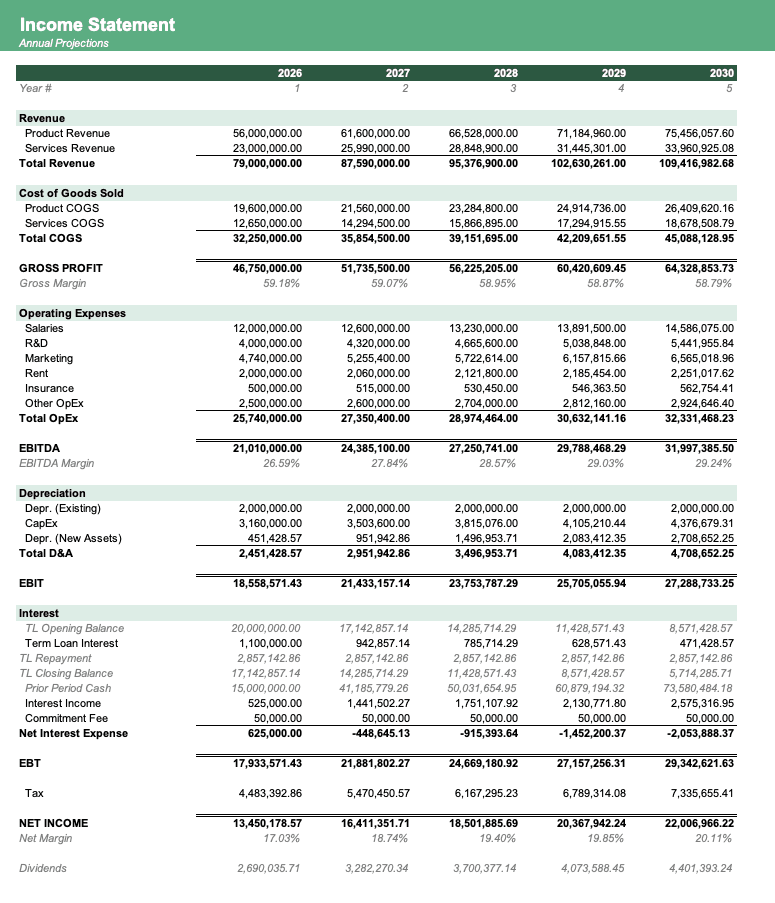
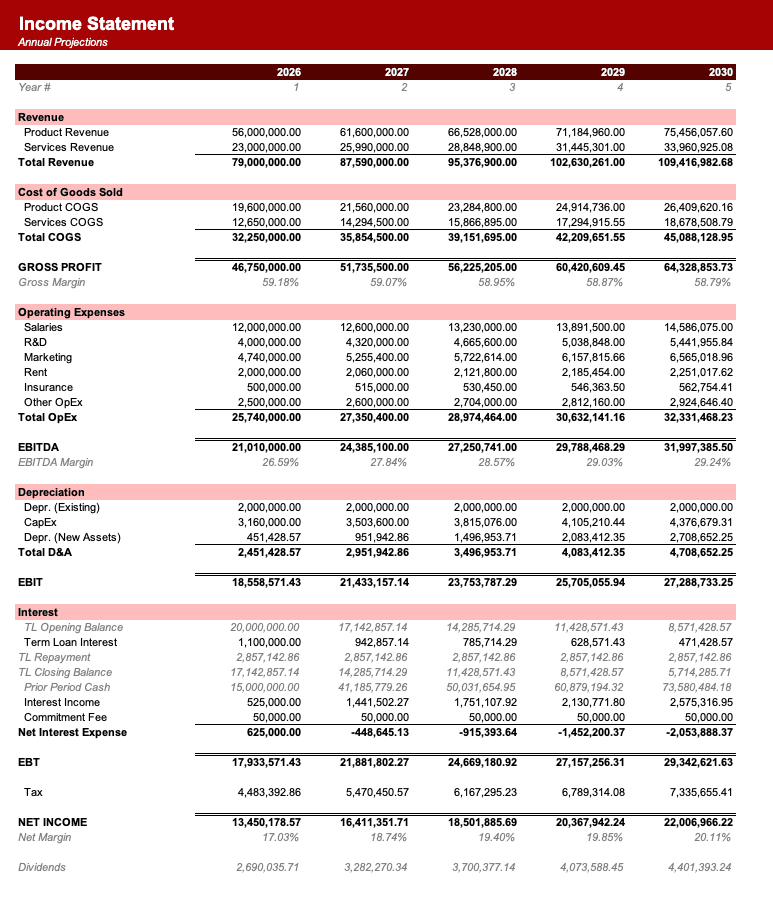
Formatted to IB standards
Named theme colors repaint the whole workbook in one click, on top of an investment-banking structure with clear input, output, and cross-sheet reference styling - brand-ready, institutional-grade, and fully auditable.

Created by ex-finance professionals
Hey, I’m Alex and I created Finamodel.
Over my years in the finance industry I kept building the same models over and over again. Same structure, same assumptions, different logo. So I started building frameworks to turn them into clean, reusable templates.
Every model here is one I’d actually use for a client, and I personally vet each one before it goes up.
I’m not an expert in every industry, but I’ve built enough models to know what belongs in one. And when something is completely foreign to me, I reach out to my network for experts to work on our models with us.
Having a template library on hand cuts a first build from hours to minutes.
Need help finding your model? You’ll find me in the Finamodel app!
Frequently asked
What is a bank capital adequacy model?+
It is a model that calculates RWA and regulatory capital ratios under base and stress scenarios to verify Basel III compliance and dividend capacity.
What is RWA and how is it calculated?+
Risk-Weighted Assets sum balance sheet assets multiplied by regulatory risk weights (0% sovereigns, 75% retail, 100%+ commercial real estate).
What are Tier 1 and Tier 2 capital?+
Tier 1 is common equity and retained earnings (highest quality). Tier 2 includes subordinated debt, hybrids, and loan loss reserves.
Does it support CCAR submissions?+
Yes. The model is structured to produce capital projections and loss estimates required for Federal Reserve capital adequacy reviews.
How do interest rates affect capital adequacy?+
Rising rates reduce the present value of mortgages and fixed-income securities on the balance sheet; falling rates do the opposite.
Have more financial modelling questions? Contact us
Related templates
Bank Loan Analysis Model
Commercial bank loan origination and portfolio underwriting.
Credit Portfolio CDO Model
Model credit default swap portfolio, tranching, and waterfall for CDO securitization.
Mortgage Portfolio Model
Mortgage loan portfolio analysis with prepayment speeds, default rates, and cash flow projections.
Credit Card Portfolio Model
Model credit card loan losses, interest revenue, and regulatory capital requirements.