Convertible Note and SAFE Model
Corporate Finance Financial Model (Free Excel Download)
Compare SAFE and convertible financing outcomes with valuation caps, discounts, conversion shares, ownership dilution, and founder and investor proceeds before signing terms.



professionals from Deloitte
Used by professionals from






About this model
This convertible note and SAFE model projects early-stage company funding rounds and tracks how convertible instruments (SAFEs and convertible notes) convert into equity at each priced round. It models the cap table evolution across seed, Series A, Series B funding, showing dilution to founders and early investors as new capital is raised and convertibles convert at the priced round valuation. The model calculates IRR and MOIC for each investor cohort based on their entry valuation, conversion terms (valuation cap, discount rate), and eventual exit valuation.
The model includes a sources-and-uses statement for each funding round; a pro forma cap table (fully diluted) at each closing showing share counts and ownership percentages; a trigger analysis showing when conversion occurs (priced round, time-based maturity, acquisition); and conversion math comparing the cap-capped vs. discount-capped valuation for each instrument. A returns waterfall prioritises payment on exit: safe holders and note holders convert into preferred stock, which then receives preferred return before common equity distribution. Sensitivity tables show how holder returns vary with exit valuation and pre-seed cap assumptions.
This model is used by founders and startups planning capital raises and understanding future dilution; early-stage investors and syndicates evaluating SAFE and convertible note terms; and venture debt providers modelling conversion probability and equity upside. It clarifies the complex conversion mechanics that often confuse entrepreneurs evaluating term sheets.
What every model includes
Live formulas, no hardcoded values
Outputs are driven by live formulas, so the workbook updates from its assumptions instead of relying on hardcoded results.
All assumptions in one tab
Inputs are clearly marked in the Assumptions tab and separated from calculations, making it clear what to change and what to leave intact.
Statements always balancing
For integrated-statement models, the balance sheet, cash flow, and supporting schedules tie through properly.
Distinct schedules for clarity
Debt, working capital, taxes, and cash flow can get messy quickly. We group calculations in clear schedules, not across disconnected tabs.
No hidden macros or external links
There are no unexplained external workbook links or macros to undermine auditability or portability.
Changes flow through the model
Update a key driver and see the impact carry through the forecast, financing, and return outputs. We never use hardcoded numbers in formulas.
What's inside the Convertible Note and SAFE Model
- SAFE and convertible note terms: discount rate, valuation cap, maturity
- Conversion trigger modeling: priced round, maturity, and acquisition
- Equity round pricing and pre-money valuation
- Post-conversion cap table and dilution waterfall
- Holder economics and IRR by funding scenario
- Customisable assumptions for your own case
Convertible Note and SAFE Model: How the Template Works
This convertible note and SAFE model template helps founders and investors see how different funding instruments convert into equity and affect ownership. It tracks SAFEs, a convertible note, option pool changes, and a Series A round, then shows dilution and exit proceeds across several scenarios.
The model focuses on funding stages, not operating forecasts.
Key Operating Drivers
The model starts with founder shares, an option pool, and two SAFEs plus one convertible note. For each SAFE, you choose pre-money or post-money treatment; post-money ownership uses investment divided by effective cap, with supporting share calculations.
- SAFE 1 has an MFN option that selects the lower cap among SAFEs. SAFE 2 can choose better cap or discount terms and compares its cap with the discounted Series A post-money valuation.
- The note accrues simple annual interest over an input number of months and converts at the lower of cap or discount share price when its outcome is set to Convert. Other note outcomes include repay, extend, hold below qualified financing amount, and change of control.
Series A inputs include valuation, price, preference type, participation cap, and pro-rata controls that add top-up shares.
Calculation Flow
Instrument terms from the Assumptions tab feed the Instrument_Schedule, which calculates effective SAFE terms, accrued note interest, conversion price, and shares. Those results populate the Cap_Table, showing ownership stages from pre-SAFE through post-Series-B.
- The post-Series-A capitalisation then drives the Waterfall, where each of six exit scenarios distributes proceeds. Exit values are input as multiples of Series A post-money valuation or as positive dollar overrides.
- Series A receives a non-participating, full-participating, or capped-participating payout, limited by available proceeds. Remaining proceeds are allocated across other post-Series-A holders.
- Returns calculate MOIC as distributions divided by original investment. Founder_Dilution shows ownership by stage and founder exit proceeds.
Sensitivity grids vary Series A valuation and investment size to test founder ownership and SAFE 1 MOIC outcomes.
Outputs and Visuals
The Dashboard summarises capital raised, Series A valuation and price, ownership by stage, and exit return charts. The Instrument_Schedule details each instrument's conversion outcome and share count.
- The Cap_Table presents pre-SAFE, post-conversion, post-Series-A, and post-Series-B shares and ownership percentages, with supporting conversion and option-pool calculations. The Waterfall and Returns tabs show six exit distributions, investor MOIC, and effective prices.
- Founder_Dilution reports ownership dilution by stage and founder exit proceeds. Sensitivity grids display how founder ownership and SAFE 1 MOIC change with Series A valuation and investment size.
Checks validate ownership, conversion, distribution, SAFE ownership, and option-pool tests. All outputs are based on the documented inputs and calculations.
Practical Use and Boundaries
Use this model to compare conversion outcomes under different Series A prices, maturity events, and acquisition scenarios, so you can understand potential dilution before signing. It suits founders and investors evaluating funding stages.
- Series B is a dilution stub; exit waterfall and returns use post-Series-A ownership, not post-Series-B capitalisation. Only Series A has an explicit preference stack, so it does not represent full legal preferences, multiple seniority tiers, or automatic contractual compliance.
- The change-of-control payoff is a reference calculation, not a complete pre-Series-A liquidation waterfall. Repay, extend, and hold outcomes suppress note conversion but do not create a debt cash-flow repayment schedule.
- Sensitivity grids embed simplified calculations and require an Excel version supporting LET. Zero exit overrides are ignored.
- Several division guards return zero, so a zero result does not confirm valid inputs. Sample investor names, valuations, and rates are illustrative, not market evidence.
The public download is a values-only preview; it does not contain live formulas or automatically recalculate.
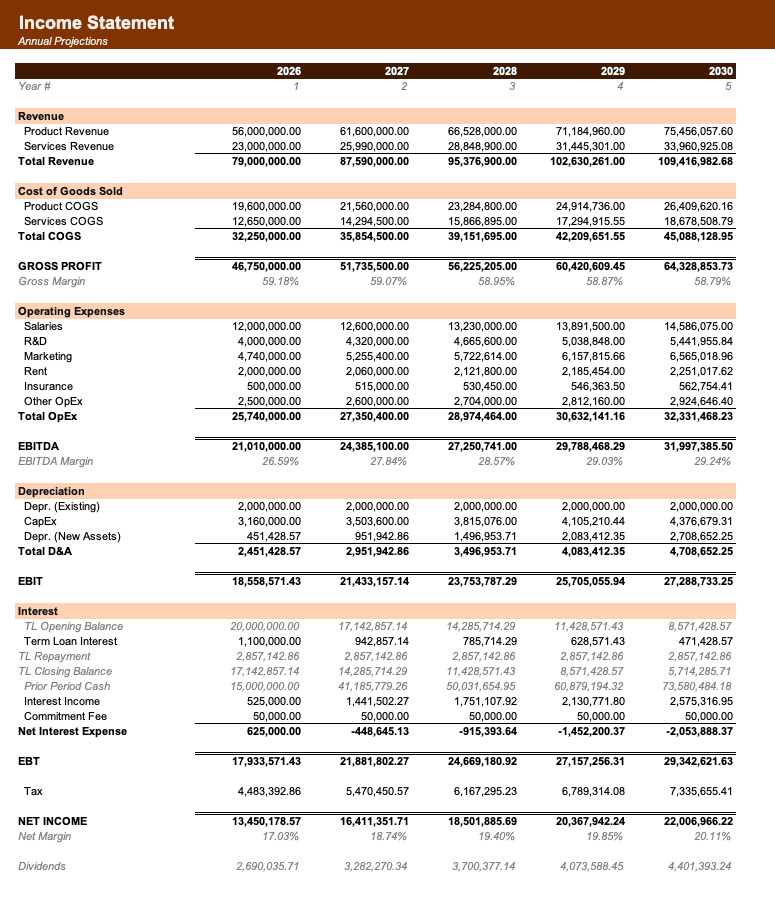
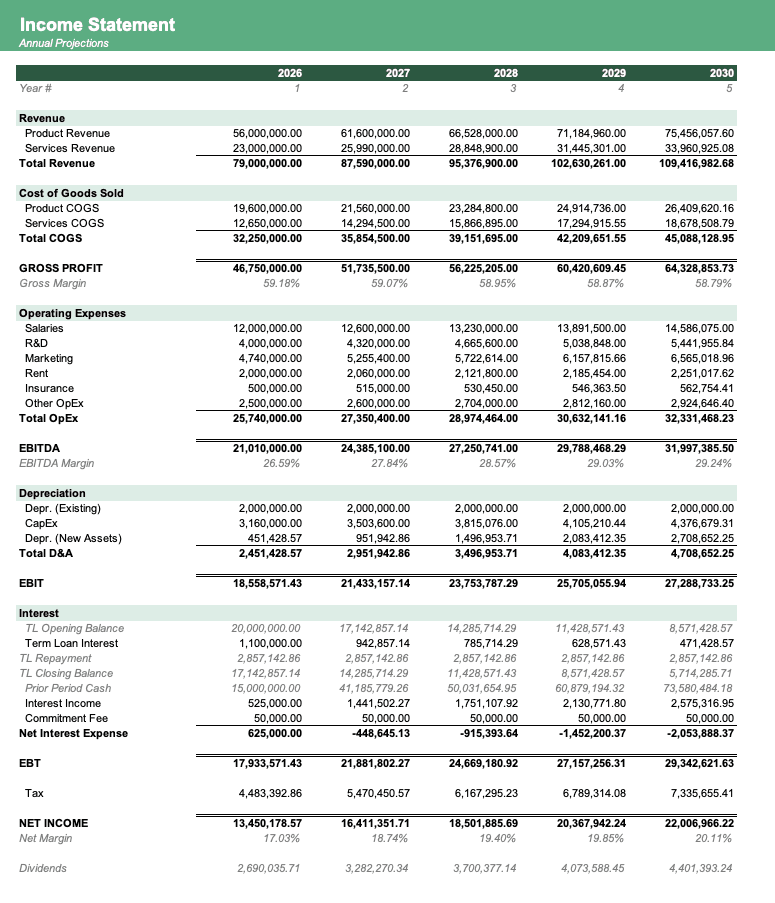
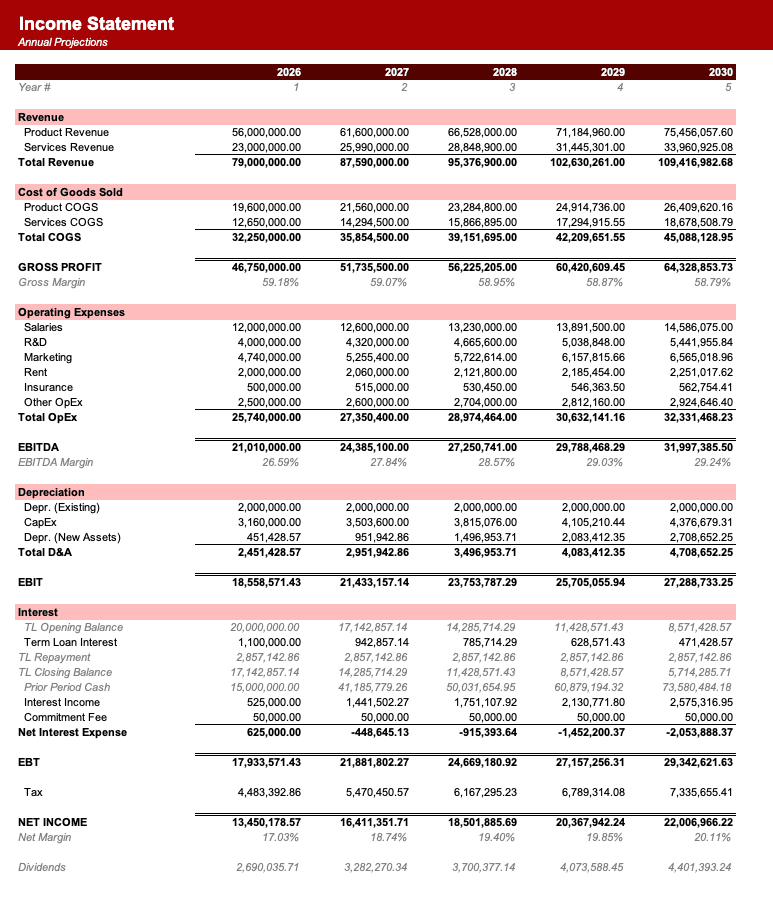
Formatted to IB standards
Named theme colors repaint the whole workbook in one click, on top of an investment-banking structure with clear input, output, and cross-sheet reference styling - brand-ready, institutional-grade, and fully auditable.

Created by ex-finance professionals
Hey, I’m Alex and I created Finamodel.
Over my years in the finance industry I kept building the same models over and over again. Same structure, same assumptions, different logo. So I started building frameworks to turn them into clean, reusable templates.
Every model here is one I’d actually use for a client, and I personally vet each one before it goes up.
I’m not an expert in every industry, but I’ve built enough models to know what belongs in one. And when something is completely foreign to me, I reach out to my network for experts to work on our models with us.
Having a template library on hand cuts a first build from hours to minutes.
Need help finding your model? You’ll find me in the Finamodel app!
Frequently asked
What is a SAFE?+
A SAFE (Simple Agreement for Future Equity) is a convertible instrument that converts at a Series A or qualifying event, typically with a valuation cap and an optional discount rate.
How does the valuation cap work?+
The valuation cap sets a maximum effective pre-money valuation at conversion. A lower cap benefits the investor by locking in a lower implied price.
What is the difference between a SAFE and a convertible note?+
A convertible note is debt with a maturity date and interest that converts into equity. A SAFE is not debt and has no maturity or interest, making it simpler for early-stage deals.
What happens if the company is acquired before Series A?+
The model covers multiple payoff scenarios: fully diluted basis conversion, preferred equivalence, or cash multiples, so you can negotiate acquisition terms with full visibility.
Who uses SAFE and convertible note models?+
Founders, seed investors, VCs, and corporate development teams use them for pre-seed fundraising, cap table planning, and M&A exit scenario analysis.
Have more financial modelling questions? Contact us
Related templates
Cap Table Management Model
Equity ownership tracking and scenario modeling.
Bridge Round Financing Model
Convertible note and SAFE financing analysis.
Venture Capital Fund Model
Model VC fund cash flows, distributed returns, and IRR by vintage year and exit scenario.
3 Statement Model
Integrated income statement, balance sheet, and cash flow forecasts.


