Chief Risk Officer Dashboard
Capital Markets Financial Model (Free Excel Download)
Forecast contract-research organization revenue from study awards, enrollment milestones, backlog conversion, therapeutic mix, project costs, staffing, and operating margins.



professionals from Deloitte
Used by professionals from






About this model
This Contract Research Organisation (CRO) financial model projects revenue from clinical trial management, consulting services, and laboratory work across multiple therapeutic areas and customer segments. It models active studies by type (oncology, rare disease, etc.), active accounts, consulting utilisation (billable hours, hourly rates), and lab samples processed. Revenue grows from study volume growth, pricing escalation, and customer mix shift toward higher-margin products. The model includes customer concentration risk (top 10 customers), backlog conversion rates, and contract-specific profitability (fixed-price versus FTE/time-and-materials contracts).
The model includes operating expense sections for direct labour (clinical research associates, project managers) scaled to study volumes and account count; fixed overhead (IT, facilities, G&A); business development and marketing; and technology investment (EDC/CTMS platform development). Working capital tracks receivables (55–80 day DSO typical for pharma sponsors), unbilled revenue, and deferred revenue. Capex includes laboratory equipment, office build-outs, and technology platform investment. Key margins include gross margin (after direct labour), EBITDA margin (after overhead absorption), and net margin.
This model is used by CRO management teams forecasting growth and profitability, PE sponsors evaluating CRO acquisition targets, lenders sizing working capital facilities (especially important given material unbilled receivables and payment delays from pharma sponsors), and public equity analysts researching CRO publicly traded stocks. It addresses the unique challenge of labour-intensive, contract-based business models with long customer sales cycles and complex revenue recognition.
What every model includes
Live formulas, no hardcoded values
Outputs are driven by live formulas, so the workbook updates from its assumptions instead of relying on hardcoded results.
All assumptions in one tab
Inputs are clearly marked in the Assumptions tab and separated from calculations, making it clear what to change and what to leave intact.
Statements always balancing
For integrated-statement models, the balance sheet, cash flow, and supporting schedules tie through properly.
Distinct schedules for clarity
Debt, working capital, taxes, and cash flow can get messy quickly. We group calculations in clear schedules, not across disconnected tabs.
No hidden macros or external links
There are no unexplained external workbook links or macros to undermine auditability or portability.
Changes flow through the model
Update a key driver and see the impact carry through the forecast, financing, and return outputs. We never use hardcoded numbers in formulas.
What's inside the Chief Risk Officer Dashboard
- Risk appetite framework with risk limits by business line and risk type
- Market risk: VaR, Greeks, and stress losses by trading desk
- Credit risk: exposure by counterparty, sector, and geography
- Operational risk: loss incidents and capital charge calculations
- Liquidity risk: funding gaps and coverage ratios
- Customisable assumptions for your own case
CRO Model: How the Financial Model Works
This CRO model template helps users evaluate whether to invest in, acquire, or expand a contract research organisation. It focuses on study volumes, backlog conversion, staffing utilisation, and margin trajectory.
The model is asset-light and labour-intensive, with revenue driven by full-time equivalent billing and fixed-price study contracts.
Operating Drivers: Backlog, Utilisation, and Pass-Throughs
The model's operating logic is anchored in a few core drivers. Revenue is largely contract-driven, so the backlog roll-forward—opening backlog plus new bookings minus cancellations minus revenue recognised—sets the top line.
- Book-to-bill ratio, typically 1.1x to 1.3x for growth, indicates whether bookings are outpacing revenue. Service lines are separated: clinical operations uses a backlog burn rate of 25% to 35% per annum, consulting relies on consultant headcount, billable hours, rates, and utilisation, and lab services depends on sample volumes and setup fees.
- Billable staff utilisation is modelled at 70% to 80%, reflecting training and bench time. Pass-through costs such as investigator grants and IRB fees are revenue with zero margin and must be offset in COGS to avoid overstated margins.
Cost and Margin Calculation Flow
Costs scale primarily with labour, which represents 70% to 80% of direct costs. Direct labour is built bottom-up from billable headcount and fully loaded cost per head, rather than as a percentage of revenue, allowing operating leverage to show as utilisation improves.
- Travel, laboratory consumables, and pass-throughs are added to arrive at gross profit. Operating expenses include SG&A, business development, IT, and facilities, each tied to revenue percentages, headcount, or fixed escalation.
- These feed into EBITDA, operating income, and net income, with margins influenced by offshoring and automation but offset by wage inflation. This structure helps users see how hiring, utilisation, and contract mix affect profitability.
Outputs: Financial Statements and Key Metrics
The model produces an income statement, balance sheet, and cash flow statement. It also generates working capital schedules for billed receivables, unbilled receivables, payables, and deferred revenue, plus a debt schedule with term loan amortisation and revolver mechanics.
- Key outputs include book-to-bill ratio, DSCR, free cash flow, and balance sheet checks. Validation flags cover gross margin, EBITDA margin, utilisation caps, DSO, and cash floor, helping users catch unrealistic assumptions.
- These outputs support evaluating the target's ability to convert backlog into cash and service debt under different growth and margin assumptions.
Practical Use in Investment and Acquisition Decisions
Practically, the model is structured for investors, acquirers, or operators assessing a CRO with roughly $50 million to $500 million in revenue.
- It allows testing of scenarios such as changes in new bookings growth, cancellation rates, backlog burn, utilisation, and cost inflation.
- The model highlights risks like ignoring pass-throughs, double-counting them, or assuming 100% utilisation, and it enforces checks such as balance sheet balancing and DSCR thresholds.
- Because the public download is a values-only preview, users can see the logic and relationships without live formulas; the focus is on understanding how operating drivers translate into financial outcomes rather than predesigned results.
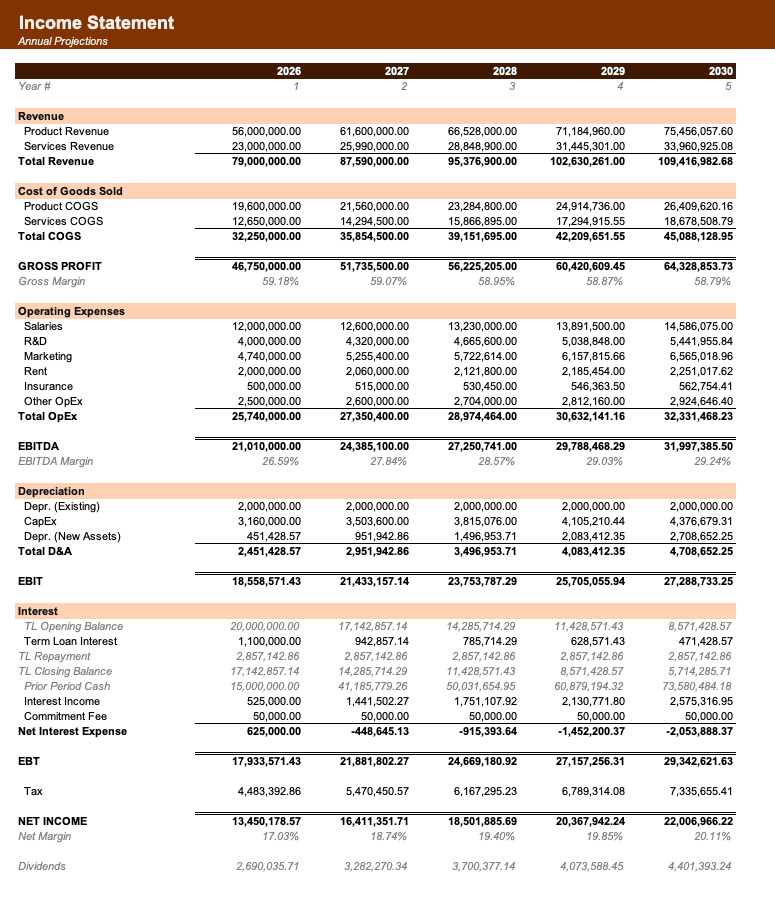
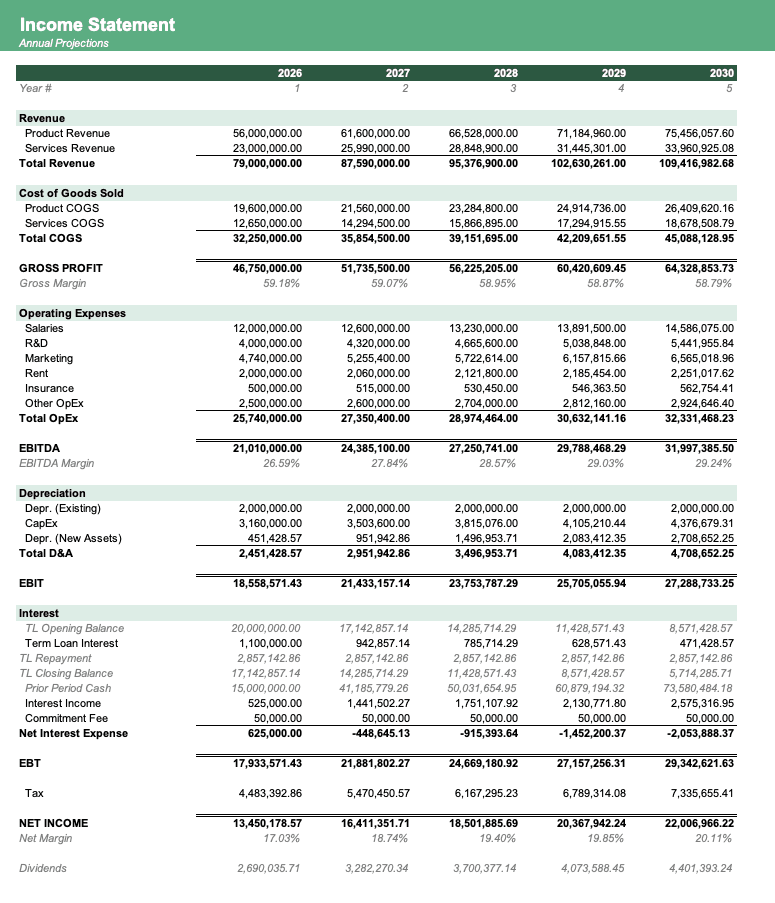
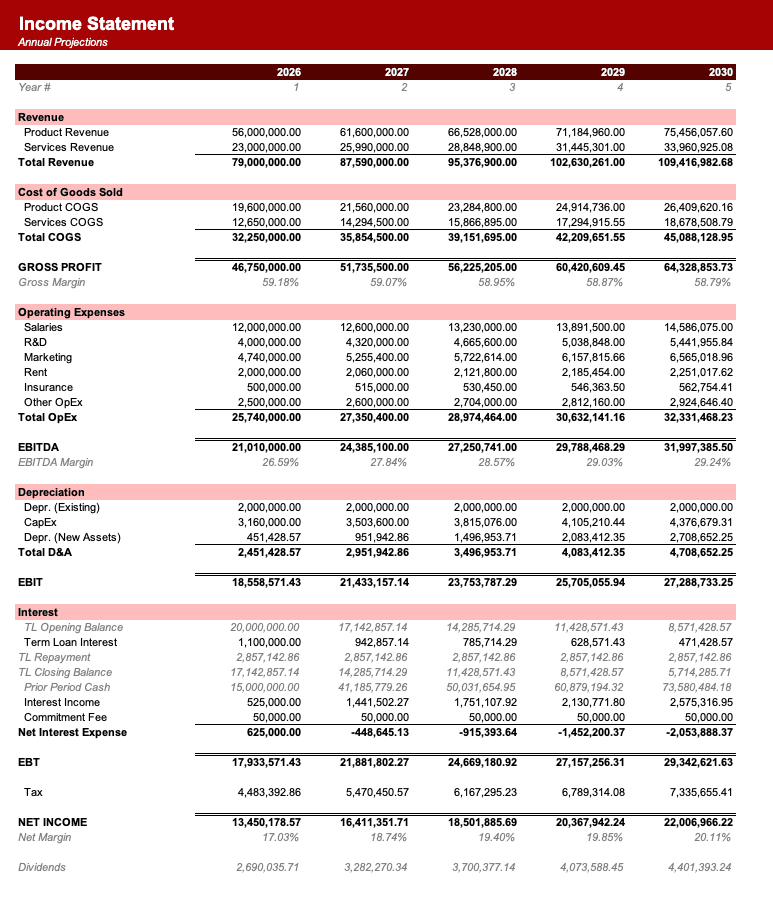
Formatted to IB standards
Named theme colors repaint the whole workbook in one click, on top of an investment-banking structure with clear input, output, and cross-sheet reference styling - brand-ready, institutional-grade, and fully auditable.

Created by ex-finance professionals
Hey, I’m Alex and I created Finamodel.
Over my years in the finance industry I kept building the same models over and over again. Same structure, same assumptions, different logo. So I started building frameworks to turn them into clean, reusable templates.
Every model here is one I’d actually use for a client, and I personally vet each one before it goes up.
I’m not an expert in every industry, but I’ve built enough models to know what belongs in one. And when something is completely foreign to me, I reach out to my network for experts to work on our models with us.
Having a template library on hand cuts a first build from hours to minutes.
Need help finding your model? You’ll find me in the Finamodel app!
Frequently asked
What is a CRO dashboard?+
It is a consolidated risk reporting tool that aggregates market, credit, and operational risk exposures across business lines and tracks them against a firm-wide risk appetite and regulatory limits.
How do I set risk limits?+
Start with industry peer benchmarks as a percentage of capital, then adjust based on your risk appetite and business strategy. Cascade limits through the hierarchy.
What is VaR and how is it calculated?+
VaR (Value at Risk) is the maximum expected loss at a given confidence level over a time horizon. Common methods include historical simulation, parametric, and Monte Carlo.
Can I automate data feeds into the dashboard?+
Yes. Use data warehouse APIs or ETL tools to pull positions, market data, and risk metrics automatically each day, reducing manual input and reconciliation.
Who uses CRO dashboards?+
Chief risk officers, risk committees, business heads, and regulators use them for weekly risk reporting, regulatory stress testing under CCAR and ICAAP, and operational capital allocation.
Have more financial modelling questions? Contact us
Related templates
Credit Stress Testing Framework
Stress test credit portfolios across default probabilities, loss severities, and adverse macroeconomic scenarios.
Equity Portfolio Analysis
Portfolio-level analytics for equity holdings with performance attribution, risk, and rebalancing.
DCF Model
Discounted cash flow valuation model with explicit forecast, terminal value, and WACC.
Comparable Companies Analysis
Pull trading multiples from peer companies and calculate implied valuation ranges.