Data Center Operations Model
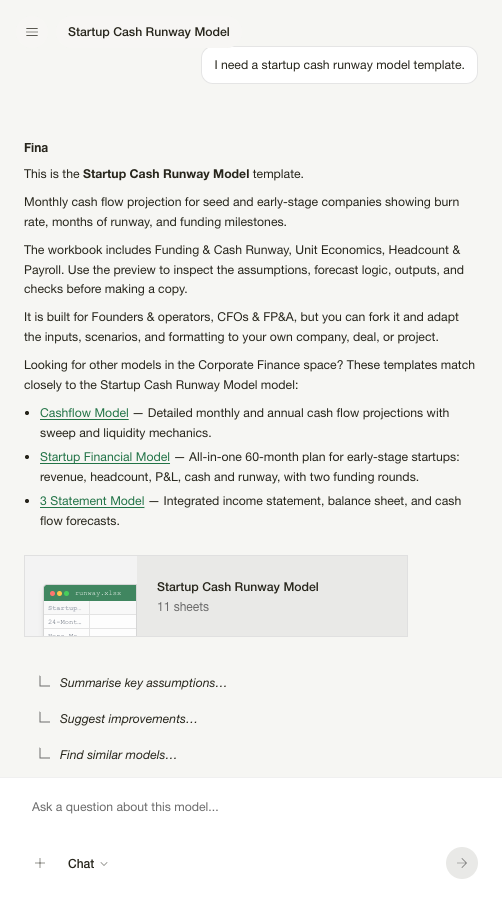
Infrastructure Financial Model (Free Excel Download)
Forecast data-centre power, racks, utilisation, pricing, energy costs, uptime, capex, and debt service to evaluate operating cash flow and returns.



professionals from Deloitte
Used by professionals from






About this model
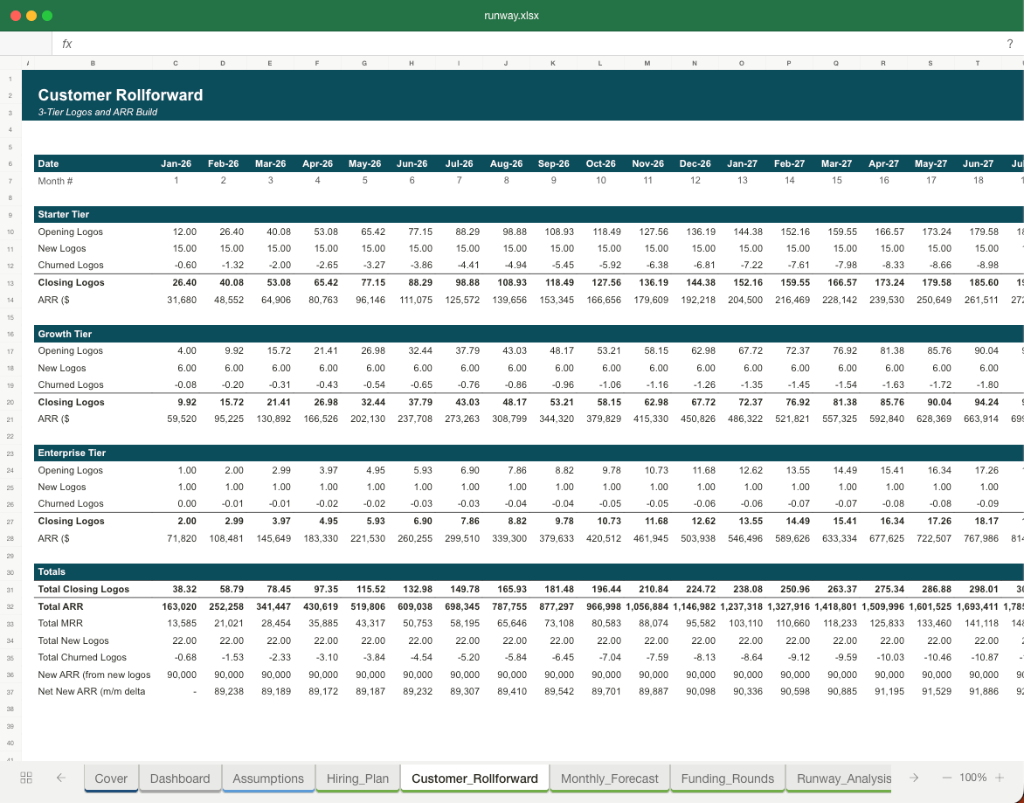
This data centre operations model forecasts the unit economics of running a facility renting colocation space and power to enterprise, cloud, and hyperscale customers. It projects installed capacity (MW available), leased capacity (MW sold), occupancy ramp, and pricing across wholesale (low $/kW/month, long-term contracts) and retail colocation (high $/kW/month, shorter terms). Revenue includes space rent (leased kW × MRC), power pass-through (kWh × PUE × electricity rate, typically at cost plus small admin margin), and interconnection fees (per cross-connect port). The model includes customer segments (Amazon, Google, enterprise, carrier) with different pricing and lock-in terms.
The model includes a capacity ramp schedule showing lease-up from opening through stabilised occupancy (70–90%); a revenue builder with space rent, power, and interconnection fees independently calculated; an operating cost section covering facility staff (engineers, security), property taxes and insurance, maintenance capex (2–4% of revenue), and SG&A. Power costs are the primary variable cost and scale linearly with occupancy and PUE (Power Usage Effectiveness, typically 1.35x in this model). A debt schedule projects project finance or secured term loan drawdown during construction, conversion to amortising term loan at stabilisation, and DSCR covenant compliance.
This model is used by infrastructure funds evaluating data centre development or acquisition; operators managing capacity planning and pricing strategy; lenders sizing project finance facilities; and equity investors assessing the IRR and equity multiple on stabilised sites. It addresses the unique challenge of capital-heavy facilities with 5–8 year payback periods and long-term customer contracts providing revenue visibility.
What every model includes
Live formulas, no hardcoded values
Outputs are driven by live formulas, so the workbook updates from its assumptions instead of relying on hardcoded results.
All assumptions in one tab
Inputs are clearly marked in the Assumptions tab and separated from calculations, making it clear what to change and what to leave intact.
Statements always balancing
For integrated-statement models, the balance sheet, cash flow, and supporting schedules tie through properly.
Distinct schedules for clarity
Debt, working capital, taxes, and cash flow can get messy quickly. We group calculations in clear schedules, not across disconnected tabs.
No hidden macros or external links
There are no unexplained external workbook links or macros to undermine auditability or portability.
Changes flow through the model
Update a key driver and see the impact carry through the forecast, financing, and return outputs. We never use hardcoded numbers in formulas.
What's inside the Data Center Operations Model
- Rack inventory by power tier: 10kW, 15kW, and 30kW
- Power and cooling costs per rack with PUE assumptions
- Customer segments: cloud, HPC, enterprise, and hyperscaler
- Pricing and unit economics per cabinet by segment
- Utilization and expansion capex forecasts
- Customisable assumptions for your own case
Data Center Operations Model: How the Template Works
A data center operations model helps you evaluate whether to invest in, develop, or acquire a facility by projecting capacity utilization, capex, and lease cash flows. This template covers revenue build-up, power procurement, debt sizing, tax losses, and equity returns.
Here is what the underlying specification captures and how the pieces connect.
Revenue Drivers and Lease-Up Mechanics
Revenue begins with leased capacity split between hyperscale and retail tenants, each with its own per-kW rent and lease term. The blended rent depends on the hyperscale mix percentage, and an escalator grows effective rent from the first operating year.
- Capacity arrives in two tranches: an initial phase and an optional second phase that comes online later. Each tranche ramps occupancy independently, so new capacity leases up from scratch rather than inheriting stabilized occupancy.
- Billed IT load is the sum of both tranches, and downstream calculations such as space rent and power consumption read that billed load directly. Interconnection fees add a smaller revenue line based on cross-connects per megawatt, capacity, and occupancy.
Power Procurement and Pass-Through
Power cost is calculated from total facility consumption, which equals billed IT load multiplied by hours in the year and the power usage effectiveness (PUE) ratio. The procurement structure splits power between a fixed PPA portion and a spot-exposed remainder, each with its own rate.
- Blended power cost is the weighted average of those two rates applied to total kilowatt-hours. Power revenue is then that cost plus a markup percentage, so a zero markup means full pass-through to tenants.
- Cross-connects generate additional revenue based on cross-connects per megawatt, capacity, and occupancy. This structure lets you see how hedging choices and spot exposure affect both cost and revenue.
Cost, Capital, and Financing Structure
Operating costs include facility opex per megawatt, property tax and insurance as a percentage of cumulative capex gated to operations, SG&A as a percentage of revenue, and repairs and maintenance booked as opex. Pre-opening G&A hits only construction years.
- Maintenance capex reserve is a separate line used for DSCR. Construction capex splits between shell and MEP fit-out, with Phase 2 adding both shell and MEP costs in its online year.
- Debt is sized as a loan-to-cost percentage of period capex, with capitalized construction interest added to the debt balance and a separate PP&E line. Principal repayment uses a running operating-year schedule with a one-year interest-only grace period.
Tax Losses, Returns, and Validation
The model tracks net operating loss carry-forwards on the income statement. NOL opening equals prior closing, NOL created is the positive portion of negative pre-tax earnings, and NOL used is limited to a percentage of positive pre-tax income.
- This calculation flows to taxable income and cash tax. Returns are measured through unlevered and levered free cash flow streams, IRRs, equity multiple, NPV, and per-megawatt unit economics.
- Exit value uses trailing NOI divided by a cap rate, with a separate EV/EBITDA cross-check not fed into IRR. Validation checks flag balance sheet balance, capacity limits, PUE minimums, DSCR covenant, EBITDA margin, and cash balance.
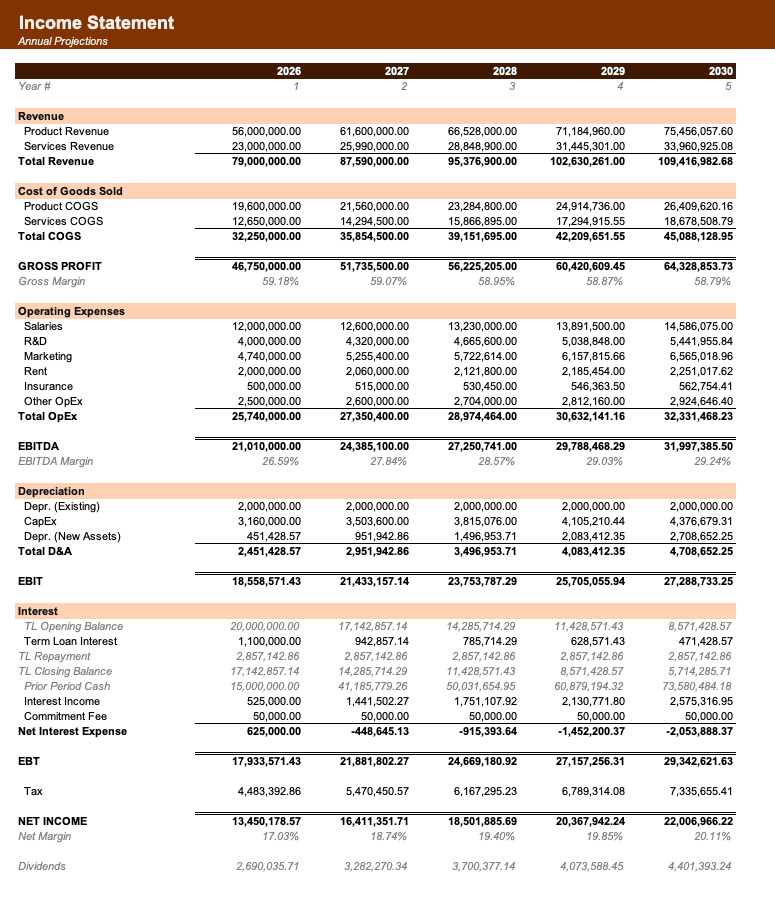
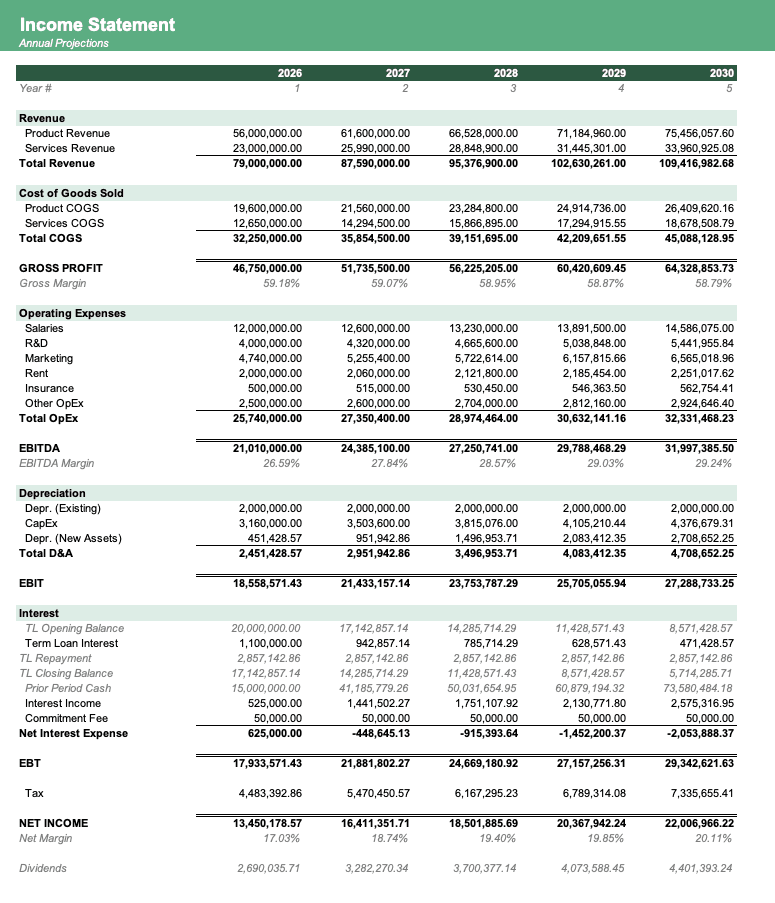
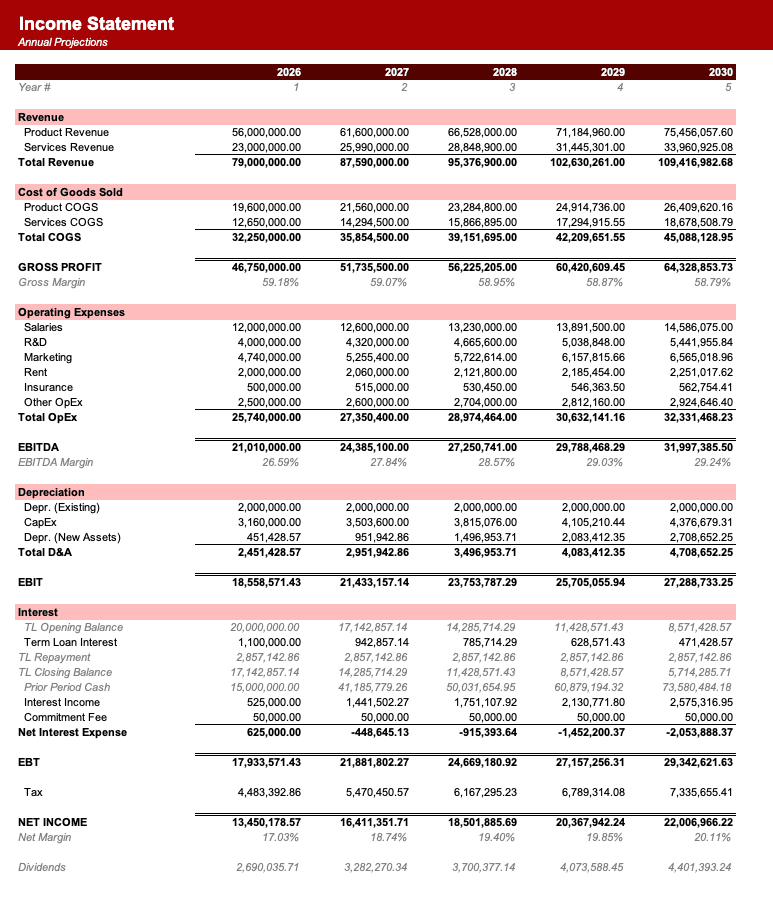
Formatted to IB standards
Named theme colors repaint the whole workbook in one click, on top of an investment-banking structure with clear input, output, and cross-sheet reference styling - brand-ready, institutional-grade, and fully auditable.

Created by ex-finance professionals
Hey, I’m Alex and I created Finamodel.
Over my years in the finance industry I kept building the same models over and over again. Same structure, same assumptions, different logo. So I started building frameworks to turn them into clean, reusable templates.
Every model here is one I’d actually use for a client, and I personally vet each one before it goes up.
I’m not an expert in every industry, but I’ve built enough models to know what belongs in one. And when something is completely foreign to me, I reach out to my network for experts to work on our models with us.
Having a template library on hand cuts a first build from hours to minutes.
Need help finding your model? You’ll find me in the Finamodel app!
Frequently asked
What is a data center operations model?+
It is a model that forecasts rack utilization, power costs, and unit economics per cabinet and customer segment to support pricing, expansion, and margin management decisions.
What is PUE and what is a good target?+
PUE (Power Usage Effectiveness) is total facility power divided by IT equipment power. Industry average is around 1.5; best-in-class facilities achieve 1.2 or below.
How much does power cost vary by location?+
Power rates range from $0.05 per kWh in hydro-rich regions to $0.15 per kWh in expensive markets, making location one of the most important site selection factors.
How do I model customer mix and pricing?+
Segment by contract type (monthly versus 3-year) and workload type (continuous versus bursty). Price based on power tier and commitment term to reflect true cost-to-serve.
Who uses data center operations models?+
Data center operators, infrastructure investors, IT directors, and capacity planners use them for facility expansion decisions, pricing negotiations, and hyperscaler deal modeling.
Have more financial modelling questions? Contact us
Related templates
Cloud Infrastructure Model
Forecast cloud compute, storage, and networking spend with capacity and pricing assumptions.
Data Centre Investment Model
Model data centre acquisition, lease-up, and exit returns for infrastructure investors.
Industrial Warehouse and Logistics Real Estate Model
Operating model for industrial warehouse properties including occupancy, net rent, operating expense pass-through, and cap rate valuation.
Fibre Network Deployment Model
Capital and financial model for fiber optic network buildout with capex, subscribers, and ARPU.