Fintech Payments Platform Model
Tech & Software Financial Model (Free Excel Download)
Forecast payments-platform growth through transaction volume, take rates, processing costs, churn, contribution margin, and cash needs for pricing and expansion decisions.



professionals from Deloitte
Used by professionals from






About this model
A fintech payments platform model projects profitability for a software company that facilitates electronic transactions between merchants and consumers, earning a blended take rate (0.2–3% of total payment volume, or TPV) that varies by merchant size and payment type. For a platform processing $5 billion in annual TPV, total gross revenue is $12.5–75 million depending on take rate; the key is that TPV is 50–200x larger than revenue, so confusing the two destroys the model.
The model separates transaction processing revenue from subscription fees ($25–200 per merchant monthly) and value-added services (fraud protection, instant settlement, FX markup). The largest cost is interchange - fees paid to card networks and issuing banks - which runs 60–75% of gross transaction revenue, compressing margins significantly. Net revenue (after interchange deduction) generates gross margins of 55–70%, but operating expenses (engineering 20–30%, sales & marketing 15–25%, compliance 3–5%, G&A 8–12%) consume most of that, leaving EBITDA margins of 0–30% depending on scale and maturity.
Working capital is favorable: settlement float (the time between collecting from merchants and paying out) is typically negative 1–3 days, so the platform holds merchant funds briefly before remittance. The model shows the path to profitability as transaction volume scales and operating leverage kicks in. This template is suitable for VC and growth equity investors evaluating fintech payment platforms.
What every model includes
Live formulas, no hardcoded values
Outputs are driven by live formulas, so the workbook updates from its assumptions instead of relying on hardcoded results.
All assumptions in one tab
Inputs are clearly marked in the Assumptions tab and separated from calculations, making it clear what to change and what to leave intact.
Statements always balancing
For integrated-statement models, the balance sheet, cash flow, and supporting schedules tie through properly.
Distinct schedules for clarity
Debt, working capital, taxes, and cash flow can get messy quickly. We group calculations in clear schedules, not across disconnected tabs.
No hidden macros or external links
There are no unexplained external workbook links or macros to undermine auditability or portability.
Changes flow through the model
Update a key driver and see the impact carry through the forecast, financing, and return outputs. We never use hardcoded numbers in formulas.
What's inside the Fintech Payments Platform Model
- Transaction volume forecasts by customer segment and payment type
- Take rate and per-transaction fees relative to processing costs
- Payment processing costs: acquirer fees, network fees, and fraud losses
- Customer acquisition by cohort with organic, sales, and marketing CAC
- Unit economics: LTV, payback period, and net revenue per customer
- Churn and retention by customer segment and vintage
Fintech Payments Platform Model: How Transaction Volume Drives Revenue
This fintech payments model template helps you evaluate a payments business by linking merchant growth, transaction volume, take rates, and costs into a structured financial forecast. It is designed for investors, operators, and analysts assessing whether to build, acquire, or invest in a payments platform.
The model covers revenue drivers, cost structure, cash flow, and key checks to support informed decision-making. Rates and financial results described here reflect illustrative model settings, not industry benchmarks.
Operating Drivers and Revenue Build
The model projects revenue from transaction processing, subscription fees, and value-added services. Transaction processing revenue depends on total payment volume (TPV), which is driven by active merchants and average volume per merchant, multiplied by a blended take rate.
- Subscription revenue equals active merchants times a monthly platform fee, while value-added services revenue is based on transaction volume, penetration rate, and service fees. These drivers are fed from the assumptions sheet and flow into the revenue build, allowing you to see how merchant growth and pricing changes affect overall revenue.
- The model separately handles each stream because subscription and value-added services are not subject to interchange deductions.
Cost Structure and Profitability
Costs are split between variable and operating expenses. Variable costs include interchange and network fees (a large share of gross transaction revenue), processor fees, fraud losses, and cloud hosting.
- Operating expenses cover engineering, sales and marketing, general and administrative, and compliance. Interchange is deducted from gross transaction revenue to arrive at net revenue, while other direct costs are subtracted to calculate gross profit.
- Operating expenses are then deducted to derive EBITDA and operating income. The model captures operating leverage as engineering and compliance costs scale sub-linearly with revenue, potentially improving margins at higher volumes.
Calculation Flow and Outputs
The model links schedules for revenue, cost of goods sold, operating expenses, capital expenditures, working capital, and debt. Revenue builds feed the income statement, working capital, and key metrics.
- The income statement flows to the balance sheet and cash flow statement. The cash flow statement reconciles opening and closing cash using net income, non-cash items, working capital changes, capital expenditures, and financing activities.
- Key outputs include TPV growth, take rate, net revenue per merchant, gross margin, EBITDA margin, net margin, and cash conversion. The balance sheet includes assets like cash and settlement receivables, liabilities such as merchant payables and debt, and equity, with a balance check to flag balance-sheet differences.
Practical Use and Validation
Use this model to test scenarios for merchant acquisition, take rate compression, and cost management. The assumptions sheet lets you adjust growth rates, take rates, and expense ratios to see the impact on profitability and cash flow.
- Built-in validation checks flag unrealistic inputs, such as gross margins outside 50% to 75% or take rates beyond 0.20% to 3.00%. Common pitfalls are addressed, like avoiding double-counting interchange or misapplying DSO to net revenue instead of gross TPV.
- The model is designed for evaluating a payments platform's financial viability, not for day-to-day accounting, and it expects debt to be pre-sized without circular references.
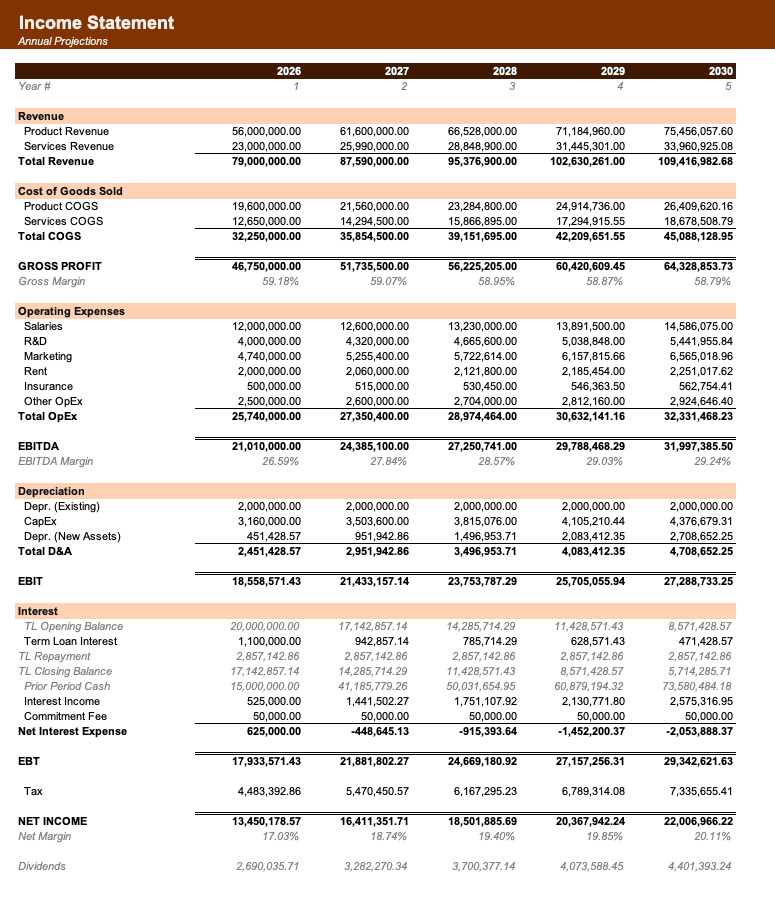
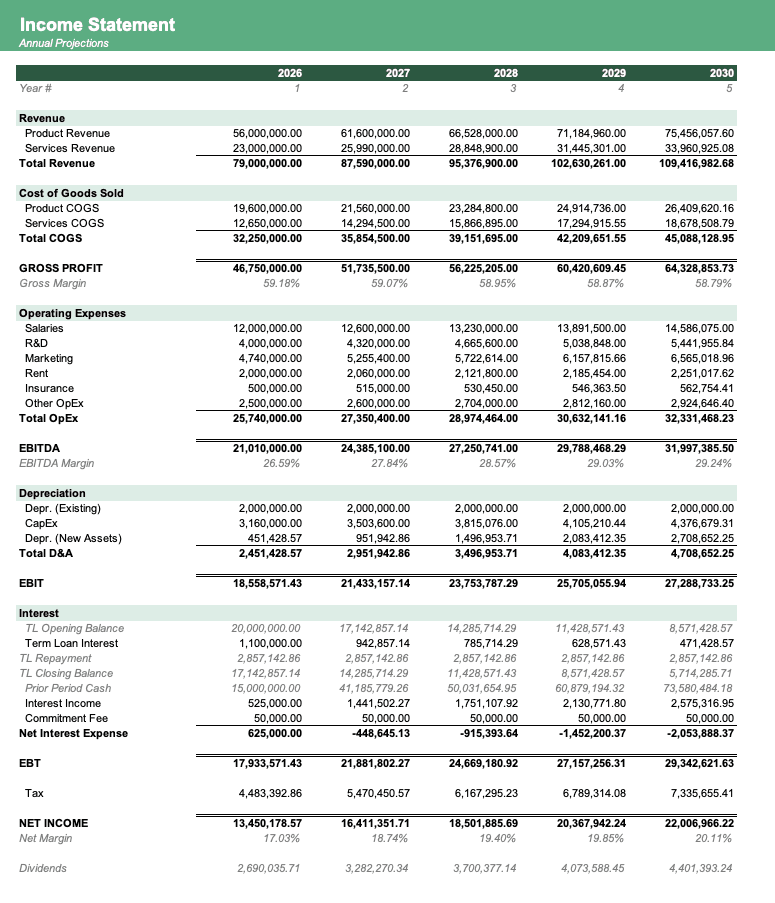
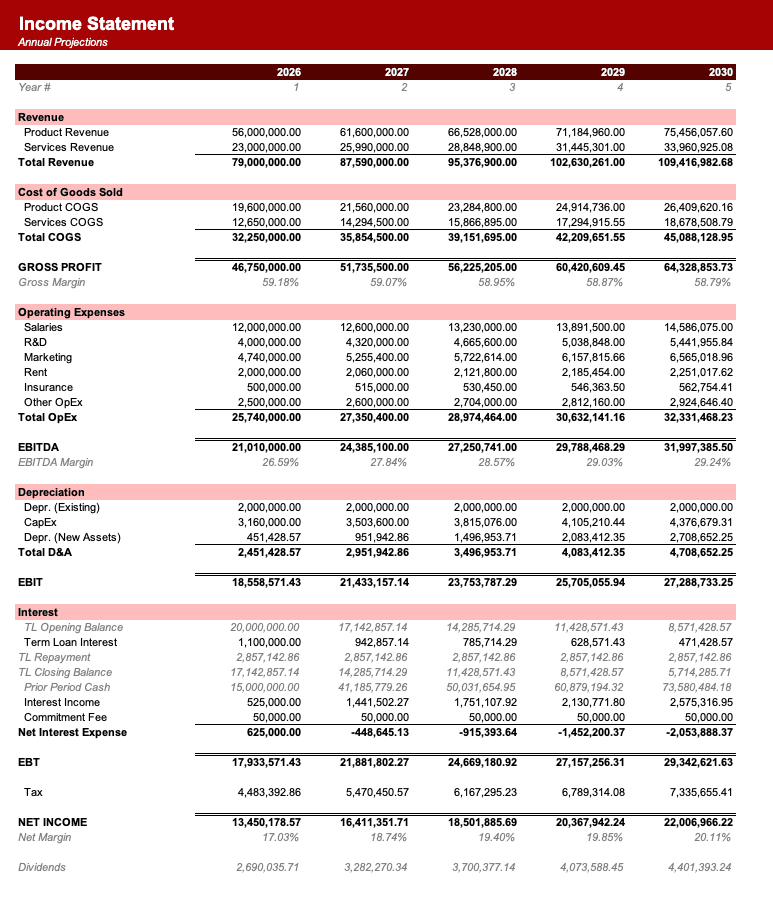
Formatted to IB standards
Named theme colors repaint the whole workbook in one click, on top of an investment-banking structure with clear input, output, and cross-sheet reference styling - brand-ready, institutional-grade, and fully auditable.

Created by ex-finance professionals
Hey, I’m Alex and I created Finamodel.
Over my years in the finance industry I kept building the same models over and over again. Same structure, same assumptions, different logo. So I started building frameworks to turn them into clean, reusable templates.
Every model here is one I’d actually use for a client, and I personally vet each one before it goes up.
I’m not an expert in every industry, but I’ve built enough models to know what belongs in one. And when something is completely foreign to me, I reach out to my network for experts to work on our models with us.
Having a template library on hand cuts a first build from hours to minutes.
Need help finding your model? You’ll find me in the Finamodel app!
Frequently asked
What is a fintech payments model?+
A model that forecasts transaction volume, take rate revenue, processing costs, and customer unit economics for a payments platform or processor.
What is a typical take rate for payment processors?+
Interchange-plus models run 1.5-2.9% plus $0.30 per transaction for SMBs. Enterprise and high-volume platforms negotiate lower flat rates.
What costs does a payment processor incur?+
Interchange fees, network fees from Visa and Mastercard, fraud and chargeback losses, settlement costs, and platform operations overhead.
What drives fintech payment customer churn?+
Pricing increases, poor customer support, limited features, competitive alternatives, and customer business cycles such as bankruptcy or acquisition.
Who uses fintech payment models?+
Fintech founders, payment processors, CFOs, and investors use them to plan growth strategy, optimize pricing, and present cohort economics to investors.
Have more financial modelling questions? Contact us
Related templates
Marketplace Economics Model
Financial model for two-sided or multi-sided marketplace platforms with transaction volumes, take rates, and unit economics.
Subscription Box Economics
Model recurring revenue, churn, customer acquisition, and fulfillment costs for a subscription service.
Cloud Infrastructure Model
Forecast cloud compute, storage, and networking spend with capacity and pricing assumptions.
SaaS MRR/ARR Forecast Model
Subscription forecast with logo motion, MRR build, ARR, NRR/GRR, and CAC payback for SaaS businesses.


