Food Manufacturing Model
Operating Businesses Financial Model (Free Excel Download)
Forecast food-manufacturing margins from production volume, SKU mix, pricing, yield loss, ingredients, labor, plant capacity, capex, and working capital.



professionals from Deloitte
Used by professionals from






About this model
This operating model projects five-year financials for a branded food manufacturer with co-packing operations. Answer: can the facility sustain profitable growth while servicing debt and maintaining gross margins at 40–50% despite channel mix dilution from contract manufacturing? The model builds revenue bottom-up from physical capacity: three production lines at 72% utilisation split 65% branded CPG and 35% co-pack. Track ingredient costs, yield assumptions, trade spend at 10% of branded revenue, and capacity ramps.
The workbook consolidates production scheduling, ingredient and packaging cost management, overhead allocation by product line, and cash flow impact of working capital swings. COGS is 55% (raw materials 28%, packaging 8%, labour 12%, overhead 7%). Key outputs: five-year P&L with 29.9% EBITDA margin by Year 1, balance sheet tracking $29M opening PP&E net, and cash flow showing positive generation by Year 1 as rent escalations and utilisation gains offset wage inflation.
Used by mid-market branded manufacturers, private equity sponsors evaluating brownfield asset acquisitions, and lenders assessing leverage and DSCR across commodity cycles. The model handles the structural challenge of blended margins: co-pack at 30–35% gross margin de-risks underutilised capacity while branded CPG at 50%+ supports premiumisation. Benchmarks: General Mills (34–36% gross, 18–20% EBITDA), Kraft Heinz (32–35% gross, 20–22% EBITDA).
What every model includes
Live formulas, no hardcoded values
Outputs are driven by live formulas, so the workbook updates from its assumptions instead of relying on hardcoded results.
All assumptions in one tab
Inputs are clearly marked in the Assumptions tab and separated from calculations, making it clear what to change and what to leave intact.
Statements always balancing
For integrated-statement models, the balance sheet, cash flow, and supporting schedules tie through properly.
Distinct schedules for clarity
Debt, working capital, taxes, and cash flow can get messy quickly. We group calculations in clear schedules, not across disconnected tabs.
No hidden macros or external links
There are no unexplained external workbook links or macros to undermine auditability or portability.
Changes flow through the model
Update a key driver and see the impact carry through the forecast, financing, and return outputs. We never use hardcoded numbers in formulas.
What's inside the Food Manufacturing Model
- Production schedule with line capacity and shift planning
- Ingredient cost tracking with seasonal price adjustments
- Yield assumptions and waste management modeling
- Pricing mechanics and gross margin by product line
- Cash flow impact of inventory buildup and seasonal demand
- Overhead allocation across product lines
How the Food Manufacturing Model Projects Profitability and Cash Needs
This food manufacturing model projects a five-year three-statement financial outlook for a mid-market branded manufacturer operating three production lines at 72% utilisation from Day 0, combining branded CPG and co-pack revenue. It supports base, bull, and bear commodity-inflation scenarios, with outputs including an income statement, balance sheet, cash flow, and KPI dashboard.
Rates and financial results described here reflect illustrative model settings, not industry benchmarks.
Operating drivers: volume, price, and channel mix
Operating drivers start with physical capacity: three production lines, each capable of two million units per year, give six million units of theoretical capacity, with utilisation rising from 72% at 2 percentage points per year up to a 90% cap.
- Total volume splits 65% branded CPG and 35% co-pack.
- Branded volume earns a premium price that escalates 2.5% annually, while co-pack volume earns a lower toll fee escalating 1.5% annually and carries no trade spend, because that deduction applies only to branded gross revenue.
Revenue calculation flow and cost build
Revenue is built bottom-up from volume, then channel pricing, then trade-spend deduction.
- Branded gross revenue is branded volume multiplied by branded price; net branded revenue deducts 10% trade spend; co-pack revenue is co-pack volume multiplied by its toll fee; and total net revenue adds net branded and co-pack revenue.
- On the cost side, raw materials and packaging come from a six-ingredient bill of materials, while direct labour, variable overhead, and fixed overhead are separate COGS components.
- Fixed overhead is absorbed using actual utilisation relative to an 80% normal base, with the under- or over-absorption variance shown as a visible COGS line, and spoilage is applied at 2% of full production cost.
Outputs: three statements, working capital, and debt
Outputs include a five-year income statement, balance sheet, and indirect cash flow, each with a Day 0 column. The balance sheet carries opening non-zero working capital driven by 35-day DSO, 60-day DIO, and 45-day DPO, plus net PP&E and a term loan.
- The debt schedule amortises the loan with interest on the opening balance, avoiding circularity, and distinguishes current versus long-term portions. A KPI dashboard reports profitability, operational, cash, and debt metrics, with covenant tests including DSCR, leverage, and liquidity showing per-year pass or fail.
- Twenty-four checks validate balance sheet balancing, cash positivity, and other relationships.
Practical use: scenario analysis and forecasting
Practically, the model serves as a five-year forecasting and scenario tool. A base, bull, or bear commodity-inflation toggle changes nine drivers, including bill-of-materials inflation dampened by hedge coverage, allowing comparison of outcomes.
- Users follow calculation flow from assumptions to revenue and cost sheets, then statements, then checks. The model supports evaluation of whether a mid-market branded food manufacturer with co-packing operations can sustain profitable growth while servicing a term loan.
- It is not designed for generic CPG businesses or other segments outside the documented branded CPG and co-pack scope.
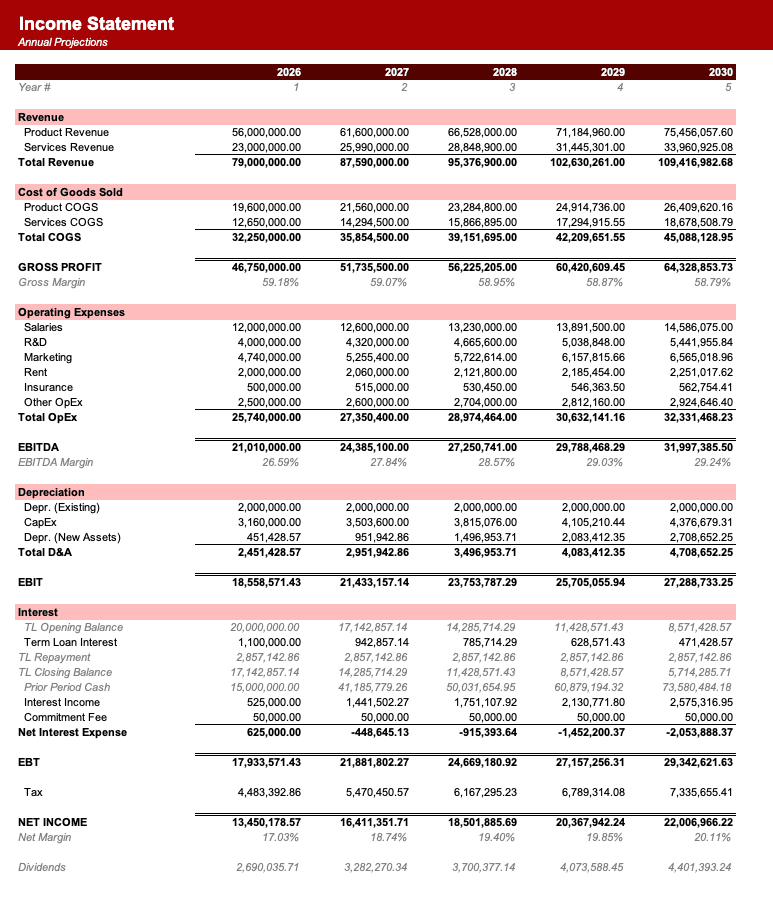
Formatted to IB standards
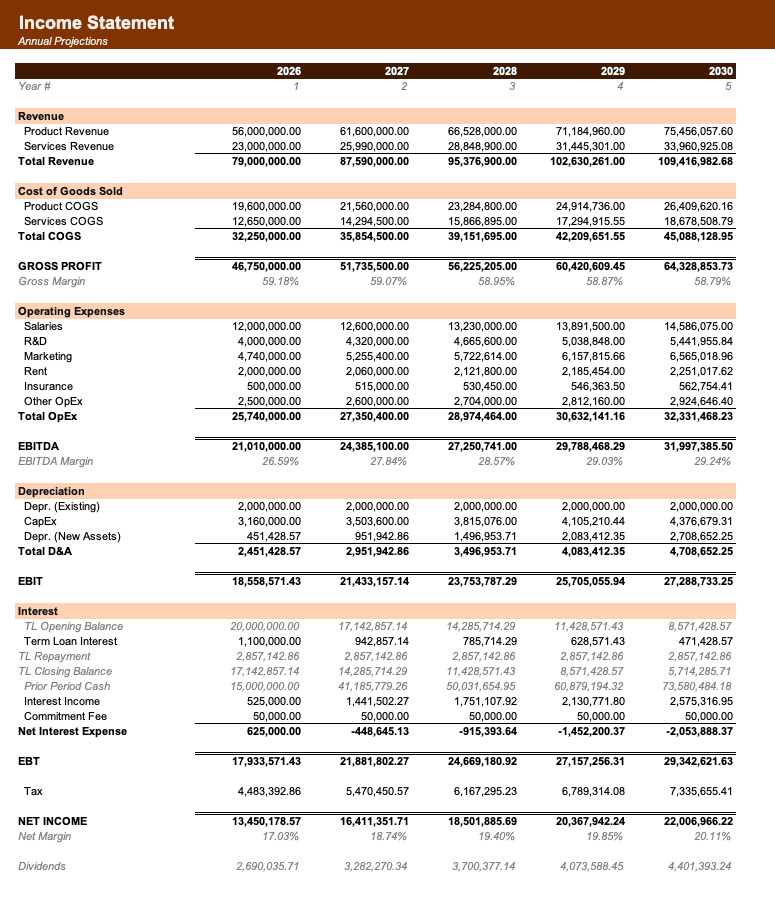
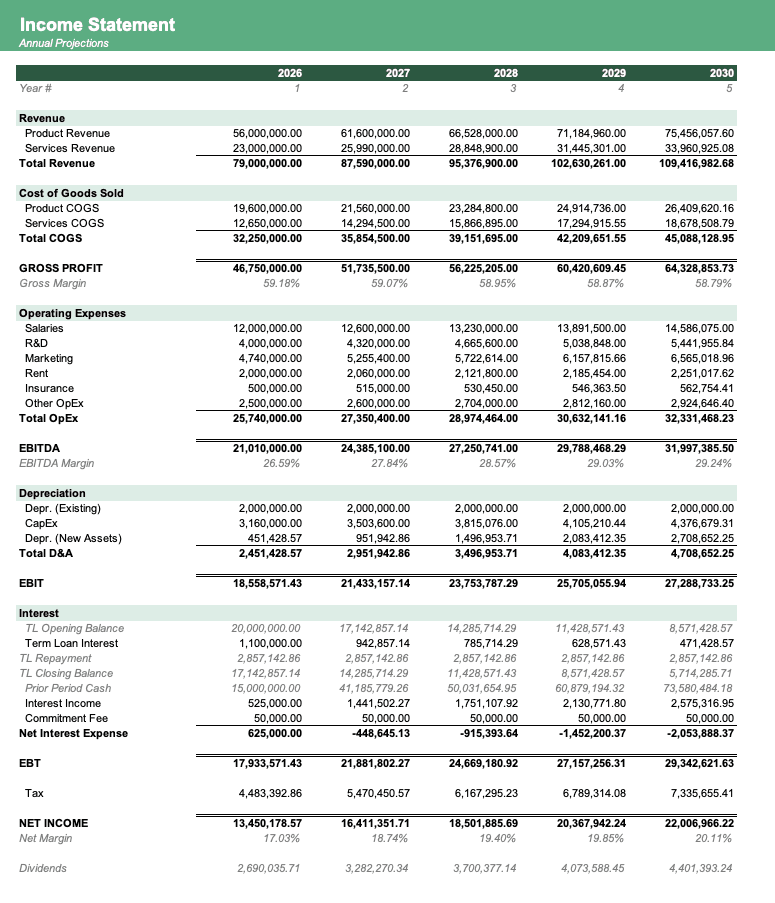
Named theme colors repaint the whole workbook in one click, on top of an investment-banking structure with clear input, output, and cross-sheet reference styling - brand-ready, institutional-grade, and fully auditable.

Created by ex-finance professionals
Hey, I’m Alex and I created Finamodel.
Over my years in the finance industry I kept building the same models over and over again. Same structure, same assumptions, different logo. So I started building frameworks to turn them into clean, reusable templates.
Every model here is one I’d actually use for a client, and I personally vet each one before it goes up.
I’m not an expert in every industry, but I’ve built enough models to know what belongs in one. And when something is completely foreign to me, I reach out to my network for experts to work on our models with us.
Having a template library on hand cuts a first build from hours to minutes.
Need help finding your model? You’ll find me in the Finamodel app!
Frequently asked
What is a food manufacturing financial model?+
A model that links production schedules, ingredient costs, yields, and capacity to forecast revenue, gross margin, and operating cash flow for a food production business.
How do I model production yield losses?+
Build yield percentage inputs by product line and multiply units produced by the yield rate to get saleable units. The difference flows to waste or rework costs.
How should I handle ingredient cost volatility?+
Create a price assumption table for each ingredient, run high and low commodity price scenarios, and link ingredient costs directly to production forecasts.
Can I model equipment depreciation and maintenance?+
Yes. Build a fixed asset schedule with depreciation by production line and link maintenance costs to equipment age and cumulative production volume.
Who uses food manufacturing models?+
Food manufacturers, operations managers, supply chain analysts, and private equity investors use them for planning, budgeting, and acquisition due diligence.
Have more financial modelling questions? Contact us
Related templates
Farm Operations Model
Agricultural business model with crop yields, commodity pricing, operating costs, and profitability.
Subscription Box Economics
Model recurring revenue, churn, customer acquisition, and fulfillment costs for a subscription service.
Consulting Firm
Five-year pyramid model: headcount, utilization, billable rate, comp, and margins.
Dental Practice
Five-year service-mix model: visits, production, collections, comp, and margins.