

IAP revenue = MAU × monthly ARPU × twelve × the platform fee adjustmentGaming Studio Operating Model
Tech & Software Financial Model (Free Excel Download)
Forecast game economics through player acquisition, retention, monetisation, live-operations spend, contribution margin, and cash flow for launch investment decisions.
DownloadSign up to downloadFree, no credit card required
Edit in Excelprofessionals from Deloitte
Loading...
Used by professionals from






About this model
This operating model projects five years of profitability and cash flow for a single-title indie or mid-size video game studio across pre-launch development (Years 1–2), launch and live service (Years 3–5). Forecast when the game reaches cash flow breakeven and determine equity runway and Series B funding requirements. No revenue Years 1–2; all P&L from Year 3 launch onward.
The workbook capitalises development costs (engineering + art + QA salaries, Years 1–2) as an intangible asset on the balance sheet, then amortises 50% Year 3, 30% Year 4, 20% Year 5 through COGS - matching revenue ramp and capturing industry practice (EA, animation studios). Revenue builds from four streams: premium sales (250k units Year 3 launch × £23.24 net after platform fee), DLC (18% attach rate on cumulative install base), IAP (20–40% of base as monthly active × £1.80–£2.50 ARPU), and live service/battle pass (12% adoption × £7.99 per season). Marketing spend £600k Year 2 (launch), then 12% revenue Year 3, 6% Years 4–5.
Critical for indie and mid-tier studios, PE investors in gaming tech, and venture lenders sizing Series A/B rounds. The model reveals the J-curve: Years 1–2 cash burn funded by equity, Year 3 large positive cash event at launch (£6M+ revenue), declining in Years 4–5 as live service monetisation offsets sales tail. Revolver availability (£1M at 9.5%) manages intra-year cash timing. Benchmarks: mid-tier premium £34.99, platform take 30%, 5% refund rate; live services 73% of revenue mix by Year 5 per EA reporting.
What every model includes
Live formulas, no hardcoded values
Outputs are driven by live formulas, so the workbook updates from its assumptions instead of relying on hardcoded results.
All assumptions in one tab
Inputs are clearly marked in the Assumptions tab and separated from calculations, making it clear what to change and what to leave intact.
Statements always balancing
For integrated-statement models, the balance sheet, cash flow, and supporting schedules tie through properly.
Distinct schedules for clarity
Debt, working capital, taxes, and cash flow can get messy quickly. We group calculations in clear schedules, not across disconnected tabs.
No hidden macros or external links
There are no unexplained external workbook links or macros to undermine auditability or portability.
Changes flow through the model
Update a key driver and see the impact carry through the forecast, financing, and return outputs. We never use hardcoded numbers in formulas.
What's inside the Gaming Studio Operating Model
- Player acquisition by channel with cost-per-install assumptions
- Retention curves and monthly active user progression
- Average revenue per user by monetization model
- Live ops spending: events, cosmetics, and battle passes
- Platform revenue splits and payment processing fees
- Development costs, overhead, and studio staffing
Gaming Model: How a Single-Title Studio Forecasts Cash Flow
This gaming model forecasts whether a single-title studio can fund development, launch, and live service without running out of cash. It projects five years across development, launch, and post-launch phases, linking player acquisition, retention, and monetisation assumptions to revenue.
Outputs include three financial statements, capitalised development costs, and cash burn. The public preview shows values only.
Operating drivers across the development and live service lifecycle
The model structures a single-title studio across three phases. Years 1–2 cover pre-production and development, with no revenue and cash burn funded by equity.
- Year 3 marks launch, where premium unit sales peak. Years 4–5 shift toward live service, with DLC, in-app purchases, and battle passes becoming the primary revenue streams.
- This reflects a games-as-a-service strategy: premium pricing is a secondary event, and post-launch monetisation drives long-run revenue. Key drivers include unit sales, cumulative install base, monthly active users, ARPU, DLC attach rate, and battle pass adoption.
Platform fees of 30% apply to all digital revenue.
Calculation flow from assumptions to financial statements
The model calculates revenue from unit sales and net price after platform fees and refunds. DLC revenue uses cumulative install base times attach rate times net price per pack.
- IAP revenue equals MAU times monthly ARPU times twelve times the platform fee adjustment. Live service revenue uses MAU times adoption rate times seasons times price.
- On the cost side, development labour in Years 1–2 is capitalised as an intangible asset, not expensed. Amortisation is accelerated at 50%, 30%, and 20% over Years 3–5 and appears in COGS.
- Staffing drives both capitalised costs and G&A, while marketing, rent, and software licences flow to operating expenses. A revolver facility prevents negative cash.
The income statement, balance sheet, and cash flow statement are fully linked.
Outputs and practical use for evaluating cash needs
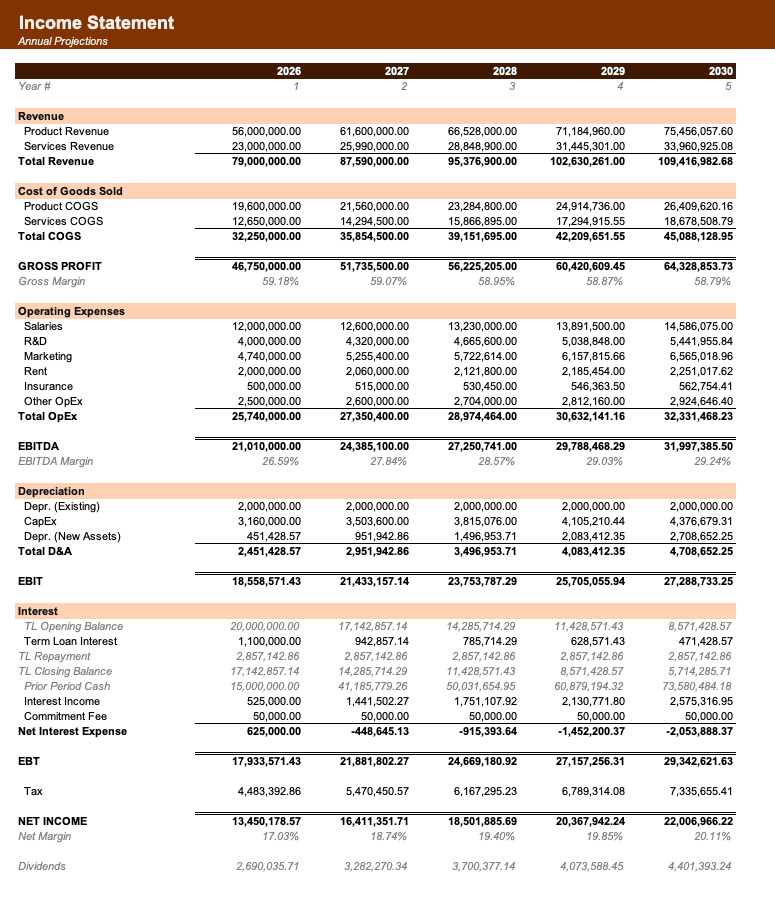
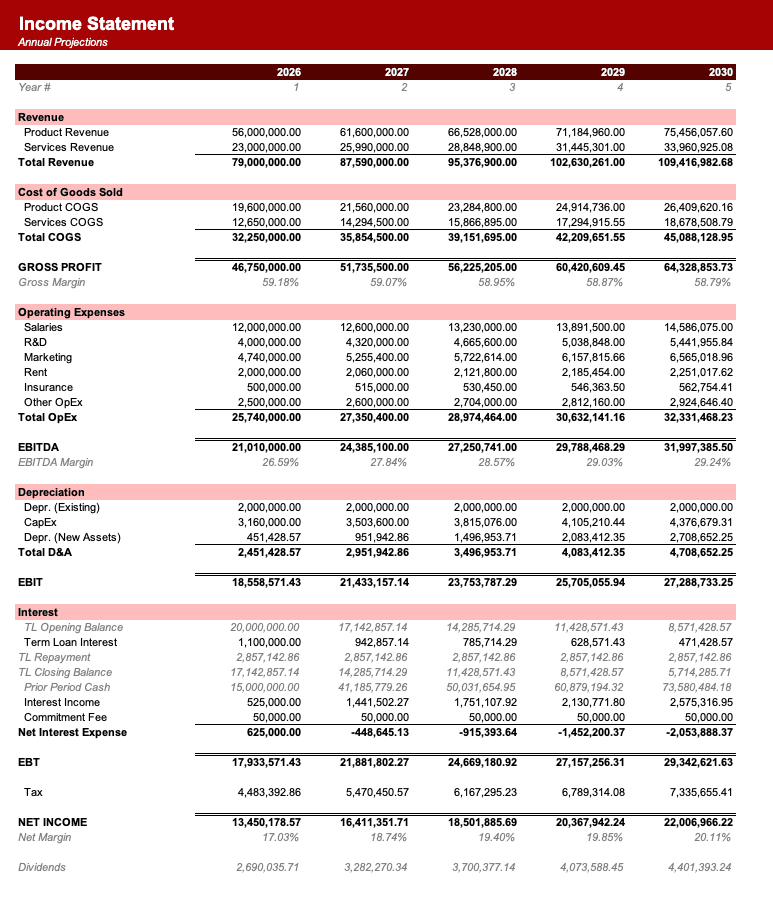
Primary outputs are the income statement, balance sheet, and cash flow statement across five years. These show revenue by stream, gross profit after amortisation, EBITDA, EBIT, and net income.
- The balance sheet tracks capitalised development costs, PP&E, working capital, equity, and revolver balances. The cash flow statement reveals operating, investing, and financing cash flows, highlighting the pre-revenue burn and the timing of breakeven.
- Validation checks ensure the balance sheet balances, cash never goes negative, and amortisation and depreciation add-backs reconcile. This model is for evaluating whether a single premium title can sustain a studio through launch and live operations without additional funding beyond planned equity.
Scope and limitations of the template
This model covers a single title with one premium launch and post-launch live service. It excludes scenario toggles, sensitivity analysis, WACC, DCF valuation, and term debt.
- Scenarios and valuation would require separate templates. The model assumes no deferred revenue for premium sales or IAP, consistent with delivery-based recognition.
- It includes a working capital facility but no conventional bank debt, as pre-revenue studios would not qualify. The public download is a values-only preview and does not contain live formulas or automatic recalculation.
Illustrative assumptions are provided, but users should replace them with their own data for decision-making.
income_statement.xlsx
income_statement.xlsx
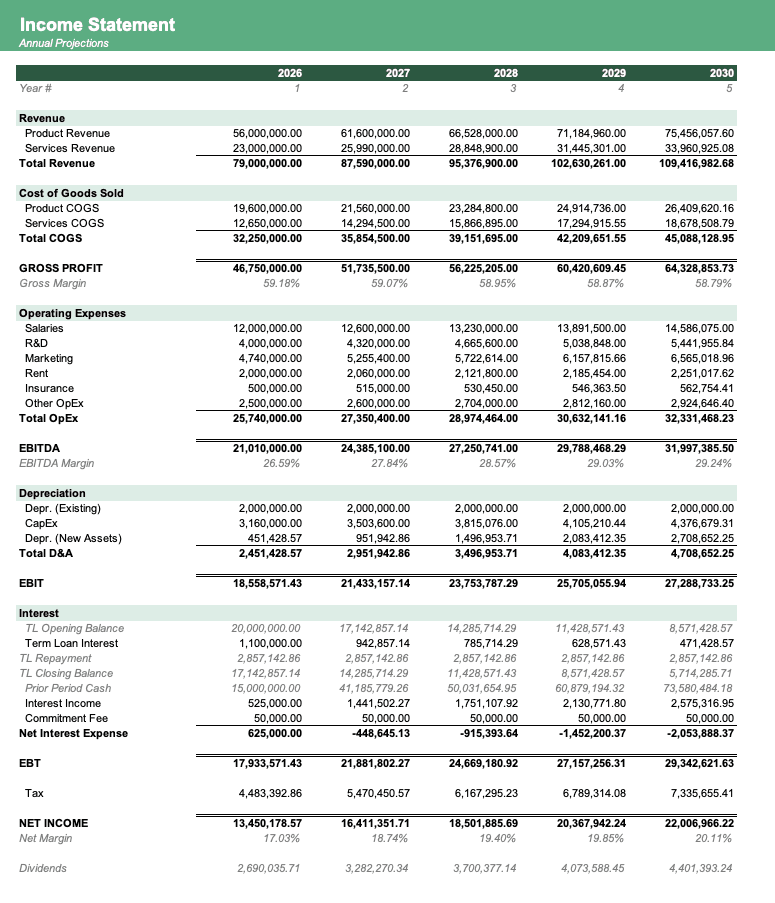
income_statement.xlsx
Formatted to IB standards
Named theme colors repaint the whole workbook in one click, on top of an investment-banking structure with clear input, output, and cross-sheet reference styling - brand-ready, institutional-grade, and fully auditable.

Created by ex-finance professionals
Hey, I’m Alex and I created Finamodel.
Over my years in the finance industry I kept building the same models over and over again. Same structure, same assumptions, different logo. So I started building frameworks to turn them into clean, reusable templates.
Every model here is one I’d actually use for a client, and I personally vet each one before it goes up.
I’m not an expert in every industry, but I’ve built enough models to know what belongs in one. And when something is completely foreign to me, I reach out to my network for experts to work on our models with us.
Having a template library on hand cuts a first build from hours to minutes.
Need help finding your model? You’ll find me in the Finamodel app!
Frequently asked
What is a gaming studio financial model?+
A model that forecasts player acquisition costs, retention curves, ARPU, live ops spend, and platform fees to project studio revenue and profitability.
What is a realistic CAC and payback period for mobile games?+
CAC ranges from $0.50 to $3.00 per install depending on channel and geography. Payback should occur within 3-12 months of install for a healthy free-to-play game.
How do I forecast retention curves?+
Use power-law or exponential decay models. Assume Day 1 retention of 30-50%, Day 7 of 10-20%, and Day 30 of 2-8%, then refine based on genre and player segment.
What ARPU should I assume for free-to-play games?+
Typical free-to-play ARPU is $1-5 per user per month. The top 1-5% of spenders drive 50-80% of revenue, with 2-10% of players spending any money.
Who uses gaming studio models?+
Game developers, studio heads, publishers, and gaming investors use them for launch planning, monetization strategy, and acquisition due diligence.
Have more financial modelling questions? Contact us
Related templates
GameFi_Token_Economics_Model.xlsx
Metric
2026
Revenue
--
EBITDA
--
GameFi Token Economics Model
Token supply, mint/burn mechanics, and player economics model for play-to-earn games and blockchain-based gaming platforms.
Subscription_Box_Economics.xlsx
Metric
2026
Revenue
--
EBITDA
--
Subscription Box Economics
Model recurring revenue, churn, customer acquisition, and fulfillment costs for a subscription service.
Marketplace_Model.xlsx
Metric
2026
Revenue
--
EBITDA
--
Marketplace Economics Model
Financial model for two-sided or multi-sided marketplace platforms with transaction volumes, take rates, and unit economics.
SaaS_MRR_ARR_Forecast.xlsx
Metric
2026
Revenue
--
EBITDA
--
SaaS MRR/ARR Forecast Model
Subscription forecast with logo motion, MRR build, ARR, NRR/GRR, and CAC payback for SaaS businesses.