Hydrogen Production and Storage Model
Energy Financial Model (Free Excel Download)
Model hydrogen production, electrolyser utilisation, electricity costs, offtake pricing, transport, capex, and project returns under multiple scenarios.



professionals from Deloitte
Used by professionals from






About this model
This project finance model determines the viability of a green hydrogen production facility (100 MW electrolyser) by forecasting levelised cost of hydrogen, debt service coverage, and equity IRR under various power pricing and offtake scenarios. Answer: what hydrogen price ($/kg) is required to achieve 1.40× DSCR and 8–12% equity IRR, and how does production tax credit (US IRA, EU subsidies) improve deal economics?
The workbook models hydrogen production: electrolyser capacity × capacity factor / efficiency (kWh/kg) = annual production volume. Primary costs: power (£45/MWh blended PPA+grid), water (£2/m³), fixed O&M (2.5% of capex/year), stack replacement every 7–10 years. Revenue: hydrogen sales (£6.50/kg base case), subsidies (£0–£3.00/kg US IRA production tax credit), oxygen and heat by-products. Capex £1,500/kW for full EPC + balance of plant; stack replacement £450/kW (~30% of initial capex). Debt: 65% of total project cost at 6.5% rate, 15-year tenor. Target DSCR 1.40x minimum.
Used by renewable energy developers, infrastructure funds evaluating hydrogen as energy transition play, project finance lenders sizing non-recourse debt, and industrial offtakers (steel, ammonia, refining) securing hydrogen supply. The model reveals sensitivity to power costs (60–80% of LCOH): cheap renewable PPA under £30/MWh makes £4–5/kg LCOH achievable; grid power at £80/MWh produces £7–8/kg LCOH. Stack degradation (1.5% per 10k operating hours) and efficiency erosion compound over 20-year project life. Benchmarks: Nel ASA, Plug Power, Thyssenkrupp Nucera - all targeting £2–4/kg LCOH at scale; current generation £5–8/kg pre-subsidy.
What every model includes
Live formulas, no hardcoded values
Outputs are driven by live formulas, so the workbook updates from its assumptions instead of relying on hardcoded results.
All assumptions in one tab
Inputs are clearly marked in the Assumptions tab and separated from calculations, making it clear what to change and what to leave intact.
Statements always balancing
For integrated-statement models, the balance sheet, cash flow, and supporting schedules tie through properly.
Distinct schedules for clarity
Debt, working capital, taxes, and cash flow can get messy quickly. We group calculations in clear schedules, not across disconnected tabs.
No hidden macros or external links
There are no unexplained external workbook links or macros to undermine auditability or portability.
Changes flow through the model
Update a key driver and see the impact carry through the forecast, financing, and return outputs. We never use hardcoded numbers in formulas.
What's inside the Hydrogen Production and Storage Model
- Electrolyzer or steam methane reformer capex and installation costs
- Electricity costs for electrolysis or natural gas for SMR
- Production capacity, utilization rate, and hydrogen output
- Hydrogen storage and distribution costs
- Offtake agreements and hydrogen pricing in dollars per kilogram
- Water and feedstock input requirements
Hydrogen Model: Project Finance Template for Green Hydrogen Production
This hydrogen model evaluates green hydrogen production by forecasting electrolyser output, power and feedstock costs, and offtake revenues to determine project IRR, equity returns, and levelised cost of hydrogen (LCOH). It is built for utility-scale electrolysis projects under project finance structures, using default assumptions that are illustrative and can be replaced with actual project data.
Key Operating Drivers
The hydrogen model's production forecast starts with installed electrolyser capacity, capacity factor, and efficiency. Hydrogen output equals capacity in kilowatts times capacity factor times 8,760 hours, divided by efficiency in kilowatt-hours per kilogram.
- Efficiency degrades over time, and capacity factor may also decline annually. The default assumptions in the template include 100,000 kW capacity, 65% capacity factor, 52 kWh/kg base efficiency, and 1.5% degradation per 10,000 hours, but these are illustrative.
- Output determines all downstream revenues and variable costs. The model also captures by-product oxygen and heat sales, though these are secondary.
Calculation Flow and Integration
The hydrogen model follows a sequential calculation path: Operations feeds production volumes into Revenue_Opex, which calculates hydrogen sales, subsidies, and by-product revenue alongside power, water, and fixed operating costs. The resulting cash flow moves through the Cash_Waterfall, where operating cash flow after costs and maintenance capex becomes cash available for debt service (CADS).
- Debt is sized and amortised in the Debt_Schedule using a DSCR-sculpted profile that equalises the debt service ratio across the tenor. Construction-period interest is capitalised, and the model includes a maintenance reserve account that accumulates annually for stack replacement.
- Financial statements and returns are then generated from these integrated schedules.
Outputs and Financial Statements
The hydrogen model produces integrated financial statements, including income statement, balance sheet, and cash flow statement, all driven by the operating and financing assumptions. From these, the model calculates project IRR, equity IRR, net present value, and LCOH.
- The LCOH is computed by discounting total costs and total hydrogen production to present value. A sensitivity tab shows how project IRR, equity IRR, LCOH, and minimum DSCR respond to changes in power cost and hydrogen sale price.
- The model also includes a checks tab to validate balance sheet balancing, minimum DSCR, LCOH range, and debt repayment. All outputs are values-only in the public download.
Practical Use in Project Evaluation
This hydrogen model is designed for developers and infrastructure investors assessing utility-scale green hydrogen facilities under project finance structures. It allows users to input their own assumptions for power pricing, offtake contracts, capital costs, and financing terms to test project viability.
- The debt sizing and DSCR sculpting features reflect typical non-recourse debt structures with covenants and reserve accounts. By adjusting the sensitivity analysis, users can see how changes in key variables impact returns.
- The model captures important nuances like electrolyser degradation, lumpy stack replacement costs, and by-product revenue. It is not intended for small-scale or non-electrolysis hydrogen production.
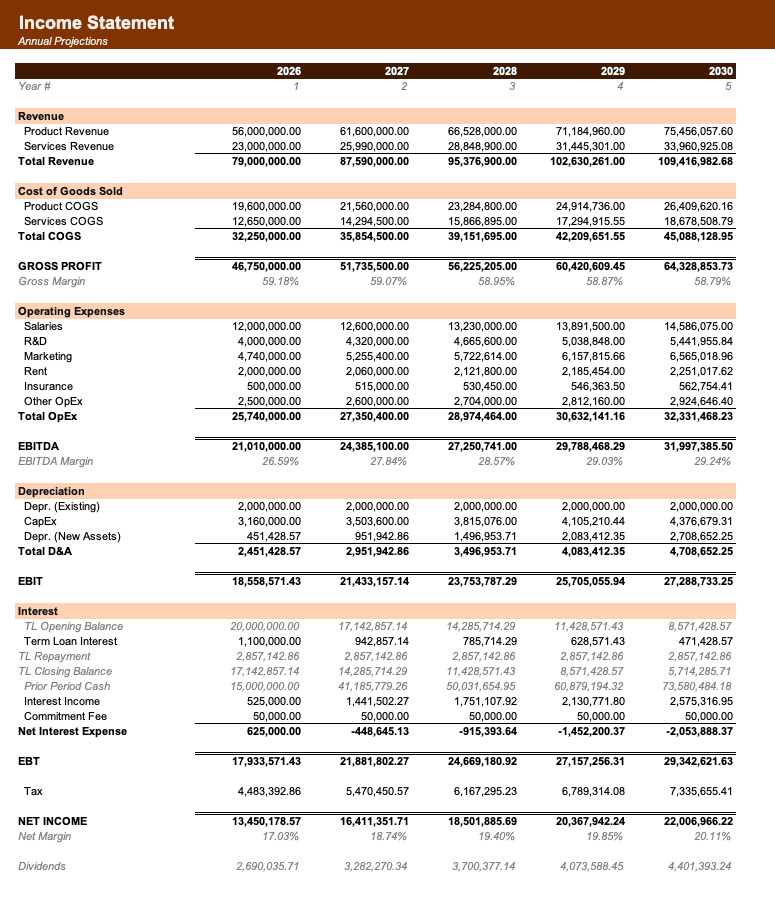
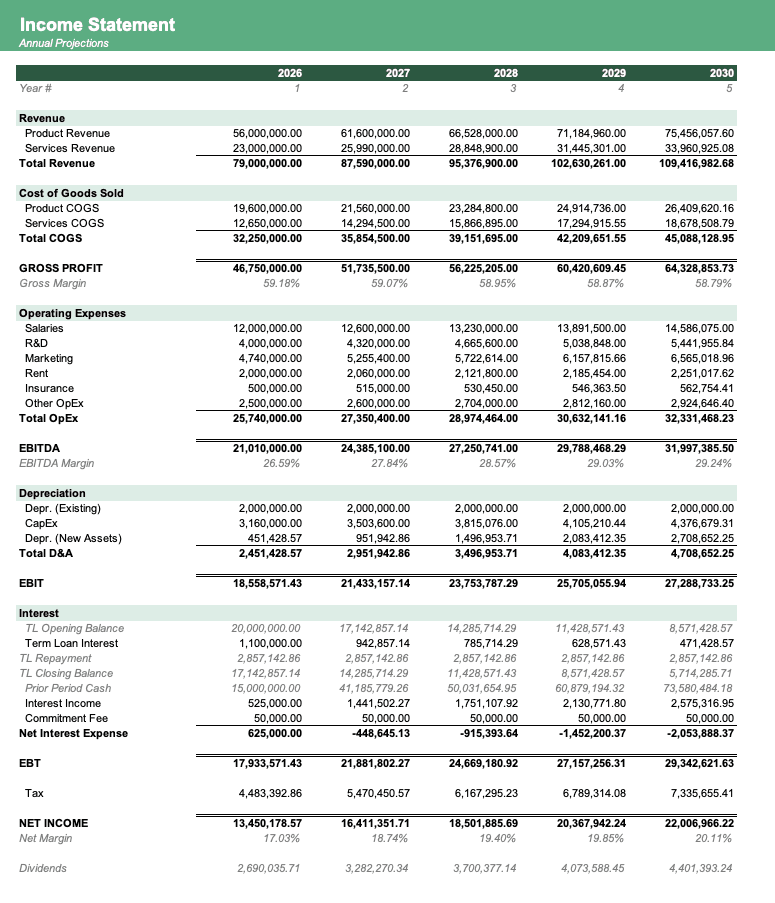
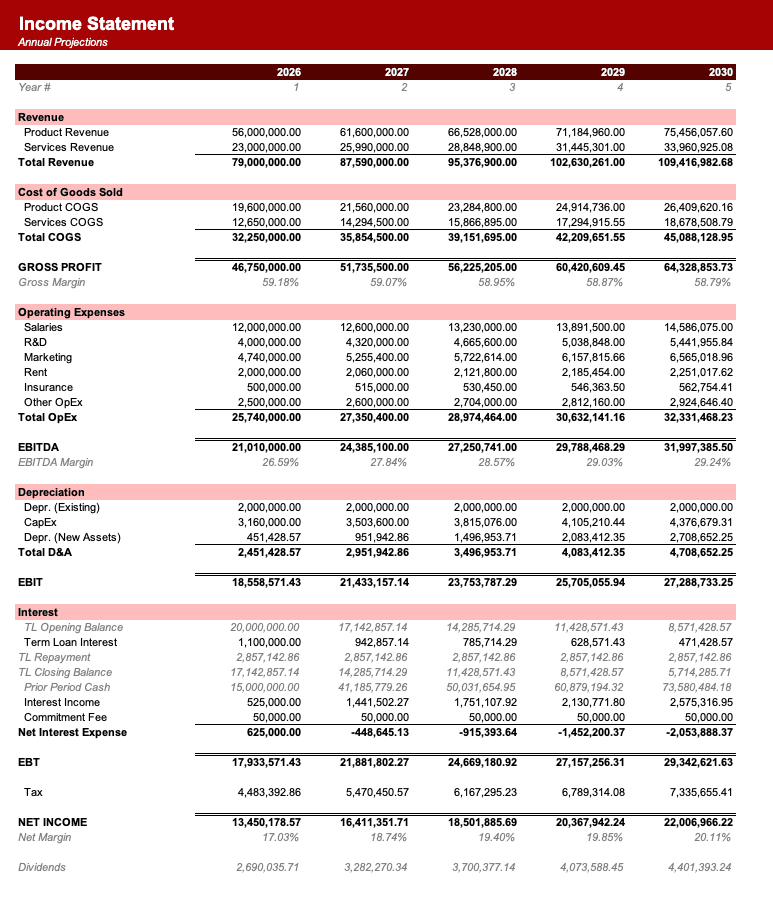
Formatted to IB standards
Named theme colors repaint the whole workbook in one click, on top of an investment-banking structure with clear input, output, and cross-sheet reference styling - brand-ready, institutional-grade, and fully auditable.

Created by ex-finance professionals
Hey, I’m Alex and I created Finamodel.
Over my years in the finance industry I kept building the same models over and over again. Same structure, same assumptions, different logo. So I started building frameworks to turn them into clean, reusable templates.
Every model here is one I’d actually use for a client, and I personally vet each one before it goes up.
I’m not an expert in every industry, but I’ve built enough models to know what belongs in one. And when something is completely foreign to me, I reach out to my network for experts to work on our models with us.
Having a template library on hand cuts a first build from hours to minutes.
Need help finding your model? You’ll find me in the Finamodel app!
Frequently asked
What is a hydrogen production financial model?+
A project finance model that forecasts hydrogen production facility capex, operating costs, utilization, and offtake revenue to calculate project IRR and LCOH.
What is LCOH and how is it calculated?+
LCOH is the levelized cost of hydrogen: total NPV of capex plus opex divided by total hydrogen produced. It measures long-term average production cost per kilogram.
What electricity cost is needed for green hydrogen competitiveness?+
Electrolysis requires $20-40 per MWh electricity for a competitive LCOH. At typical U.S. rates of $40-60 per MWh, hydrogen costs $3-5 per kilogram.
How do I model offtake agreement pricing?+
Typical offtake agreements include a fixed minimum price of $2-4 per kilogram plus escalators tied to natural gas, electricity, or inflation. Model both take-or-pay and usage-based structures.
Who uses hydrogen production models?+
Energy engineers, green hydrogen investors, industrial gas producers, and project financiers use them for project development, investment decisions, and procurement strategy.
Have more financial modelling questions? Contact us
Related templates
Renewable Energy Project Economics Model
Solar, wind, or hydro project generation, power purchase agreements, operating costs, and project IRR.
Battery Storage Project Model
Energy storage system financial analysis and PPA modeling.
Oil & Gas Upstream Model
Integrated production, cost, and project economics for upstream oil and gas assets.
Commodity Hedging Model
Structure and monitor hedges for commodity price exposure with effectiveness metrics.


