Water Utility Financial Model
Public Finance Financial Model (Free Excel Download)
Model water-utility performance using connections, consumption, tariff recovery, treatment costs, leakage, infrastructure capex, regulatory returns, and debt capacity.



professionals from Deloitte
Used by professionals from






About this model
Model a water and wastewater utility with regulated tariffs, volume-driven consumption, and massive capital requirements. Revenue is split between fixed charges (per-connection annual fee) and volumetric charges (per-cubic-meter tariff), with separate tariffs for water supply and wastewater collection/treatment. Non-Revenue Water (NRW) of 15–20% reflects leakage losses; wastewater volumes are modeled as a percentage of water deliveries (typically 90–95% return to sewer).
Costs include power (largest variable cost, 6 kWh per cubic meter at $0.12/kWh = $0.72/m³), chemicals (chlorine, coagulants at $0.05/m³), and labor (30–40% of opex). Capex is 15–30% of revenue (much higher than electric utilities) due to aging pipe networks and new environmental regulations (PFAS remediation, nutrient discharge limits). Capex is bifurcated: RAB-eligible infrastructure (70–90% of total) recovers through tariffs; other capex (vehicles, IT) is expensed.
Key metrics: Debt/RAB ratio (target 60–65%), interest coverage ratio (ICR, minimum 1.5x), and customer connection growth (1–3% p.a.). Tariff adequacy is critical: if tariffs are held flat against inflation, coverage ratios deteriorate and borrowing capacity shrinks, limiting capex. This model is essential for municipal water systems, regional utilities (Severn Trent, United Utilities), and water infrastructure investors.
What every model includes
Live formulas, no hardcoded values
Outputs are driven by live formulas, so the workbook updates from its assumptions instead of relying on hardcoded results.
All assumptions in one tab
Inputs are clearly marked in the Assumptions tab and separated from calculations, making it clear what to change and what to leave intact.
Statements always balancing
For integrated-statement models, the balance sheet, cash flow, and supporting schedules tie through properly.
Distinct schedules for clarity
Debt, working capital, taxes, and cash flow can get messy quickly. We group calculations in clear schedules, not across disconnected tabs.
No hidden macros or external links
There are no unexplained external workbook links or macros to undermine auditability or portability.
Changes flow through the model
Update a key driver and see the impact carry through the forecast, financing, and return outputs. We never use hardcoded numbers in formulas.
What's inside the Water Utility Financial Model
- Customer growth and consumption projections by customer class
- Revenue model with fixed charges and volumetric usage rates
- Infrastructure capex for treatment, transmission, and replacement
- Debt service and rate covenants (coverage ratios)
- Rate case financial analysis and revenue requirement modeling
- Operating cost escalation and affordability impacts
Water Utility Financial Model: How the Specification Works
This water utility financial model template captures the regulated economics of water and wastewater businesses — connecting customer and demand assumptions to tariffs, cost of sales, capital expenditure, the Regulated Asset Base, financing and valuation. The design document below explains the operating drivers, calculation flow and outputs, so you can judge what the template does before relying on it.
Operating drivers: connections, consumption and non-revenue water
The model begins with the customer base rather than with revenue. Closing connections equal opening connections plus new connections, and new connections grow at population growth.
- That single connection line drives both the billing base and developer fees, so the two never disagree. Water volume then builds from connections multiplied by persons per household, per-capita consumption and days, with an annual per-capita demand trend that reduces use over time.
- Non-revenue water starts at an opening percentage and falls by a fixed number of basis points each year, so billed volume is total volume less the leakage share. A nominated dry year applies a demand uplift that raises both volume and the volume-driven costs, which matters because a drought lifts revenue and power and chemical costs together.
Revenue build: tariffs, wastewater and developer fees
Water revenue combines a fixed charge per connection with a volumetric charge on billed volume. Tariff escalation is not hardcoded: it is computed as inflation plus a K factor, and the tariff index compounds that escalation across the forecast.
- Wastewater revenue follows the same structure using a fixed sewerage charge and a volumetric wastewater tariff, with wastewater volume equal to billed water volume multiplied by the return-to-sewer percentage, which prevents billing all water as sewage. Developer or connection fees are a separate line, escalated at inflation.
- Because developer fees sit outside the price control, the model compares allowed revenue only against regulated revenue — water plus wastewater — rather than total revenue.
Costs, capex and the RAB roll-forward
Cost of sales separates variable costs — power, chemicals and sludge — from the direct shares of labour and network maintenance, with the remaining shares sitting in operating expenses alongside IT, insurance, compliance and bad debt. Capital expenditure is built as a percentage of revenue split between maintenance and growth, with a leakage-reduction block added on top and driven by the non-revenue-water improvement target.
- An eligibility flag determines the share that enters the Regulated Asset Base. The RAB roll-forward adds eligible capex, subtracts regulatory depreciation and adds CPI indexation on the opening balance.
- Because the RAB is indexed, the allowed return applied to it must be a real WACC — using a nominal rate as well would pay for inflation twice.
Financing, outputs and practical use
Debt is sized off cash need rather than a gearing target. Cash available before debt movements is compared with a minimum cash balance; any surplus repays debt, and any shortfall is funded by a drawdown capped at the target debt-to-RAB capacity.
- Interest expense and interest income are both calculated on opening balances, so the sweep can be driven off the actual full-year cash flow without a circular reference.
- The outputs include the income statement, balance sheet, cash flow, covenant ratios such as interest cover and debt to RAB, a dashboard with KPI cards and a RAB waterfall, and a single valuation bridge that discounts explicit free cash flow and adds a terminal value based on the closing RAB. The public download is a values-only preview, not a live model.
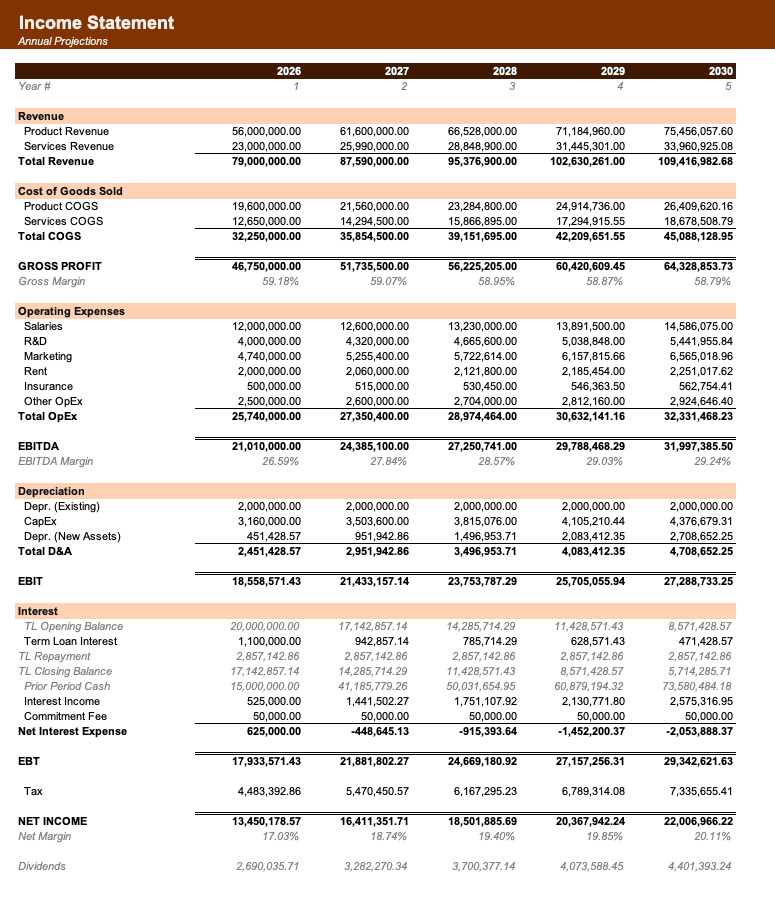
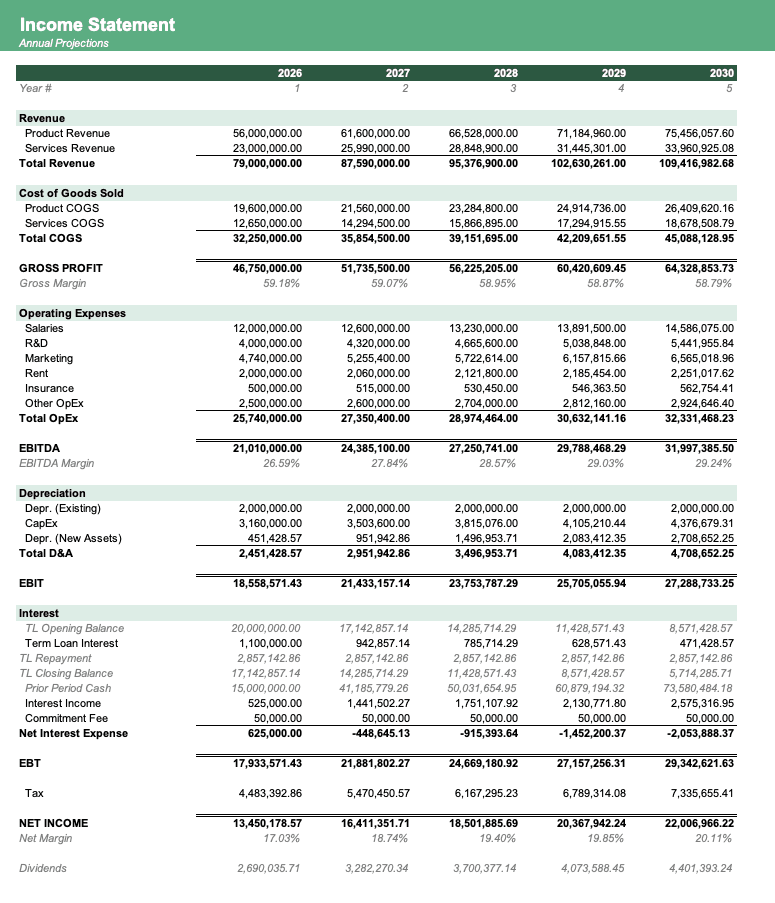
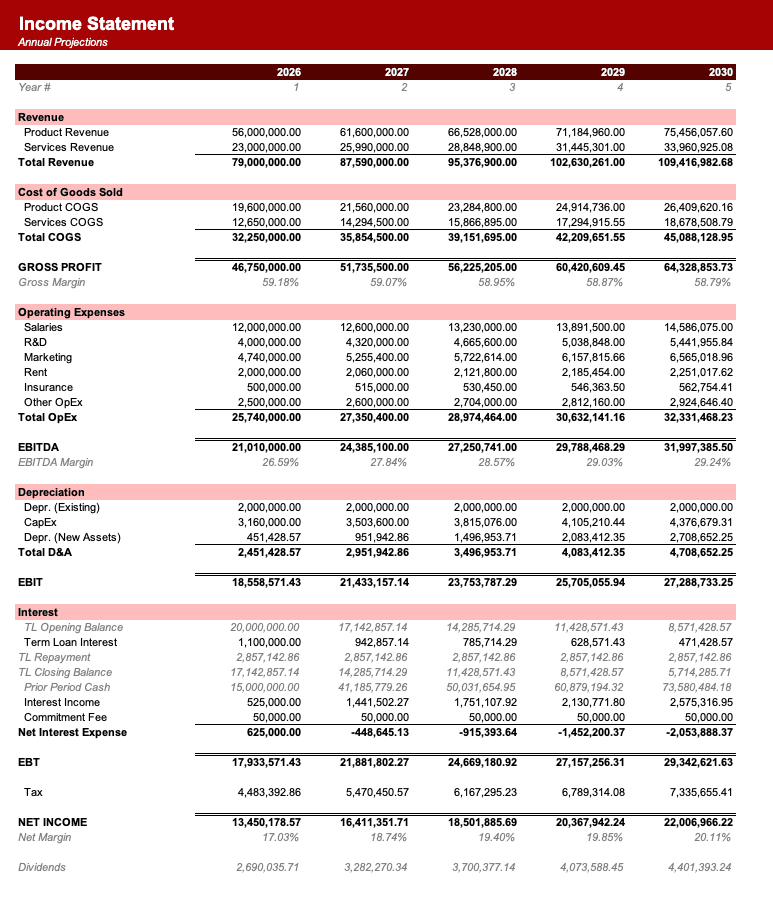
Formatted to IB standards
Named theme colors repaint the whole workbook in one click, on top of an investment-banking structure with clear input, output, and cross-sheet reference styling - brand-ready, institutional-grade, and fully auditable.

Created by ex-finance professionals
Hey, I’m Alex and I created Finamodel.
Over my years in the finance industry I kept building the same models over and over again. Same structure, same assumptions, different logo. So I started building frameworks to turn them into clean, reusable templates.
Every model here is one I’d actually use for a client, and I personally vet each one before it goes up.
I’m not an expert in every industry, but I’ve built enough models to know what belongs in one. And when something is completely foreign to me, I reach out to my network for experts to work on our models with us.
Having a template library on hand cuts a first build from hours to minutes.
Need help finding your model? You’ll find me in the Finamodel app!
Frequently asked
What revenue model should a water utility use?+
Most utilities use a two-part model: a fixed customer charge per month and a volumetric usage charge per thousand gallons. Some use tiered rates that increase at higher volumes to encourage conservation.
What debt service coverage ratio do bond covenants require?+
Municipal bond covenants typically require 1.25-1.50x debt service coverage (net revenue divided by debt service). Higher coverage is required for weaker credit profiles or first-time issuers.
How much capex does a water utility typically need?+
Utilities typically spend 2-4% of revenue annually on maintenance capex, plus additional spending for growth and regulatory compliance. Infrastructure age and climate resilience needs drive significant variability.
How do you model affordability impacts?+
Track the percentage of median household income consumed by the average customer bill. Bills above 2% of household income are considered unaffordable by most regulatory standards and may trigger subsidy requirements.
Who uses water utility financial models?+
Utility finance teams preparing rate case filings, water infrastructure investors, regulators reviewing revenue requirements, and rate consultants supporting municipal bond issuances and strategic financial planning.
Have more financial modelling questions? Contact us
Related templates
Electric Utility Tariff Model
Model utility revenue based on customer class, usage levels, and tariff rate schedules.
Municipal Budget Model
Financial model for municipal governments including revenue forecasts, expenditure planning, and debt capacity.
Public Housing Authority Operating Model
Unit mix, rent roll, operating expenses, and asset replacement reserve for public housing portfolios.
Pension Fund Asset Allocation Model
Liability-driven investment strategy, asset allocation, and funding ratio analysis for pension plan portfolios.