Alternatives Allocation Model
Private Equity Financial Model (Free Excel Download)
Compare private equity, credit, real assets, and liquid investments by commitment pacing, distributions, liquidity, risk, and portfolio-level returns.



professionals from Deloitte
Used by professionals from






About this model
An alternatives allocation model projects capital flows, net asset value (NAV), and risk-adjusted returns across an institutional investor's portfolio of private equity, hedge funds, real estate, infrastructure, and private credit commitments to optimise allocation, manage the J-curve drawdown profile, and forecast dividend capacity. The model answers how much capital must be committed and drawn over time to maintain target allocations, when distributions from successful exits will arrive, and what net-of-fee blended return the portfolio will achieve.
Each asset class is modelled with distinct capital call and distribution pacing: private equity and venture capital exhibit a deep J-curve (negative returns in years 1–3 as capital is called and deployed, then positive returns years 4–8 from exits), while hedge funds and private credit generate steadier quarterly/annual cash flows. Fee structures vary by asset class (PE: 1.5–2.0% management fee plus 20% carry over 8% hurdle; hedge funds: 1–1.5% plus 15–20% performance fee; infrastructure: 1–1.5% plus 15–20% promote). The model tracks cumulative capital calls against available liquidity, management fees charged against committed capital or NAV depending on the asset class, and performance fees (carry) calculated on excess returns above hurdle rates.
Endowments, pension funds, sovereign wealth funds, and family offices use alternatives allocation models to stress-test liquidity (can we meet capital calls without forced asset sales?), benchmark fee drag, project blended portfolio return including the impact of manager underperformance, and determine optimal rebalancing across asset classes to maintain strategic targets.
What every model includes
Live formulas, no hardcoded values
Outputs are driven by live formulas, so the workbook updates from its assumptions instead of relying on hardcoded results.
All assumptions in one tab
Inputs are clearly marked in the Assumptions tab and separated from calculations, making it clear what to change and what to leave intact.
Statements always balancing
For integrated-statement models, the balance sheet, cash flow, and supporting schedules tie through properly.
Distinct schedules for clarity
Debt, working capital, taxes, and cash flow can get messy quickly. We group calculations in clear schedules, not across disconnected tabs.
No hidden macros or external links
There are no unexplained external workbook links or macros to undermine auditability or portability.
Changes flow through the model
Update a key driver and see the impact carry through the forecast, financing, and return outputs. We never use hardcoded numbers in formulas.
What's inside the Alternatives Allocation Model
- Separate allocation tracking by strategy: PE, hedge, infrastructure, real estate
- J-curve modelling with capital calls and distribution timing by vintage
- IRR and multiple assumptions by strategy and market condition
- Management fees, carry, and co-investment economics
- Liquidity and cash flow forecasting with rebalancing logic
- Risk-adjusted return calculation and portfolio performance tracking
Alternatives Allocation Model: Multi-Asset Class Portfolio Simulation
This alternatives allocation model is a spreadsheet-based template for institutional allocators to project 10-year portfolio performance across seven asset classes. It simulates commitments, capital calls, distributions, fees, and net returns, capturing the J-curve and liquidity demands of private markets.
The model supports analysis of allocation drift, cash management, and risk-adjusted outcomes for a multi-asset alternatives program.
Portfolio Construction and Asset Class Coverage
The model spans seven asset classes: private equity, venture capital, hedge funds, real estate, infrastructure, private credit, and liquid alternatives. Each class has distinct return drivers and cash flow patterns.
- Private equity returns depend on net IRR and capital deployed, with a J-curve from negative early returns to exits in years four through eight. Venture capital features an extreme J-curve and power-law distribution, where a few winners drive fund performance.
- Hedge funds offer lower J-curve exposure and periodic liquidity, with net returns after fees. Real estate combines income yield and appreciation, with quarterly distributions.
- Infrastructure provides stable, predictable cash flows over long hold periods. Private credit delivers current yield with quarterly interest and principal at maturity.
Liquid alternatives provide daily liquidity and mark-to-market returns. This structure allows users to analyze how different return drivers interact within a single portfolio framework.
Calculation Flow and Fee Treatment
The model calculates new commitments per asset class by vintage, applying target allocations, an over-commitment ratio for illiquid classes, and a five-year pacing schedule. Capital calls are derived from cumulative commitments and drawdown percentages, with stress multipliers for liquidity testing.
- Gross returns use a mid-period convention based on opening NAV and half of current calls, indexed to an annual return vector that captures the J-curve. Management fees follow either committed capital during the investment period or NAV thereafter, with a step-down feature.
- Performance fees are calculated on a NAV basis with a high-water mark for hedge funds, real estate, infrastructure, and private credit, or on a realised-distribution basis for private equity, venture capital, and private credit, applying hurdle rates. Distributions begin after a specified start year, typically year three or four for private assets, and are scaled by a distribution percentage.
Net returns subtract fees from gross returns. This flow ensures that fee drag and timing effects are accurately reflected in portfolio outcomes.
Outputs and Key Metrics
The model generates several outputs for evaluating portfolio performance and health. The dashboard displays headline KPIs including NAV, TVPI, DPI, average net return, trough cash, peak credit, actual allocation percentages, and a net cash flow strip.
- A NAV bridge and liquidity traffic-light indicators provide visual summaries. The returns sheet computes gross and net returns in both dollar and percentage terms, along with commitment-weighted portfolio net return and per-asset-class multiples.
- The liquidity sheet tracks opening cash, distributions, calls, internal costs, credit facility interest, draws, repayments, and closing cash, plus unfunded commitments and a coverage ratio. The fee analysis sheet details management and performance fees by asset class, total fee burden, and fee drag as a percentage of average NAV.
A checks sheet validates allocation sum, NAV reconciliation, non-negative cash and unfunded balances, coverage ratios, and that net returns do not exceed gross returns. These outputs enable users to assess allocation drift, liquidity adequacy, and the impact of fees on net performance.
Practical Use and Validation
This model is designed for institutional allocators such as endowments, pension funds, and family offices evaluating alternatives allocations within a total portfolio. It supports scenario analysis through stress multipliers on capital calls and distributions, and allows users to adjust assumptions such as return vectors, fee terms, and pacing schedules.
- The validation checks help identify common pitfalls, including allocation percentages not summing to 100%, misapplied over-commitment ratios, incorrect fee bases, and J-curve timing mismatches. For example, the model enforces that over-commitment applies only to illiquid asset classes and that distributions for private equity and venture capital do not start before year three to preserve the J-curve shape.
- Liquidity management is a key focus, with checks ensuring cash never goes negative and that liquid reserves cover at least 50% of unfunded commitments. By integrating these checks, the model serves as a practical tool for testing allocation strategies and understanding the trade-offs between return potential and liquidity risk.
The public download is a values-only preview for evaluation.
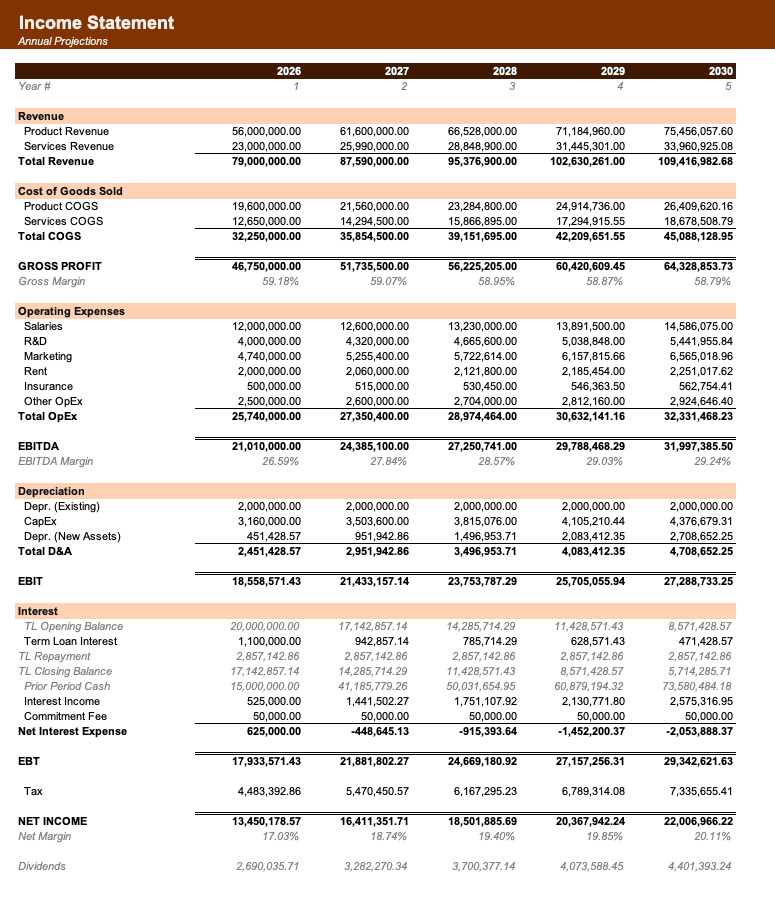
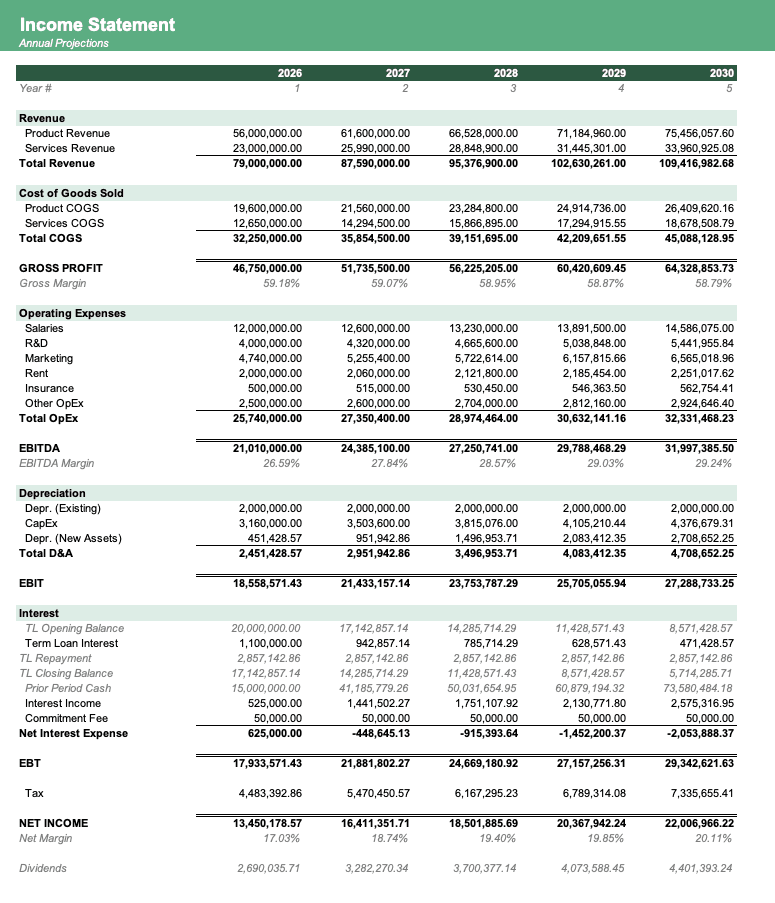
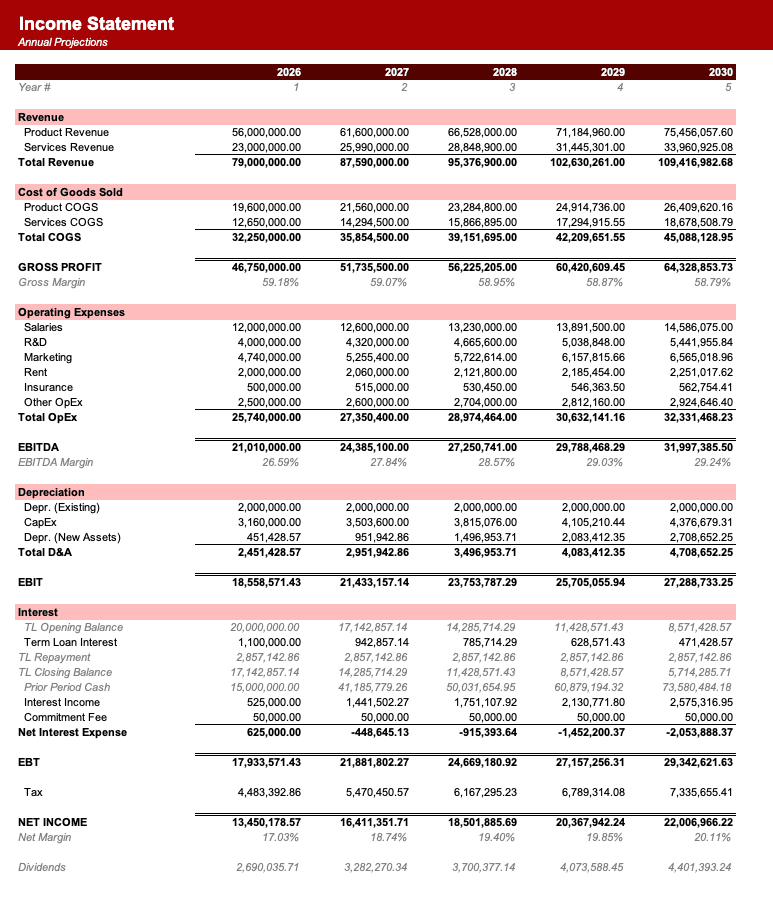
Formatted to IB standards
Named theme colors repaint the whole workbook in one click, on top of an investment-banking structure with clear input, output, and cross-sheet reference styling - brand-ready, institutional-grade, and fully auditable.

Created by ex-finance professionals
Hey, I’m Alex and I created Finamodel.
Over my years in the finance industry I kept building the same models over and over again. Same structure, same assumptions, different logo. So I started building frameworks to turn them into clean, reusable templates.
Every model here is one I’d actually use for a client, and I personally vet each one before it goes up.
I’m not an expert in every industry, but I’ve built enough models to know what belongs in one. And when something is completely foreign to me, I reach out to my network for experts to work on our models with us.
Having a template library on hand cuts a first build from hours to minutes.
Need help finding your model? You’ll find me in the Finamodel app!
Frequently asked
What is an alternatives allocation model?+
It is a model that projects capital calls, distributions, NAV, and net-of-fee returns across an institutional portfolio of private and alternative investments.
What is the J-curve?+
The J-curve reflects negative early returns from PE and other alternatives (fees, no distributions) before a high-return harvest phase begins.
How do I model management fees and carry?+
Management fees are typically 1.5–2.0% of committed capital during drawdown, declining to NAV thereafter. Carry is usually 20% above an 8% hurdle.
Should I model inflation sensitivity?+
Yes, especially for infrastructure and real estate which have inflation-linked revenues or embedded hedge value.
Is this useful for endowments and pension funds?+
Yes. It is designed for the kind of strategic asset allocation reviews endowments, pensions, sovereign wealth funds, and family offices run.
Have more financial modelling questions? Contact us
Related templates
Private Equity Fund Model
Fund-level cash flow, investment allocation, and LP returns including fees, distributions, and net IRR.
Hedge Fund Operating Model
Operating model for hedge funds including investor cash flows, fee structure, leverage, and performance-based compensation.
Real Estate Fund Investment Model
Real estate fund cash flows, investment deployment, distribution schedules, and LP net IRR for fund-level analysis.
Leveraged Buyout Model
Complete LBO analysis with debt financing structures, sponsor returns, and sensitivity to exit scenarios.