Hedge Fund Model
Capital Markets Financial Model (Free Excel Download)
Model hedge-fund capital flows, management fees, incentive allocations, performance returns, subscriptions, redemptions, and investor-level outcomes across fund scenarios.



professionals from Deloitte
Used by professionals from






About this model
This operating model projects hedge fund management company (ManCo) profitability by forecasting AUM roll-forward with high-water mark (HWM) mechanics, calculating management and performance fees, sizing staffing costs, and computing partner distributions over five years. Answer: at what AUM scale does the ManCo break even and generate attractive partner returns?
The workbook tracks opening AUM, applies gross fund returns (12% base case) net of management fees (1.5%), deducts performance fees (15% of gains above HWM), and carries HWM forward each year (rises when NAV exceeds prior peak, stays flat when NAV declines). Revenue: management fees on average AUM (~85% gross margin) and performance fees (lumpy, only earned when fund is at or above HWM). Staffing scales with AUM milestones (5 FTEs at launch, 7+ FTEs at $300M+ AUM). Fixed opex (data, rent, compliance, insurance): ~£750k/year, escalating at 2.5%. Breakeven AUM: £80–120M at 1.5% management fee with £1.6M salary base.
Used by emerging fund managers building venture capital and hedge fund platforms, PE sponsors establishing new strategies, and existing managers considering spinouts. The model reveals extreme operating leverage: EBITDA margin below breakeven at small AUM scales (<£50M) becomes 40–60% at institutional scale (£500M+). Distributions to partners hinge on performance fee crystallisation - a down year wipes out partner income despite positive management fees. Benchmarks: Man Group, Sculptor Capital, Artisan Partners - all showing compression from historical "2 and 20" toward "1.5 and 15%" as institutional allocators negotiate rate breaks.
What every model includes
Live formulas, no hardcoded values
Outputs are driven by live formulas, so the workbook updates from its assumptions instead of relying on hardcoded results.
All assumptions in one tab
Inputs are clearly marked in the Assumptions tab and separated from calculations, making it clear what to change and what to leave intact.
Statements always balancing
For integrated-statement models, the balance sheet, cash flow, and supporting schedules tie through properly.
Distinct schedules for clarity
Debt, working capital, taxes, and cash flow can get messy quickly. We group calculations in clear schedules, not across disconnected tabs.
No hidden macros or external links
There are no unexplained external workbook links or macros to undermine auditability or portability.
Changes flow through the model
Update a key driver and see the impact carry through the forecast, financing, and return outputs. We never use hardcoded numbers in formulas.
What's inside the Hedge Fund Model
- AUM roll-forward with capital calls, redemptions, and performance gains
- Management fee and incentive allocation engine
- High-water mark and hurdle rate logic with GP catch-up
- Management company operating budget
- Gross versus net return analysis with IRR and multiple outputs
- Investor capital raises with vintage year tracking
- Management fees on AUM (typically 2%) and performance fees (typically 20% of gains above hurdle)
- Leverage and margin financing costs from prime broker
Hedge Fund Model: Understanding the ManCo Financial Engine
This hedge fund model projects the financial viability of a management company over ten years. It captures AUM roll-forward, high-water mark mechanics, blended fee structures, staffing, and partner distributions, answering whether the business is profitable across different asset levels.
The model is asset-light and exhibits strong operating leverage.
Key Operating Drivers: Fees, AUM, and Fund Returns
The model's core revenue drivers are management and performance fees, calculated on assets under management (AUM). Management fees are earned on average AUM using a blended rate across share classes, while performance fees are charged on eligible gains above a high-water mark (HWM).
- The HWM never decreases, so performance fees remain zero until prior losses are recovered. AUM itself rolls forward with subscriptions, redemptions, gross returns, and fund expenses.
- These drivers interact to create a highly seasonal and lumpy revenue profile, especially because performance fees crystallise annually and depend on the fund's cumulative performance relative to its peak.
Calculation Flow: From AUM Roll-Forward to Net Income
The calculation flow begins with the AUM roll-forward, which incorporates net flows, gross returns, and fees charged to the fund to arrive at closing AUM and the updated HWM. Management and performance fees are then computed and blended across share classes to produce total ManCo revenue.
- From there, the model deducts seeder revenue shares, staffing costs (including base salaries, benefits, and a bonus pool tied to pre-bonus profit), and non-compensation operating expenses. The result is EBITDA, which after depreciation and tax (with NOL carryforward) yields net income.
- This net income feeds into the cash flow statement, balance sheet, and partner distribution calculations, ensuring all statements remain integrated.
Outputs: Financial Statements and Performance Metrics
The model generates a full three-statement financial model for the ManCo: income statement, balance sheet, and cash flow statement, all projected over ten years.
- It also produces a dedicated distributions schedule that determines available cash for partner payouts based on net income and a minimum cash buffer.
- Additionally, a risk metrics sheet summarises the blended portfolio volatility, Sharpe ratio, and maximum drawdown, derived from the strategy weights.
- The outputs are designed to show the impact of AUM growth, fee compression, and cost structure on profitability and partner economics, with validation checks to ensure balance sheet integrity and AUM reconciliation.
Practical Use: Evaluating Viability and Partner Economics
Practically, this model helps founders and investors assess whether a hedge fund management company can reach and sustain profitability across different AUM outcomes. It highlights the importance of operating leverage: at low AUM, costs exceed revenue, but as AUM grows, EBITDA margins expand significantly.
- The model also reveals the sensitivity of partner distributions to performance fee timing and the bonus deferral/clawback mechanism. Users can adjust assumptions such as fee rates, growth rates, and staffing triggers to test scenarios.
- The included checks and controls ensure that the projections remain internally consistent, making it a reliable tool for strategic planning and capital allocation decisions.
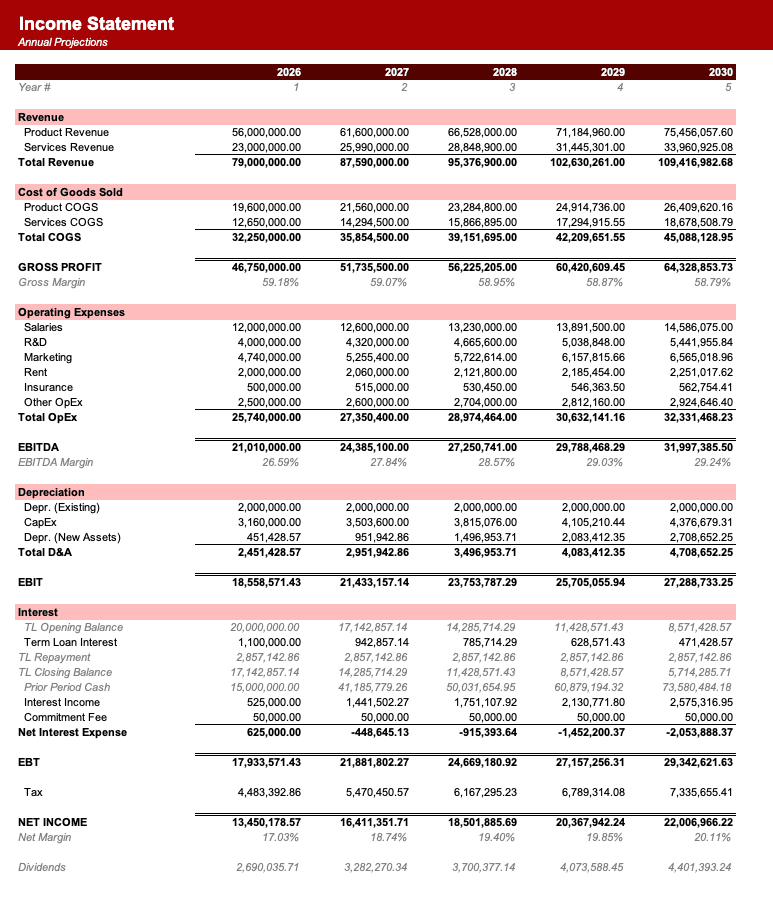
Formatted to IB standards
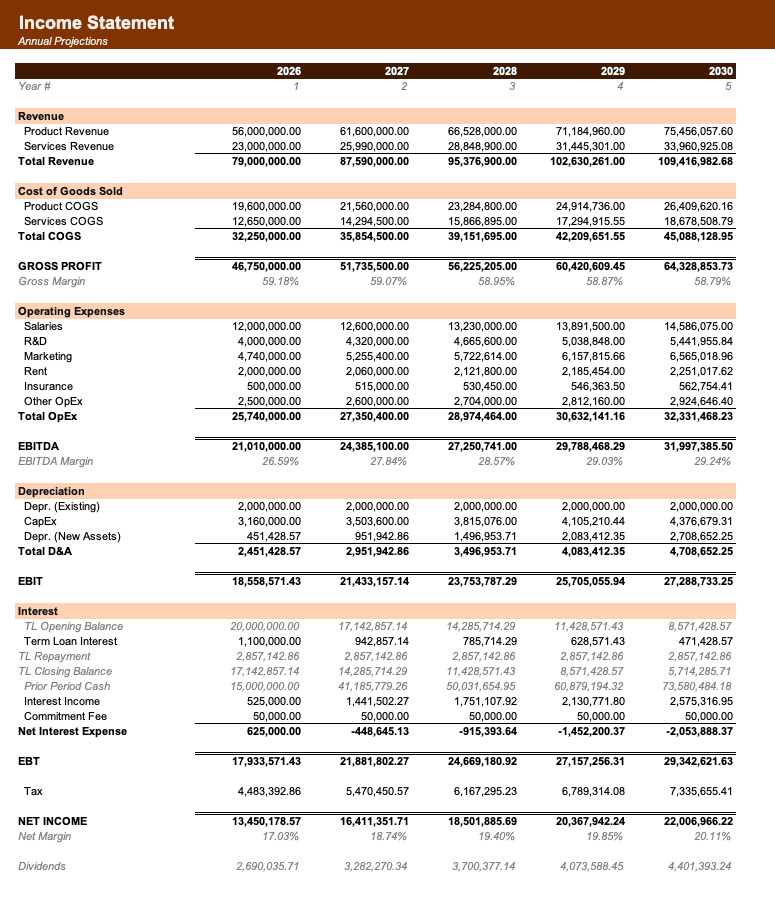
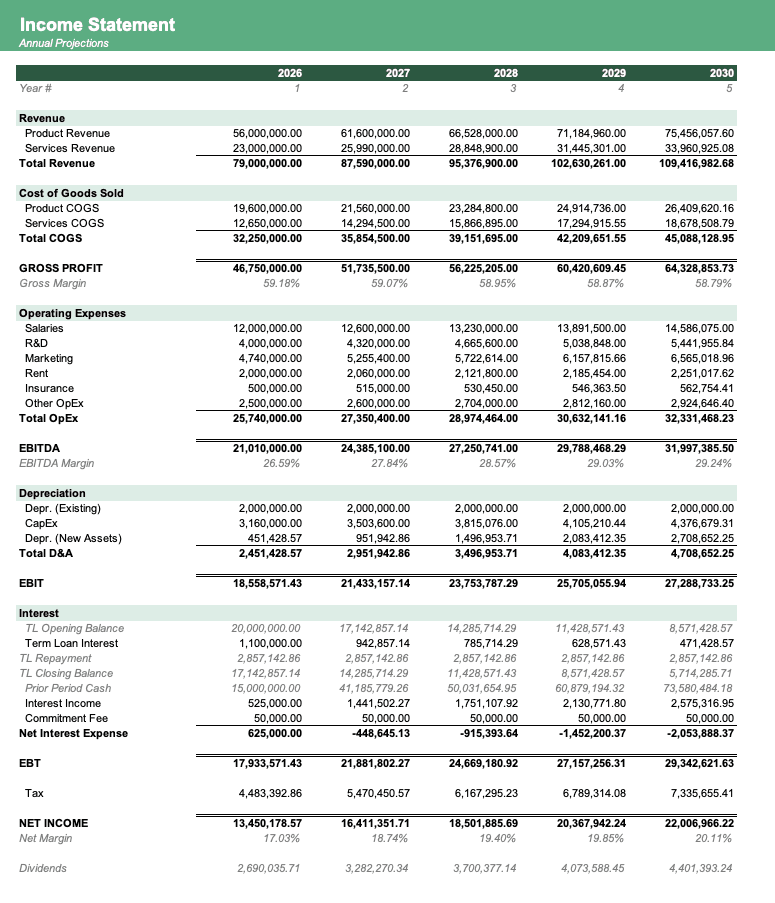
Named theme colors repaint the whole workbook in one click, on top of an investment-banking structure with clear input, output, and cross-sheet reference styling - brand-ready, institutional-grade, and fully auditable.

Created by ex-finance professionals
Hey, I’m Alex and I created Finamodel.
Over my years in the finance industry I kept building the same models over and over again. Same structure, same assumptions, different logo. So I started building frameworks to turn them into clean, reusable templates.
Every model here is one I’d actually use for a client, and I personally vet each one before it goes up.
I’m not an expert in every industry, but I’ve built enough models to know what belongs in one. And when something is completely foreign to me, I reach out to my network for experts to work on our models with us.
Having a template library on hand cuts a first build from hours to minutes.
Need help finding your model? You’ll find me in the Finamodel app!
Frequently asked
What is a hedge fund financial model?+
It is a model that forecasts AUM, fee income, fund expenses, and investor returns for an alternative investment fund structure.
Who uses hedge fund models?+
Emerging managers, GP/LP analysts, family office principals, and fund operations teams use them for launch planning and ongoing fund management.
What should a hedge fund model include?+
It should include AUM roll-forward, management and performance fee calculations, high-water mark logic, hurdle rates, and gross versus net return outputs.
How does the high-water mark work?+
The model maintains a running peak AUM per unit. Performance fees are only calculated on appreciation above this peak, adjusted for subsequent subscriptions and redemptions.
Can I model hard and soft hurdles?+
Yes. The model toggles between a hard hurdle where fees apply only on returns exceeding the hurdle, and a soft hurdle with GP catch-up once the hurdle is met.
Have more financial modelling questions? Contact us
Related templates
Fund of Funds Portfolio Model
Portfolio construction and performance tracking model for fund-of-funds vehicles investing across multiple manager-run funds.
Private Equity Fund Model
Fund-level cash flow, investment allocation, and LP returns including fees, distributions, and net IRR.
Venture Capital Fund Model
Model VC fund cash flows, distributed returns, and IRR by vintage year and exit scenario.
DCF Model
Discounted cash flow valuation model with explicit forecast, terminal value, and WACC.