Aquaculture Operations Model
Agriculture Financial Model (Free Excel Download)
Model stocking, survival, harvest cycles, feed costs, pricing, capacity, capex, and working capital to evaluate aquaculture operating economics.



professionals from Deloitte
Used by professionals from






About this model
An aquaculture financial model projects salmon farm profitability by tracking stocking density, feed conversion ratio (FCR), mortality, harvest cycles, and fish prices to determine revenue per kilogram, working capital requirements driven by the long grow-out cycle, and break-even price sensitivity. The model answers whether an Atlantic salmon farm can achieve efficient cost per kilogram (EBIT/kg target $1.00–$2.00) given biological constraints and commodity price volatility, and what borrowing capacity the farm can support against its biomass.
The production schedule tracks smolt intake (1M smolts, 150g average), growth to harvest weight (4.5kg), cumulative mortality (15%), and economic FCR (1.25), producing annual harvest volume in tonnes. Revenue is driven by harvest price (premium fish $7.50/kg, downgraded 40% discount), with 10% downgrade rate and annual price growth of 2%. Feed cost (the single largest input) is modelled as cost per kilogram consumed and escalates at 3% annually, reflecting inflation and potential supply tightness. Working capital is substantial: accounts receivable (20 DSO), accounts payable (45 DPO), and a biological asset inventory (standing biomass valued at cost of production) that ties to the maximum allowed biomass (MAB) license constraint.
Lenders, seafood processors, and strategic investors use aquaculture models to confirm that unit economics ($/kg and EBIT/kg) support debt service, verify that the farm stays within licensed biomass limits, and stress revenue around fish price (which trades like a commodity), feed cost inflation, and disease scenarios that impact mortality and FCR.
What every model includes
Live formulas, no hardcoded values
Outputs are driven by live formulas, so the workbook updates from its assumptions instead of relying on hardcoded results.
All assumptions in one tab
Inputs are clearly marked in the Assumptions tab and separated from calculations, making it clear what to change and what to leave intact.
Statements always balancing
For integrated-statement models, the balance sheet, cash flow, and supporting schedules tie through properly.
Distinct schedules for clarity
Debt, working capital, taxes, and cash flow can get messy quickly. We group calculations in clear schedules, not across disconnected tabs.
No hidden macros or external links
There are no unexplained external workbook links or macros to undermine auditability or portability.
Changes flow through the model
Update a key driver and see the impact carry through the forecast, financing, and return outputs. We never use hardcoded numbers in formulas.
What's inside the Aquaculture Operations Model
- Stocking density and biomass tracking by species and site
- Feed conversion ratio (FCR) and feed cost inflation by source
- Mortality assumptions and health management costs
- Harvest timing and yield per production cycle
- Revenue by species and channel (commodity, premium, processed)
- Labor, equipment maintenance, and regulatory compliance costs
Aquaculture Financial Model: How a Salmon Farming Template Projects Biology, Cash and Debt
This aquaculture financial model template sets out how an Atlantic salmon grow-out operation can be projected over five years in USD. It links smolt stocking, mortality and feed conversion to harvest volumes, revenue, operating costs, capital spending, working capital and debt, so a reader can see how biological assumptions translate into earnings and cash flow before forming a view on investment, lending or acquisition.
Biological and Operational Drivers
The template's starting point is a set of biological assumptions that govern what the farm can produce. Each year begins with a smolt stocking count, an intake weight and a target harvest weight.
- Cumulative mortality reduces the number that reach harvest, while the economic feed conversion ratio determines how much feed is needed for each kilogram of growth. A Maximum Allowed Biomass cap limits standing biomass, growing with cumulative growth capex, so expansion is constrained by licence rather than by space alone.
- A mortality stress switch allows one year to carry an elevated mortality rate, illustrating how a disease or algal event could disrupt the cycle. These drivers are the operating levers a user would change first when evaluating a production plan.
Calculation Flow from Stocking to Harvest
Harvest volume is calculated from smolts stocked, adjusted for mortality, multiplied by harvest weight. Net growth in tonnes takes account of harvest, mortality and the change in standing biomass, so feed consumption captures growth held in inventory rather than only fish removed.
- Feed consumed is then net growth multiplied by the economic feed conversion ratio. Revenue combines a premium price for the majority of fish with a discounted price for downgraded fish, and both prices grow annually.
- Feed, smolt, processing and related costs sit beneath revenue, with health and site overhead applied as percentages of direct cost and general and administrative expenses growing on their own base. The calculation flow therefore connects a biological plan directly to a profit-and-loss outcome.
Outputs and Financial Statements
The model produces a full set of primary statements. The income statement runs from revenue to net income and reports EBIT per kilogram, a useful measure of operating profitability per unit of production.
- Capital expenditure and depreciation feed into the income statement and balance sheet, while working capital covers receivables, payables and biological inventory valued at cost of production. Debt includes a term loan and a biomass-backed revolver, with interest and commitment fees calculated from opening balances.
- Cash flow is split into operating, investing and financing activities, and closes to the balance sheet, which has a validation check. Additional checks cover the biomass cap, feed conversion range, EBIT per kilogram, cash floor, borrowing base and debt service cover.
Practical Use and Scenario Testing
The template is annual and spans five years, making it a planning and scenario tool rather than a monthly cohort tracker. A user can adjust stocking numbers, mortality, feed conversion, prices and costs to see how harvest revenue, EBIT per kilogram and cash generation respond.
- The revolver is drawn only to bring closing cash up to a minimum buffer and is capped by the borrowing base advance rate against biomass value, which shows how working capital and biological assets interact with liquidity. A stress year can be set to model a one-off mortality event and observe the effect on margins, debt and cash.
- The model therefore supports a structured view of biological risk, funding needs and returns.
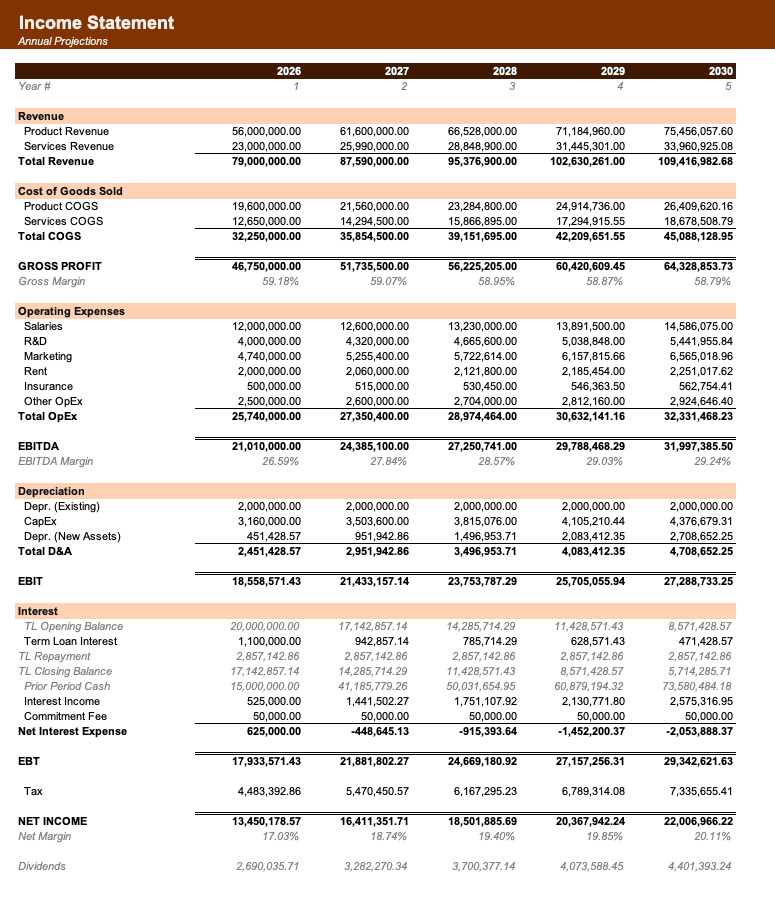
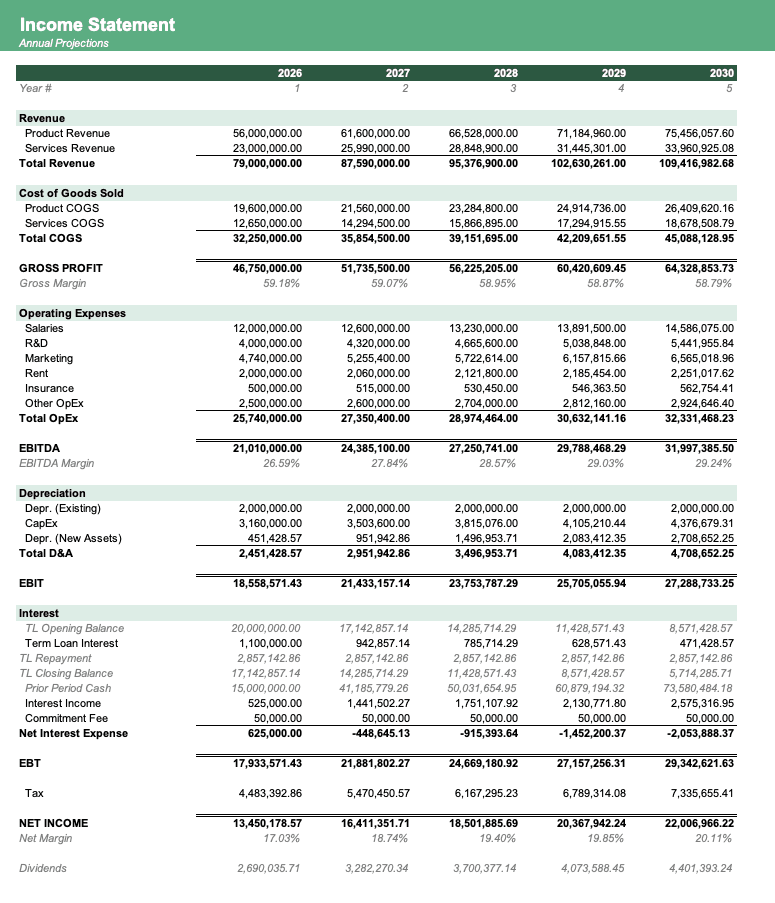
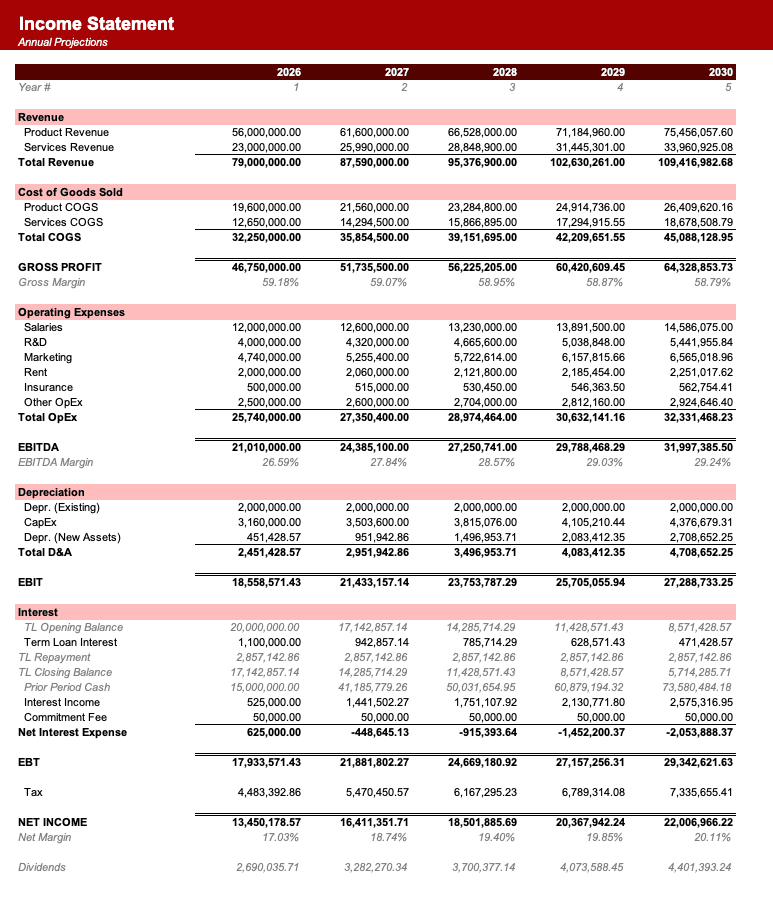
Formatted to IB standards
Named theme colors repaint the whole workbook in one click, on top of an investment-banking structure with clear input, output, and cross-sheet reference styling - brand-ready, institutional-grade, and fully auditable.

Created by ex-finance professionals
Hey, I’m Alex and I created Finamodel.
Over my years in the finance industry I kept building the same models over and over again. Same structure, same assumptions, different logo. So I started building frameworks to turn them into clean, reusable templates.
Every model here is one I’d actually use for a client, and I personally vet each one before it goes up.
I’m not an expert in every industry, but I’ve built enough models to know what belongs in one. And when something is completely foreign to me, I reach out to my network for experts to work on our models with us.
Having a template library on hand cuts a first build from hours to minutes.
Need help finding your model? You’ll find me in the Finamodel app!
Frequently asked
What is an aquaculture financial model?+
It is a model that projects fish farm profitability through stocking, feed, mortality, and harvest mechanics tied to species-specific biology.
What is feed conversion ratio (FCR)?+
FCR is the weight of feed required to produce one unit of fish; lower FCR means more efficient growth and better margins.
How long is a typical production cycle?+
Salmon and rainbow trout take 14–18 months, tilapia 6–9 months, and shrimp 4–6 months. The model is customisable by species.
Should I model disease and mortality risk?+
Yes. Mortality should reflect historical rates for the species and region, and include treatment and vaccination costs.
Does it handle the biomass licence constraint?+
Yes. Standing biomass is tracked against the maximum allowed biomass (MAB) licence so harvest timing reflects the regulatory ceiling.
Have more financial modelling questions? Contact us
Related templates
Farm Operations Model
Agricultural business model with crop yields, commodity pricing, operating costs, and profitability.
Livestock Operation Model
Financial model for animal agriculture operations including breeding cycles, feed costs, and commodity pricing.
Food Manufacturing Model
Operating model for food production and processing businesses with ingredient sourcing, production scheduling, and margin analysis.
Timber REIT Model
Value a timber portfolio with growth assumptions, harvest schedules, and stumpage price projections.


