Captive Insurance Company
Insurance Financial Model (Free Excel Download)
Model captive premiums, claims reserves, reinsurance, investment income, and capital to test risk-financing economics and the captive’s after-tax returns.



professionals from Deloitte
Used by professionals from






About this model
A captive insurance company model projects underwriting profit, investment income, claims reserves, and dividend capacity to show whether the parent company can save money by self-insuring its own risks through a captive subsidiary rather than buying commercial policies. The model answers how much capital is required at formation, how quickly the captive returns profit to the parent through dividends, and whether the target return on invested assets (float income) is achievable.
Premium revenue flows in from the parent, calculated using actuarial transfer pricing to reflect the true cost of the parent's insurable risks. Net earned premium equals gross written premium less the reinsurance cession to a fronting carrier. Incurred losses and loss adjustment expenses (LAE) are modelled using a vintage-based payout pattern: 50% in the year of loss, 30% in year +1, 20% in year +2 (tail). Investment income is earned on the float (the lag between premium collection and claims payment), scaled by a bond portfolio yield (4.5% typical on short-duration investment-grade bonds). Operating expenses include captive management fees (10% of GWP), actuarial and audit (2.5% combined), legal and regulatory compliance, directors' fees, and Vermont insurance premium tax (0.214%). Dividend capacity is calculated from prior-year surplus and is constrained by Vermont's ordinary dividend rule (maximum 10% of surplus or prior-year net income, whichever is less).
Parent companies, risk managers, and insurance brokers use captive models to quantify premium savings vs. commercial insurance, stress-test the captive under catastrophe scenarios (spike in incurred losses, extended reserves), and project the cumulative dividend stream back to the parent over a 10-year time horizon.
What every model includes
Live formulas, no hardcoded values
Outputs are driven by live formulas, so the workbook updates from its assumptions instead of relying on hardcoded results.
All assumptions in one tab
Inputs are clearly marked in the Assumptions tab and separated from calculations, making it clear what to change and what to leave intact.
Statements always balancing
For integrated-statement models, the balance sheet, cash flow, and supporting schedules tie through properly.
Distinct schedules for clarity
Debt, working capital, taxes, and cash flow can get messy quickly. We group calculations in clear schedules, not across disconnected tabs.
No hidden macros or external links
There are no unexplained external workbook links or macros to undermine auditability or portability.
Changes flow through the model
Update a key driver and see the impact carry through the forecast, financing, and return outputs. We never use hardcoded numbers in formulas.
What's inside the Captive Insurance Company
- Premium income by insurance line: property, casualty, workers compensation
- Claims frequency and severity assumptions with loss triangle development
- Combined ratio tracking: loss, LAE, and underwriting expense versus premium
- Reinsurance program with retention limits, excess layer costs, and aggregate limits
- Capital adequacy and loss reserve calculations
- Underwriting profit and investment income
Captive Insurance Model: How the Financial Template Works
This captive insurance model projects whether forming a single-parent Vermont captive makes financial sense. It captures premium flows, multi-year claims runoff, investment float, regulatory capital tests, and dividend capacity.
The template is aimed at CFOs, captive managers, and advisors evaluating capital adequacy, parent cash extraction, and return on equity over a six-year horizon. Rates and financial results described here reflect illustrative model settings, not industry benchmarks.
Operating Drivers Behind the Captive
The model focuses on a pure single-parent captive that underwrites the parent's own property and casualty risks. Gross written premium is set by actuarial pricing of those insurable risks and grows 5% annually, reflecting parent exposure and pricing adjustments.
- A fronting carrier writes the business for regulatory compliance; the captive then assumes 100% of the risk through a quota-share reinsurance arrangement. Because the parent retains underwriting profit instead of paying a commercial carrier, the template evaluates premium savings, investment income on float, and risk-adjusted return on capital.
- All operating costs are expressed as percentages of gross written premium, so expenses scale with premium volume, while loss costs are tied to net earned premium.
Calculation Flow From Premium to Net Income
Premiums cascade from gross written to net earned: gross written premium minus ceded premium gives net written premium, which is further reduced by the change in unearned premium reserve to arrive at net earned premium. Incurred losses equal net earned premium times an assumed loss ratio, with loss adjustment expenses shown separately.
- Each accident year's incurred losses then pay out over a three-year pattern, with 50% in the year of incurrence, 30% in the following year, and 20% in the third year. A vintage triangle tracks paid and unpaid balances by accident year, so total paid claims in any calendar year sum across all open vintages.
- Revenue includes net earned premium, investment income on the float, and ceding commission income; after operating expenses and tax, the result is net income.
Outputs and Regulatory Metrics
The income statement reports revenue, costs, and net income, with separate lines for incurred losses and loss adjustment expenses, plus distinct loss and combined ratios. The balance sheet shows investments as the core asset, loss reserves, unearned premium reserve, and equity comprising initial capital plus retained earnings.
- A cash flow statement reconciles operating, investing, and financing activities, treating portfolio growth as a use of cash and dividends as a financing outflow. Key metrics include premium-to-surplus ratio, checked against a regulatory limit; return on equity; payback period based on cumulative net income versus initial capital; and cumulative dividends returned to the parent.
- Dividend capacity is computed from prior-period equity to avoid circularity and to reflect the regulatory test using prior year-end surplus.
Practical Use in Evaluating a Captive
This template is built for decision-makers weighing whether to form a captive, how much capital to inject, and how much cash can be extracted over time. It lets users adjust assumptions such as gross written premium, cession rate, loss ratio, payout pattern, portfolio yield, and dividend payout to see effects on capital adequacy and payback.
- The dividend policy models ordinary dividends limited by prior-period surplus and net income, reflecting the Vermont regulatory framework. The model includes validation checks for balance sheet integrity, premium leverage, non-negative reserves, and payout pattern sums.
- Practical use is to compare base and stress scenarios, assess capital buffers, and understand the timing of returns to the parent. It supports a first-pass feasibility analysis, not detailed actuarial pricing.
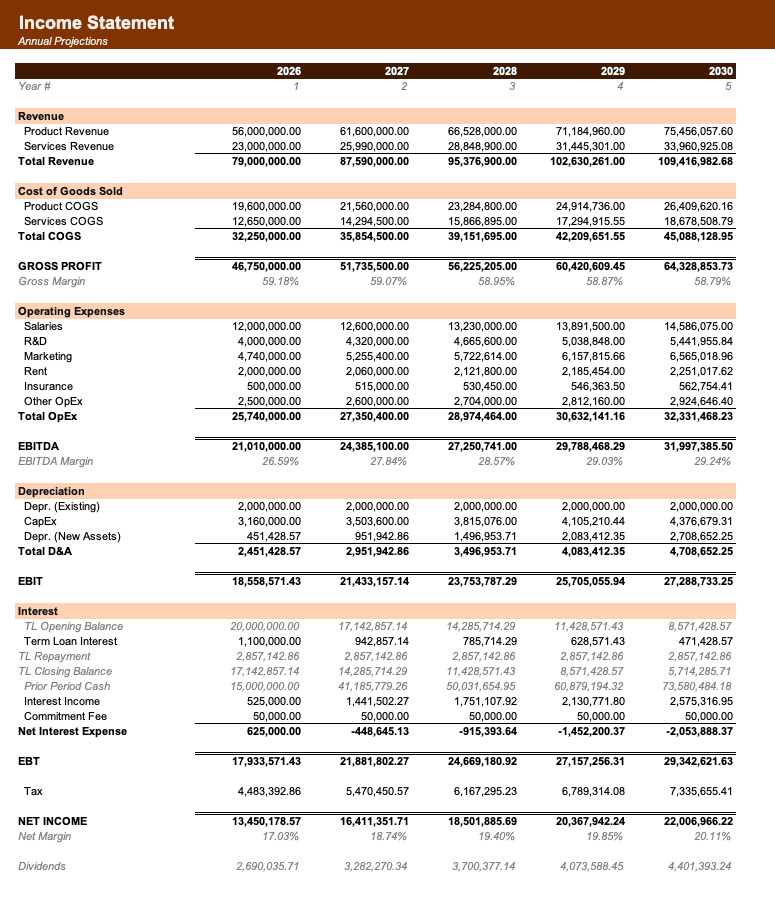
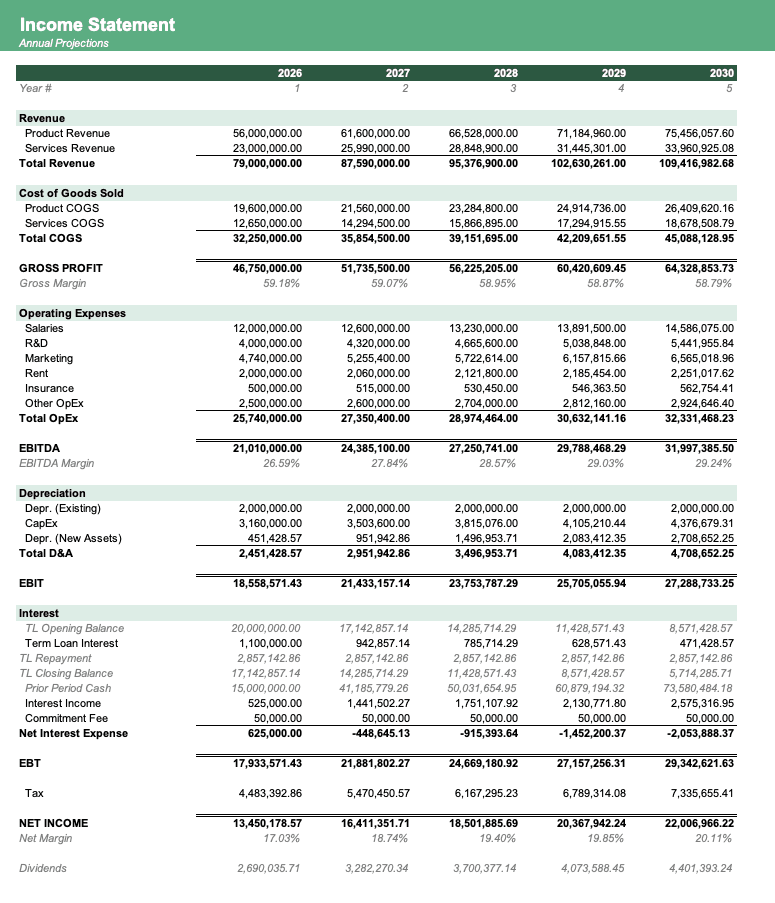
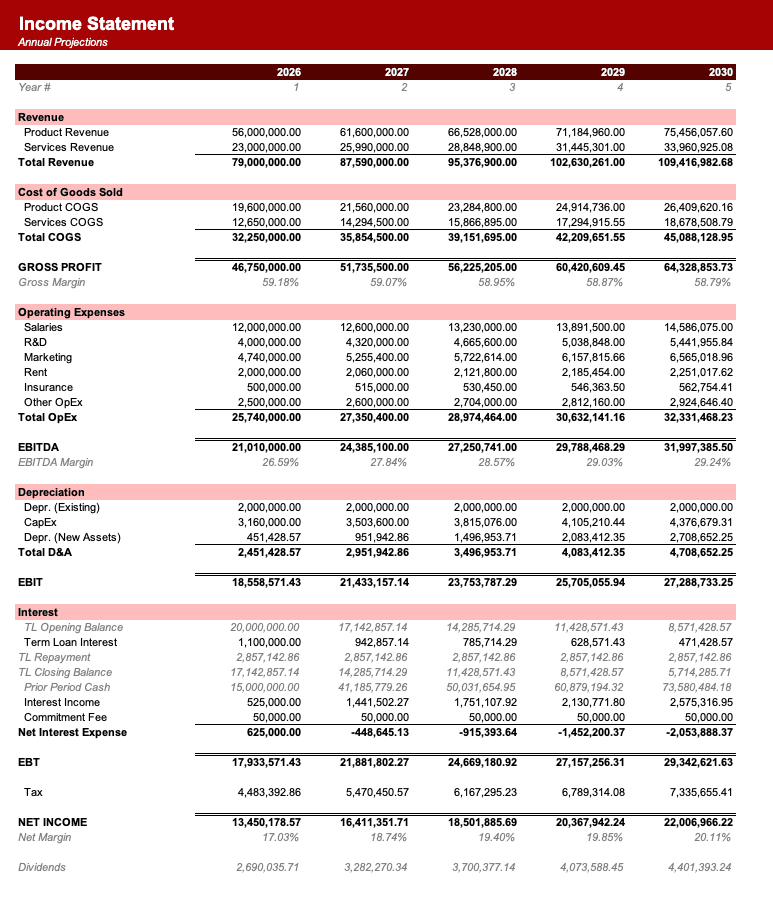
Formatted to IB standards
Named theme colors repaint the whole workbook in one click, on top of an investment-banking structure with clear input, output, and cross-sheet reference styling - brand-ready, institutional-grade, and fully auditable.

Created by ex-finance professionals
Hey, I’m Alex and I created Finamodel.
Over my years in the finance industry I kept building the same models over and over again. Same structure, same assumptions, different logo. So I started building frameworks to turn them into clean, reusable templates.
Every model here is one I’d actually use for a client, and I personally vet each one before it goes up.
I’m not an expert in every industry, but I’ve built enough models to know what belongs in one. And when something is completely foreign to me, I reach out to my network for experts to work on our models with us.
Having a template library on hand cuts a first build from hours to minutes.
Need help finding your model? You’ll find me in the Finamodel app!
Frequently asked
What is a captive insurance company?+
A captive is an insurance entity formed by a parent company to underwrite its own risks, capturing underwriting profit and improving risk management control.
What is combined ratio and what is profitable?+
Combined ratio equals losses plus loss adjustment expense plus underwriting expense, divided by premium. A ratio below 100% means underwriting profit; above 100% means a loss.
How do I estimate loss frequency and severity?+
Use historical actuals from the parent company where available. Otherwise apply industry benchmarks; severity often follows a lognormal distribution.
What is a reasonable retention limit?+
Retentions typically range from 10 to 50 percent of expected losses, depending on parent company risk tolerance and capital position.
Who uses captive insurance models?+
Risk managers, captive managers, insurance investors, and CFOs use them for captive establishment business plans, annual actuarial reviews, and reinsurance procurement decisions.
Have more financial modelling questions? Contact us
Related templates
Insurance Portfolio Risk and Return Model
Portfolio model for insurance investment holdings including asset allocation, duration matching, credit risk, and spread analysis.
Life Insurance Valuation Model
Valuation model for life insurance products and in-force book value using mortality assumptions and surrender rates.
Reinsurance Company Underwriting Model
Reinsurance premium income, claims reserves, underwriting margin, and ROE for reinsurance portfolios.
InsurTech Operating and Valuation Model
Operating model for insurance tech platforms including underwriting volumes, loss ratios, expense ratios, and insurance-linked returns.