InsurTech Operating and Valuation Model
Insurance Financial Model (Free Excel Download)
Forecast policy acquisition, retention, claims, underwriting margin, and technology costs to test the growth path and economics of a digital insurance platform.



professionals from Deloitte
Used by professionals from






About this model
This operating model forecasts InsurTech profitability by projecting premium volume growth across distribution channels, calculating underwriting and administrative expense ratios, forecasting loss ratios and loss adjustment expenses, and computing investment income from premium float. Answer: can the platform sustain combined ratios <100% and generate positive underwriting profit while scaling customer acquisition?
The workbook builds premium revenue from multiple lines of business (auto, home, specialty) and channels (direct digital, partner distribution, B2B). Customer acquisition cost (CAC) targets: Year 1–2 £100–200 per customer for digital, declining with scale. Loss ratio (incurred losses / premiums) by line: auto 65–75%, home 60–70%, specialty 55–75%. LAE (loss adjustment expense) 8–12% of premium. Commissions and admin expenses 20–25% of premium. Investment income on premium float (float earning yield on treasury + credit investments). Combined ratio (losses+LAE+expenses / premium) must stay <95–100% for sustainability. Breakeven premium scale: typically £50M–100M annual premium depending on loss experience and expense run-rate.
Used by InsurTech founders raising Series A/B funding, PE sponsors acquiring digital insurance platforms, and traditional carriers evaluating digital strategies. The model reveals the capital intensity of customer acquisition (CAC payback 2–4 years depending on retention) and sensitivity to loss ratio assumptions (1% change in loss ratio impacts combined ratio by 1pp, often wiping out profitability). Premium float investment income is material (2–3% annually), but growth phase companies often spend float on marketing rather than retaining for investment. Benchmarks: Lemonade (underwriting loss offset by investment income), Root, Oscar - all targeting sub-100% combined ratios at scale.
What every model includes
Live formulas, no hardcoded values
Outputs are driven by live formulas, so the workbook updates from its assumptions instead of relying on hardcoded results.
All assumptions in one tab
Inputs are clearly marked in the Assumptions tab and separated from calculations, making it clear what to change and what to leave intact.
Statements always balancing
For integrated-statement models, the balance sheet, cash flow, and supporting schedules tie through properly.
Distinct schedules for clarity
Debt, working capital, taxes, and cash flow can get messy quickly. We group calculations in clear schedules, not across disconnected tabs.
No hidden macros or external links
There are no unexplained external workbook links or macros to undermine auditability or portability.
Changes flow through the model
Update a key driver and see the impact carry through the forecast, financing, and return outputs. We never use hardcoded numbers in formulas.
What's inside the InsurTech Operating and Valuation Model
- Premium volume growth by line of business and distribution channel
- Loss ratio and loss adjustment expense as a percentage of premium
- Commissions and administrative expenses
- Customer acquisition cost and lifetime value by channel
- Investment income from premium float and combined ratio analysis
- Combined ratio and underwriting profitability
Inside the InsurTech Operating and Valuation Model
This insurtech model template helps you evaluate a full-stack digital P&C carrier's path to profitability. It connects premium growth, loss and expense ratios, and float income to show how scale and underwriting discipline drive combined ratio improvement.
The design assumes a carrier with $50M–$500M in gross written premium, not an MGA or brokerage.
What Drives Premium and Float
The model builds revenue from policies in force and average premium per policy to get gross written premium (GWP). Ceded reinsurance premium is then subtracted to produce net written premium (NWP), and the change in unearned premium reserve (UPR) converts that into net earned premium (NEP).
- This distinction matters: GWP is not P&L revenue because premiums are earned over the policy term, typically six or twelve months. Growth assumptions range from 20%–60% for early-stage carriers, decelerating to 10%–20% at scale.
- Embedded API distribution, cross-sell, and rate adequacy are the primary growth levers, while digital customer acquisition cost inflation and reinsurance capacity constraints act as headwinds. Investment income adds a second revenue stream: average invested assets, or float, multiplied by portfolio yield.
Float grows as premiums are collected upfront and claims are paid later, so a growing book generates cash even when underwriting is unprofitable.
How Claims and Operating Costs Flow into Margins
Incurred losses are calculated as NEP multiplied by the loss ratio, while paid claims follow a development pattern (for example, 40% in year one, 30% in year two, and 30% thereafter). The difference between cumulative incurred and cumulative paid forms loss reserves, split between case reserves and IBNR.
- Loss adjustment expenses cover claims staff, legal costs, and AI-driven processing. Operating expenses are tracked by category: sales and marketing at 15%–25% of GWP for growth-stage carriers, technology and engineering at 8%–15% of NEP, plus G&A, policy administration, compliance, and reinsurance brokerage.
- These costs feed into the loss ratio, expense ratio, and combined ratio. The design assumes early-stage combined ratios of 95%–130% improving to 85%–95% at maturity, reflecting the operating leverage that comes with scale and better risk selection.
The model captures this improvement trajectory rather than holding a flat loss ratio.
Outputs and the Balance Sheet
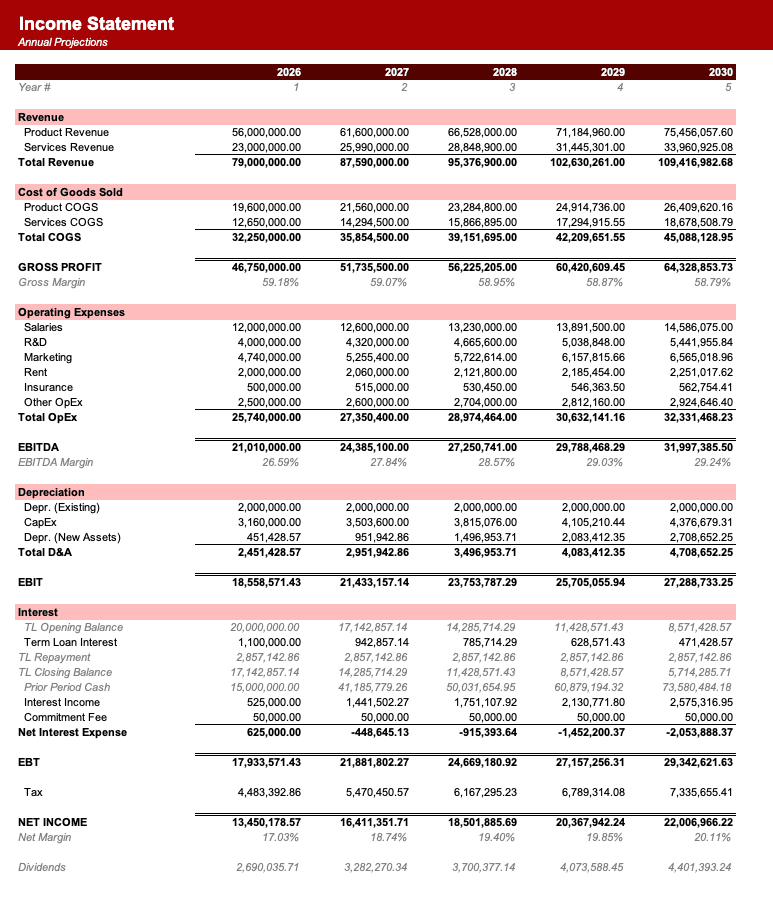
The model produces an income statement, balance sheet, cash flow statement, capital adequacy schedule, and KPI dashboard. The income statement shows NEP, fee income, and investment income, then subtracts incurred losses, LAE, and operating expenses to arrive at underwriting profit, EBITDA, net income, and key ratios.
- The balance sheet captures investments (float), premium receivables, reinsurance recoverables, deferred acquisition costs, loss reserves, UPR, and equity, with a balance check. The cash flow statement uses the indirect method, adjusting net income for non-cash items such as changes in loss reserves and UPR.
- Capital adequacy calculates required risk-based capital and premium-to-surplus ratio, which must stay below 3.0x. The KPI sheet tracks loss ratio, expense ratio, combined ratio, ROE, customer acquisition cost, retention, and investment yield.
Cross-sheet dependencies flow from premium build and claims reserves into the statements, with a deliberate one-period lag to avoid circularity between investment income and cash flow.
Practical Use and Validation
This template is designed for evaluating investment, acquisition, or growth capital decisions for a full-stack digital P&C carrier. It helps you test how changes in premium growth, loss ratio improvement, and expense discipline interact to produce a path to profitability.
- The validation checks highlight common modeling mistakes: confusing GWP with earned revenue, skipping the UPR roll-forward, treating paid claims as incurred losses, or modeling positive working capital in a business that collects premiums upfront. It also enforces that cash never turns negative without a facility, that loss reserves cover IBNR, and that the balance sheet balances every period.
- The public download is a values-only preview, so you can review the structure and logic, but live formulas and automatic recalculation are not included. The design assumes a full-stack carrier and does not cover MGA or brokerage structures.
Formatted to IB standards
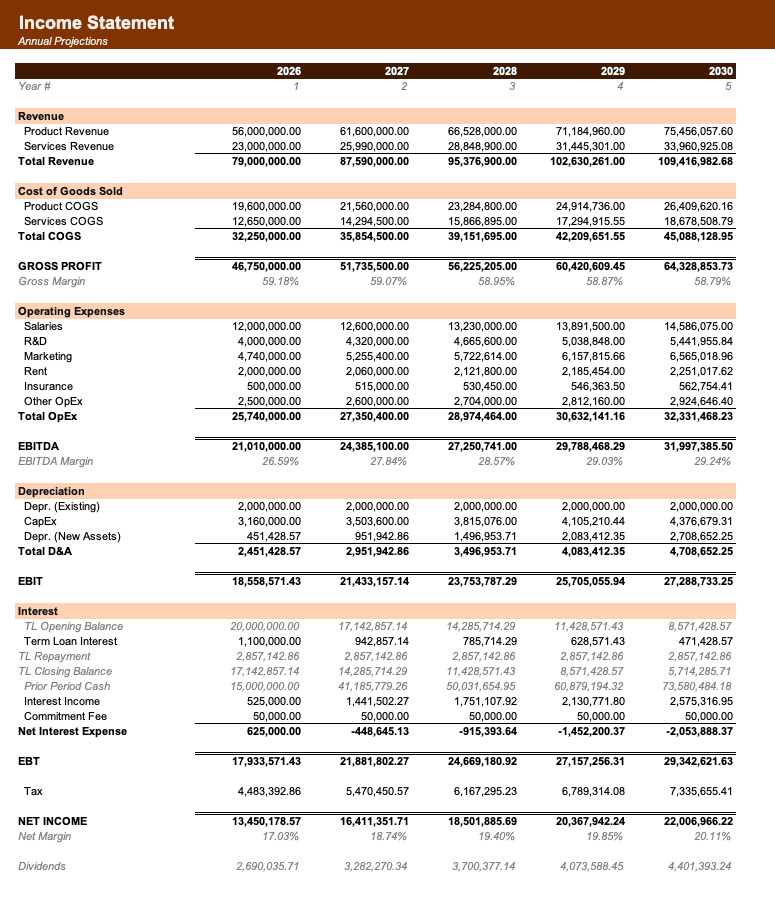
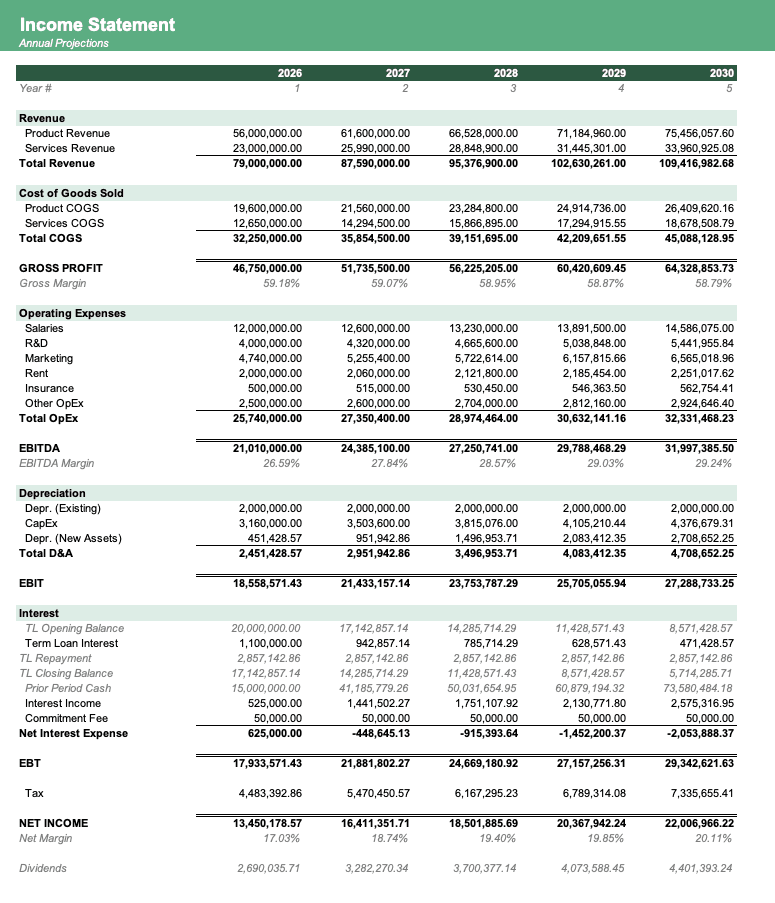
Named theme colors repaint the whole workbook in one click, on top of an investment-banking structure with clear input, output, and cross-sheet reference styling - brand-ready, institutional-grade, and fully auditable.

Created by ex-finance professionals
Hey, I’m Alex and I created Finamodel.
Over my years in the finance industry I kept building the same models over and over again. Same structure, same assumptions, different logo. So I started building frameworks to turn them into clean, reusable templates.
Every model here is one I’d actually use for a client, and I personally vet each one before it goes up.
I’m not an expert in every industry, but I’ve built enough models to know what belongs in one. And when something is completely foreign to me, I reach out to my network for experts to work on our models with us.
Having a template library on hand cuts a first build from hours to minutes.
Need help finding your model? You’ll find me in the Finamodel app!
Frequently asked
What is the combined ratio and how does it relate to profitability?+
Combined ratio equals losses plus LAE plus commissions plus expenses, divided by premiums. Below 100% means underwriting profit. Above 100% means underwriting loss, though investment income from float can offset that loss.
What loss ratio should I assume for a new insurtech line?+
Start conservative at 60-70% for auto or homeowners lines and 50-60% for higher-margin specialty lines. Refine using historical data or peer benchmarks, and model loss ratio inflation at 3-5% annually.
How do I calculate CAC payback?+
CAC payback equals customer acquisition cost divided by annual underwriting profit per customer. A payback period of 2-3 years or less is generally healthy for profitable insurance businesses.
Who uses insurtech financial models?+
InsurTech founders, insurance investors, P&C underwriters, and insurance VCs use these models for underwriting profitability analysis, customer acquisition strategy, and company valuation.
What is premium float and why does it matter?+
Float is the pool of premiums collected but not yet paid out as claims. Insurers invest this float, generating income that can subsidize underwriting losses. Larger float and higher investment yields improve overall profitability.
Have more financial modelling questions? Contact us
Related templates
Insurance Portfolio Risk and Return Model
Portfolio model for insurance investment holdings including asset allocation, duration matching, credit risk, and spread analysis.
Captive Insurance Company Model
Captive insurer financial projections and reinsurance analysis.
Reinsurance Company Underwriting Model
Reinsurance premium income, claims reserves, underwriting margin, and ROE for reinsurance portfolios.
Life Insurance Valuation Model
Valuation model for life insurance products and in-force book value using mortality assumptions and surrender rates.