Construction Draw Schedule
Real Estate Financial Model (Free Excel Download)
Control construction funding with a monthly draw schedule tracking hard costs, soft costs, contingencies, retainage, lender advances, interest carry, and remaining budget.



professionals from Deloitte
Used by professionals from






About this model
This construction draw model forecasts a multi-family residential development from groundbreaking to stabilised operations, projecting monthly construction draws, lease-up absorption, permanent debt financing, and levered returns. It models a 200-unit apartment project with $48–50M total development cost (land, hard costs, soft costs, contingency, developer fee, capitalised interest, and operating deficit reserve). Construction is funded through equity-first mechanics (equity exhausted before construction debt draws) with interest-during-construction capitalised onto the loan balance. The permanent loan converts at stabilisation (typically Month 27) and amortises on a 30-year schedule with a 5-year balloon.
The model includes nine supporting schedules: a development budget sources-and-uses statement; a monthly construction draw showing hard costs on an S-curve, soft costs pro-rata, and opening/closing loan balances; a monthly lease-up sheet tracking unit deliveries, absorption, occupancy %, delinquencies, and cumulative operating deficit. Three annual operating sheets project rent (base, vacancy, bad debt, ancillary); operating expenses (property management, payroll, repairs, turnover, utilities, taxes, insurance, reserves - all independently driven); and NOI. Returns sheets calculate levered IRR, equity multiple, yield on cost, and development spread; a waterfall distributes annual cash flow and exit proceeds through LP preferred return, GP catch-up, and pro-rata tiers.
This model is used by developers, sponsors, and institutional investors underwriting multifamily acquisition, repositioning, and development opportunities. It addresses the unique challenges of construction phase negative cash flow, lease-up operating deficits, and interest capitalisation, making it essential for project finance lenders and equity sponsors sizing capital requirements and stress-testing downside scenarios.
What every model includes
Live formulas, no hardcoded values
Outputs are driven by live formulas, so the workbook updates from its assumptions instead of relying on hardcoded results.
All assumptions in one tab
Inputs are clearly marked in the Assumptions tab and separated from calculations, making it clear what to change and what to leave intact.
Statements always balancing
For integrated-statement models, the balance sheet, cash flow, and supporting schedules tie through properly.
Distinct schedules for clarity
Debt, working capital, taxes, and cash flow can get messy quickly. We group calculations in clear schedules, not across disconnected tabs.
No hidden macros or external links
There are no unexplained external workbook links or macros to undermine auditability or portability.
Changes flow through the model
Update a key driver and see the impact carry through the forecast, financing, and return outputs. We never use hardcoded numbers in formulas.
What's inside the Construction Draw Schedule
- Construction budget by trade and cost category
- Progress schedule with completion percentage by phase
- Lender draw limits and retainage percentages
- Draw request submissions and reconciliation process
- Budget variance and cost overrun tracking
- Customisable assumptions for your own case
Construction Draw Model: How the Schedule Drives the Budget and Returns
A construction draw model links monthly spending to loan draws, capitalised interest and lease-up funding. This template’s monthly construction draw schedule traces hard and soft costs, equity-first funding, pay-in-kind interest and operating deficits into the development budget, then carries the results through permanent debt, levered cash flow and a joint-venture waterfall.
The public download is a values-only preview. Rates and financial results described here reflect illustrative model settings, not industry benchmarks.
Monthly Draw Schedule and Funding Sources
The Construction_Draw sheet is the engine of the template. It runs monthly across thirty columns, covering a twenty-four month build plus a six month buffer.
- Hard costs follow a manual S-curve profile: roughly 10% in months 1–6, 60% in months 7–18 and 30% in months 19–24, with soft costs spread pro-rata. Each period’s total uses are funded first from equity until the commitment is exhausted, then from the construction loan, matching the industry-standard equity-first sequence.
- Loan draws equal period costs less any remaining equity.
- Opening and closing loan balances are tracked monthly. Pay-in-kind interest is charged on the opening balance, so it compounds into the loan without creating a same-period circular reference.
The cumulative PIK total is summed separately and passed to the development budget as the financing cost line, keeping capitalised interest in exactly one place.
Development Budget and Lease-Up Reserve
The Dev_Budget sheet presents a single-period sources and uses statement. Uses include land, hard costs, soft costs at 18% of hard, contingency at 5% of hard plus soft, a 4% developer fee, capitalised interest read from Construction_Draw and an operating deficit reserve read from Lease_Up.
- Sources are equity and the construction loan. A check confirms sources equal uses.
- The Lease_Up sheet runs monthly and tracks phased deliveries, cumulative units available and leased, physical and economic occupancy. Absorption is capped at the lesser of the monthly absorption rate and available unleased units.
Monthly revenue uses leased units times average rent less concessions, while monthly operating expenses include partial-year costs and a property tax step-up at Month 25. Negative NOI months accumulate into the operating deficit reserve, so the budget responds to rent or absorption changes rather than relying on a hardcoded figure.
Permanent Debt and Operating Cash Flow
The Debt_Schedule sheet closes the construction loan at permanent loan payoff, then amortises the take-out loan. Permanent loan sizing is the minimum of three constraints: 65% loan-to-value against exit value, the amount supported by a 1.25x DSCR, and the amount supported by a 7.5% debt yield.
- The annual payment is calculated on a 30-year amortisation schedule with a 5-year term, leaving a balloon at exit. DSCR and debt yield are reported each hold year.
- The Operating_PL sheet computes EGI from gross potential rent less vacancy and bad debt plus ancillary income. Every operating expense line is independently driven; the OpEx percentage row is informational only and never acts as a plug.
- NOI after reserves feeds the Cash_Flow sheet, which shows Year 0 as the equity contribution only. Construction loan draws are not a separate cash flow line because they are already embedded in the development budget.
Operating years subtract permanent interest, principal and capital reserves, and the exit year adds gross sale proceeds less cost of sale and debt payoff.
Partnership Waterfall and Return Metrics
The Waterfall sheet uses an American-style structure, distributing each period through the full waterfall rather than deferring to exit. LP and GP contributions are recorded first.
- The 8% LP preferred return accrues on unreturned LP capital, so the base shrinks as capital is returned, and is distributable each period from available levered cash flow. Remaining cash then splits 80/20 LP/GP until the LP reaches a 1.5x equity multiple, 65/35 to 2.0x, and 50/50 above that as GP carried interest.
- The Returns sheet aggregates levered project IRR, equity multiple, cash-on-cash, yield on cost and development spread, alongside separate LP and GP IRRs and multiples, peak equity, stabilised DSCR and debt yield.
A Checks sheet applies ten quantitative validations, including sources equalling uses, maximum loan within LTC, waterfall distributions equalling levered free cash flow, and confirmation that capitalised interest is not double-counted between the budget and draw schedule.
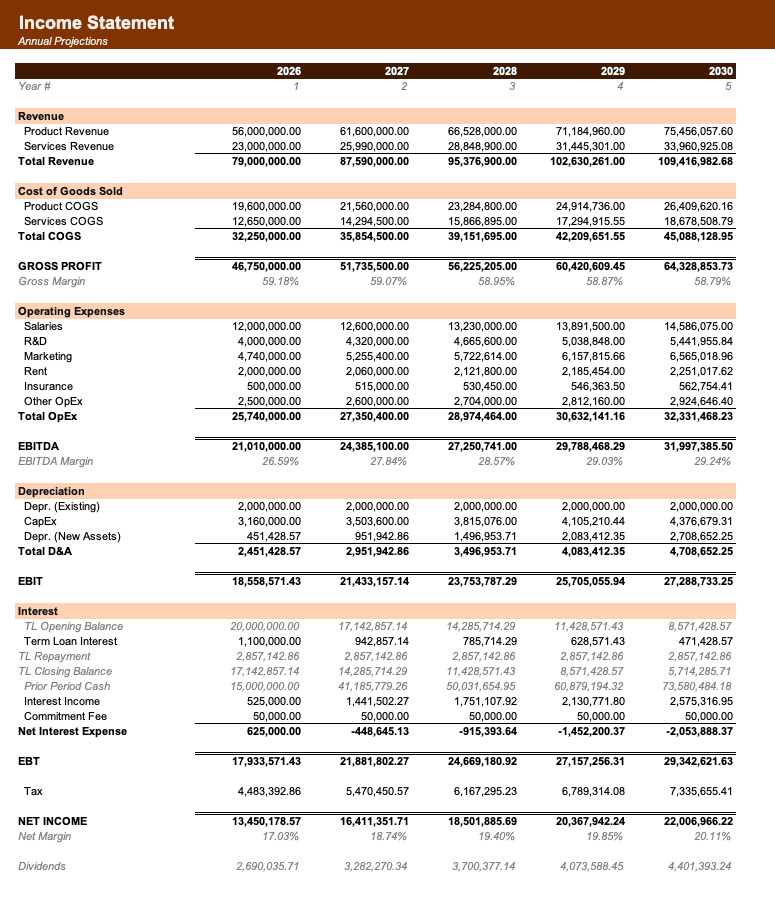
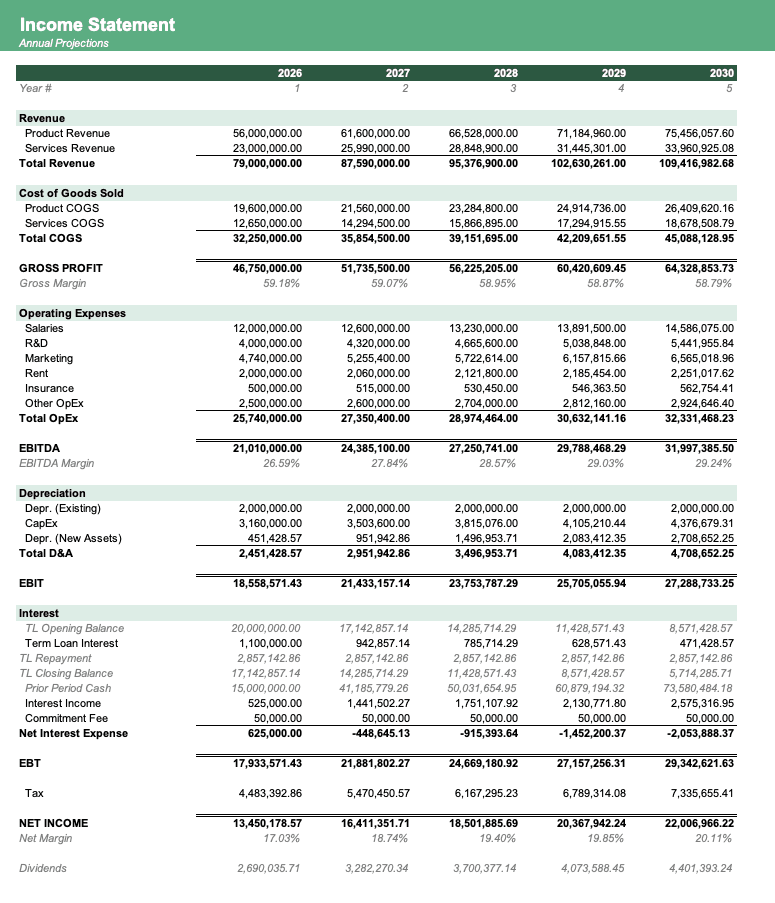
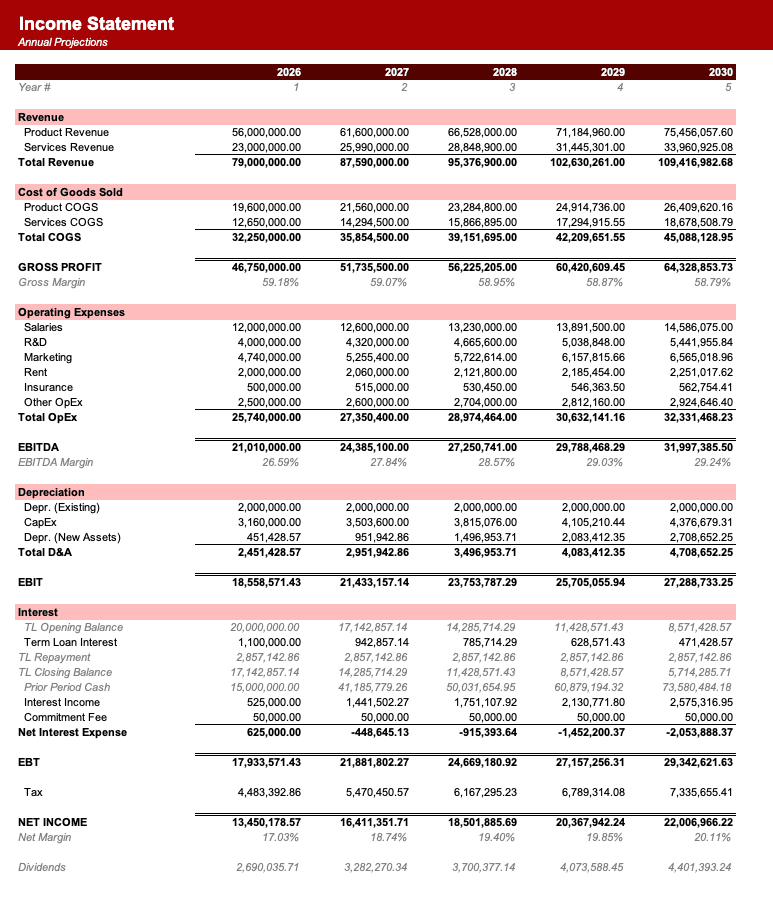
Formatted to IB standards
Named theme colors repaint the whole workbook in one click, on top of an investment-banking structure with clear input, output, and cross-sheet reference styling - brand-ready, institutional-grade, and fully auditable.

Created by ex-finance professionals
Hey, I’m Alex and I created Finamodel.
Over my years in the finance industry I kept building the same models over and over again. Same structure, same assumptions, different logo. So I started building frameworks to turn them into clean, reusable templates.
Every model here is one I’d actually use for a client, and I personally vet each one before it goes up.
I’m not an expert in every industry, but I’ve built enough models to know what belongs in one. And when something is completely foreign to me, I reach out to my network for experts to work on our models with us.
Having a template library on hand cuts a first build from hours to minutes.
Need help finding your model? You’ll find me in the Finamodel app!
Frequently asked
What is a construction draw schedule?+
It is a model that ties lender loan disbursements to verified construction progress, ensuring draws are released only when milestones are certified complete.
How does retainage work?+
Lenders typically hold back 5 to 10 percent of each draw and release it when construction is certified complete. The model tracks this as a waterfall.
What happens with change orders?+
Approved change orders are added to the budget, pending approvals are flagged separately, and total project cost updates in real time.
Can I track interest during construction?+
Yes. The model applies interest accrual to the outstanding loan balance each month so total project cost includes interest during construction.
Who uses construction draw schedules?+
Real estate developers, project managers, construction lenders, and construction finance teams use them for loan administration, draw requests, and project feasibility modeling.
Have more financial modelling questions? Contact us
Related templates
Real Estate Development Pro Forma Model
Land cost, construction budget, lease assumptions, and project IRR for commercial and residential development.
Mixed-Use Real Estate Development
Financial model for mixed-use projects combining residential, commercial, and retail with phased development.
Development Pro Forma
Real estate development underwriting model with lot acquisition, construction, presales, and cash flow timing.
Hotel Operating Model
Operating model for hotel properties including occupancy rates, average daily rate (ADR), RevPAR optimization, and facility-level profitability.


