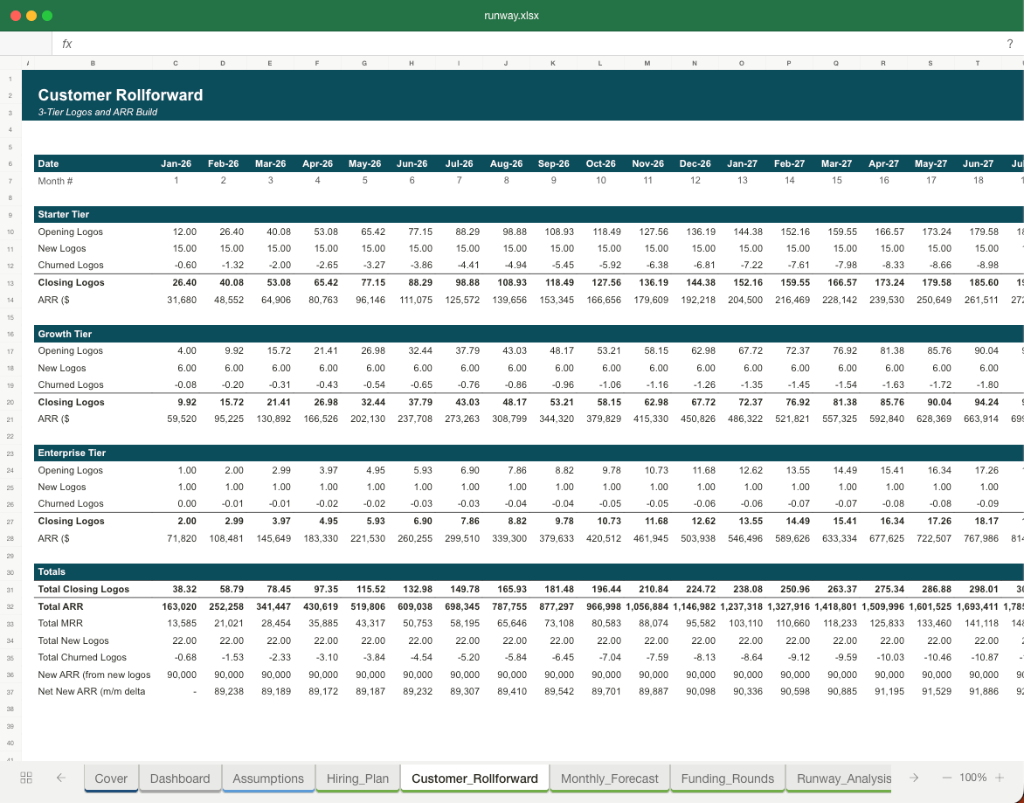
Mixed-Use Real Estate Development Model
Real Estate Financial Model (Free Excel Download)
Evaluate mixed-use developments through residential and commercial occupancy, rent, tenant mix, construction costs, financing, operating income, and exit returns.



professionals from Deloitte
Used by professionals from






About this model
A Mixed-Use Real Estate Development Model evaluates a ground-up development combining residential (200 units, $1,200-2,400/month rents), ground-floor commercial NNN retail (15,000 sq ft at $40/sq ft/year), and amenity space. The project cycles through construction (Years -1 to 0), residential lease-up (Year 1 at 15 units/month absorption, averaging 50% occupancy that year), and stabilization (Years 2-5 at 95% occupancy, 5% structural vacancy, and full commercial occupancy with tenant TI/LC costs). Total development cost (TDC) of ~$70M (land $10M, hard costs $68.75M, soft costs $13.75M, developer fee $3.3M, cap interest $2-3M) is financed 65% construction debt ($45M at 8.0%) and 35% equity ($25M sponsor + LP equity).
The Resi_Revenue sheet calculates Year 1 gross potential rent using an average-occupancy ramp (not phantom Year 1 income from end-of-period units), capturing realistic lease-up timing. Commercial base rent applies 10% Year 1 vacancy (first lease negotiation) and 5% stabilized; tenant improvement ($50/sq ft = $750K total) and leasing commission (4% of 5-year rent = $300K) hit Year 1 as cash costs, not depressing stabilized NOI. Operating_Expenses (property tax 12% of EGI, insurance 3%, management 3%, maintenance 4%, capital reserves $275/unit/year) stabilize at ~40% of EGI, producing 60-63% NOI margin. Permanent Loan sizing uses stabilized NOI (typically Year 2 for mixed-use to account for lease-up lags) indexed to both LTV (65% of exit value) and DSCR (minimum 1.25×), selecting the more conservative constraint. Exit proceeds (Year 5 forward NOI / cap rate) must exceed permanent loan balance plus cost of sale (2%) for equity to realize cash proceeds and levered IRR.
This model suits real estate sponsors, opportunity zone investors, and institutional LPs evaluating mixed-use development investments. Typical yield-on-cost is 5.5-7.5% (stabilized NOI / TDC); entry cap rate (Year 1 NOI / purchase price adjusted for lease-up) runs 4.5-5.5%. Development spread (YoC minus entry cap) targets 150-200 bps to justify risk. Levered equity IRR typically ranges 15-20% with 1.8-2.5× MOIC over 7-9 year total hold (construction + operations).
What every model includes
Live formulas, no hardcoded values
Outputs are driven by live formulas, so the workbook updates from its assumptions instead of relying on hardcoded results.
All assumptions in one tab
Inputs are clearly marked in the Assumptions tab and separated from calculations, making it clear what to change and what to leave intact.
Statements always balancing
For integrated-statement models, the balance sheet, cash flow, and supporting schedules tie through properly.
Distinct schedules for clarity
Debt, working capital, taxes, and cash flow can get messy quickly. We group calculations in clear schedules, not across disconnected tabs.
No hidden macros or external links
There are no unexplained external workbook links or macros to undermine auditability or portability.
Changes flow through the model
Update a key driver and see the impact carry through the forecast, financing, and return outputs. We never use hardcoded numbers in formulas.
What's inside the Mixed-Use Real Estate Development Model
- Residential unit count, pricing, and absorption schedule
- Office net leasable area, lease rates, and tenant improvement allowances
- Retail space, percentage leases, and anchor tenant contributions
- Development phasing and construction timeline
- Blended IRR and return on cost analysis
- Construction draws and hard costs by phase
Mixed-Use Model: How the Development Template Forecasts Returns
This mixed-use model explains how a project finance template evaluates a combined residential and commercial development. It links construction draws, lease-up timing, commercial leasing costs and permanent debt sizing to produce levered returns.
The aim is to show which operating drivers and calculation steps matter when judging whether a development clears its return hurdles.
Revenue drivers during lease-up and stabilisation
Residential gross potential rent is driven by units, monthly rent and an average occupancy ramp rather than end-of-year occupancy, so the first operating year is not overstated.
- Parking, pet and storage fees add ancillary income based on occupied units.
- Commercial NNN base rent is driven by gross leasable area, rent per square foot and occupancy, with contractual escalations and a lower first-year occupancy that stabilises from the second year.
- Together these streams build effective gross income and feed the net operating income calculation.
Costs, construction draws and total development cost
Development costs are capitalised on a budget schedule covering land, hard costs per gross building area, soft costs as a percentage of hard costs, developer fee, origination fee and capitalised interest.
- Hard costs are drawn on an S-curve across the construction period, and the construction loan funds the related cash deficit.
- Total development cost is the closing cumulative balance of that schedule, including financing costs, so the project yield on cost uses a fully loaded basis rather than a partial subtotal.
From NOI to net cash flow and debt sizing
Operating expenses are charged as percentages of effective gross income, with commercial tenants reimbursing their own costs under NNN leases.
- Net operating income excludes capital and leasing items; capital reserves and tenant improvements or leasing commissions are deducted below NOI to arrive at net cash flow.
- The permanent loan is the lower of an LTV amount based on stabilised NOI capitalised at the exit cap rate and a DSCR amount based on stabilised net cash flow.
- An interest reserve and any recapitalisation equity address the lease-up year.
Exit, returns and practical checks
Exit value capitalises forward NOI at the exit cap rate, with cost of sale deducted alongside the outstanding permanent loan balance to produce net sale proceeds.
- The returns schedule reports IRR, equity multiple, NPV, yield on cost and development spread.
- Checks confirm sources equal uses, the permanent loan stays below exit value, covenant DSCR meets its minimum, and NOI remains positive.
- Practically, the template is built for evaluating a single mixed-use project through construction, lease-up and hold, without scenario toggles or sensitivity tables.
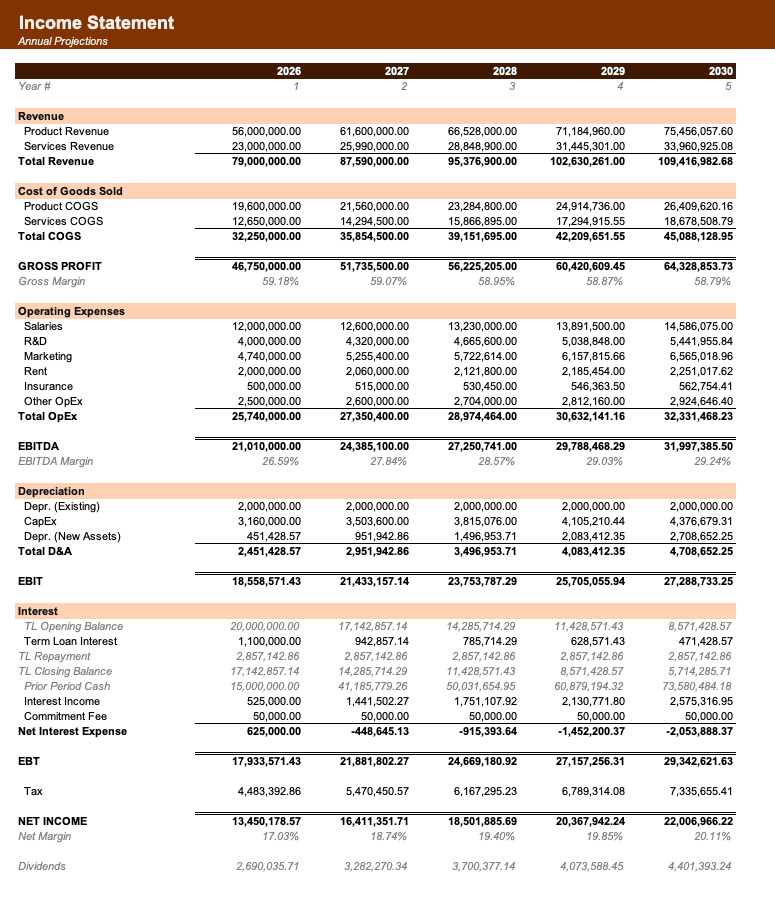
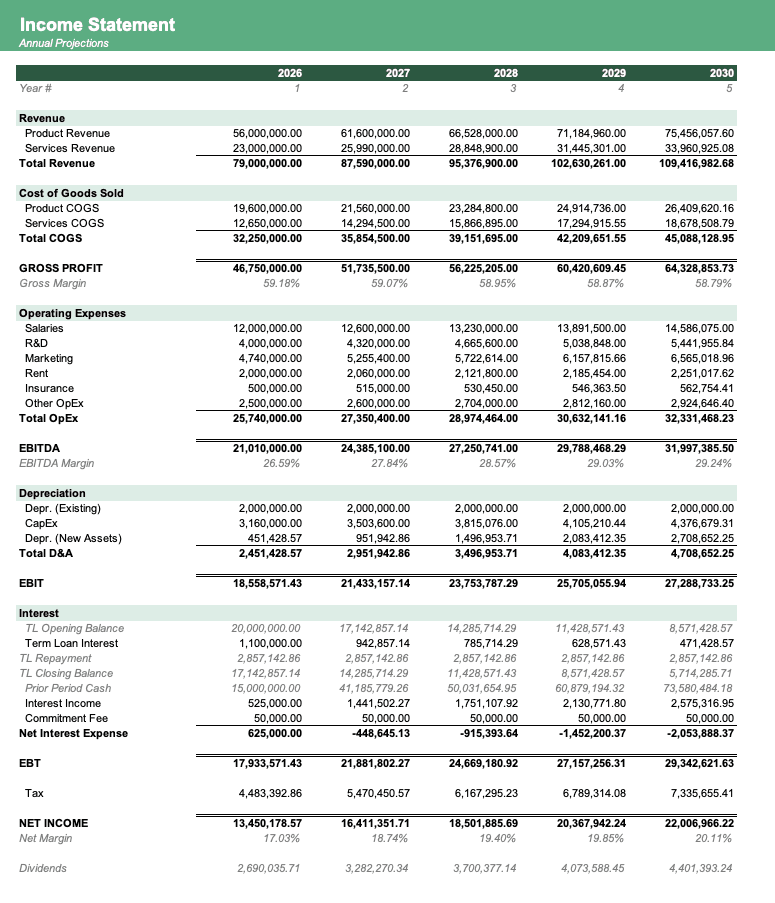
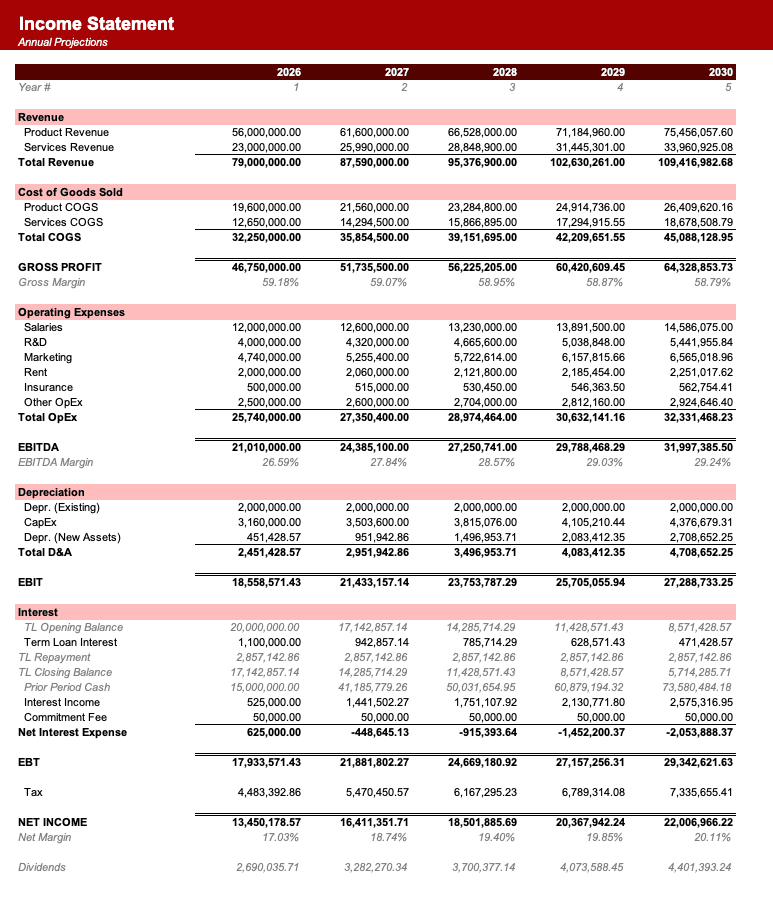
Formatted to IB standards
Named theme colors repaint the whole workbook in one click, on top of an investment-banking structure with clear input, output, and cross-sheet reference styling - brand-ready, institutional-grade, and fully auditable.

Created by ex-finance professionals
Hey, I’m Alex and I created Finamodel.
Over my years in the finance industry I kept building the same models over and over again. Same structure, same assumptions, different logo. So I started building frameworks to turn them into clean, reusable templates.
Every model here is one I’d actually use for a client, and I personally vet each one before it goes up.
I’m not an expert in every industry, but I’ve built enough models to know what belongs in one. And when something is completely foreign to me, I reach out to my network for experts to work on our models with us.
Having a template library on hand cuts a first build from hours to minutes.
Need help finding your model? You’ll find me in the Finamodel app!
Frequently asked
What is a typical office lease rate versus retail percentage lease?+
Office rates range from $15-60 per square foot per year depending on location and market tier. Retail percentage leases typically run 5-15% of sales for anchor tenants and 8-12% for smaller retailers, usually with a base rent floor.
How do I forecast residential absorption in a mixed-use project?+
Use comparable new developments, market absorption trends, and seasonal patterns. A conservative assumption for steady markets is 5-10 units per month for residential components of mixed-use buildings.
What contingency should I budget for mixed-use construction?+
Standard practice is a 10% hard cost contingency during design phase, reducing to 5% once fully permitted. Also budget separately for design contingency and an owner contingency for scope changes.
Who uses mixed-use development financial models?+
Real estate developers, development managers, real estate finance teams, and investors use these models for project feasibility analysis, financing and equity raises, and long-term operating strategy decisions.
How does phasing affect financing strategy?+
Phased development allows earlier phases to generate cash flow that can reduce construction loan draws on later phases. Lenders and equity investors often require a phased draw schedule tied to pre-leasing and sales milestones.
Have more financial modelling questions? Contact us
Related templates
Office Building Investment Model
Income-producing office building model with lease-up, rent growth, occupancy, and terminal value analysis.
Retail Centre Operating and Development Model
Tenant mix, rent roll, operating expenses, and profitability for shopping centers and retail property.
Hotel Operating Model
Operating model for hotel properties including occupancy rates, average daily rate (ADR), RevPAR optimization, and facility-level profitability.
Real Estate Development Pro Forma Model
Land cost, construction budget, lease assumptions, and project IRR for commercial and residential development.