Endowment Fund Model
Capital Markets Financial Model (Free Excel Download)
Forecast endowment allocations, spending policy, contributions, investment returns, liquidity, and distributions to assess long-term funding capacity.



professionals from Deloitte
Used by professionals from






About this model
An endowment fund financial model projects the growth and sustainability of a perpetual investment portfolio funding annual distributions to operating budgets. For a university or foundation with $1 billion in assets, the model allocates capital across public equities (40%), fixed income (20%), private equity (18%), real assets (10%), hedge funds (10%), and cash (2%), applies multi-asset-class return assumptions (7.5% equities, 4.5% bonds, 11% private equity), and compounds the portfolio year-over-year. Against this growing asset base, a spending policy (typically 4–5% of a trailing three-year average) funds annual distributions to the institution's operating budget, with inflation adjustments to preserve real purchasing power.
The model validates that the endowment's real corpus (inflation-adjusted value) is preserved or grows over the projection horizon. Key risks include sequence-of-returns (a bad market early in a spending cycle can force forced selling at low prices), high fees in private assets (which drag net returns), and the temptation to increase spending when markets are strong. The workbook shows how different spending rates and return assumptions affect long-term sustainability, making it clear that a 3% spending rate on a poorly-allocated portfolio is more sustainable than 5% spending on a well-diversified one.
This template is standard for institutional wealth managers, university treasurers, and foundation boards evaluating endowment policy and asset allocation targets.
What every model includes
Live formulas, no hardcoded values
Outputs are driven by live formulas, so the workbook updates from its assumptions instead of relying on hardcoded results.
All assumptions in one tab
Inputs are clearly marked in the Assumptions tab and separated from calculations, making it clear what to change and what to leave intact.
Statements always balancing
For integrated-statement models, the balance sheet, cash flow, and supporting schedules tie through properly.
Distinct schedules for clarity
Debt, working capital, taxes, and cash flow can get messy quickly. We group calculations in clear schedules, not across disconnected tabs.
No hidden macros or external links
There are no unexplained external workbook links or macros to undermine auditability or portability.
Changes flow through the model
Update a key driver and see the impact carry through the forecast, financing, and return outputs. We never use hardcoded numbers in formulas.
What's inside the Endowment Fund Model
- Multi-asset allocation: equities, fixed income, real estate, hedge funds, and private equity
- Return assumptions by asset class with correlation and rebalancing logic
- Annual spending policy based on rolling average value
- Inflation adjustment and real purchasing power preservation
- Long-term asset growth, solvency stress testing, and payout sustainability
- Payout sustainability and capital needs scenarios
Endowment Fund Model: A Guide to Perpetual Spending and Portfolio Sustainability
An endowment fund model is a structured financial tool for evaluating how a perpetual pool of donated capital can fund annual operating distributions while preserving intergenerational equity. This guide outlines the core mechanics: diversified asset returns, fee structures, smoothing-based spending rules, donation inflows, and validation checks that together test whether spending grows with inflation over a ten-year horizon.
Key Operating Drivers: Allocation, Returns, and Fees
The model's operating drivers begin with a diversified asset allocation across public equities, fixed income, private equity, real assets, hedge funds, and cash. Each class carries its own expected return and fee rate, so portfolio outcomes depend on both the weight mix and class-level performance.
- Investment returns accrue as yield plus appreciation, and fees include base management charges, performance fees for private equity above a hurdle, and internal operating costs. Donations add a philanthropic inflow, typically growing annually, while spending distributions represent the primary outflow.
- Together, these drivers determine whether the endowment grows in real terms or erodes over time.
Calculation Flow: From Assumptions to AUM Rollforward
The calculation flow moves from assumptions to asset allocation, then to gross returns and fee schedules. The core engine is the AUM rollforward: beginning assets plus donations, minus spending payout, fees, and internal opex, plus gross investment return, yielding ending assets.
- Spending uses a trailing three-year average AUM, which smooths market volatility rather than applying the rate to current-year assets. Fees are calculated on beginning AUM to avoid circularity, and private equity performance fees reference gross returns above a hurdle.
- Ending AUM feeds the next year's allocation, and rebalancing realigns weights to targets, creating a multi-year cycle.
Outputs: Performance Metrics and Sustainability Checks
Key outputs include nominal and real returns, the total expense ratio, spending as a percentage of AUM, and the real corpus preservation ratio.
- The real corpus preservation check divides ending AUM by the beginning AUM inflated over the projection period, requiring a result of at least 1.0 by the final year to confirm the endowment has not shrunk in purchasing power.
- Additional checks verify that allocation weights sum to 100%, the AUM rollforward balances, cash never goes negative, and the spending rule is correctly applied.
- These metrics help users assess whether the spending policy and portfolio strategy are sustainable across a multi-decade horizon.
Practical Use: Stress-Testing and Decision Support
In practice, this model supports stress-testing spending policies against adverse market sequences and comparing alternative asset allocations to meet return targets.
- By adjusting inputs such as spending rate, smoothing period, expected returns, and donation growth, users can explore trade-offs between current distributions and long-term corpus preservation.
- The structure separates realised and unrealised cash flows, tracks restricted versus unrestricted net assets, and includes liquidity tiers to manage private capital calls.
- Validation checks flag issues like weight drift, cash shortfalls, or spending above sustainable levels, making the model a useful tool for fiduciary deliberation and policy design.
Formatted to IB standards
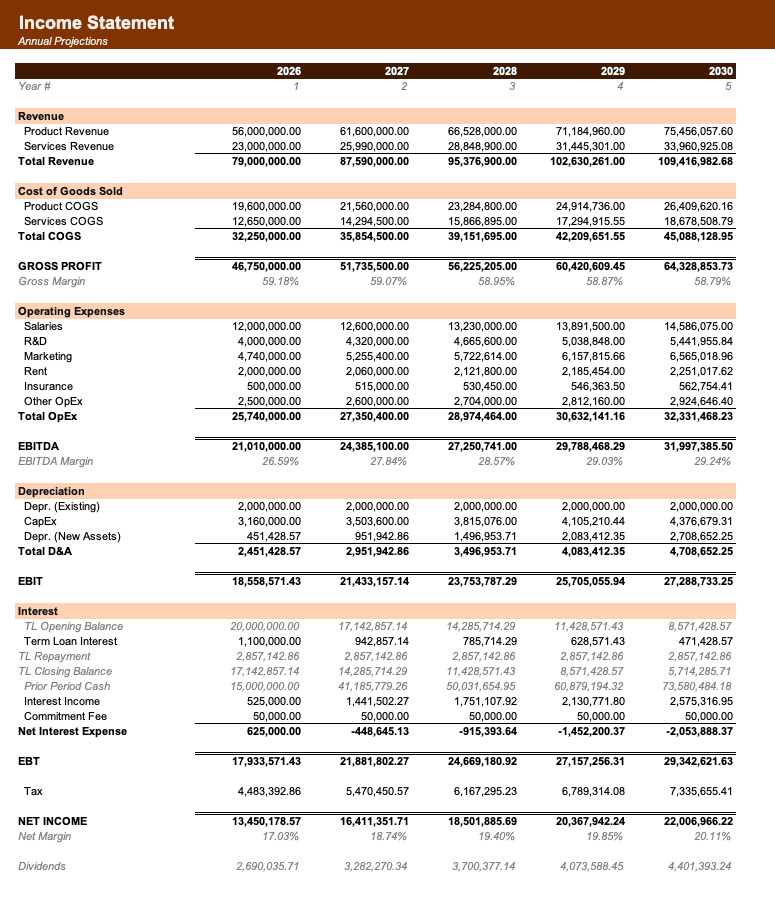
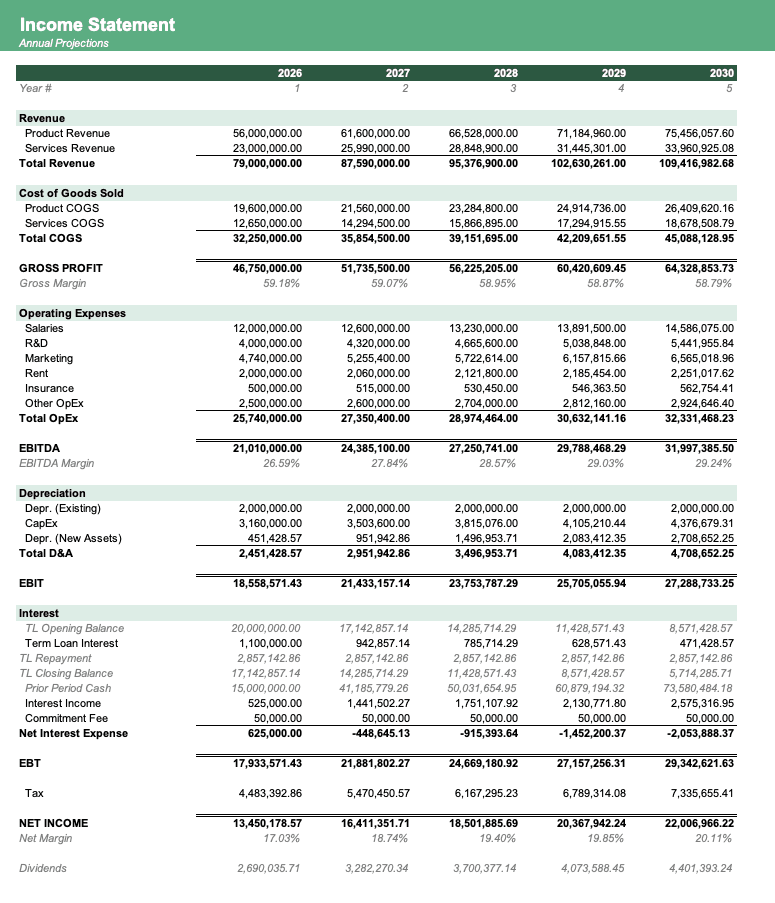
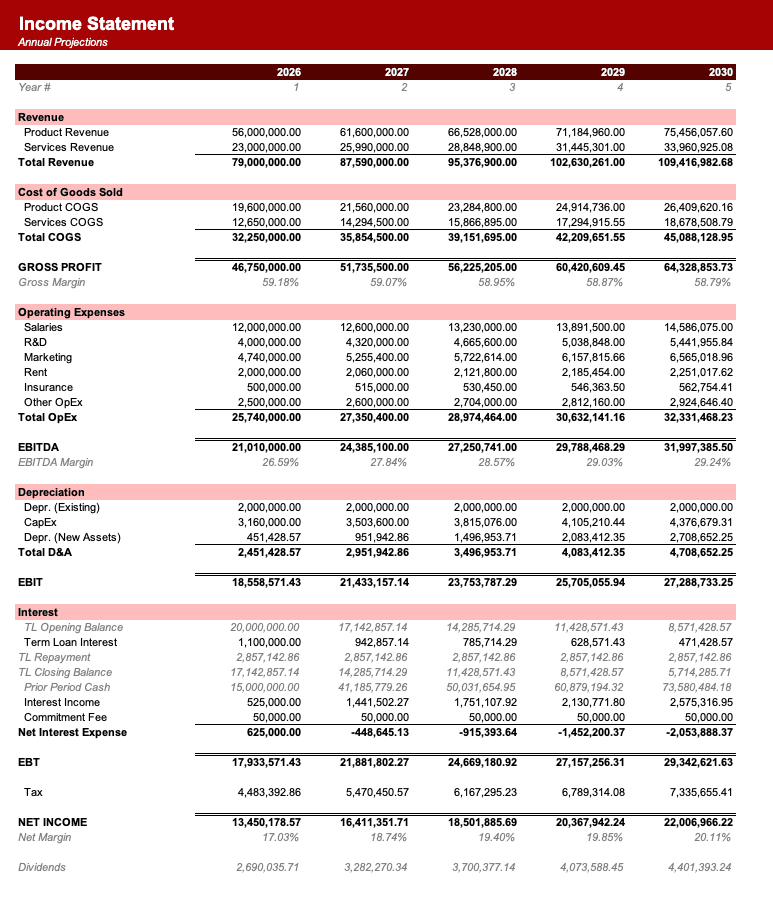
Named theme colors repaint the whole workbook in one click, on top of an investment-banking structure with clear input, output, and cross-sheet reference styling - brand-ready, institutional-grade, and fully auditable.

Created by ex-finance professionals
Hey, I’m Alex and I created Finamodel.
Over my years in the finance industry I kept building the same models over and over again. Same structure, same assumptions, different logo. So I started building frameworks to turn them into clean, reusable templates.
Every model here is one I’d actually use for a client, and I personally vet each one before it goes up.
I’m not an expert in every industry, but I’ve built enough models to know what belongs in one. And when something is completely foreign to me, I reach out to my network for experts to work on our models with us.
Having a template library on hand cuts a first build from hours to minutes.
Need help finding your model? You’ll find me in the Finamodel app!
Frequently asked
What is an endowment fund model?+
It is a model that forecasts a perpetual fund asset growth, investment returns, and annual spending to confirm the fund can maintain purchasing power indefinitely.
What is a sustainable endowment spending rate?+
Most endowments target 4 to 5 percent of a rolling 3-year average value annually, calibrated to preserve real purchasing power after inflation and fees.
Why does endowment allocation differ from personal portfolios?+
Endowments have perpetual time horizons, so they can hold illiquid assets such as private equity and real estate and tolerate volatility in pursuit of long-term real returns.
How do I model alternative asset returns?+
Use realistic net-of-fee returns, typically 6 to 9 percent for private equity and 5 to 7 percent for hedge funds, and apply a lock-up period to model illiquidity.
Who uses endowment fund models?+
Endowment managers, university finance teams, investment committees, and institutional investors use them for spending policy review, asset allocation decisions, and capital campaign planning.
Have more financial modelling questions? Contact us
Related templates
Pension Fund Asset Allocation Model
Liability-driven investment strategy, asset allocation, and funding ratio analysis for pension plan portfolios.
Sovereign Wealth Fund Portfolio Model
Asset allocation and performance tracking model for sovereign wealth funds showing allocation drift, returns, and rebalancing mechanics.
Multi-Asset Portfolio Allocation
Asset allocation model optimizing portfolio construction across equities, bonds, alternatives, and real assets.
DCF Model
Discounted cash flow valuation model with explicit forecast, terminal value, and WACC.