Multi-Asset Portfolio Allocation Model
Capital Markets Financial Model (Free Excel Download)
Model portfolio weights, expected returns, volatility, correlations, rebalancing, and drawdowns to test strategic asset-allocation decisions.



professionals from Deloitte
Used by professionals from






About this model
A Multi-Asset Portfolio Allocation Model projects a $500M single family office's 10-year wealth trajectory across five asset classes: Equities (40%, 7.5% total return), Fixed Income (20%, 4.5%), Alternatives (25%, 12% net IRR), Real Estate (10%, 7%), and Cash (5%, 4%). The model decomposes return into yield (cash income: 2% from equities, 4.5% from bonds, 3% from alts, 4% from real estate) and appreciation (mark-to-market gains). Annual costs include external management fees (0.75% of AUM), performance fees (15% of gross return if positive, zero if negative), custody (0.10% of AUM), transaction costs (0.20% on absolute rebalancing volume / 2), operating expenses ($2.7M Year 1, escalating 2.5% inflation annually), family distributions (3% of beginning AUM), and taxes (37% on ordinary income, 20% on capital gains).
The Allocation_Returns sheet builds in two phases to avoid circularity. Phase 1 computes pre-cost class ending balances (beginning × (1 + return) by class) and transaction costs from absolute rebalancing flows. Phase 2 rebalances to target allocation weights post-cost, feeding the end-of-period AUM. Portfolio_Summary deducts all costs from gross return to derive ending AUM and year-over-year wealth preservation. The Cash_Flow sheet uses a Sources & Uses design: annual cash yield income (sum of class yields) versus annual cash needs (distributions, fees, opex, taxes), revealing whether income suffices or portfolio must be partially liquidated to fund spending. A typical $500M portfolio at 7.9% blended gross return and 7.7% blended outflow rate (fees + distributions + taxes) grows modestly; real purchasing power depends on inflation assumptions.
This model suits ultra-high-net-worth families, endowments, and foundations managing large concentrated portfolios. Key metrics include real return (nominal return minus inflation), cash yield (total dividends and interest as % of AUM), and sustainability of the 3% distribution rate (conservative relative to 4.5% NACUBO endowment standard). Stress tests reveal impact of market downturns (e.g., -20% equities shock) and rising cost-of-living on distribution sustainability.
What every model includes
Live formulas, no hardcoded values
Outputs are driven by live formulas, so the workbook updates from its assumptions instead of relying on hardcoded results.
All assumptions in one tab
Inputs are clearly marked in the Assumptions tab and separated from calculations, making it clear what to change and what to leave intact.
Statements always balancing
For integrated-statement models, the balance sheet, cash flow, and supporting schedules tie through properly.
Distinct schedules for clarity
Debt, working capital, taxes, and cash flow can get messy quickly. We group calculations in clear schedules, not across disconnected tabs.
No hidden macros or external links
There are no unexplained external workbook links or macros to undermine auditability or portability.
Changes flow through the model
Update a key driver and see the impact carry through the forecast, financing, and return outputs. We never use hardcoded numbers in formulas.
What's inside the Multi-Asset Portfolio Allocation Model
- Asset class return expectations and historical volatility
- Correlation matrix across all asset classes
- Risk budgeting and target portfolio volatility constraints
- Minimum and maximum allocation constraints per asset class
- Scenario analysis and stress testing across market regimes
- Constraint sets (minimum/maximum allocation per asset)
- Efficient frontier and optimal portfolio construction
Multi-Asset Allocation Model: How the Template Works
This multi-asset allocation model projects a family office portfolio over ten years. It shows how asset class returns, spending policies, and tax rules interact to affect ending wealth.
The template balances liquidity needs with real wealth preservation, using a structured flow from assumptions to outputs.
Portfolio Setup and Operating Drivers
The template starts with a $500 million single family office portfolio allocated across equities (40%), fixed income (20%), alternatives (25%), real estate (10%), and cash (5%). Each asset class has its own expected total return, yield, and volatility.
- Operating costs include eight full-time staff at a blended $250,000 average, technology, professional fees, office, and insurance, all escalated annually by inflation. A minimum cash buffer of 3% of AUM ensures liquidity.
- The model applies a 3% distribution rate, with a selector for spending based on beginning AUM, three-year average AUM, or a banded variant. A risk-free rate input supports Sharpe ratio calculations.
Calculation Flow and Yearly Projection
Each projection year begins by growing asset class balances using the yield and appreciation components of total return. Pre-cost rebalancing flows are computed to measure turnover and derive transaction costs, without circularity.
- The portfolio summary then deducts all costs—management fees, a performance fee with a 6% hurdle and high-water mark, custody fees, operating expenses, family distributions, and taxes—to arrive at ending AUM. The ending AUM feeds back to set post-cost asset class balances, ensuring the sum matches the portfolio total.
- This accounting integrity is validated by a checks sheet, and the process repeats for ten years.
Outputs and Performance Metrics
The model produces a dashboard with key performance indicators, including ending AUM, net and real returns, volatility, Sharpe ratio, and a one-year 95% value-at-risk estimate. A summary table shows beginning and ending AUM, distributions, wealth indices, and return percentages over the ten-year horizon.
- Charts illustrate AUM progression, return trends, allocation drift, and a waterfall bridge from beginning to ending AUM. The returns analysis sheet details nominal and real returns, cumulating distributions, and real terminal AUM.
- A cash flow sheet presents sources and uses, highlighting net annual cash flow and liquidity buffer coverage.
Practical Use and Scenario Analysis
This template helps evaluate how a family office portfolio might behave under different market conditions. A scenario toggle allows switching between base, bull, and bear cases, which adjust returns, yields, and inflation assumptions.
- These scenarios stress-test the portfolio's ability to fund distributions and preserve real wealth. The model explicitly surfaces the trade-off between spending rate and real corpus preservation, showing whether the family is spending more than the portfolio earns in real terms.
- Users can explore how changes in allocation, spending policy, or market assumptions affect long-term outcomes, making it a tool for policy setting and risk assessment.
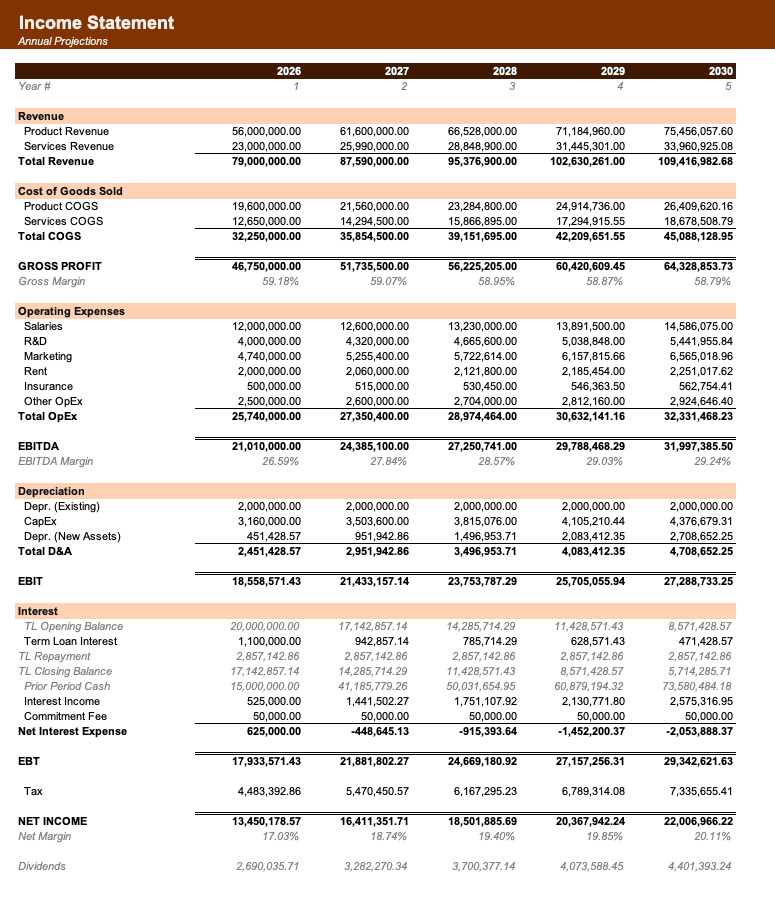
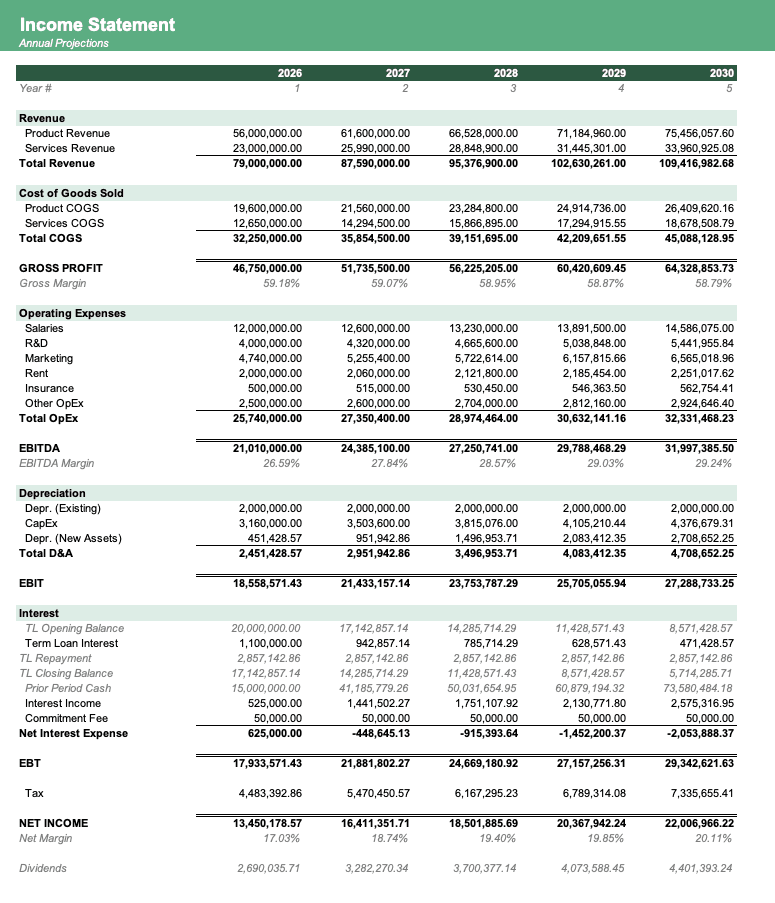
Formatted to IB standards
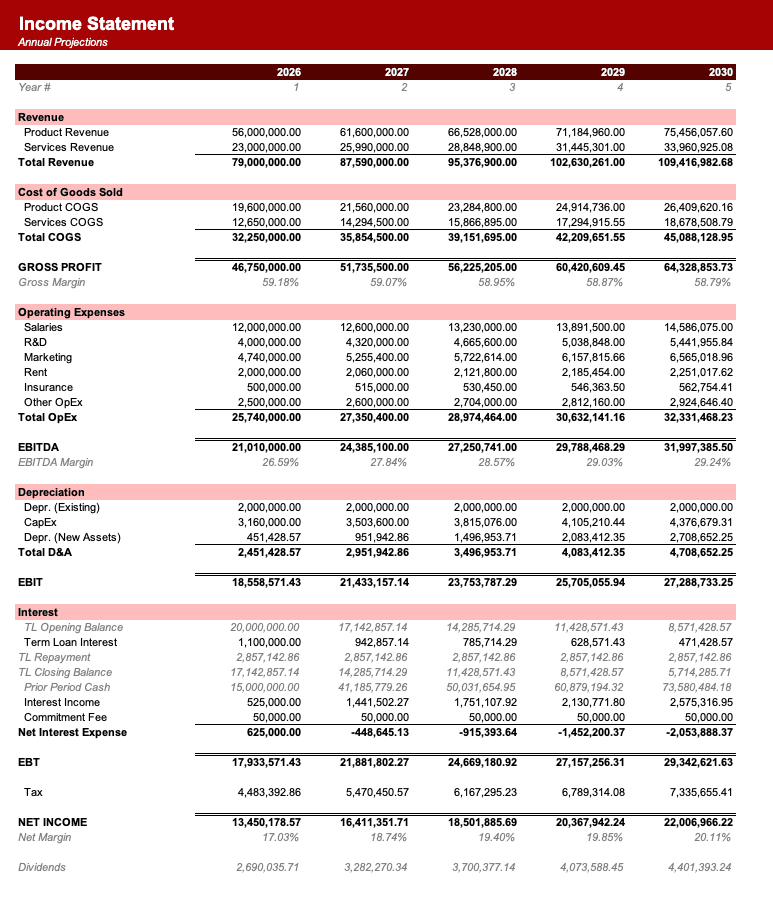
Named theme colors repaint the whole workbook in one click, on top of an investment-banking structure with clear input, output, and cross-sheet reference styling - brand-ready, institutional-grade, and fully auditable.

Created by ex-finance professionals
Hey, I’m Alex and I created Finamodel.
Over my years in the finance industry I kept building the same models over and over again. Same structure, same assumptions, different logo. So I started building frameworks to turn them into clean, reusable templates.
Every model here is one I’d actually use for a client, and I personally vet each one before it goes up.
I’m not an expert in every industry, but I’ve built enough models to know what belongs in one. And when something is completely foreign to me, I reach out to my network for experts to work on our models with us.
Having a template library on hand cuts a first build from hours to minutes.
Need help finding your model? You’ll find me in the Finamodel app!
Frequently asked
What is a reasonable stock and bond allocation?+
It depends on risk tolerance and time horizon. Conservative investors often hold 40% stocks and 60% bonds. A moderate allocation is 60/40, growth-oriented is 80/20, and more aggressive strategies may hold 100% in equities or alternatives.
How do I estimate asset class returns?+
Use historical averages with appropriate skepticism, forward-looking estimates from research providers, or building-block approaches such as adding an equity risk premium to the long-term bond yield.
Why do correlations matter in portfolio construction?+
Correlations show how assets move relative to each other. Low or negative correlations between assets provide diversification benefits and reduce portfolio volatility without proportionally reducing expected returns.
Who uses multi-asset allocation models?+
Asset allocators, portfolio managers, wealth managers, and institutional investors use these models for strategic asset allocation, rebalancing decisions, and evaluating whether to add alternative assets to a portfolio.
How do I account for illiquidity in alternative assets?+
Apply an illiquidity premium to expected returns (typically 1-3% for private equity or infrastructure) and model a liquidity constraint that limits the allocation to illiquid assets based on the portfolio cash flow needs.
Have more financial modelling questions? Contact us
Related templates
Equity Portfolio Analysis
Portfolio-level analytics for equity holdings with performance attribution, risk, and rebalancing.
Fixed Income Portfolio Model
Bond portfolio analytics with duration, convexity, credit spreads, and yield curve positioning.
Hedge Fund Operating Model
Operating model for hedge funds including investor cash flows, fee structure, leverage, and performance-based compensation.
DCF Model
Discounted cash flow valuation model with explicit forecast, terminal value, and WACC.