ESOP Pool Model
Corporate Finance Financial Model (Free Excel Download)
Plan employee equity grants with option-pool sizing, vesting schedules, dilution, exercise outcomes, and ownership visibility for compensation and fundraising decisions.



professionals from Deloitte
Used by professionals from






About this model
An ESOP (Employee Stock Ownership Plan) pool model projects the dilution impact of equity grants to employees over a five-year period. The model tracks how many shares are granted each year based on hiring (new hires receive 2% of fully diluted shares each), retention grants (0.8% of outstanding options annually to keep key staff), and how many of those grants vest. With a standard four-year vesting cliff (zero vesting until Year 1, then 25% per year), the model tracks which grants are still unvested, which have vested and are exercisable, and which employees exercise to buy shares.
The workbook ensures the option pool never becomes exhausted (expansion events at funding rounds top up the pool), and shows the dilution to founders and investors as the fully diluted share count grows from exercise activity. When employees exercise options at the original strike price (409A fair value at grant), the company receives cash proceeds. The model tracks the share-based compensation (SBC) expense under ASC 718 accounting: each grant is valued at Black-Scholes fair value at grant date (typically 40% of underlying FMV), then expensed straight-line over the vesting period.
This template is essential for growth-stage startups planning equity budgets, compensation committees assessing dilution, and investors performing cap table modeling.
What every model includes
Live formulas, no hardcoded values
Outputs are driven by live formulas, so the workbook updates from its assumptions instead of relying on hardcoded results.
All assumptions in one tab
Inputs are clearly marked in the Assumptions tab and separated from calculations, making it clear what to change and what to leave intact.
Statements always balancing
For integrated-statement models, the balance sheet, cash flow, and supporting schedules tie through properly.
Distinct schedules for clarity
Debt, working capital, taxes, and cash flow can get messy quickly. We group calculations in clear schedules, not across disconnected tabs.
No hidden macros or external links
There are no unexplained external workbook links or macros to undermine auditability or portability.
Changes flow through the model
Update a key driver and see the impact carry through the forecast, financing, and return outputs. We never use hardcoded numbers in formulas.
What's inside the ESOP Pool Model
- Grant schedule by employee level with vesting curves (typically 4-year cliff)
- Annual ESOP pool burn and remaining pool balance
- Share count impact on cap table and fully diluted shares
- Dilution to founders and earlier investors
- Tax treatment and 409A valuation considerations
- Valuation impact (ASP) as share count increases
ESOP Pool Model: How It Works, What It Captures and Who It Helps
This ESOP pool model template projects a venture-backed startup's equity compensation programme over five years. It tracks pool availability, vesting and forfeitures, dilution for founders and investors, share-based compensation expense and exercise proceeds.
The document explains the model's operating drivers, calculation flow, outputs and practical application for anyone evaluating whether the template fits their planning needs.
What the ESOP Pool Model Tracks and Why It Matters
The model is a standalone equity compensation tracker built to answer four planning questions: how large an option pool must be to fund a hiring programme, what dilution founders and investors face as options are granted and exercised, what share-based compensation expense hits the income statement under straight-line attribution, and when cash exercise proceeds arrive.
- It is not a three-statement or project-finance model, so it omits operating revenue, balance sheet and debt.
- Instead, it concentrates on the capital-structure mechanics that determine whether a pool is large enough and how ownership shifts over five annual periods.
What Drives the Numbers?
The primary drivers sit on the Assumptions sheet: hiring plan headcount additions, grant per hire, refresh grant rate, pool expansion events, vesting and cliff periods, forfeiture rate, exercise rate, 409A fair market value growth, and the Black-Scholes inputs for volatility, risk-free rate, expected term and dividend yield.
- A scenario toggle lets you switch between base, bull and bear multipliers on forfeiture, exercise and fair-market-value growth, so the effective named ranges consumed by the rest of the model adjust without changing the underlying base inputs.
- This design keeps the model acyclic while letting you test more aggressive or conservative assumptions in a controlled way.
Following the Calculation Flow
The calculation follows a directed acyclic graph to avoid circular references. Pool_Summary first computes total grants by capping new-hire and refresh demand at opening pool plus expansion; this does not reference vesting.
- Vesting_Schedule then takes those grants as cohort inputs and rolls forward unvested, vested and forfeited shares using the cliff and vesting period. Pool_Summary subsequently completes its closing pool row by reading current-period forfeitures from Vesting_Schedule.
- Exercise_Proceeds and SBC_Expense sit downstream, reading vested cumulative shares and grant values, and Dilution_Analysis reads outstanding options. This one-way flow ensures every sheet depends only on prior stages, which is why the model recalculates cleanly.
Outputs and Practical Use
Outputs include an annual pool roll-forward, a five-cohort vesting schedule, fully diluted ownership percentages by stakeholder, an option overhang block showing granted and unallocated reserves, share-based compensation expense, exercise proceeds and a checks sheet.
- The overhang block is particularly useful because it reports dilution both as a net outstanding figure and as a fully diluted pool percentage, giving founders a term-sheet view of the reserve.
- The model is aimed at founders or finance leads planning a hiring programme who need to see whether the existing pool supports planned grants without a top-up, and how forfeitures and exercises affect cap-table dilution over time.
- Its focus on equity mechanics means it complements rather than replaces a full operating model.
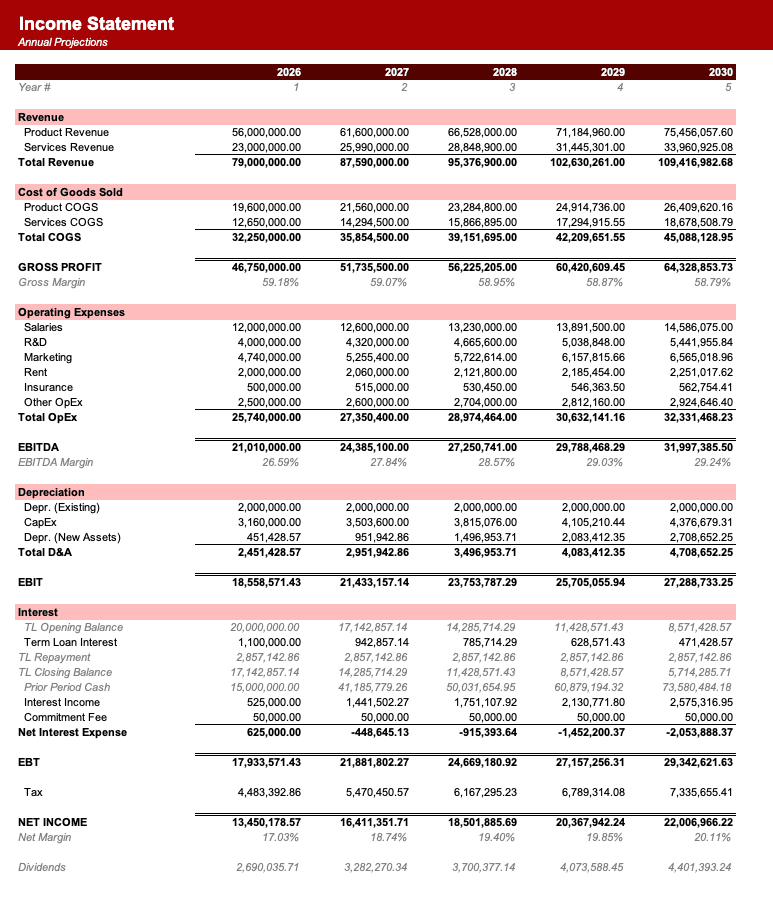
Formatted to IB standards
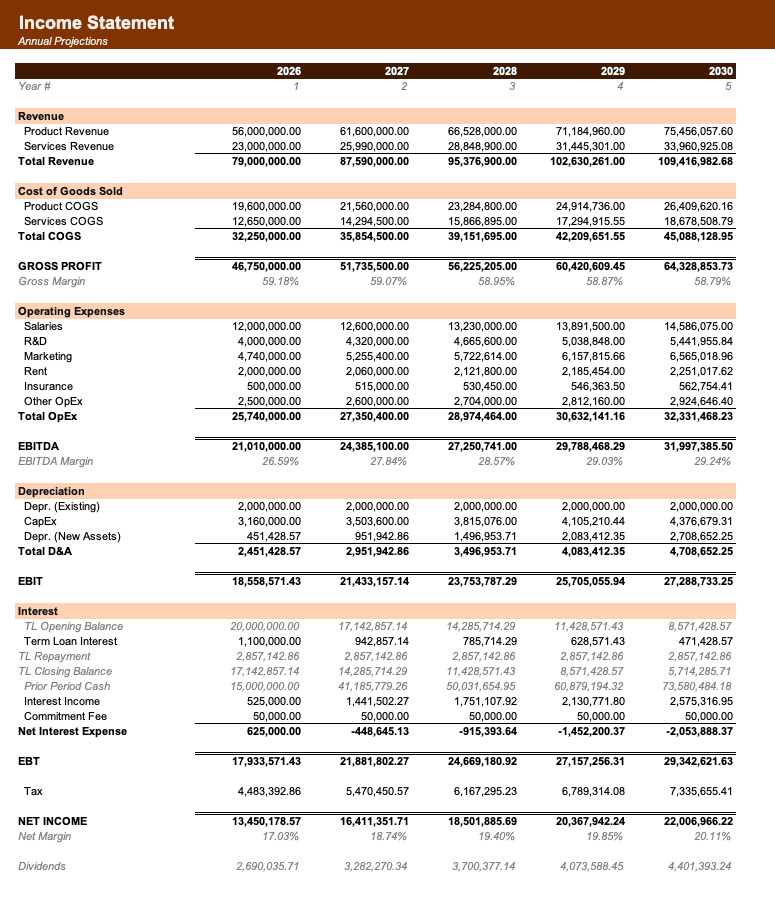
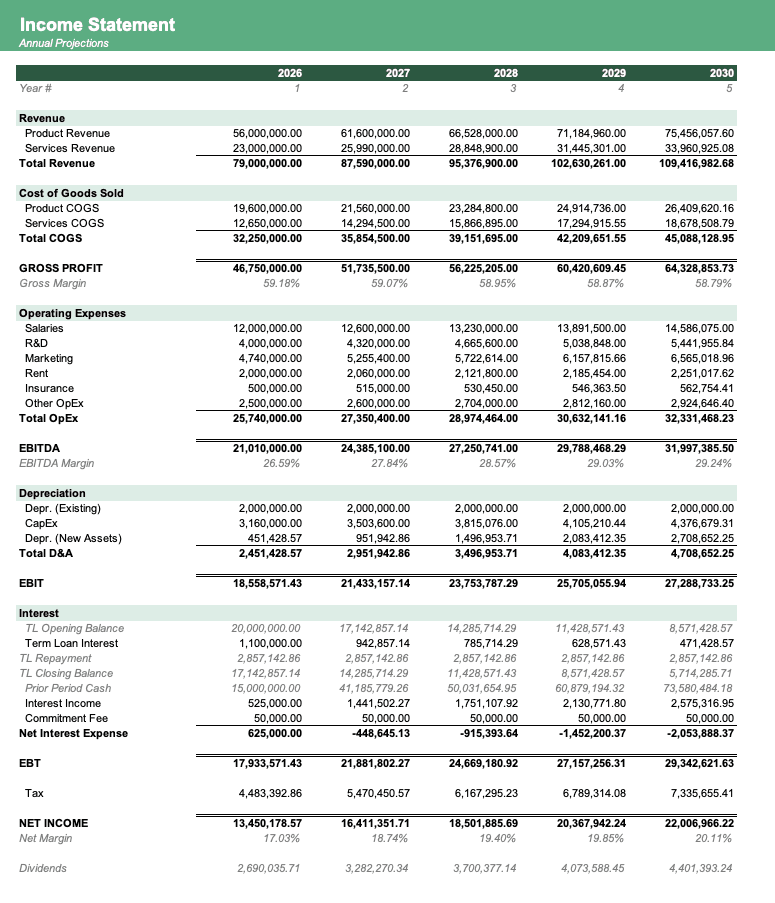
Named theme colors repaint the whole workbook in one click, on top of an investment-banking structure with clear input, output, and cross-sheet reference styling - brand-ready, institutional-grade, and fully auditable.

Created by ex-finance professionals
Hey, I’m Alex and I created Finamodel.
Over my years in the finance industry I kept building the same models over and over again. Same structure, same assumptions, different logo. So I started building frameworks to turn them into clean, reusable templates.
Every model here is one I’d actually use for a client, and I personally vet each one before it goes up.
I’m not an expert in every industry, but I’ve built enough models to know what belongs in one. And when something is completely foreign to me, I reach out to my network for experts to work on our models with us.
Having a template library on hand cuts a first build from hours to minutes.
Need help finding your model? You’ll find me in the Finamodel app!
Frequently asked
What is a typical ESOP pool size?+
Early-stage startups allocate 10-20% of fully diluted equity. Mature companies may use 5-10%. The pool is set and refreshed at board discretion.
What is a 4-year vest with 1-year cliff?+
The employee earns nothing for 12 months, then vests 25% of the grant, then 1/48 per month for the remaining 36 months.
How does ESOP dilute my ownership?+
ESOP shares increase the denominator in the fully diluted share count, reducing your ownership percentage unless you participate pro-rata in new fundraising.
Who uses ESOP pool models?+
Founders, CFOs, HR leaders, and equity specialists use them during fundraising rounds, new hire planning, and board conversations about pool size.
How do I calculate exit proceeds to employees?+
Apply the per-share exit price to vested shares held by each employee, net of any exercise price and applicable taxes, under each acquisition scenario.
Have more financial modelling questions? Contact us
Related templates
Cap Table Management Model
Equity ownership tracking and scenario modeling.
Bridge Round Financing Model
Convertible note and SAFE financing analysis.
Convertible Note and SAFE Model
Model SAFE and convertible note terms with conversion triggers and equity rounds.
3 Statement Model
Integrated income statement, balance sheet, and cash flow forecasts.