Family Office Financial Plan
Capital Markets Financial Model (Free Excel Download)
Model family-office assets, investment returns, spending, taxes, staffing, and liquidity to plan multigenerational wealth and portfolio cash flow.



professionals from Deloitte
Used by professionals from






About this model
A family office financial model projects the management of $500 million in ultra-high-net-worth family assets across five asset classes: public equities (40%, 7.5% return), fixed income (20%, 4.5% return), private equity (25% committed, 12% return with J-curve), real estate (10%, 7% return), and cash (5%, 3.5% return). The office funds annual family distributions ($7.5 million, or 1.5% of AUM) plus operating expenses ($2.8 million, or 56 basis points of AUM), and is responsible for tax optimization, compliance, and asset allocation oversight.
The core tension is liquidity: private equity is deliberately illiquid and generates zero distributions for Years 1–3 (J-curve), while family distributions must be funded from yield (dividends, interest, rental income) and PE distributions after the curve turns positive. The model ensures that cash reserves never fall below a minimum buffer despite capital calls to PE funds totaling $6 million annually. Tax treatment separates ordinary income (37% rate on yield) from capital gains (20% rate on realized gains and the gain portion of PE distributions, with return-of-capital treated as non-taxable).
The model answers: can the family sustain $7.5 million in annual lifestyle distributions while funding a 25% PE allocation? What happens if PE returns decline or capital calls spike? This template is calibrated for institutionalized single-family offices with $300 million–$1 billion AUM.
What every model includes
Live formulas, no hardcoded values
Outputs are driven by live formulas, so the workbook updates from its assumptions instead of relying on hardcoded results.
All assumptions in one tab
Inputs are clearly marked in the Assumptions tab and separated from calculations, making it clear what to change and what to leave intact.
Statements always balancing
For integrated-statement models, the balance sheet, cash flow, and supporting schedules tie through properly.
Distinct schedules for clarity
Debt, working capital, taxes, and cash flow can get messy quickly. We group calculations in clear schedules, not across disconnected tabs.
No hidden macros or external links
There are no unexplained external workbook links or macros to undermine auditability or portability.
Changes flow through the model
Update a key driver and see the impact carry through the forecast, financing, and return outputs. We never use hardcoded numbers in formulas.
What's inside the Family Office Financial Plan
- Asset base: public equities, fixed income, alternatives, real estate, and private equity
- Spending policy with inflation adjustment and emergency reserve
- Tax analysis: income tax, capital gains, estate tax, and planning strategies
- Generational transfer: trusts, charitable giving, and inheritance planning
- Long-term sustainability and wealth preservation scenarios
- Administration costs and governance structure
How the Family Office Model Projects Liquidity and Generational Wealth
This family office model template helps evaluate whether a $500m single-family office can sustain distributions and operating costs while preserving real wealth. It rolls forward a five-asset-class portfolio, models private equity capital calls and the J-curve, taxes yield and realised gains, and tracks cash, balance sheet, and operating expenses over a seven-year horizon.
What Drives the Family Office Model
The template centres on a $500m investable pool split across public equities, fixed income, private equity, real estate, and cash. Each asset class contributes cash yield and, for equities and real estate, unrealised capital appreciation.
- Investment returns are calculated on prior-period closing balances, so asset growth compounds from actual portfolio roll-forward. Operating costs are built bottom-up, starting with staff compensation for eight full-time equivalents, plus technology, professional fees, rent, insurance, and other expenses.
- All lines escalate with an inflation assumption, keeping cost growth tied to a single input rather than separate escalators. Family distributions are modelled as a percentage of opening assets, giving a direct link between portfolio size and lifestyle spending.
- Private equity sits apart from the liquid sleeve. The model tracks a total commitment, an unfunded pool, capital calls drawn each year, and an opening funded net asset value derived from commitment less unfunded capital.
Distributions remain zero during the early J-curve years, then begin as a rate applied to fund NAV. This structure reflects how private capital moves from cash out to cash back over time.
How Cash, Tax, and Asset Flows Move Through the Model
Cash flow is the model's single source of truth for closing cash, and other sheets read that figure rather than recalculating it. The flow starts with opening cash, adds yield from each asset class and any private equity distributions, then subtracts capital calls, operating expenses, family distributions, interest expense, and taxes.
- Interest expense is ordered before tax so any borrowing cost is visible before the tax calculation. Taxes are split: ordinary income tax applies to cash yield such as dividends, interest, and rent, while capital gains tax applies only to realised gains and the taxable portion of private equity distributions.
- Return of capital from private equity is separated from gain so the full distribution is not taxed. Closing cash then feeds the portfolio build and balance sheet.
Outputs and Diagnostics Available in the Template
The model produces per-class asset balances, total assets under management, a balance sheet with contributed capital and retained earnings, and a cash flow statement. Operating expenses appear as a bottom-up P&L with an inflation escalator.
- Distributions and tax are shown together, allowing the family to see how much cash leaves the portfolio and how much goes to tax authorities. Private markets output includes unfunded commitment, capital calls, distributions, and NAV.
- A checks sheet runs eight quantitative validations across all seven projection years, covering balance sheet balance, minimum cash buffer, allocation totals, unfunded commitment staying non-negative, operating expense ratios, liquidity coverage, distribution affordability, and private equity concentration relative to target. These checks are useful for spotting when assumptions push the plan outside intended guardrails.
Practical Use for Evaluating the Family Office Plan
This model is suited to testing whether a $500m single-family office can sustain a given spending rate while funding private equity calls and covering operating costs. By adjusting allocation, return assumptions, distribution rate, and inflation, a reviewer can observe how closing cash and retained earnings respond over the projection horizon.
- The model does not include scenario toggles or sensitivity tables, so it works best as a single-path base case that can be manually re-run with changed inputs. It also does not model debt beyond an optional margin loan, and it omits charitable deductions.
- The public download is a values-only preview of the underlying model rather than a live, recalculating workbook, so it should be used to understand structure and relationships rather than as an operational planning tool without rebuilding the formulas.
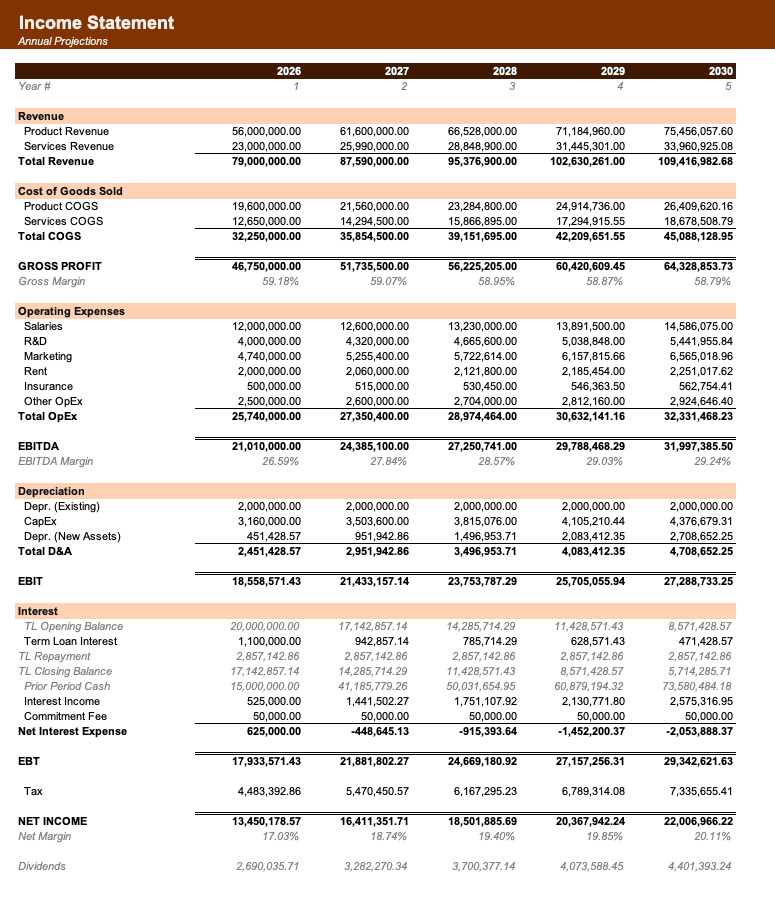
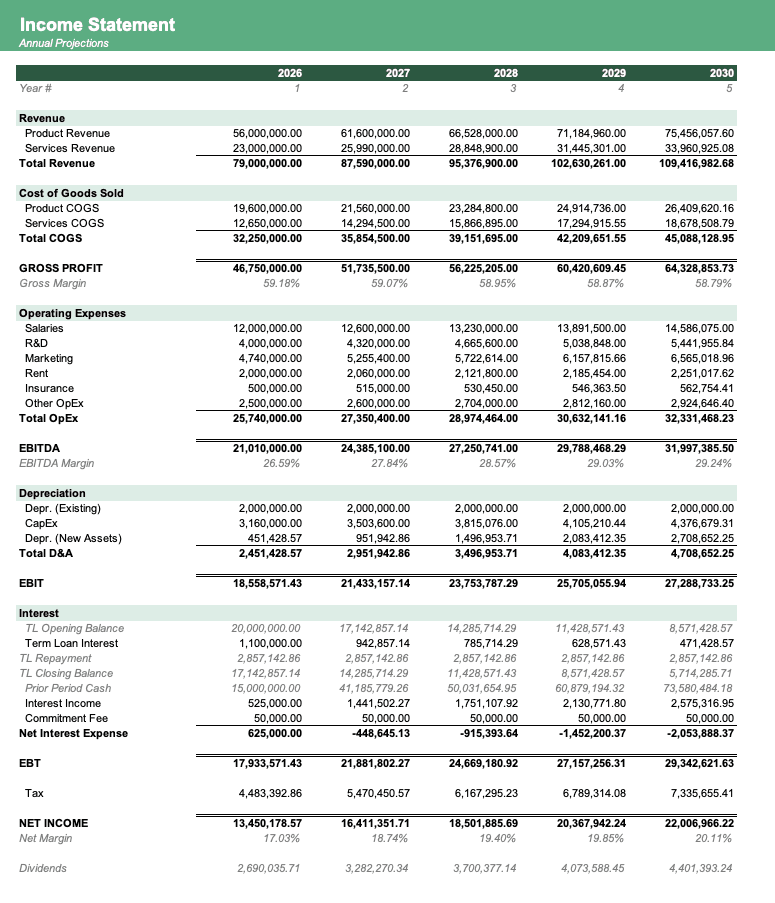
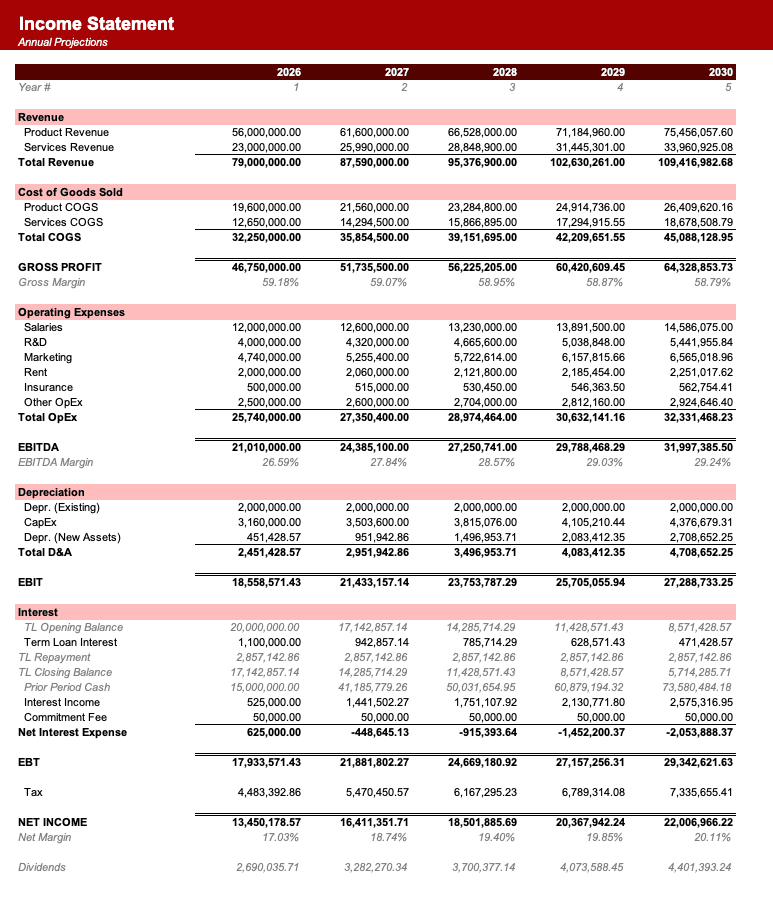
Formatted to IB standards
Named theme colors repaint the whole workbook in one click, on top of an investment-banking structure with clear input, output, and cross-sheet reference styling - brand-ready, institutional-grade, and fully auditable.

Created by ex-finance professionals
Hey, I’m Alex and I created Finamodel.
Over my years in the finance industry I kept building the same models over and over again. Same structure, same assumptions, different logo. So I started building frameworks to turn them into clean, reusable templates.
Every model here is one I’d actually use for a client, and I personally vet each one before it goes up.
I’m not an expert in every industry, but I’ve built enough models to know what belongs in one. And when something is completely foreign to me, I reach out to my network for experts to work on our models with us.
Having a template library on hand cuts a first build from hours to minutes.
Need help finding your model? You’ll find me in the Finamodel app!
Frequently asked
What is a family office financial model?+
A model that consolidates family assets, projects spending and tax obligations, and models wealth transfer strategies across generations.
What is a sustainable withdrawal rate for family offices?+
Typically 4-5% of assets per year adjusted for inflation, assuming long-term returns of 6-7% and a multi-decade investment horizon.
How does a trust differ from outright inheritance?+
A trust provides ongoing asset management, creditor protection, and tax benefits, whereas outright inheritance transfers full control immediately.
What is a GRAT?+
A Grantor Retained Annuity Trust transfers appreciated assets to beneficiaries while the grantor retains an income stream, reducing estate tax exposure.
Who uses family office financial models?+
Family office managers, wealth advisors, trustees, and high-net-worth individuals use them for succession planning, governance, and estate structuring.
Have more financial modelling questions? Contact us
Related templates
Sovereign Wealth Fund Portfolio Model
Asset allocation and performance tracking model for sovereign wealth funds showing allocation drift, returns, and rebalancing mechanics.
Pension Fund Asset Allocation Model
Liability-driven investment strategy, asset allocation, and funding ratio analysis for pension plan portfolios.
Endowment Fund Model
Multi-asset portfolio model for endowments with allocation, returns, spending, and perpetual sustainability.
DCF Model
Discounted cash flow valuation model with explicit forecast, terminal value, and WACC.