Ground Lease Economics Model
Real Estate Financial Model (Free Excel Download)
Model ground-lease economics through land rent, escalations, tenant improvements, property income, residual value, financing, and investor yield over the lease term.



professionals from Deloitte
Used by professionals from






About this model
This project finance model values a ground lease investment by forecasting rent escalation, calculating debt service coverage, and projecting levered and unlevered IRR over a 10-year hold. Answer: does the lessor generate sufficient NOI to support the debt and achieve target returns (8–14% levered IRR), and are refinancing/buyout economics attractive? Model a 99-year ground lease on a $20–50M commercial asset.
The workbook projects annual ground rent (base rent escalating at 2% p.a., typical for institutional ground leases), minimal operating expenses (3% of rent for legal/admin/insurance - triple-net structure shifts costs to lessee), and NOI approaching 97% of rent. Senior debt is sized at 55% LTV (conservative for non-recourse ground lease lending) and subjected to a 1.25× DSCR constraint, whichever binds first. Debt service using standard amortisation (25-year tenor matching the perpetual income stream). Exit valuation at Year 10 using forward NOI (Year 11) capitalised at 5% cap rate (50 bps wider than entry 4.5% reflecting shorter remaining term).
Used by institutional investors (pension funds, infra funds) acquiring fee-simple land under long-term leases, lenders structuring non-recourse mortgages on ground lease cash flows, and landowners evaluating whether to lease vs. develop. Ground leases offer ultra-long-duration income with near-zero operating cost. Reversion value (improvements revert to landowner at lease expiry) is typically not modelled in a 10-year hold (assumption is sale of leasehold interest). Benchmarks: Safehold (SAFE) operates 60–70% LTV; ground lease cap rates 3.5–5.5% depending on credit quality and term length.
What every model includes
Live formulas, no hardcoded values
Outputs are driven by live formulas, so the workbook updates from its assumptions instead of relying on hardcoded results.
All assumptions in one tab
Inputs are clearly marked in the Assumptions tab and separated from calculations, making it clear what to change and what to leave intact.
Statements always balancing
For integrated-statement models, the balance sheet, cash flow, and supporting schedules tie through properly.
Distinct schedules for clarity
Debt, working capital, taxes, and cash flow can get messy quickly. We group calculations in clear schedules, not across disconnected tabs.
No hidden macros or external links
There are no unexplained external workbook links or macros to undermine auditability or portability.
Changes flow through the model
Update a key driver and see the impact carry through the forecast, financing, and return outputs. We never use hardcoded numbers in formulas.
What's inside the Ground Lease Economics Model
- Annual ground rent with fixed and percentage escalations
- Building improvements and depreciation by asset class
- Lease expiration timeline and renewal probability assumptions
- Ground lease buyout valuation and financing scenarios
- Return analysis: IRR, cash yield, and unlevered returns before renewal risk
- Operating expenses and property taxes on long-term basis
Ground Lease Model: How Land Rent and Reversion Economics Work
This ground lease model evaluates the landowner’s risk-adjusted return from owning land under a long-term lease. It captures rent escalation, minimal lessor operating costs, DSCR-constrained mortgage sizing, and reversion value at sale or lease expiry.
The underlying workbook converts these drivers into levered IRR, MOIC, cash-on-cash return, and minimum DSCR for a mid-market institutional asset.
Operating drivers: ground rent, escalation, and minimal lessor expenses
The ground lease model focuses on contractual ground rent as the core revenue source. Base rent is usually derived from an initial yield on land value; the template sets it as land value multiplied by an initial rent yield.
- Rent then escalates annually, often at a fixed rate for simplicity. The lessor bears very limited costs because the tenant handles property-level expenses under a triple-net structure.
- Lessor-level operating expenses, such as legal, insurance, and administration, are small relative to rent, typically a low single-digit percentage. Because of this, net operating income stays close to gross rent, with the margin compressing only slightly over time if operating costs inflate faster than rent.
Calculation flow: loan sizing and amortisation under DSCR constraints
Loan sizing is a critical calculation flow. The model determines the loan amount as the minimum of an LTV-based cap and a DSCR-based cap.
- The DSCR cap is the Year 1 net operating income divided by the product of a target DSCR and an annual debt constant. That constant is the payment per dollar of loan principal at a given interest rate and amortisation term.
- Once sized, the debt schedule uses a standard level-payment mortgage: interest is the opening balance times the rate, principal is the payment minus interest, and the closing balance reduces accordingly. The model checks DSCR each year and confirms the balance declines.
This flow matters because lower-yield ground leases often hit the DSCR limit before the LTV limit, directly affecting how much debt the asset can support.
Key outputs: return metrics and exit value
The model produces several outputs for evaluating the investment. Levered IRR, MOIC, cash-on-cash return, and minimum DSCR are the main return metrics.
- Cash-on-cash return is defined as free cash flow to equity divided by initial equity. The exit value is calculated by capitalising forward net operating income, typically Year 11, at an exit cap rate that is usually modestly wider than the entry cap rate to reflect a shorter remaining lease term.
- Selling costs are deducted, and the outstanding loan balloon is repaid before net disposition proceeds are calculated. These proceeds then flow into the equity cash flow array for the IRR calculation.
The model uses a bare IRR formula so errors are visible rather than hidden, which helps maintain model integrity.
Practical use: scenario testing and decision support
This ground lease model helps a landowner assess whether a proposed lease generates adequate risk-adjusted returns. It can test how different rent escalation rates, entry yields, LTV assumptions, target DSCR levels, and exit caps affect levered returns.
- Because the DSCR constraint often limits debt capacity at lower yields, the model highlights the trade-off between leverage and covenant compliance. It also clarifies the impact of transaction and selling costs, balloon repayment, and operating cost inflation on equity returns.
- The structure is designed for a single-asset SPV with non-recourse debt. Users can compare base case outputs to target IRR, MOIC, and cash-on-cash hurdles, and the validation checks flag common errors such as DSCR breaches or balloon shortfalls.
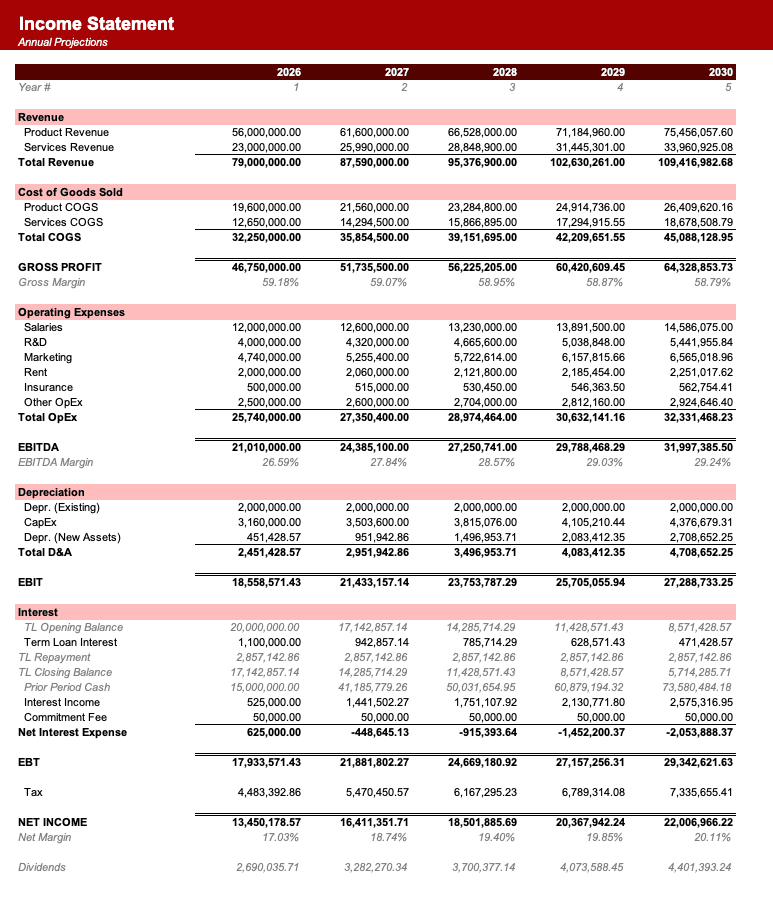
Formatted to IB standards
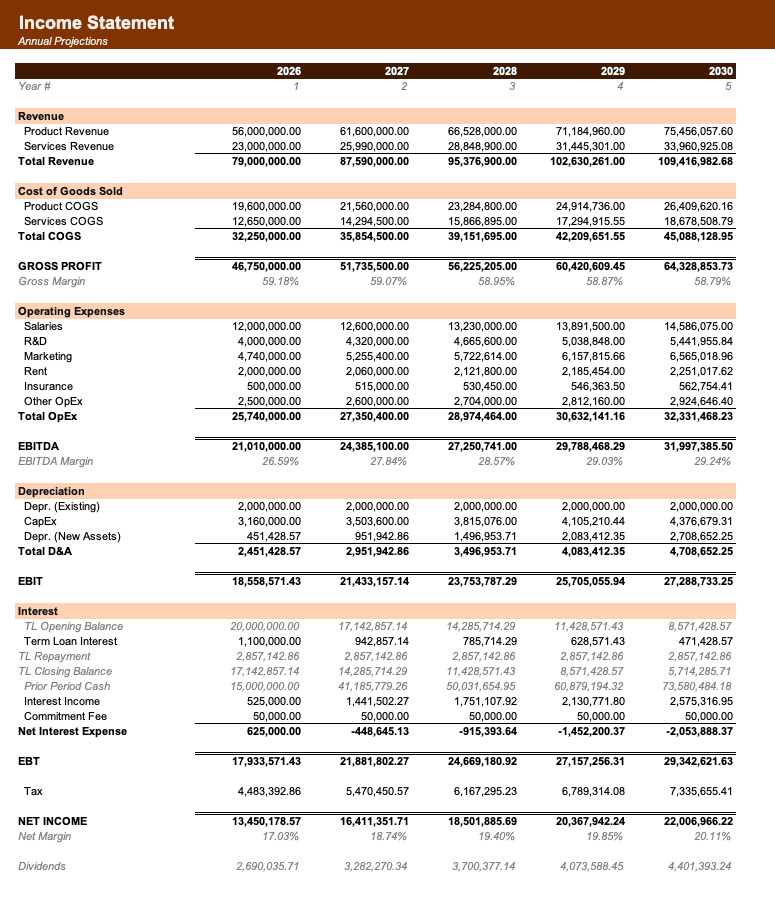
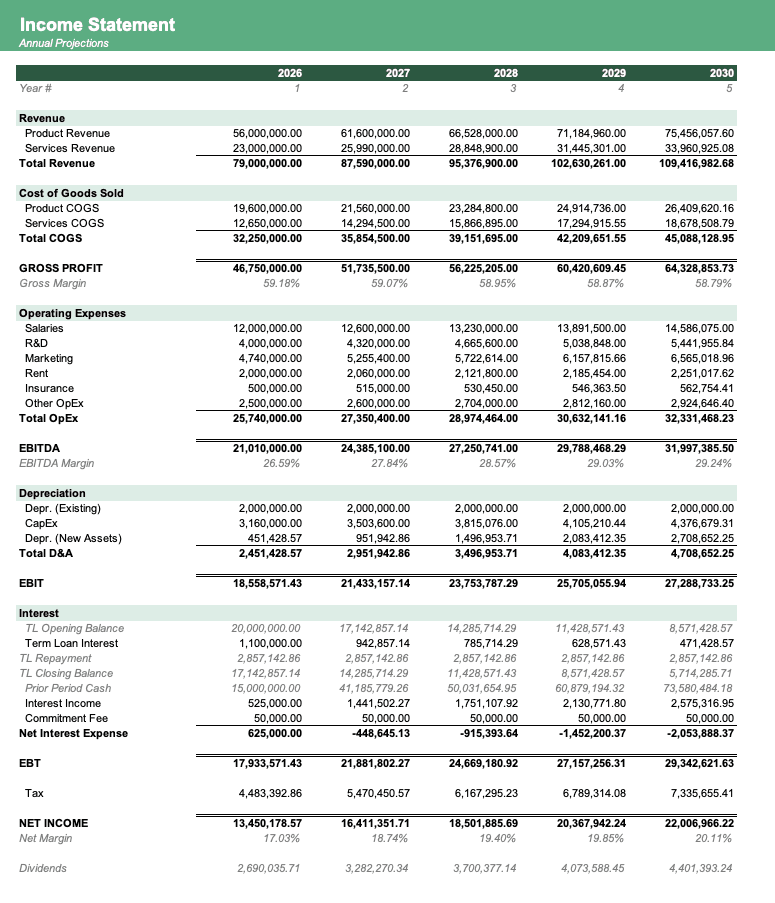
Named theme colors repaint the whole workbook in one click, on top of an investment-banking structure with clear input, output, and cross-sheet reference styling - brand-ready, institutional-grade, and fully auditable.

Created by ex-finance professionals
Hey, I’m Alex and I created Finamodel.
Over my years in the finance industry I kept building the same models over and over again. Same structure, same assumptions, different logo. So I started building frameworks to turn them into clean, reusable templates.
Every model here is one I’d actually use for a client, and I personally vet each one before it goes up.
I’m not an expert in every industry, but I’ve built enough models to know what belongs in one. And when something is completely foreign to me, I reach out to my network for experts to work on our models with us.
Having a template library on hand cuts a first build from hours to minutes.
Need help finding your model? You’ll find me in the Finamodel app!
Frequently asked
What is a ground lease financial model?+
A real estate model that values the economics of land leased to a building owner, including rent escalation, renewal risk, improvements, and buyout optionality.
How do I calculate ground lease buyout value?+
Use perpetuity of remaining ground rent at a cap rate typically 50-100 bps above comparable real estate deals, or a fixed multiple of 10-15x annual rent discounted to present value.
What renewal probability should I assume?+
Use 75-90% renewal probability for well-leased properties on favorable terms. Reduce to 50-75% if renewal terms are uncertain or the lease is near expiration.
How should I model building improvements on leasehold?+
Capitalize improvements and depreciate over the lesser of useful life or remaining lease term to avoid negative equity at expiration. Consider improvement recovery at renewal.
Who uses ground lease models?+
Real estate investors, REITs, asset managers, and development companies use them for investment underwriting, lease renewal negotiation, and securitization structuring.
Have more financial modelling questions? Contact us
Related templates
Real Estate Development Pro Forma Model
Land cost, construction budget, lease assumptions, and project IRR for commercial and residential development.
Sale-Leaseback Real Estate Model
Financing model for property owners selling real estate to investors and leasing it back, with lease terms, IRR, and tax deferral analysis.
Mixed-Use Real Estate Development
Financial model for mixed-use projects combining residential, commercial, and retail with phased development.
Hotel Operating Model
Operating model for hotel properties including occupancy rates, average daily rate (ADR), RevPAR optimization, and facility-level profitability.