Infrastructure Bond Valuation Model
Infrastructure Financial Model (Free Excel Download)
Price infrastructure bonds through construction and operations, linking project costs, drawdowns, coupons, reserves, refinancing, debt service, and investor yield.



professionals from Deloitte
Used by professionals from






About this model
This project finance model values infrastructure bonds (toll road concession) by forecasting toll revenue, calculating debt service coverage ratio (DSCR) and loan life coverage ratio (LLCR), and computing project and equity IRR over a 28-year projection (3-year construction + 25-year operations). Answer: can the project sustain 1.50× DSCR in all operating years and generate 10–14% equity IRR with traffic volume and tariff risks?
The workbook projects toll revenue from two streams: light vehicles (55,000 daily AADT × £2.80 toll × 365 × occupancy ramp 70%→100% Years 1–3, then 1.5% annual growth, 98% collection efficiency) and heavy vehicles (6,000 AADT × £8.40 = 3× light rate × 2% annual growth). Operating costs: toll collection 4% of revenue, routine O&M £160k/km (total £6.4M for 40km corridor), SPV management £2.8M, insurance £1.2M. All opex escalates at 2.5% CPI annually. Lifecycle capex: £30M major resurfacing (Years 12, 24), £4M tolling refresh (Years 8, 20). Senior debt: £381M drawn across construction, interest during construction (IDC) capitalised, repayment sculpted to hit 1.50× DSCR target.
Used by infrastructure funds, concession sponsors bidding on toll roads and ports, project lenders sizing non-recourse debt, and public authorities evaluating PPP vs. public delivery. The model reveals extreme traffic ramp sensitivity: 1% miss in traffic volume erodes Year 1 DSCR by ~50–100 bps. Toll escalation mechanics (CPI 2.5% p.a.) typically lag inflation (2.5%+), making real tariff decline a long-term headwind. Lifecycle capex lumpy nature requires careful DSRA/MMRA reserve sizing. Benchmarks: Transurban (TCL.AX), Ferrovial (FER.MC), Abertis - all operating toll roads at 70–85% EBITDA margins with 1.3–1.8× steady-state DSCR.
What every model includes
Live formulas, no hardcoded values
Outputs are driven by live formulas, so the workbook updates from its assumptions instead of relying on hardcoded results.
All assumptions in one tab
Inputs are clearly marked in the Assumptions tab and separated from calculations, making it clear what to change and what to leave intact.
Statements always balancing
For integrated-statement models, the balance sheet, cash flow, and supporting schedules tie through properly.
Distinct schedules for clarity
Debt, working capital, taxes, and cash flow can get messy quickly. We group calculations in clear schedules, not across disconnected tabs.
No hidden macros or external links
There are no unexplained external workbook links or macros to undermine auditability or portability.
Changes flow through the model
Update a key driver and see the impact carry through the forecast, financing, and return outputs. We never use hardcoded numbers in formulas.
What's inside the Infrastructure Bond Valuation Model
- Project revenue forecasts including tolls, concession fees, and user charges
- Operating expense and maintenance cost schedules
- Debt service schedule with interest and principal repayment
- Debt service coverage ratio and leverage covenants
- Subordinated equity returns and distribution waterfall
- Refinancing and balloon payment risk
Infrastructure Bond Model: Toll Road Concession Template
This infrastructure bond model template projects 28 years of a greenfield toll road concession, from construction through operations. It calculates debt service coverage ratios (DSCR) and loan life coverage ratios (LLCR) to evaluate bond viability.
The model incorporates traffic ramp-up, toll escalation, lifecycle capex and sculpted debt repayment, providing a structured framework for assessing project finance transactions. Rates and financial results described here reflect illustrative model settings, not industry benchmarks.
How the Model Works
The model is built for a greenfield toll road concession with a 3-year construction phase and 25 years of operations. It addresses whether a lender should subscribe to, or an equity fund co-invest in, the project.
- The model uses a non-recourse project finance structure where debt is secured against project assets and cash flows. Revenue comes from tolls on light and heavy vehicles, with no secondary streams.
- The projection covers 28 annual periods, and the model incorporates sector benchmarks for assumptions, such as traffic growth, toll escalation, and cost structures. The design emphasises accuracy in debt scheduling and concession asset accounting.
Key Operating Drivers
Revenue is driven by traffic volume and toll rates. Light vehicle traffic starts at 55,000 vehicles per day and ramps up to 100% over three years.
- Heavy vehicle traffic starts at 6,000 vehicles per day, with a 3x toll multiplier. Toll rates escalate annually at 2.5% (CPI), and traffic grows at 1.5% for light vehicles and 2.0% for heavy vehicles.
- Collection efficiency is 98%. Operating costs include toll collection (4% of revenue), routine O&M, SPV management, and insurance, all escalating with inflation.
These drivers create high operating leverage, as Opex is largely fixed. The model also accounts for lifecycle capex events like resurfacing and gantry refreshes, which are lumpy cash outflows.
Calculation Flow and Debt Sculpting
The model calculates cash flow available for debt service (CFADS) as EBITDA minus cash tax and lifecycle capex. Debt service is sculpted to target a DSCR of 1.50x.
- Repayment is the minimum of opening debt or the maximum of zero and (CFADS divided by target DSCR minus interest). This ensures debt service aligns with project cash flows.
- The model tracks interest during construction (IDC) and capitalises it into the opening debt at commercial operation date (COD). The debt schedule begins at COD, avoiding double-counting.
DSCR is computed annually, and LLCR uses the net present value of remaining CFADS divided by opening debt. Distributions to equity are gated by a minimum DSCR covenant of 1.20x.
Outputs and Practical Use
The model outputs project IRR (unlevered) and equity IRR (levered), NPV, payback period, and break-even traffic volume. It also includes validation checks like balance sheet balance, debt zero at maturity, and concession asset zero at end.
- The template is useful for lenders and equity investors assessing toll road concessions. It is a values-only preview, so it does not contain live formulas or automatically recalculate.
- Users can examine the modelled relationships to understand how traffic, tolls, costs, and debt interact. The model assumes no terminal value, with all returns realised within the concession window.
It provides a structured framework for evaluating infrastructure bond investments.
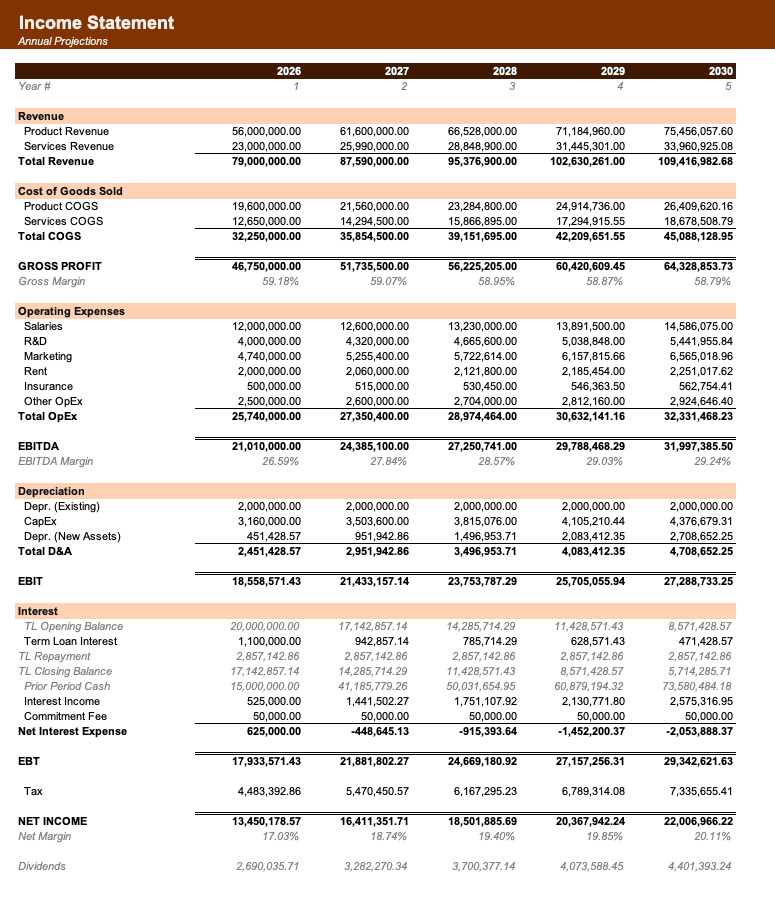
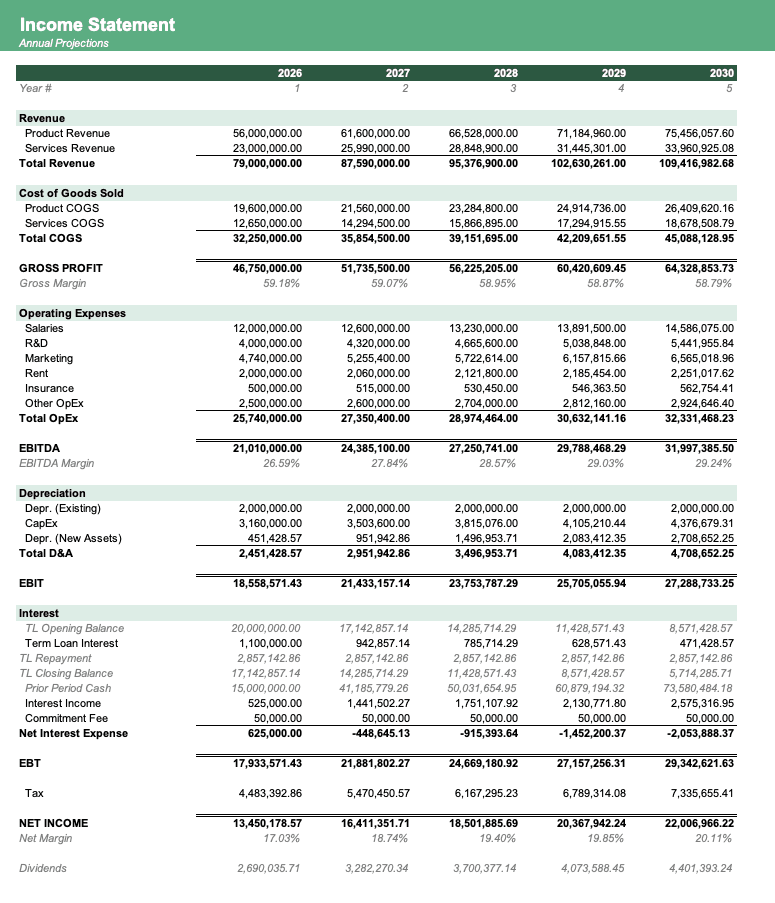
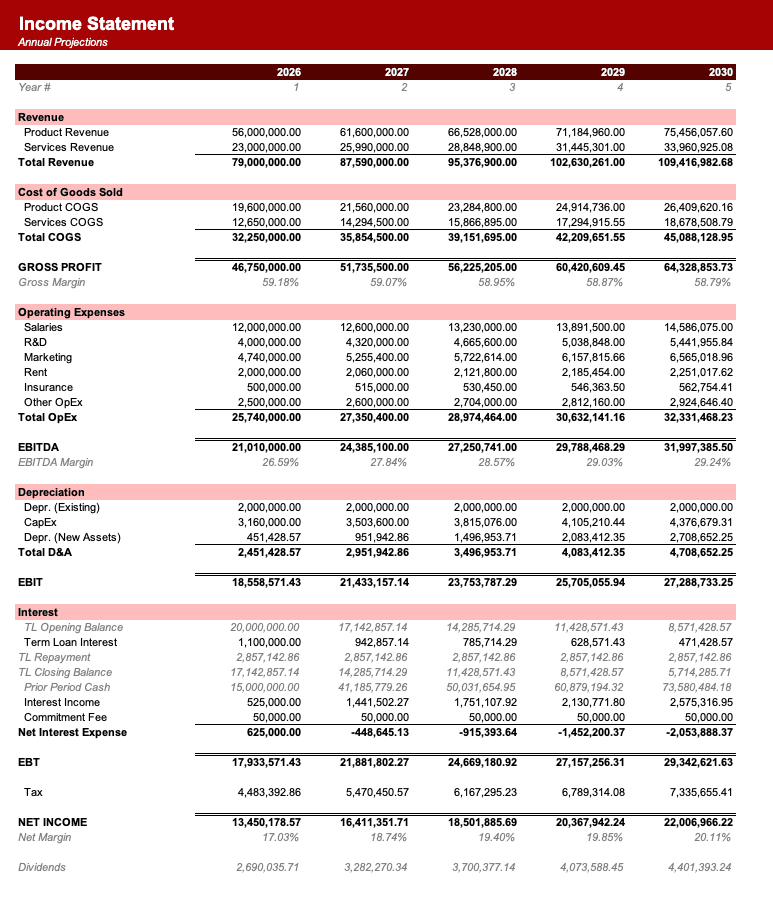
Formatted to IB standards
Named theme colors repaint the whole workbook in one click, on top of an investment-banking structure with clear input, output, and cross-sheet reference styling - brand-ready, institutional-grade, and fully auditable.

Created by ex-finance professionals
Hey, I’m Alex and I created Finamodel.
Over my years in the finance industry I kept building the same models over and over again. Same structure, same assumptions, different logo. So I started building frameworks to turn them into clean, reusable templates.
Every model here is one I’d actually use for a client, and I personally vet each one before it goes up.
I’m not an expert in every industry, but I’ve built enough models to know what belongs in one. And when something is completely foreign to me, I reach out to my network for experts to work on our models with us.
Having a template library on hand cuts a first build from hours to minutes.
Need help finding your model? You’ll find me in the Finamodel app!
Frequently asked
What DSCR levels correspond to different credit ratings?+
AAA/AA typically requires DSCR above 2.0x, A requires 1.5-2.0x, BBB requires 1.25-1.5x, and below-investment-grade implies coverage below 1.25x. Thresholds vary by project risk and sponsor strength.
How do I model refinancing risk?+
Assume refinancing at maturity using then-current interest rates. Run a base case with flat rates and a stress scenario with rates 100-200bps higher, then assess whether DSCR remains sufficient.
What is an appropriate traffic or revenue growth assumption?+
Use conservative near-term growth of 1-3% annually for mature projects and 5-10% for growing markets, with growth flattening in later years. Incorporate stochastic traffic scenarios for downside analysis.
Who uses infrastructure bond models?+
Fixed income investors, project finance teams, rating agencies, and infrastructure funds use these models for credit analysis, investment decisions, and deal structuring.
How does subordination affect bond returns?+
Senior bonds receive payment before subordinated debt and equity. Higher subordination provides a thicker loss buffer, enabling lower coupon rates and stronger credit ratings for senior tranches.
Have more financial modelling questions? Contact us
Related templates
Toll Road Concession Model
Model toll road cash flows, traffic demand, toll rate escalation, and debt service with concession life assumptions.
Infrastructure Concession and Toll Road Model
Concession agreement model for toll roads, airports, and ports including traffic/volume forecasts, tariff escalation, and equity returns.
Bond Trading Model
Fixed income trading desk P&L and risk analytics.
Fibre Network Deployment Model
Capital and financial model for fiber optic network buildout with capex, subscribers, and ARPU.


