Infrastructure Concession and Toll Road Model
Infrastructure Financial Model (Free Excel Download)
Forecast concession traffic or availability revenue, lifecycle costs, reserve accounts, debt service, and investor returns across a long-term infrastructure contract.



professionals from Deloitte
Used by professionals from






About this model
This project finance model values a PPP/availability-payment concession (hospital, school, sports facility) by forecasting fixed contractual availability revenue indexed to CPI, calculating sculpted debt service, and computing project and equity IRR over the 22–25 year concession term. Answer: given fixed unitary charges with CPI escalation, what capital structure (debt/equity ratio) and debt service sculpting (S-curve, S/Z-curve hybrid) maximises equity returns while maintaining 1.20× minimum DSCR throughout operations?
The workbook projects annual availability revenue (£30M Year 1, CPI escalation 2.5% p.a., 2% unavailability deduction for performance shortfalls). Operating costs passed through to FM subcontractor via back-to-back fixed-price contracts: £4M O&M, £1.5M SPV management, £0.75M insurance (all escalate at CPI). EBITDA margin stable ~82% across the concession life (both revenue and costs CPI-indexed). Senior debt: 85% gearing sculpted to hit 1.20x–1.50x DSCR over 22-year tenor (S-curve: low early payments ramping as availability revenue escalates). Shareholder loans (30% of equity tranche at 10% rate) repaid Years 1–7. DSRA funding (6 months senior DS) required at close. MMRA (Major Maintenance Reserve) accumulates for lifecycle capex (£20–25M events Years 10, 15, 20).
Used by infrastructure sponsors bidding PPP contracts, equity co-investors in social infrastructure, project lenders on NHS/education/sports projects, and public authorities structuring DBFOM deals. The key structural advantage: no volume or demand risk (unlike toll roads). Downside: government counterparty credit (typically AAA-rated but subject to political risk and budget appropriations), unavailability deductions on service failures, and lifecycle capex volatility. Benchmarks: European PPP markets show 1.2–1.5× entry DSCR, 8–12% project IRR, 12–16% equity IRR post-fees. UK PFI/PPP legacy shows £50B+ in infrastructure financed via availability-payment model.
What every model includes
Live formulas, no hardcoded values
Outputs are driven by live formulas, so the workbook updates from its assumptions instead of relying on hardcoded results.
All assumptions in one tab
Inputs are clearly marked in the Assumptions tab and separated from calculations, making it clear what to change and what to leave intact.
Statements always balancing
For integrated-statement models, the balance sheet, cash flow, and supporting schedules tie through properly.
Distinct schedules for clarity
Debt, working capital, taxes, and cash flow can get messy quickly. We group calculations in clear schedules, not across disconnected tabs.
No hidden macros or external links
There are no unexplained external workbook links or macros to undermine auditability or portability.
Changes flow through the model
Update a key driver and see the impact carry through the forecast, financing, and return outputs. We never use hardcoded numbers in formulas.
What's inside the Infrastructure Concession and Toll Road Model
- Traffic, passenger, or cargo volume forecasts for the full concession term
- Tariff or toll rate escalation linked to inflation or contract-defined schedules
- Operating and maintenance costs tied to volume and inflation
- Reinvestment capex requirements and reserves
- Equity cash flows and return on investment including IRR and MoIC
- Refinancing and debt maturity profile
How an Availability-Payment Infrastructure Concession Model Works
This template presents a 25-year availability-payment infrastructure concession model for a social infrastructure PPP. It forecasts a three-year construction phase and a 22-year operating phase, sizes senior debt in closed form, runs a full cash waterfall with reserves, and reports project and equity returns measured from financial close.
The public download is a values-only preview.
What Drives the Availability Payment
The model is an availability-payment concession: the authority pays a unitary charge for each year the asset is available to specification, so there is no volume risk. The base unitary charge is the model's single calibration input, not an observed market figure.
- It is back-solved so that the payment covers construction, senior debt service, operating and lifecycle costs, tax and handback, while still delivering a market equity return. The charge is split 65/35 between an indexed portion escalated at CPI and a fixed portion, which is the structural source of the SPV's inflation exposure.
- Deductions for availability and performance failures reduce the gross charge, subject to a contractual annual cap. Third-party income is modelled only as a small ancillary stream, net of an authority revenue share.
Construction Funding and Debt Sizing
Construction is modelled as a real three-year build using an input S-curve of 20, 45 and 35 per cent, with two spare slots. The cost stack includes EPC milestones, contingency, development fee, owner costs, insurance, advisory and legal fees.
- Financing costs are expressed as coefficients per dollar of facility, which lets the model solve the senior facility algebraically in one step rather than iterating. The facility must fund its own arrangement fee, commitment fee, interest during construction and debt service reserve.
- Two sizing legs are compared: a gearing cap and a DSCR capacity test, with the binding constraint reported. The deal is leverage-constrained at the shipped inputs.
A funding-order switch selects pro-rata or equity-first drawdown.
Operating Costs, Tax and Cash Flow
Operating costs cover hard and soft facilities management, SPV management, insurance and a final-year handback survey. Soft FM is subject to market testing at operating years five and ten, which steps up its cost, and it escalates at wage inflation above CPI; this is the main source of margin decay across the concession.
- Tax is a genuine computation with interest deductibility and loss carry-forward, plus a separate unlevered tax stream for project returns. CFADS is EBITDA less tax payable, excluding lifecycle capex, because the debt service reserve and lifecycle reserve fund those events.
- A strict waterfall then pays senior interest and principal, funds reserves, services the shareholder loan subject to a cash gate, and distributes to equity only if the lock-up test passes.
Returns, Sensitivities and Practical Use
The model reports project and equity IRR, NPV, multiple and payback from financial close. The equity return stream combines ordinary equity and shareholder loan contributions as outflows during construction with distributions, shareholder loan interest and principal as inflows during operations.
- Three cases are switchable: Base, Downside and Lender, changing CPI, deductions, lifecycle overrun and operating cost overrun; the deduction cap can bind in the Downside case. Two-way data tables on equity IRR flex gearing and senior rate, and CPI and availability deductions.
- The Checks sheet holds 21 integrity tests against named thresholds. The underlying model is suited to evaluating an availability-payment social infrastructure PPP, not demand-risk toll roads.
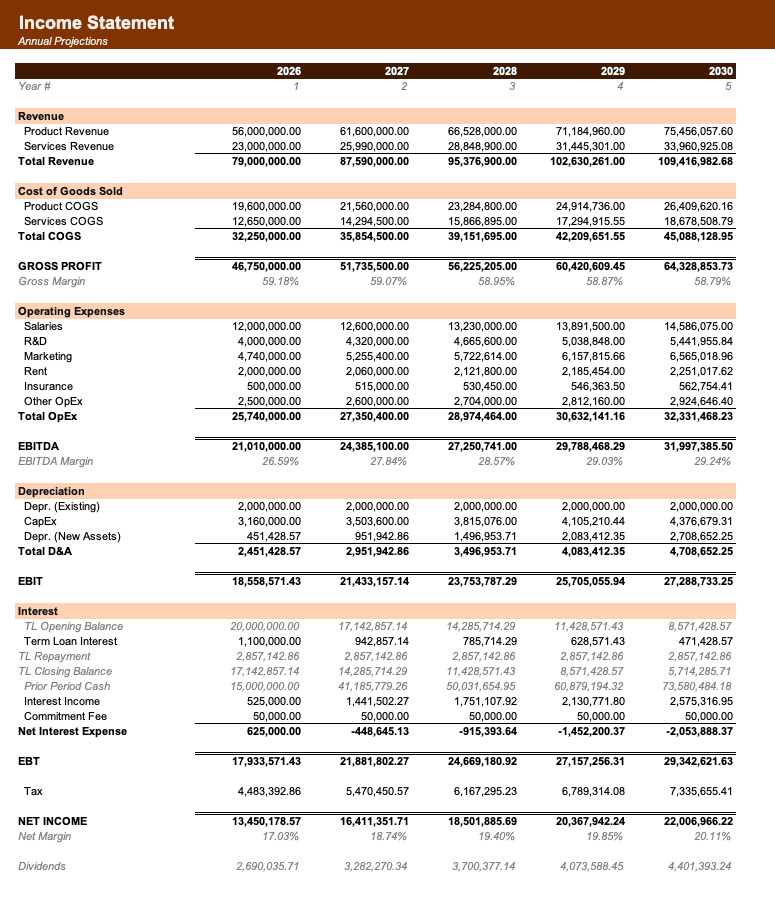
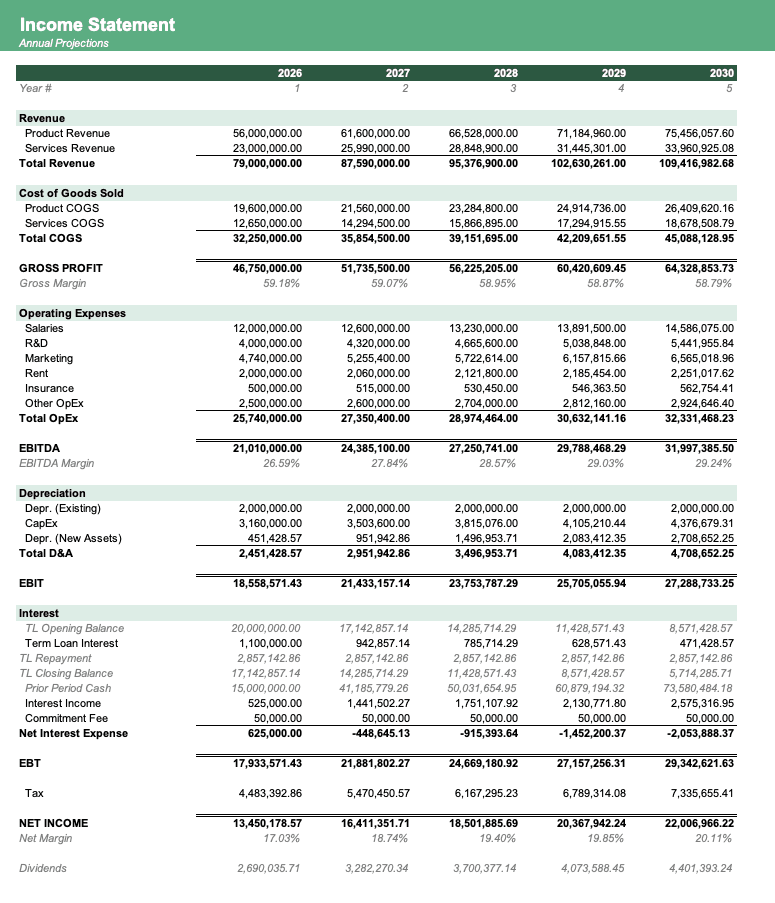
Formatted to IB standards
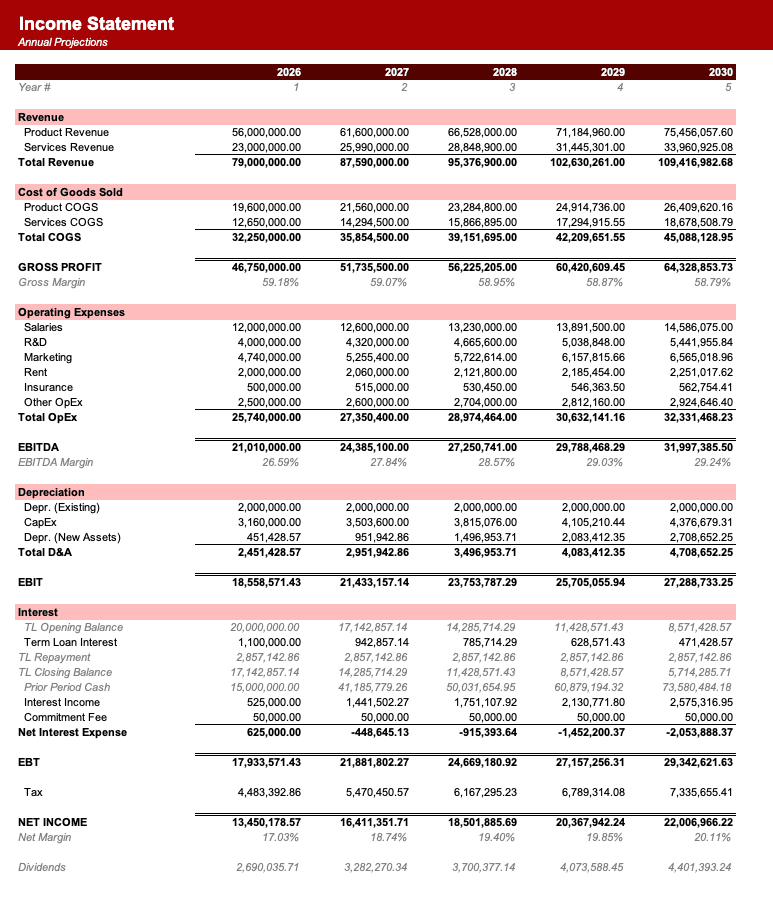
Named theme colors repaint the whole workbook in one click, on top of an investment-banking structure with clear input, output, and cross-sheet reference styling - brand-ready, institutional-grade, and fully auditable.

Created by ex-finance professionals
Hey, I’m Alex and I created Finamodel.
Over my years in the finance industry I kept building the same models over and over again. Same structure, same assumptions, different logo. So I started building frameworks to turn them into clean, reusable templates.
Every model here is one I’d actually use for a client, and I personally vet each one before it goes up.
I’m not an expert in every industry, but I’ve built enough models to know what belongs in one. And when something is completely foreign to me, I reach out to my network for experts to work on our models with us.
Having a template library on hand cuts a first build from hours to minutes.
Need help finding your model? You’ll find me in the Finamodel app!
Frequently asked
How do I forecast traffic growth for a toll road?+
Link near-term growth to GDP and population, typically 2-4% annually for mature corridors, declining to 1-2% in outer years. Apply elasticity adjustments if toll rates rise significantly and stress-test for recession.
How are tariff escalation mechanisms structured?+
Common mechanisms include annual fixed escalation (for example 2.5%), CPI-linked adjustments, or a basket of indices. Some concessions include tariff caps or floors that should be modeled in both upside and downside cases.
What reinvestment capex should I assume?+
Reserve 3-8% of annual EBITDA for pavement resurfacing, bridge maintenance, and modernization. Reinvestment capex typically increases in later concession years as assets age.
Who uses infrastructure concession models?+
Infrastructure investors, concession operators, project finance teams, and public-private partnership advisors use these models for bid pricing, tariff negotiation, and capital management.
What is the typical length of a concession agreement?+
Concession terms range from 20 to 50 years depending on asset type, government policy, and required investor returns. Longer terms provide more time to recover capital but introduce greater volume and tariff uncertainty.
Have more financial modelling questions? Contact us
Related templates
Project Finance Debt Sculpting Model
Optimized debt schedules, amortization profiles, and DSCR tailoring for project finance and infrastructure loans.
Infrastructure Bond Valuation Model
Valuation model for infrastructure bonds including project cash flows, debt service coverage, and credit rating sensitivity.
Toll Road Concession Model
Model toll road cash flows, traffic demand, toll rate escalation, and debt service with concession life assumptions.
Fibre Network Deployment Model
Capital and financial model for fiber optic network buildout with capex, subscribers, and ARPU.