Project Finance Debt Sculpting Model
Infrastructure Financial Model (Free Excel Download)
Size and sculpt project debt against cash flow, minimum DSCR, repayment timing, reserve requirements, and equity returns across the project life.



professionals from Deloitte
Used by professionals from






About this model
Design project debt repayment profiles that maintain target debt service coverage ratios (typically 1.25–1.30x) across changing project cash flows, from construction through mature operations. This template sculpts annual principal repayment as CFADS (cash flow available for debt service) grows, ensuring lenders maintain consistent coverage while equity receives maximum distributions after debt service. The model handles interest-only construction and early operations periods, then transitions to amortising debt during the stable cash generation phase.
The workbook includes a construction phase with capex phasing (S-curve), interest during construction accruals, a revenue model (toll revenue, PPA revenue, or concession availability payments depending on project type), an opex schedule, and a debt schedule sheet that calculates sculpted principal as MAX(0, CFADS/DSCR_Target − Interest_Expense). DSRA (debt service reserve account) is pre-funded at commercial operations date and monitored throughout. The waterfall prioritizes debt service, covenant calculations (DSCR, leverage), and equity lock-up mechanics (when DSCR drops below 1.15x, equity distributions are suspended). Project IRR and equity IRR are calculated from separate cash flow streams, showing leverage amplification.
Target users are project sponsors, infrastructure funds, pension funds, and project finance lenders evaluating greenfield projects, concessions, and infrastructure assets valued at $500M to $5B+.
What every model includes
Live formulas, no hardcoded values
Outputs are driven by live formulas, so the workbook updates from its assumptions instead of relying on hardcoded results.
All assumptions in one tab
Inputs are clearly marked in the Assumptions tab and separated from calculations, making it clear what to change and what to leave intact.
Statements always balancing
For integrated-statement models, the balance sheet, cash flow, and supporting schedules tie through properly.
Distinct schedules for clarity
Debt, working capital, taxes, and cash flow can get messy quickly. We group calculations in clear schedules, not across disconnected tabs.
No hidden macros or external links
There are no unexplained external workbook links or macros to undermine auditability or portability.
Changes flow through the model
Update a key driver and see the impact carry through the forecast, financing, and return outputs. We never use hardcoded numbers in formulas.
What's inside the Project Finance Debt Sculpting Model
- Project cash flow from operations and capex schedule
- Debt sizing based on DSCR targets and lender requirements
- Tailored amortisation schedule matching project cash flow profile
- Interest reserve and cash sweep mechanics
- Debt service coverage ratio monitoring by year
- Debt size calculation based on DSCR targets
- Tailored amortization schedule matching project maturity
- Sponsor equity IRR under sculpted debt profile
Project Finance Sculpting Model: How Debt Sizing and Amortisation Work
This project finance sculpting model structures senior debt so repayments track a target coverage ratio rather than a flat schedule. It covers traffic-driven revenue, operating costs, reserve accounts, a refinancing, and an equity waterfall over a full concession life, letting you examine how gearing caps, coverage covenants and cash sweeps interact in one consistent framework.
Operating Drivers and Revenue Build-Up
Revenue starts with base traffic for each tolled segment, split by vehicle class.
- A net demand factor combines a phased structural growth rate, a GDP-linked contribution, a ramp-up vector, price elasticity and diversion to a free alternative.
- Tolls escalate with a CPI-linked formula subject to a cap and periodic regulatory resets, and peak pricing lifts the revenue base.
- Leakage from violations and bad debt reduces gross toll income to net revenue, while service areas, advertising and utility leasing add smaller income streams.
Cost Structure and Reserves
Operating costs are fully indexed to CPI and include routine O&M driven by traffic and axle weight, tolling system costs per transaction, policing, employee costs, insurance and property taxes.
- Concession and grantor payments sit inside EBITDA.
- Routine lifecycle capex and lumpy major maintenance events are funded partly through a Major Maintenance Reserve Account with a look-forward accrual, while a handback reserve builds over the final operating years.
- Both reserves open and close at zero, acting as timing devices only.
Debt Sizing and Amortisation
Debt capacity is calculated as the present value of pre-tax CADS divided by a target DSCR across the amortising window, discounted at the all-in rate to the end of the interest-only period.
- Senior debt raised is the lower of this capacity and a gearing cap applied to total project cost.
- A scale factor then adjusts the sculpted principal so that the loan amortises at a realised DSCR equal to the target divided by the scale.
- If the gearing cap binds, realised coverage is higher and flatter than the sizing target.
Waterfall, Refinancing and Outputs
A cash waterfall funds construction, services debt, tops up reserves and distributes the residual above a minimum cash balance, subject to a lock-up if coverage falls below a threshold.
- A cash sweep prepays debt only when coverage clears a trigger.
- At senior maturity the model refinances the remaining balance, sized against DSCR and PLCR caps, with proceeds flowing through the waterfall.
- Outputs include DSCR, LLCR and PLCR profiles, project and equity IRRs, and a dashboard of KPIs for evaluating the structure.
Formatted to IB standards
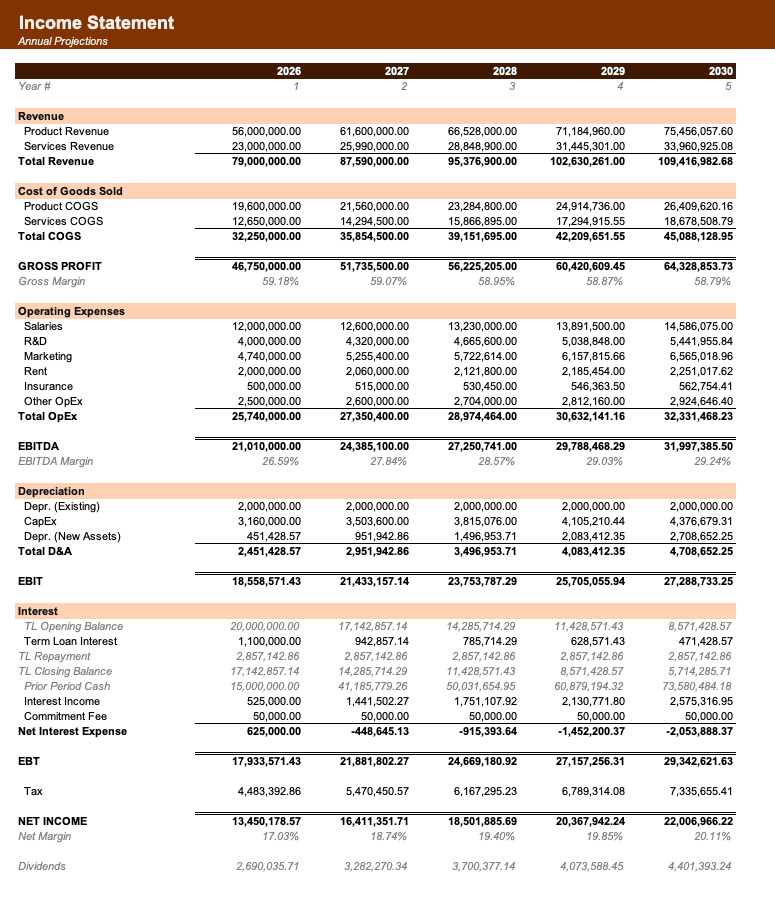
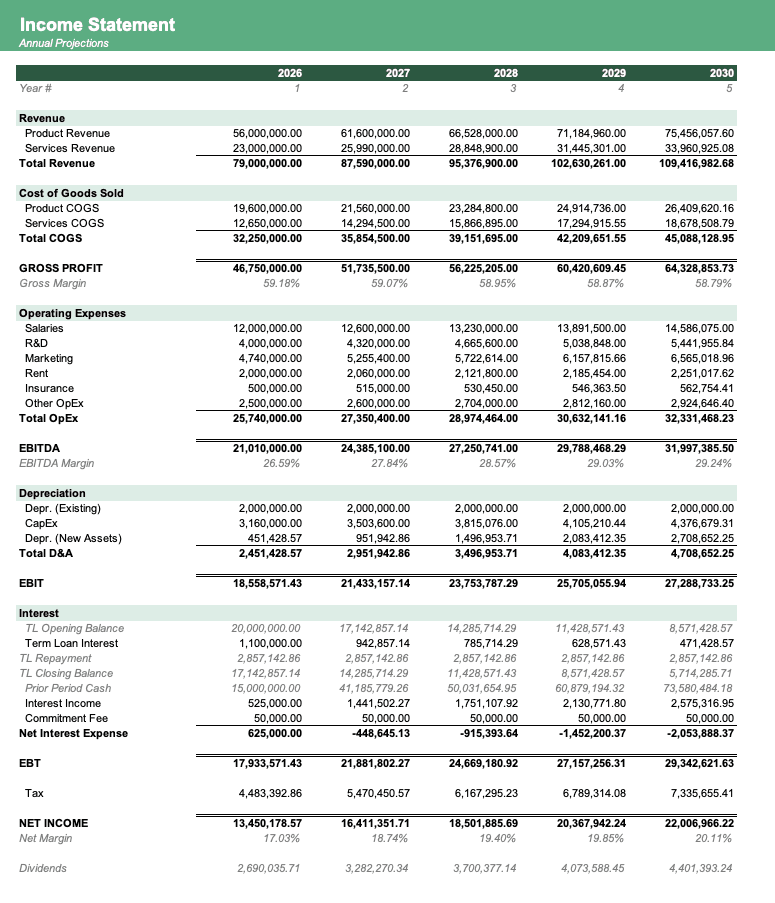
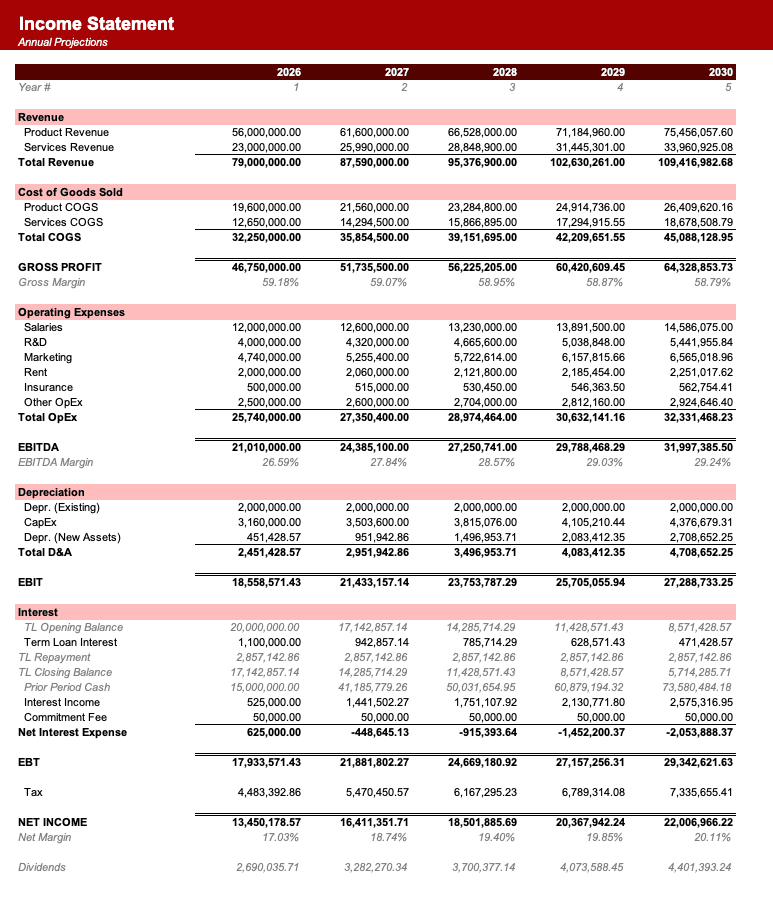
Named theme colors repaint the whole workbook in one click, on top of an investment-banking structure with clear input, output, and cross-sheet reference styling - brand-ready, institutional-grade, and fully auditable.

Created by ex-finance professionals
Hey, I’m Alex and I created Finamodel.
Over my years in the finance industry I kept building the same models over and over again. Same structure, same assumptions, different logo. So I started building frameworks to turn them into clean, reusable templates.
Every model here is one I’d actually use for a client, and I personally vet each one before it goes up.
I’m not an expert in every industry, but I’ve built enough models to know what belongs in one. And when something is completely foreign to me, I reach out to my network for experts to work on our models with us.
Having a template library on hand cuts a first build from hours to minutes.
Need help finding your model? You’ll find me in the Finamodel app!
Frequently asked
What is debt sculpting in project finance?+
Debt sculpting tailors the amortisation schedule to the project cash flow profile so that debt service coverage ratios stay above covenant minimums throughout the loan life.
What is a typical project finance DSCR requirement?+
Minimum DSCRs typically range from 1.20x to 1.50x depending on project risk, lender appetite, and asset class. Riskier projects require higher coverage buffers.
Why is debt sculpting better than straight-line amortisation?+
It allows sponsors to maximise the upfront debt draw while ensuring coverage covenants are met throughout project life, which improves equity returns without breaching lender terms.
Can I model interest reserves and cash sweeps?+
Yes. The model tracks reserves funded at financial close and applies cash sweep mechanics to accelerate paydown when project cash flow exceeds target levels.
How do I stress test debt service coverage?+
Run downside cash flow scenarios against the sculpted debt schedule to evaluate how much revenue can fall before covenant thresholds are breached.
Have more financial modelling questions? Contact us
Related templates
Public-Private Partnership Availability Model
Revenue availability model, unitary payments, debt service coverage, and equity IRR for PPP infrastructure projects.
Railway Concession and Operations Model
Passenger and freight revenue, operating costs, capital investment, and concessionaire returns for railway projects.
Toll Road Concession Model
Model toll road cash flows, traffic demand, toll rate escalation, and debt service with concession life assumptions.
Fibre Network Deployment Model
Capital and financial model for fiber optic network buildout with capex, subscribers, and ARPU.


