

The effective sculpting DSCR = the NPV of pre-financing CFADS ÷ senior debt drawnPPP Availability Model
Infrastructure Financial Model (Free Excel Download)
Evaluate public-private partnership payments using availability fees, service deductions, lifecycle costs, financing, reserve accounts, debt service, and equity returns.
DownloadSign up to downloadFree, no credit card required
Edit in Excelprofessionals from Deloitte
Loading...
Used by professionals from






About this model
Determine PPP infrastructure project viability under availability-payment structuring, where the government grantor guarantees a minimum annual unitary fee regardless of usage, reducing private sector demand risk. This template projects project traffic demand and corresponding toll/usage revenue, models availability payment mechanics with inflation indexing, and calculates debt service coverage ratio (DSCR) by year. The debt sculpting mechanism maintains target DSCR (typically 1.25–1.35x) by tailoring principal repayment as usage rises, while interest-reserve accounts ensure lenders are protected during ramp-up.
The workbook includes traffic forecasts with ramp-up profiles (new infrastructure typically reaches 80–100% of mature demand over 2–3 years), opex assumptions (O&M scales with asset condition and usage), a debt schedule with sculpted amortisation, and a waterfall that prioritizes debt service, covenant monitoring (DSCR, leverage ratios), equity distributions, and reserve funding. The model calculates both project IRR (on unlevered cash flows) and equity IRR (on levered distributions). It handles both operating years and any construction phase with interest capitalization.
Target users are pension funds, infrastructure investment advisors, public-sector sponsors, and project finance lenders evaluating PPP projects ranging from toll roads and rail concessions to water/utility assets valued at $500M to $5B+.
What every model includes
Live formulas, no hardcoded values
Outputs are driven by live formulas, so the workbook updates from its assumptions instead of relying on hardcoded results.
All assumptions in one tab
Inputs are clearly marked in the Assumptions tab and separated from calculations, making it clear what to change and what to leave intact.
Statements always balancing
For integrated-statement models, the balance sheet, cash flow, and supporting schedules tie through properly.
Distinct schedules for clarity
Debt, working capital, taxes, and cash flow can get messy quickly. We group calculations in clear schedules, not across disconnected tabs.
No hidden macros or external links
There are no unexplained external workbook links or macros to undermine auditability or portability.
Changes flow through the model
Update a key driver and see the impact carry through the forecast, financing, and return outputs. We never use hardcoded numbers in formulas.
What's inside the PPP Availability Model
- Unitary charge calculation with indexation and abatement logic
- Sculpted debt sizing to target constant DSCR
- Lifecycle maintenance reserve funding and release mechanics
- Construction phase modelling with interest capitalisation
- Equity IRR and project-level return outputs
- Traffic or usage forecast assumptions and growth rates
- Availability payment calculation and annual escalation
- Operating expense and maintenance cost schedules
PPP Availability Model: How the Template Works and When to Use It
This PPP availability model template lets you evaluate an availability-payment PPP for social infrastructure. It covers a 25–30 year concession, with revenue driven by an indexed unitary charge, sculpted senior debt to a target DSCR, lifecycle reserve mechanics, and equity return analysis.
Use it to check whether a project earns acceptable equity returns while debt clears covenants.
Revenue drivers and cost structure
The PPP availability model template captures revenue through a single indexed unitary charge. The gross payment grows annually by an inflation factor.
- Deductions for unavailability and poor performance are subtracted to arrive at net availability revenue. Crucially, there is no demand or volume term in the revenue build.
- This reflects the availability-payment structure, where the SPV bears no demand risk. Operating costs are split into hard and soft facilities management, insurance, and SPV administration.
Lifecycle major maintenance is handled separately via a reserve account, not as an annual P&L line, because refurbishment spend is lumpy and pre-funded.
Debt sculpting and cover ratios
Senior debt is sculpted to a target DSCR. The effective sculpting DSCR is calculated as the NPV of pre-financing CFADS divided by senior debt drawn.
- Principal repayments are set so that total debt service equals the target, amortising the loan exactly over the tenor. This avoids a balloon payment at maturity.
- The covenant DSCR floor is a separate input used only for verification, not to floor the sculpt ratio. The model also computes DSCR, LLCR, and PLCR.
Pre-financing CFADS excludes tax to keep the model non-circular. These mechanics help you assess whether the debt structure is robust under the project's cash flows.
Cash flow waterfall and reserves
The cash flow waterfall follows strict priority. CFADS equals EBITDA minus tax and working capital changes.
- From CFADS, senior debt service is paid first, then any DSRA top-up, then the MMRA contribution. What remains is distributable cash, which is paid out as equity distributions, with any residue retained.
- Two reserve accounts are central: the DSRA, funded at COD and maintained at a target based on forward debt service, and the MMRA, which accumulates a level annual charge to fund periodic refurbishment every fifth operating year. The model includes checks to ensure neither reserve goes negative and that deductions do not exceed gross revenue.
Outputs and practical use
The model produces project and equity IRRs, NPVs, MOIC, and payback, alongside a full three-statement set that balances each period. It includes integrity checks for sources and uses, debt repayment, DSCR compliance, and reserve balances.
- Two sensitivity grids show how equity IRR responds to construction-cost overruns and availability-deduction rates, and how minimum DSCR varies with senior margin and indexation. This template is designed for evaluating availability-payment PPPs in social infrastructure.
- It is not a demand-risk model. The public download is a values-only preview, so you can explore the relationships without live formulas.
income_statement.xlsx
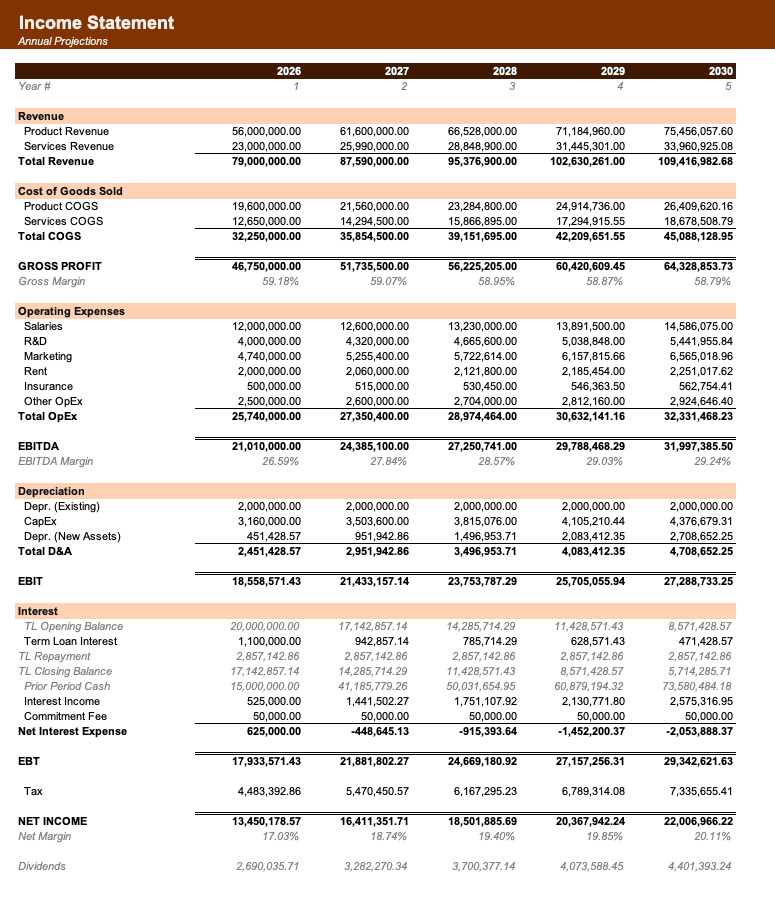
income_statement.xlsx
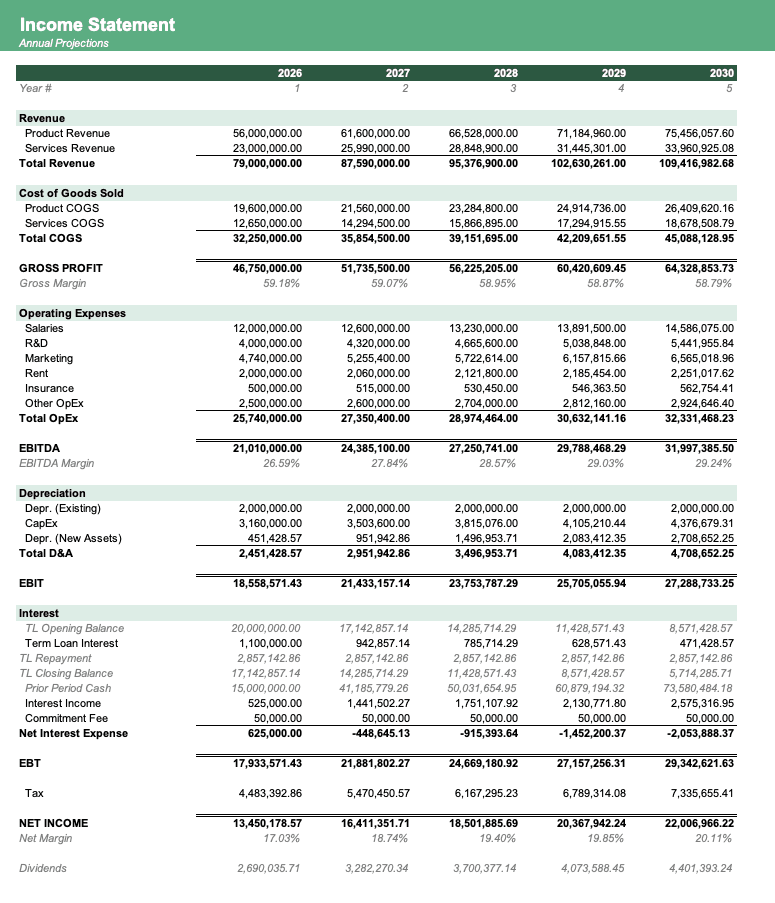
income_statement.xlsx
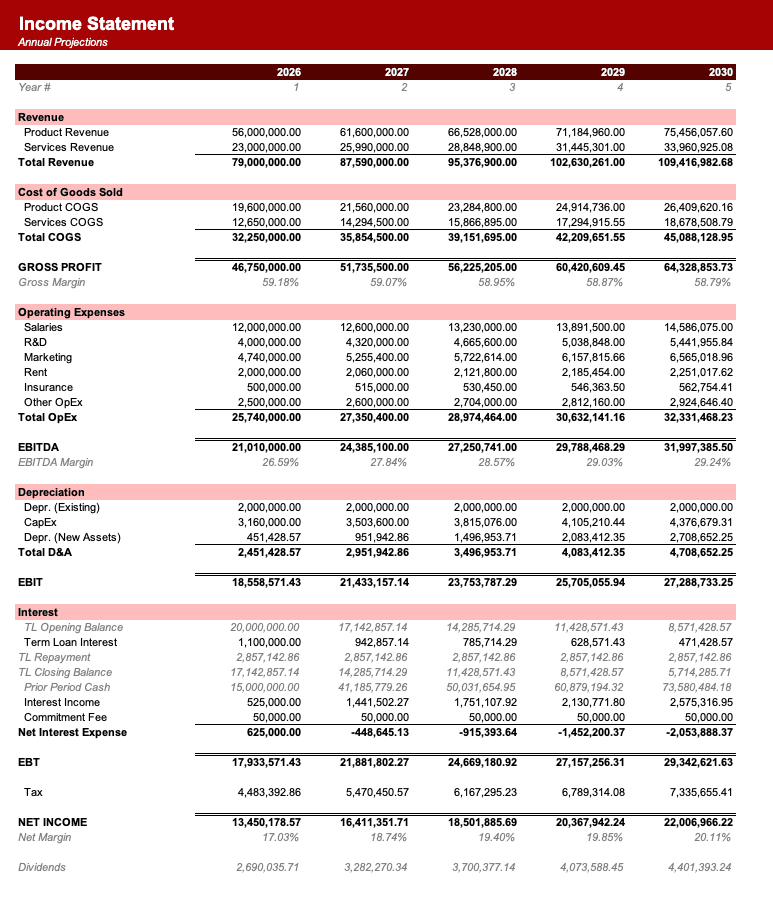
Formatted to IB standards
Named theme colors repaint the whole workbook in one click, on top of an investment-banking structure with clear input, output, and cross-sheet reference styling - brand-ready, institutional-grade, and fully auditable.

Created by ex-finance professionals
Hey, I’m Alex and I created Finamodel.
Over my years in the finance industry I kept building the same models over and over again. Same structure, same assumptions, different logo. So I started building frameworks to turn them into clean, reusable templates.
Every model here is one I’d actually use for a client, and I personally vet each one before it goes up.
I’m not an expert in every industry, but I’ve built enough models to know what belongs in one. And when something is completely foreign to me, I reach out to my network for experts to work on our models with us.
Having a template library on hand cuts a first build from hours to minutes.
Need help finding your model? You’ll find me in the Finamodel app!
Frequently asked
What is a PPP availability payment model?+
It is a project finance model for public-private partnerships where the private partner earns revenue through availability payments rather than user charges or tolls.
What should a PPP model include?+
It should include unitary charge calculations, sculpted debt, DSCR and LLCR metrics, lifecycle costing, construction phase modelling, and equity return outputs.
Who uses PPP availability models?+
Infrastructure developers, project finance lenders, financial advisors, and government agencies use them for bid pricing, due diligence, and value-for-money analysis.
What is debt sculpting?+
Debt sculpting adjusts principal repayments so that debt service matches available cash flow over time, typically targeting a constant DSCR throughout the concession.
Does this cover the construction phase?+
Yes. The model includes construction period modelling with interest capitalisation and drawdown scheduling before transitioning to the operations phase.
Have more financial modelling questions? Contact us
Related templates
Project_Finance_Sculpting_Model.xlsx
Metric
2026
Revenue
--
EBITDA
--
Project Finance Debt Sculpting Model
Optimized debt schedules, amortization profiles, and DSCR tailoring for project finance and infrastructure loans.
Rail_Concession_Model.xlsx
Metric
2026
Revenue
--
EBITDA
--
Railway Concession and Operations Model
Passenger and freight revenue, operating costs, capital investment, and concessionaire returns for railway projects.
Toll_Road_Concession.xlsx
Metric
2026
Revenue
--
EBITDA
--
Toll Road Concession Model
Model toll road cash flows, traffic demand, toll rate escalation, and debt service with concession life assumptions.
Fibre_Network_Deployment_Model.xlsx
Metric
2026
Revenue
--
EBITDA
--
Fibre Network Deployment Model
Capital and financial model for fiber optic network buildout with capex, subscribers, and ARPU.