Self-Storage Operations Dashboard
Real Estate Financial Model (Free Excel Download)
Manage self-storage operations by linking unit inventory, occupancy, rates, discounts, ancillary revenue, payroll, and property expenses to NOI and cash flow.



professionals from Deloitte
Used by professionals from






About this model
Track self-storage operations month-by-month so you spot rental rate pressure, occupancy drift, and expense creep before they derail budgets. The model captures monthly occupancy %, average monthly rent per occupied unit, move-in/move-out volume, and year-to-date occupancy change. Operating expenses tracked vs. budget by category (staff, utilities, insurance, maintenance). Ancillary revenue by type (late fees, insurance, auction proceeds) visible separately. Outputs include YTD performance summary, variance-to-plan reports, and KPI trending.
Merchanage occupancy and pricing health: the dashboard shows occupancy % (with traffic light on 85% target), average rent trending, and rent growth vs inflation assumptions. Expense variance shows which categories are over/under budget - utilities in a hot month, staffing in a busy season - so you can adjust. Ancillary revenue visibility reveals whether auctions and tenant insurance are performing to plan. Monthly granularity catches churn spikes and competitive rate pressure in real time, not in quarterly reviews.
Essential for self-storage operators, regional managers, and facility controllers who need early warning of performance drift. Works with multi-property portfolio aggregation and lender reporting.
What every model includes
Live formulas, no hardcoded values
Outputs are driven by live formulas, so the workbook updates from its assumptions instead of relying on hardcoded results.
All assumptions in one tab
Inputs are clearly marked in the Assumptions tab and separated from calculations, making it clear what to change and what to leave intact.
Statements always balancing
For integrated-statement models, the balance sheet, cash flow, and supporting schedules tie through properly.
Distinct schedules for clarity
Debt, working capital, taxes, and cash flow can get messy quickly. We group calculations in clear schedules, not across disconnected tabs.
No hidden macros or external links
There are no unexplained external workbook links or macros to undermine auditability or portability.
Changes flow through the model
Update a key driver and see the impact carry through the forecast, financing, and return outputs. We never use hardcoded numbers in formulas.
What's inside the Self-Storage Operations Dashboard
- Monthly occupancy percentage and trend analysis
- Average monthly rent and rent growth rate tracking
- Move-in and move-out volume and net occupancy change
- Operating expense actuals vs. budget by category
- YTD performance summary and variance to plan
- Ancillary revenue by type (fees, auctions, insurance)
Self-Storage Operations Dashboard: Development-to-Stabilisation Mechanics
This is a self-storage operations dashboard built from the project finance model's documented outputs. It explains how the template takes assumptions for a ground-up facility across a 12-month build, 18–36 month lease-up, and a 7-year hold, then drives revenue, fixed operating costs, debt service, exit valuation, and investor returns.
Use it to judge whether the model's structure matches your underwriting approach. Rates and financial results described here reflect illustrative model settings, not industry benchmarks.
Revenue and the Lease-Up Occupancy Pattern
Rental income, roughly 90% of total revenue, is driven by NRSF multiplied by market rent per square foot, occupancy, and twelve months.
- Occupancy uses an average-of-period formula capped at stabilised occupancy: the first year averages only a partial ramp, the second year continues, and by the third year the facility reaches its stabilised level.
- A fixed vacancy and concessions allowance is applied every year, including at stabilisation, so effective collections sit below physical occupancy.
- Tenant insurance income and ancillary income (admin fees, retail, late fees as a percentage of gross potential rent) complete the revenue build.
Fixed Operating Costs and NOI During Stabilisation
All property operating expenses are modelled as fixed or semi-fixed dollars per square foot applied to total NRSF, not occupied NRSF, and escalate annually.
- This is the key relationship: during lease-up, revenue ramps while opex stays largely fixed, producing negative or near-zero NOI in Years 1–2 and a stabilised NOI margin target of roughly 56–62% from Year 3.
- Opex is split into six operator line items—property taxes, payroll, utilities, insurance, maintenance and repairs, and marketing—plus a management fee taken as a percentage of effective gross income.
Debt, Reserve Funding, and the Levered Cash-Flow Correction
A single-tranche senior loan is sized at 65% of total development cost, with an interest-only period during lease-up before amortising.
- The model funds an operating shortfall reserve inside total development cost at Year 0.
- A reserve roll-forward on the Returns sheet then absorbs the Year 1–2 levered operating deficits, so the equity investor is not charged for the lease-up shortfall twice; any unused reserve balance is returned at exit.
- Levered cash flow floors near zero during lease-up, with any residual deficit treated as a genuine equity call.
Exit Valuation and the Outputs You Evaluate
Exit value is calculated by capitalising forward Year 8 NOI at the exit cap rate, then deducting selling costs and the Year 7 loan payoff.
- The dashboard summarises headline outputs: levered and unlevered IRR, equity multiple, yield on cost, minimum DSCR, exit value, total equity, and total development cost, alongside a Year 1–7 NOI ramp.
- A sensitivity grid shows levered IRR across exit cap rate and annual rent growth, and a Checks sheet validates structuring relationships such as sources equalling uses, NRSF consistency, DSCR covenant coverage, and whether yield on cost exceeds the exit cap rate.
- A scenario toggle switches between base, upside, and downside inputs for lease-up velocity, rent growth, and exit cap rate.
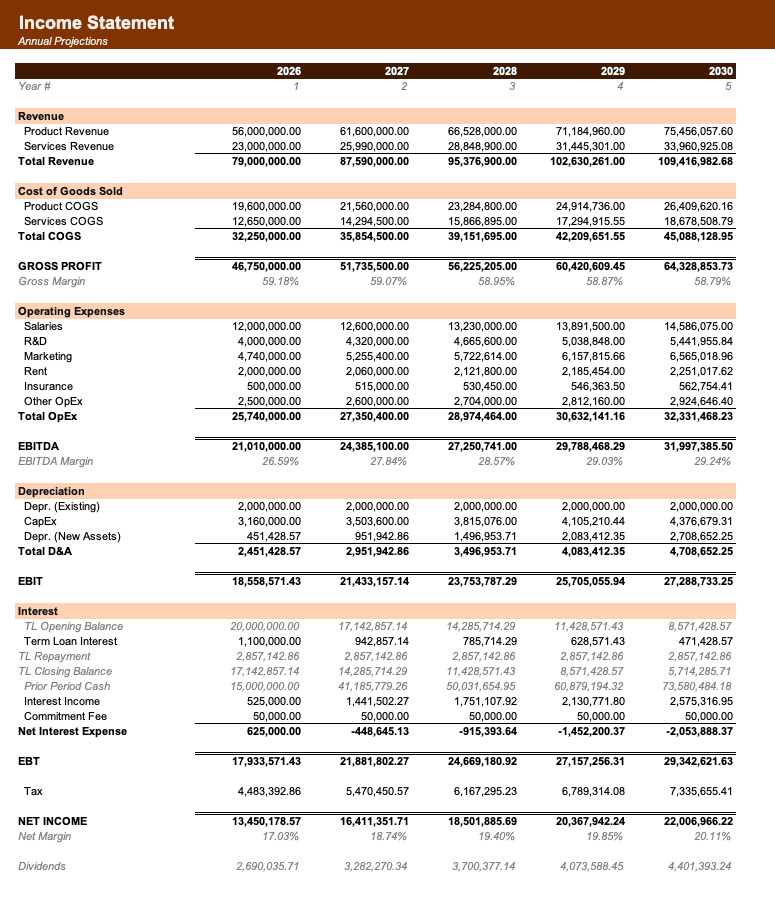
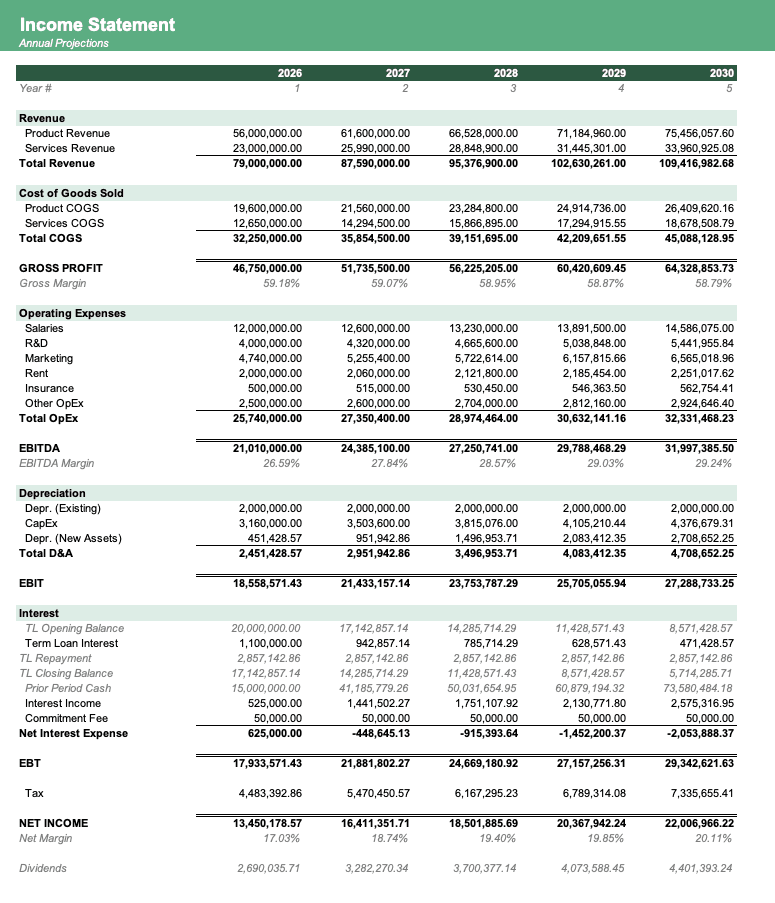
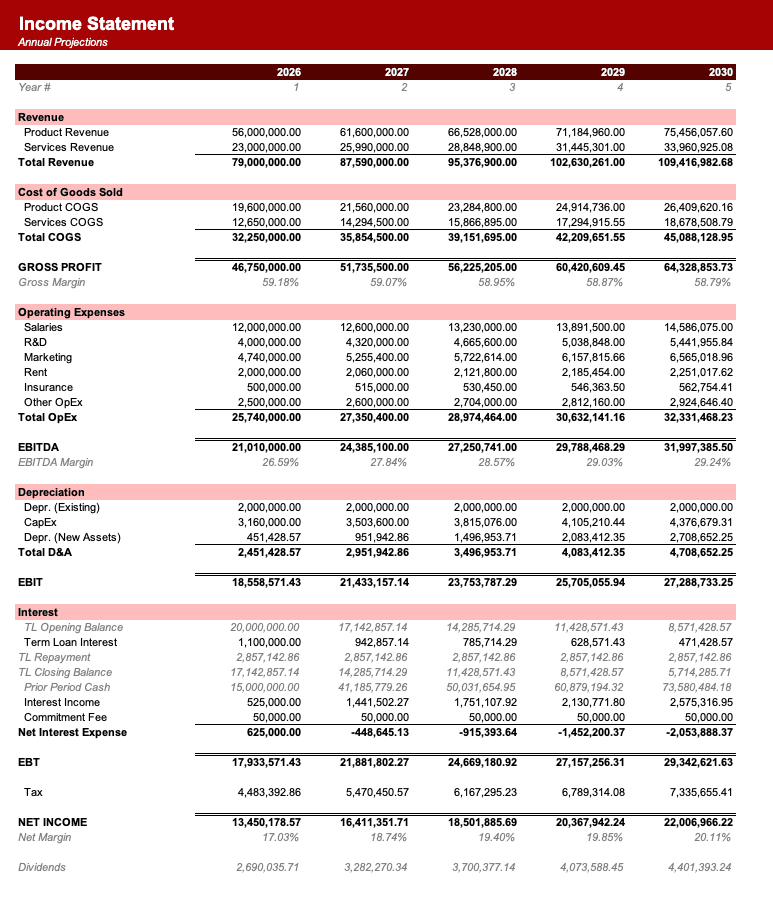
Formatted to IB standards
Named theme colors repaint the whole workbook in one click, on top of an investment-banking structure with clear input, output, and cross-sheet reference styling - brand-ready, institutional-grade, and fully auditable.

Created by ex-finance professionals
Hey, I’m Alex and I created Finamodel.
Over my years in the finance industry I kept building the same models over and over again. Same structure, same assumptions, different logo. So I started building frameworks to turn them into clean, reusable templates.
Every model here is one I’d actually use for a client, and I personally vet each one before it goes up.
I’m not an expert in every industry, but I’ve built enough models to know what belongs in one. And when something is completely foreign to me, I reach out to my network for experts to work on our models with us.
Having a template library on hand cuts a first build from hours to minutes.
Need help finding your model? You’ll find me in the Finamodel app!
Frequently asked
How often should I update the operations dashboard?+
Monthly is standard for real estate operations. Update after month-end close to compare actuals to budget and monitor trends before they compound.
What is healthy occupancy for a self-storage facility?+
Stabilized facilities should maintain 80%+ occupancy with minimal month-to-month variance. Upward trends signal pricing power; downward trends signal competitive pressure.
What drives move-out rates at self-storage facilities?+
Move-outs are driven by customer life events such as relocation and downsizing, lease expirations, and price increases. Tracking move-out rate by tenure cohort reveals retention issues.
What ancillary revenue streams should I track?+
Fees (late, admin), tenant insurance, and auction proceeds are the main ancillary lines. Each is tracked separately so you can see penetration rates and uplift opportunity.
Who uses this model?+
Facility managers, regional operators, asset managers, and REIT analysts use it for monthly ownership reporting, budget variance reviews, and pricing strategy decisions.
Have more financial modelling questions? Contact us
Related templates
Self-Storage Facility Model
Operating and valuation model for self-storage properties with occupancy, rental rates, expense management, and cash flow projections.
Real Estate Development Pro Forma Model
Land cost, construction budget, lease assumptions, and project IRR for commercial and residential development.
Data Center Operations Model
Model data center utilization, power costs, and unit economics per rack and customer.
Hotel Operating Model
Operating model for hotel properties including occupancy rates, average daily rate (ADR), RevPAR optimization, and facility-level profitability.


