Target Date Fund Model
Capital Markets Financial Model (Free Excel Download)
Design target-date portfolios by modeling glide paths, asset allocation, contributions, withdrawals, investment returns, inflation, and retirement funding outcomes over time.



professionals from Deloitte
Used by professionals from






About this model
Model a target-date fund family with customizable asset allocation glide paths, rebalancing mechanics, and fee impact across multiple vintage years (2030, 2040, 2050, etc.). Each cohort tracks its own allocation curve from growth-oriented (85%+ equities) at launch to conservative (30–50% equities) at the target retirement date. Rebalancing occurs annually with transaction costs; flows into and out of each vintage are tracked separately.
The model projects AUM buildup for each vintage over 30 years, applies market returns by asset class, and calculates management fee revenue net of underlying fund costs. The Glide_Path sheet ensures allocations sum to 100% each year; the AUM_Buildup sheet applies weighted returns and flow decay as participants retire. The Returns sheet measures gross fund returns, net-of-fee returns, and manager revenue per $1 of AUM.
Margin structure shows how TDF managers achieve scale: at sub-$1B AUM, EBITDA margins are negative; at $5B+, margins reach 35–45%. Breakeven AUM and return on seed capital are calculated explicitly. Competition from passive low-cost providers is modeled via fee compression (industry average 30 bps, down from 70 bps a decade ago).
What every model includes
Live formulas, no hardcoded values
Outputs are driven by live formulas, so the workbook updates from its assumptions instead of relying on hardcoded results.
All assumptions in one tab
Inputs are clearly marked in the Assumptions tab and separated from calculations, making it clear what to change and what to leave intact.
Statements always balancing
For integrated-statement models, the balance sheet, cash flow, and supporting schedules tie through properly.
Distinct schedules for clarity
Debt, working capital, taxes, and cash flow can get messy quickly. We group calculations in clear schedules, not across disconnected tabs.
No hidden macros or external links
There are no unexplained external workbook links or macros to undermine auditability or portability.
Changes flow through the model
Update a key driver and see the impact carry through the forecast, financing, and return outputs. We never use hardcoded numbers in formulas.
What's inside the Target Date Fund Model
- Asset allocation glide path from aggressive to conservative based on years to target date
- Cohort tracking by target date (2030, 2040, 2050) with separate allocations
- Annual rebalancing mechanics with transaction costs and tax drag
- Advisory and platform fees with impact on net returns
- Performance reporting by cohort and total fund
- Fund inflows and outflows by cohort and market value changes
Target Date Fund Model: How the Financial Model Works
This target date fund model simulates a single vintage across a 40-year horizon, from 2025 to 2064. It captures how a glide path shifts from equities to bonds, how AUM builds and then decumulates after retirement, and how fee compression erodes revenue.
It helps you evaluate whether a mid-tier TDF launch is financially viable. Rates and financial results described here reflect illustrative model settings, not industry benchmarks.
Operating Drivers: Glide Path, Flows, and Fees
The model's core driver is the glide path, which sets annual asset-class allocations for domestic equity, international equity, fixed income, TIPS, and cash. These weights must sum to 100% each year and follow a smooth curve from launch through retirement to a post-retirement level.
- Two glide types are supported: a 'to' path that holds equity flat after retirement, and a 'through' path that continues reducing equity for a decade. AUM builds from seed capital plus net new flows, which grow at a specified rate but saturate at a plateau cap to keep the vintage within scale.
- After retirement, flows turn negative as redemptions ramp linearly over ten years. Revenue is driven by average AUM multiplied by an effective fee rate that declines annually due to fee compression, floored at 10 basis points.
Calculation Flow: From AUM to Net Income
The model computes AUM year by year: opening AUM plus net flows plus market return minus rebalancing drag. Market return uses the year's glide-path allocation multiplied by each asset-class return.
- Average AUM, the average of opening and closing balances, drives management fee revenue and various cost lines. Net revenue equals net management fees after underlying fund costs, plus sub-advisory and securities lending income.
- Operating expenses include fixed and variable costs, with PM team, operations, compliance, and technology treated as attributable shares of the manager's cost base. EBITDA is net revenue minus operating expenses.
After depreciation, interest on the revolver, and tax, the model produces net income. A revolver sweep resolves cash timing gaps: it draws when pre-financing cash would go negative and repays when cash is positive, ensuring closing cash never falls below zero.
Outputs and Validation: What the Model Produces
The model generates a full set of financial statements: income statement, cash flow, and balance sheet, plus a returns sheet with fund and manager economics. Fund-level outputs include gross and net fund returns, while manager-level metrics cover EBITDA margin, FCF margin, net margin, ROE, and a KPI summary with AUM CAGR, final-year AUM, and breakeven year.
- A checks sheet validates glide path sums, AUM walk reconciliation, balance sheet balancing, revenue cross-checks, and retained earnings roll-forward. The model also flags common errors like glide paths not summing to 100%, off-by-one allocation errors, double-counted underlying fund costs, and dividends paid out of an accumulated deficit.
- These checks help ensure the model's integrity without requiring manual inspection of every formula.
Practical Use: Evaluating a TDF Launch
This model is built for asset managers or analysts assessing whether to launch a mid-tier target-date fund vintage. It helps answer questions about breakeven timing, fee compression impact, and capital needs.
- By inputting assumptions for initial AUM, flow growth, fee rates, and glide path, users can see how the fund's profitability evolves. The model includes a revolver facility to manage cash timing, with interest charged on the opening balance.
- Dividends are paid only after the accumulated deficit clears, capped at 60% of net income. The public download is a values-only preview; it does not contain live formulas or automatically recalculate.
The underlying model captures the relationships described here.
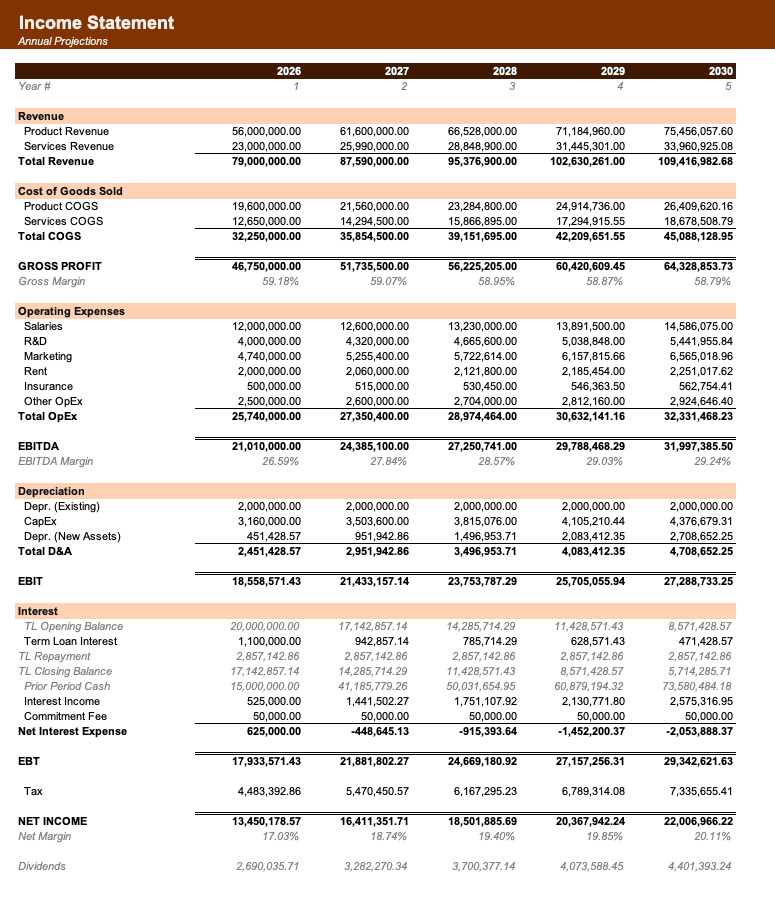
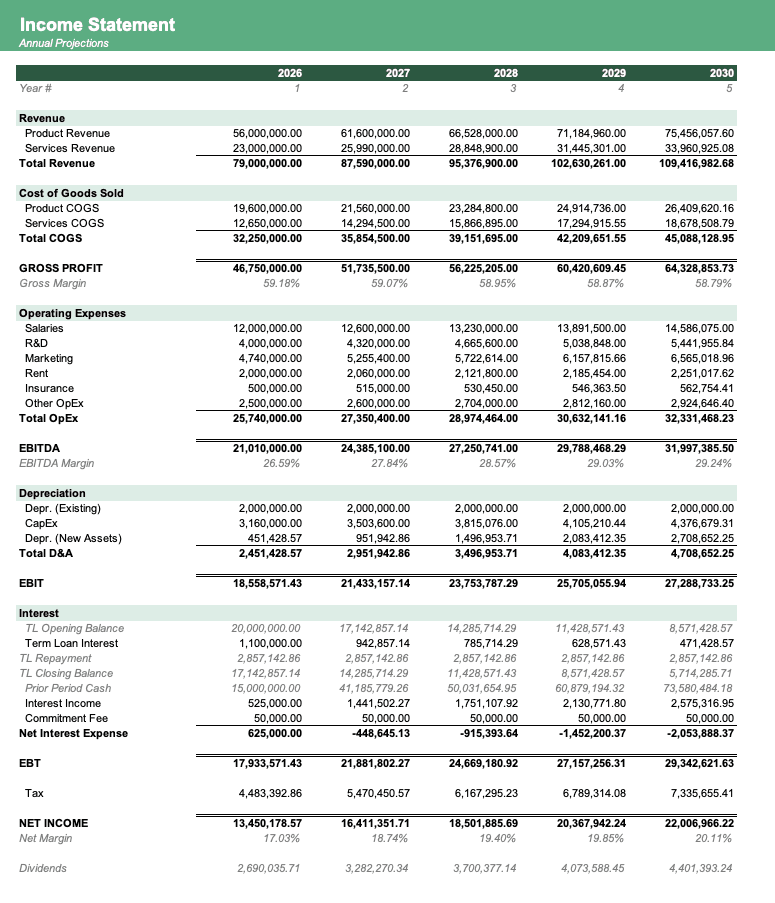
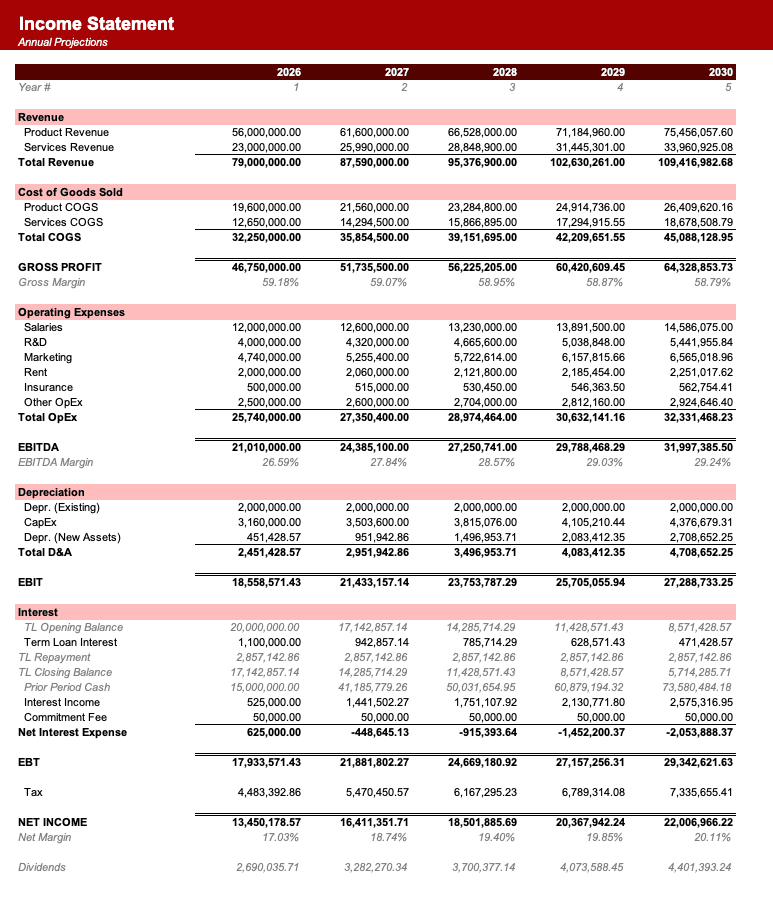
Formatted to IB standards
Named theme colors repaint the whole workbook in one click, on top of an investment-banking structure with clear input, output, and cross-sheet reference styling - brand-ready, institutional-grade, and fully auditable.

Created by ex-finance professionals
Hey, I’m Alex and I created Finamodel.
Over my years in the finance industry I kept building the same models over and over again. Same structure, same assumptions, different logo. So I started building frameworks to turn them into clean, reusable templates.
Every model here is one I’d actually use for a client, and I personally vet each one before it goes up.
I’m not an expert in every industry, but I’ve built enough models to know what belongs in one. And when something is completely foreign to me, I reach out to my network for experts to work on our models with us.
Having a template library on hand cuts a first build from hours to minutes.
Need help finding your model? You’ll find me in the Finamodel app!
Frequently asked
What is a typical target date fund glide path?+
A typical glide path starts at 90% stocks and 10% bonds for a 2050 fund and transitions to around 40% stocks and 60% bonds for funds within five years of their target retirement date.
How often should a target date fund rebalance?+
Annual or quarterly rebalancing is standard. More frequent rebalancing increases tax drag and transaction costs; infrequent rebalancing allows significant drift from target allocations.
How should I model market returns in this model?+
Use long-term historical return assumptions such as 8% for equities and 4% for bonds, or specific manager targets. Model both upside and downside scenarios to stress-test the glide path.
Why does this model track cohorts separately?+
Each cohort (2030, 2040, 2050) has a different allocation and de-risking timeline. Pooling them would obscure the distinct risk profiles and glide paths that define each vintage.
Who uses target date fund models?+
Wealth managers, plan sponsors, fund analysts, and retirement planners use them to design glide paths, document fund strategy, benchmark fees, and evaluate rebalancing policies.
Have more financial modelling questions? Contact us
Related templates
Multi-Asset Portfolio Allocation
Asset allocation model optimizing portfolio construction across equities, bonds, alternatives, and real assets.
Risk Parity Portfolio Model
Allocation framework that weights assets by inverse volatility to achieve equal risk contribution across equities, bonds, and alternatives.
Pension Fund Asset Allocation Model
Liability-driven investment strategy, asset allocation, and funding ratio analysis for pension plan portfolios.
DCF Model
Discounted cash flow valuation model with explicit forecast, terminal value, and WACC.


