Cruise Line Operator Model
Hospitality Financial Model (Free Excel Download)
Evaluate cruise-line economics through passenger capacity, occupancy, ticket yield, onboard spend, fuel, crew costs, fleet capex, debt service, and equity returns.



professionals from Deloitte
Used by professionals from






About this model
A cruise line operator model projects five years of revenue, opex, EBITDA, and net income for a multi-ship cruise line built on three ship classes - Small (premium, ~1,800 berths), Mid (contemporary, ~3,200 berths), and Large (mega-ship, ~5,400 berths) - with class-level berths, sailings per year, cruise duration, ticket yield ($/PCD), onboard yield ($/PCD), fuel cost per APCD, crew / port / insurance cost per APCD, and newbuild capex per ship. Comparable operating economics: Carnival (CCL), Royal Caribbean (RCL), Norwegian Cruise Line (NCLH).
The Fleet sheet runs closing ships per class from starting headcount plus a newbuild schedule (ships added per class per year) and computes average ships (opening + closing) / 2 for the deployment view. The Capacity sheet builds APCD per class as average ships × berths × sailings × cruise days, then OPCD = APCD × Occupancy (default 105% to reflect 3rd/4th-berth bookings on the industry's double-occupancy basis). Passengers carried = OPCD / class-specific cruise duration summed across classes.
The Revenue sheet runs ticket revenue per class = OPCD × Ticket_Yield × (1 + Yield_Growth)^(year-1) and onboard revenue per class = OPCD × Onboard_Yield × (1 + Yield_Growth)^(year-1). Total revenue = ticket + onboard. The P&L sheet runs fuel (APCD × Fuel/APCD × inflation), crew / port / insurance (APCD × Crew/APCD × inflation), commissions (% of ticket revenue), marketing (% of total revenue), and G&A (fixed base × inflation) to total opex and EBITDA. Below the line: D&A as % of revenue, interest as Debt% × cumulative fleet capex × Int_Rate (approximation appropriate for a v1 operating model), tax on positive EBT, net income, and EBITDA / net margin lines.
The Dashboard surfaces Y5 revenue, EBITDA, EBITDA margin (with traffic-light status against thresholds set in Assumptions), occupancy (with status), gross yield $/APCD (with status), fuel cost as % of revenue, total ships in fleet at Y5, passengers carried, and a Y5 capacity-mix table by ship class. Industry benchmarks baked into the threshold defaults: EBITDA margin 25-32% at scale, occupancy 100-108%, gross yield $260-340/APCD in normal operations, fuel 8-14% of revenue. Cruise line CFOs, hospitality investors, equity research analysts, and asset managers use this model to underwrite operating plans, justify newbuild capex against incremental margin contribution, and stress-test yield and fuel assumptions against industry benchmarks.
What every model includes
Live formulas, no hardcoded values
Outputs are driven by live formulas, so the workbook updates from its assumptions instead of relying on hardcoded results.
All assumptions in one tab
Inputs are clearly marked in the Assumptions tab and separated from calculations, making it clear what to change and what to leave intact.
Statements always balancing
For integrated-statement models, the balance sheet, cash flow, and supporting schedules tie through properly.
Distinct schedules for clarity
Debt, working capital, taxes, and cash flow can get messy quickly. We group calculations in clear schedules, not across disconnected tabs.
No hidden macros or external links
There are no unexplained external workbook links or macros to undermine auditability or portability.
Changes flow through the model
Update a key driver and see the impact carry through the forecast, financing, and return outputs. We never use hardcoded numbers in formulas.
What's inside the Cruise Line Operator Model
- Three ship classes (Small, Mid, Large) with editable berths, sailings per year, cruise duration, ticket and onboard yield, fuel and crew $/APCD, and capex per ship
- Newbuild schedule per class across five years to drive fleet growth
- Fleet sheet with closing ships, average ships, and total berths per class
- Capacity sheet computing Available and Occupied Passenger Cruise Days (APCD / OPCD) per class plus passengers carried
- Revenue sheet with per-class ticket and onboard yield × OPCD and annual yield growth
- P&L from revenue through fuel, crew/port/insurance, commissions, marketing, G&A, EBITDA, D&A, interest, tax, and net income, with EBITDA and net margin lines
- Dashboard with Y5 revenue, EBITDA, EBITDA margin, occupancy, gross yield, fuel % of revenue, ships in fleet, and passengers carried
- Status thresholds in Assumptions so on-track / watch / soft logic can be tuned
Understanding the Cruise Line Operator Model: Fleet, Capacity, Revenue, and Cash Flow
This cruise line model projects five years of operations for a mid-cap operator with three ship classes. It builds capacity from fleet deployment, converts occupied days into ticket and onboard revenue, and layers in full cruise-line costs to produce EBITDA, free cash flow, and leverage.
A dashboard scores key metrics against industry thresholds.
Key Operating Drivers
The model is driven by three ship classes: Small (~1,800 berths), Mid (~3,200 berths), and Large (~5,400 berths).
- Each class has its own sailings per year, cruise duration, ticket yield, onboard yield, fuel cost, port and crew operating costs, newbuild capital expenditure, and useful life.
- Fleet size ramps from six ships to eleven by Year 5.
- This class-level granularity allows you to test how deployment mix shifts capacity and economics.
Calculation Flow and Revenue Build
Capacity starts with available passenger cruise days (APCD) per ship, calculated as berths times sailings per year times cruise duration. Total APCD sums the average ships in each class multiplied by per-ship APCD.
- Occupied passenger cruise days (OPCD) equal APCD times an occupancy rate, defaulting to 105%. Revenue is built per class: ticket and onboard revenues are class OPCD times their respective yields, grown annually.
- Total revenue is the sum across classes and revenue types. Operating costs include fuel, food, crew, port, commissions, marketing, and general and administrative expenses, with fuel scaling off APCD.
Financial Outputs and Cash Flow
The model produces EBITDA, net income, and a cash flow and debt schedule. Depreciation and amortization derive from cumulative fleet investment divided by useful life, defaulting to 30 years straight-line.
- The debt schedule rolls forward opening debt, newbuild draws, and amortization. Interest expense is calculated on average debt balance.
- Free cash flow equals EBITDA minus cash tax, interest, maintenance capital expenditure, newbuild capital expenditure, plus changes in customer deposits. Net debt to EBITDA is also computed.
These outputs feed a dashboard with traffic-light status for metrics like occupancy, net yield, and leverage.
Practical Use and Scope
This template helps evaluate how fleet deployment, capacity, and yields interact to drive profitability and liquidity. The dashboard highlights Year 5 revenue, EBITDA, EBITDA margin, occupancy, net yield, leverage, free cash flow, fuel cost percentage, fleet count, and passengers.
- Traffic-light thresholds flag performance against industry benchmarks. The model assumes normal operations and excludes per-ship vintage depreciation, dispositions, brand segments, currency hedging, and demand shocks.
- It is intended for underwriting a single-operator cruise line with a multi-ship fleet.
Formatted to IB standards
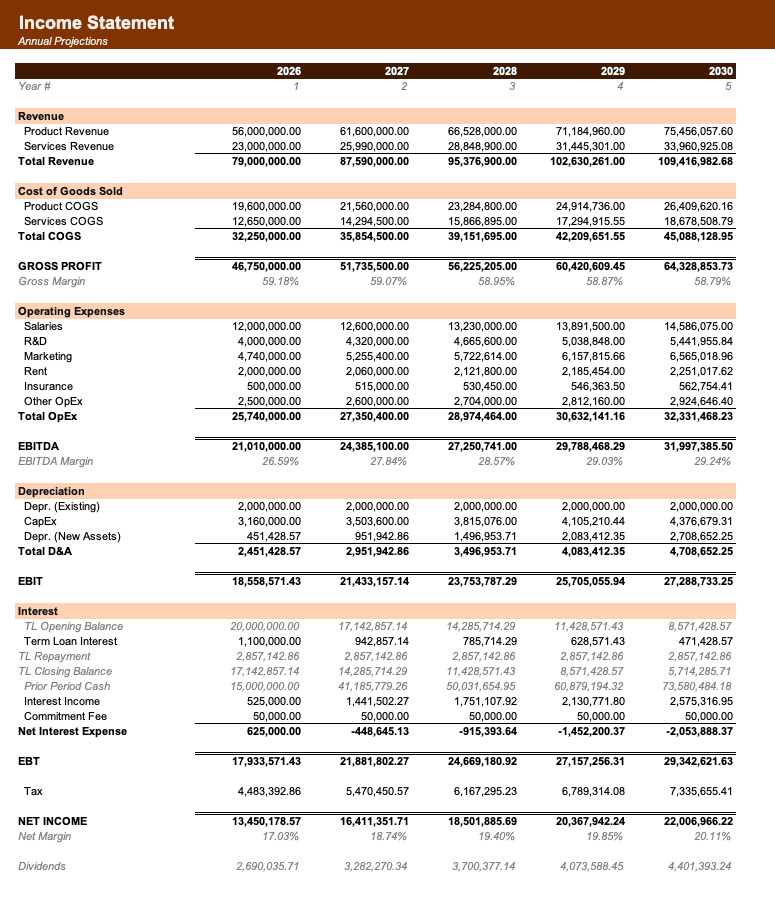
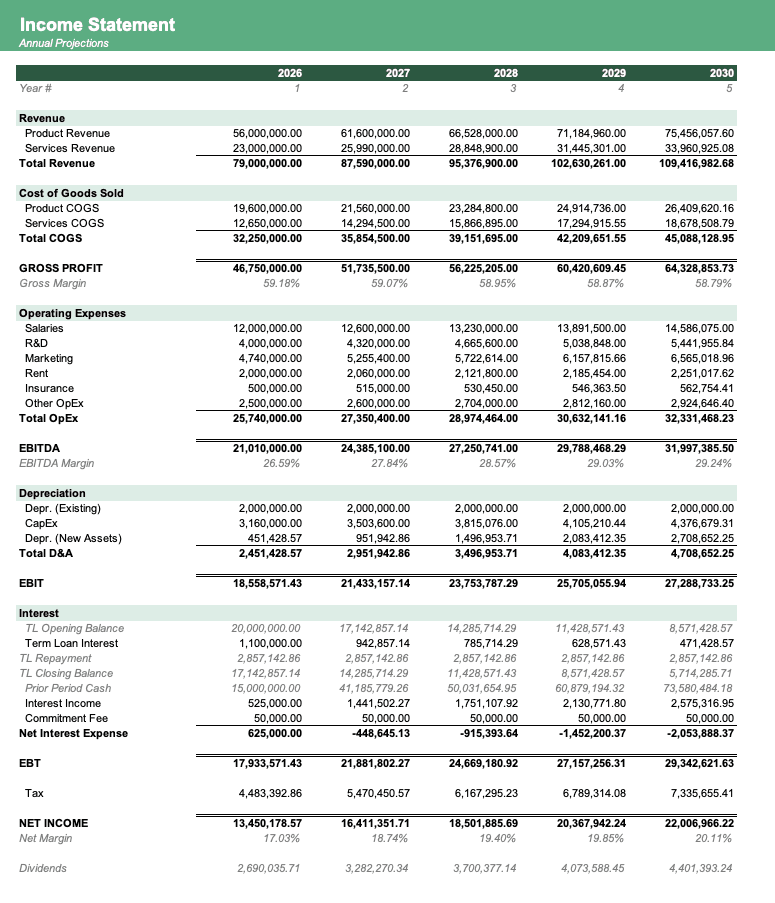
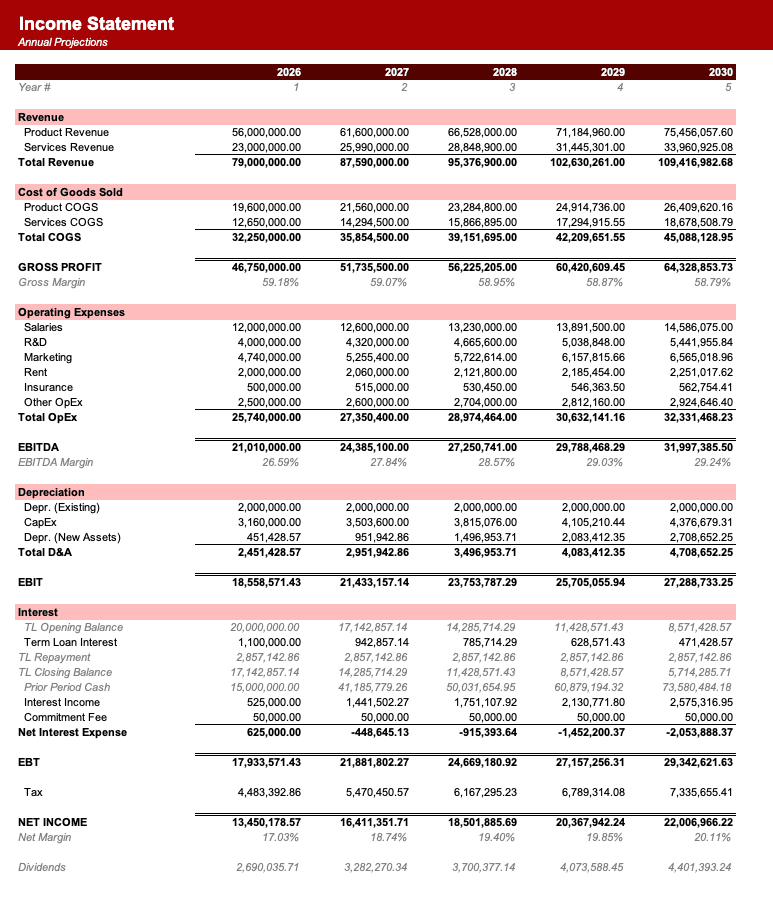
Named theme colors repaint the whole workbook in one click, on top of an investment-banking structure with clear input, output, and cross-sheet reference styling - brand-ready, institutional-grade, and fully auditable.

Created by ex-finance professionals
Hey, I’m Alex and I created Finamodel.
Over my years in the finance industry I kept building the same models over and over again. Same structure, same assumptions, different logo. So I started building frameworks to turn them into clean, reusable templates.
Every model here is one I’d actually use for a client, and I personally vet each one before it goes up.
I’m not an expert in every industry, but I’ve built enough models to know what belongs in one. And when something is completely foreign to me, I reach out to my network for experts to work on our models with us.
Having a template library on hand cuts a first build from hours to minutes.
Need help finding your model? You’ll find me in the Finamodel app!
Frequently asked
What is a cruise line operating model?+
A cruise line operating model projects revenue, opex, and EBITDA for a fleet of cruise ships built on capacity (available passenger cruise days), occupancy, and yield per occupied day. It tracks how berths, sailings per year, ticket yield, and onboard yield combine into total revenue, then subtracts fuel and crew (per APCD), commissions, marketing, and G&A to arrive at EBITDA.
What is APCD and why does it matter?+
APCD = Available Passenger Cruise Days = berths × sailings per year × cruise days × ships. It is the cruise industry standard capacity metric and the right denominator for fuel and crew costs (both incur whether the ship is sold out or empty). Revenue, by contrast, scales with OPCD = APCD × occupancy.
Why can occupancy exceed 100%?+
Cruise occupancy is calculated on a double-occupancy basis (2 passengers per cabin). When third and fourth berths are sold (common in family cabins), occupancy can exceed 100%. The industry-standard healthy occupancy benchmark is 100-108%.
How is interest computed without a full debt schedule?+
Interest is Debt_Pct × cumulative fleet capex × Int_Rate. Cumulative fleet capex is the sum of newbuild capex through the year (newbuild ships × capex per ship × $M scaler) plus cumulative maintenance capex (sum of prior revenues × Maint_Pct). It is an approximation appropriate for a v1 operating model - pair with the debt-schedule template for a full per-tranche amortisation view.
Does this replace a 3-statement model?+
No. This is a P&L-only operating model. There is no balance sheet, working capital, or cash flow statement. Pair with the 3-statement template if you need closing cash, debt roll-forward, or full BS / CF visibility.
Have more financial modelling questions? Contact us
Related templates
Hotel Operating Model
Operating model for hotel properties including occupancy rates, average daily rate (ADR), RevPAR optimization, and facility-level profitability.
Airline Operations Model
Airline financial projections with route, fleet, and capacity planning.
Theme Park Operating Model
Model theme park revenues by operating season, attendance drivers, and operating expenses with leverage and returns.
Golf Course Model
Plan and value a golf course operator using rounds played, green fees, membership dues, operating costs, and a DCF.