Theme Park Operating Model
Consumer Financial Model (Free Excel Download)
Underwrite theme-park performance using attendance, ticket yield, food and merchandise spend, seasonality, operating costs, attractions capex, and debt service.



professionals from Deloitte
Used by professionals from






About this model
Model theme park operating economics with seasonal attendance patterns, dynamic pricing, multiple revenue streams (admissions, food, merchandise, premium experiences), and significant operating leverage. The model captures peak-season revenue concentration (50–60% in Q2–Q3), seasonal staffing ramps (600+ FTEs in summer vs. 80 salaried year-round), and capacity constraints. Per-capita spending by stream is tracked separately: $65 admissions, $22 food & beverage, $18 merchandise, $35 premium (skip-the-line, VIP tours), and $10 games.
The workbook includes a ramp-up curve (60%, 80%, 90% of stabilized attendance in years 1–3), per-capita spending escalation, and fixed/variable cost segregation. EBITDA margins are 25–40% depending on scale and utilization. Capex includes major attractions ($15–40M per ride), with payback periods of 4–7 years. Debt service coverage (DSCR) is stressed across multiple attendance scenarios; maintenance capex is hardcoded at 5% of revenue (required for ride safety compliance).
Equity returns are driven by attendance growth, per-capita pricing power, and seasonal cash generation. Regional parks generate $20–150M annual revenue; destination parks (Disney, Universal) exceed $1B. Typical leverage is 3–5x Debt/EBITDA; dividend norms are modest (1–3% yield) with cash reinvested in growth capex.
What every model includes
Live formulas, no hardcoded values
Outputs are driven by live formulas, so the workbook updates from its assumptions instead of relying on hardcoded results.
All assumptions in one tab
Inputs are clearly marked in the Assumptions tab and separated from calculations, making it clear what to change and what to leave intact.
Statements always balancing
For integrated-statement models, the balance sheet, cash flow, and supporting schedules tie through properly.
Distinct schedules for clarity
Debt, working capital, taxes, and cash flow can get messy quickly. We group calculations in clear schedules, not across disconnected tabs.
No hidden macros or external links
There are no unexplained external workbook links or macros to undermine auditability or portability.
Changes flow through the model
Update a key driver and see the impact carry through the forecast, financing, and return outputs. We never use hardcoded numbers in formulas.
What's inside the Theme Park Operating Model
- Attendance projections by season with peak and off-peak day counts
- Ticket revenue with mix of gate, multi-day, and season passes
- Ancillary revenue streams (food, merchandise, hotel, parking)
- Operating expenses by category (labor, maintenance, utilities, marketing)
- EBITDA generation and debt service coverage analysis
- Per-capita spending analysis and uplift potential
Theme Park Operating Model: How Revenue, Costs, and Returns Connect
This theme park operating model template shows how attendance, per-capita spending, seasonality, capital investment, and financing combine into an integrated view of park economics. It is designed for readers evaluating a regional theme park investment, development, or acquisition, and explains the assumptions and relationships that drive admissions, ancillary revenue, costs, EBITDA, cash flow, and levered equity returns.
What Drives Park Revenue and Attendance
Revenue in this template starts with annual attendance. A stabilised attendance figure is multiplied by a ramp percentage in years one to three, then grows at a modest post-stabilisation rate.
- Annual attendance is capped by maximum daily capacity multiplied by operating days, so the model cannot sell more tickets than the park can physically handle. Average admission price escalates annually, and a ticket mix sheet splits single-day, season-pass, peak, off-peak, and group sales, with season-pass revenue recognised over the operating season.
- This matters because the admissions line is the base from which every ancillary stream is calculated.
How Ancillary Spending and Seasonality Are Captured
Food and beverage, merchandise, premium experiences, and games each follow a penetration-and-spend formula: attendance multiplied by the share of guests who buy, multiplied by average spend per guest.
- Premium experiences include skip-the-line passes, VIP tours, parking, and rentals, and carry the highest assumed growth rate.
- Seasonality is handled through twelve monthly attendance weights, which drive the monthly distribution of visitors and expose the off-season cash drain that annual totals can hide.
- Together these streams show how much of park economics depends on per-capita spending rather than gate revenue alone.
Operating Costs, Labour, and Margin Structure
Costs are built from both attendance and fixed obligations. Cost of goods applies different percentages to food, merchandise, and games revenue, with admissions COGS treated as negligible.
- Labour is split between year-round salaried headcount and seasonal hourly staff, with peak headcount built up per thousand visitors during the operating weeks. Operating expenses include utilities, insurance, marketing, maintenance, property tax, G&A, and entertainment, most expressed as a percentage of revenue.
- This structure illustrates the high operating leverage of theme parks: once fixed costs are covered, incremental attendance and per-capita spending flow through at a much higher margin.
Capital Investment, Financing, and Equity Returns
The model separates maintenance capex from growth capex, and depreciates assets by vintage and class, using different useful lives for rides, buildings, and equipment.
- Debt is sized against total project cost, with a term loan walk, revolver, and covenant tests including DSCR, leverage, and interest coverage.
- The unlevered and levered return streams run across the projection period, with the initial build cost absorbed in the first column, and performance is measured against target IRR and equity multiple.
- A scenario toggle switches attendance, per-capita spend, EBITDA margin, and exit multiple between base, bull, and bear cases.
Formatted to IB standards
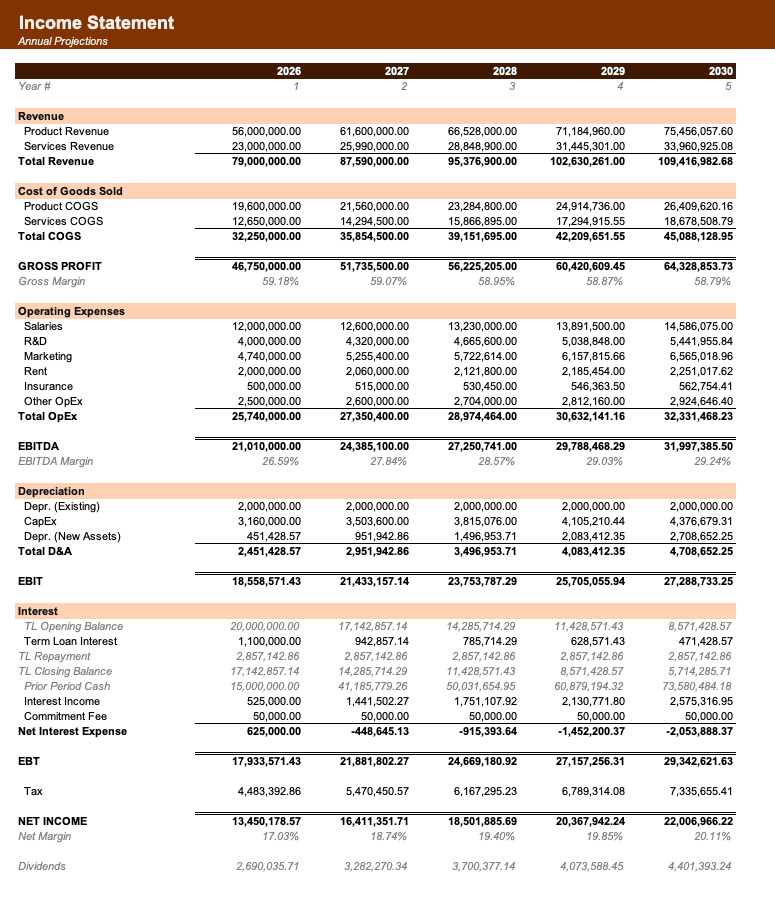
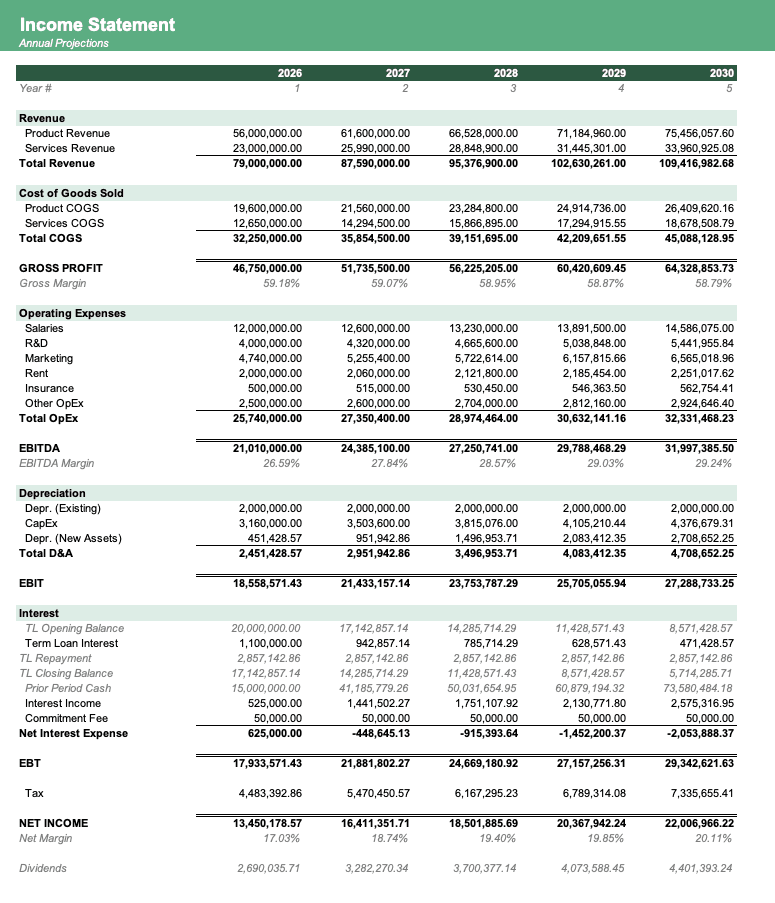
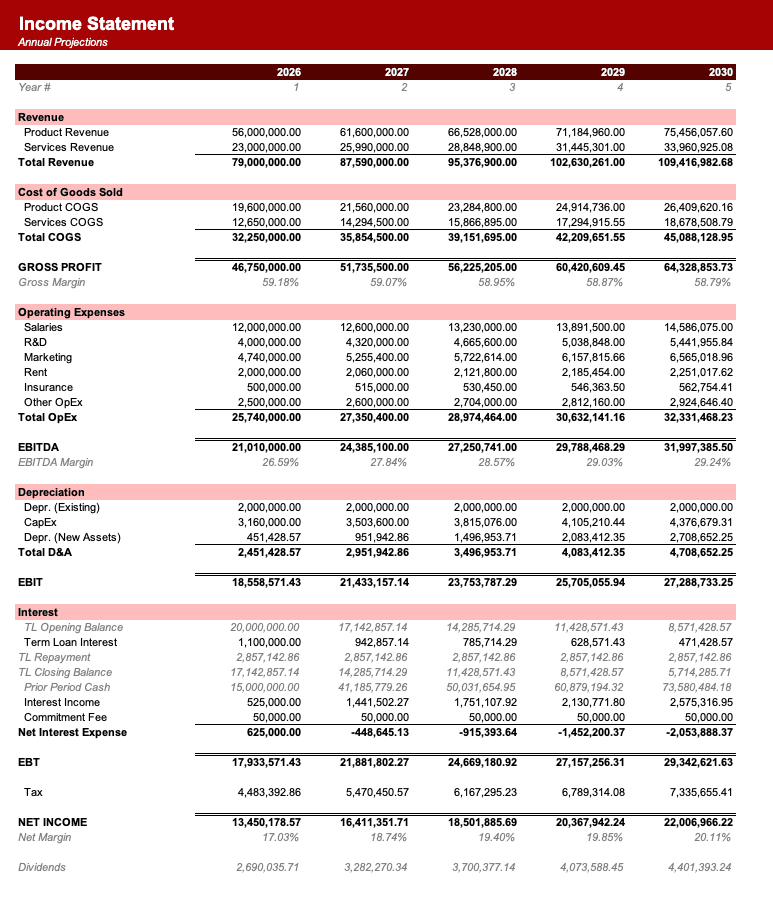
Named theme colors repaint the whole workbook in one click, on top of an investment-banking structure with clear input, output, and cross-sheet reference styling - brand-ready, institutional-grade, and fully auditable.

Created by ex-finance professionals
Hey, I’m Alex and I created Finamodel.
Over my years in the finance industry I kept building the same models over and over again. Same structure, same assumptions, different logo. So I started building frameworks to turn them into clean, reusable templates.
Every model here is one I’d actually use for a client, and I personally vet each one before it goes up.
I’m not an expert in every industry, but I’ve built enough models to know what belongs in one. And when something is completely foreign to me, I reach out to my network for experts to work on our models with us.
Having a template library on hand cuts a first build from hours to minutes.
Need help finding your model? You’ll find me in the Finamodel app!
Frequently asked
How do you forecast theme park attendance?+
Base forecasts on historical attendance trends, seasonal patterns, and external factors such as school calendars, holidays, and local competition. Use conservative growth of 1-3% annually for mature parks.
What is typical per-capita spending at a theme park?+
Per-capita spending ranges from $50 to $150 depending on park type and ticket price. Universal and Disney parks sit at the higher end; regional parks are typically lower.
What cost structure is typical for a theme park?+
Labor is typically 40-50% of operating costs. Maintenance, utilities, and marketing are each around 10-15%. Modeling labor as 50% fixed captures operating leverage as attendance grows.
How do you model a capex investment like a new attraction?+
Estimate the attendance uplift (typically 3-8% for a major attraction) and per-capita spending increase, then calculate payback period against the capital cost and incremental operating expense.
Who uses theme park operating models?+
Entertainment investors evaluating acquisitions, hospitality operators planning expansions, turnaround specialists assessing cost structures, and park operators running annual budget cycles.
Have more financial modelling questions? Contact us
Related templates
Hotel Operating Model
Operating model for hotel properties including occupancy rates, average daily rate (ADR), RevPAR optimization, and facility-level profitability.
Restaurant Unit Economics and Multi-Unit Model
Single-unit operating metrics, cost of goods sold, labor, rent, and multi-unit chain economics.
Gym and Fitness Studio Operating Model
Operating model for fitness franchises and independent gyms including membership revenue, class scheduling, and facility utilization.
E-Commerce Unit Economics
P&L model for e-commerce business with CAC, LTV, gross margin, and unit economics.


