Direct Lending Fund Model
Credit Financial Model (Free Excel Download)
Model direct-lending origination, repayments, defaults, recoveries, fees, and fund-level returns to evaluate private-credit deployment and downside protection.



professionals from Deloitte
Used by professionals from






About this model
A direct lending fund originates individual loans to middle-market companies, managing yield, defaults, and fund-level cash flows to investors. The model tracks each loan's interest income, origination fees, and principal repayment, rolls these up to fund-level cash flows, and computes IRR and MOIC (money multiple on invested capital) across junior and senior tranches. Key variables include the blended yield (interest rate plus upfront fees), the loan term, loss assumptions, and default probability.
The workbook separates accrued interest income (which swells the portfolio value) from cash interest (which funds investor distributions), capturing the timing misalignment that causes naive cash flow models to understate returns in the early hold period. Loss provisioning is modeled as a percentage of outstanding principal, with recovery assumed at a later date. The fund-level cash flow includes both original capital deployed (negative) and distributions back to investors as loans are repaid and interest is collected (positive).
Direct lending funds are appropriate for credit investors with a tolerance for illiquidity (5–7 year hold periods) and the operational complexity of loan-level tracking. This template is calibrated for institutional fund structures with 10–50 loans in the portfolio at any given time.
What every model includes
Live formulas, no hardcoded values
Outputs are driven by live formulas, so the workbook updates from its assumptions instead of relying on hardcoded results.
All assumptions in one tab
Inputs are clearly marked in the Assumptions tab and separated from calculations, making it clear what to change and what to leave intact.
Statements always balancing
For integrated-statement models, the balance sheet, cash flow, and supporting schedules tie through properly.
Distinct schedules for clarity
Debt, working capital, taxes, and cash flow can get messy quickly. We group calculations in clear schedules, not across disconnected tabs.
No hidden macros or external links
There are no unexplained external workbook links or macros to undermine auditability or portability.
Changes flow through the model
Update a key driver and see the impact carry through the forecast, financing, and return outputs. We never use hardcoded numbers in formulas.
What's inside the Direct Lending Fund Model
- Individual loan origination with price, rate, and term assumptions
- Yield calculation: interest income, OID accretion, and upfront fees
- Loss provisions and default scenario analysis
- Principal repayment and refinancing schedule
- Fund-level cash flows, investor distributions, and fund IRR and MOIC
- Fund IRR and MOIC calculation across tranches
Direct Lending Fund Model: How the Template Works
This direct lending fund model template captures the economics of a senior-secured private credit fund. It covers loan origination, interest accrual, defaults, recoveries, and fund-level cash flows over a 7-year life.
The outline below explains the key operating drivers, calculation flow, and outputs so you can assess whether it fits your analysis needs.
Loan Portfolio and Origination Mechanics
The template deploys capital over a three-year investment period, with new originations paced from fund size. Each loan enters a principal rollforward: opening balance plus new loans and payment-in-kind interest, minus scheduled amortisation, prepayments, defaults, and a final balloon repayment in year seven.
- Defaults are driven by a vintage default curve multiplied by sector-specific default multipliers, while prepayments follow a separate annual curve. Payment-in-kind interest capitalises only on the designated PIK share of the book.
- Original issue discount is tracked separately as an unamortised balance, with straight-line amortisation accreted into income each period and written off proportionally on prepayments or defaults. The model also accounts for origination economics: upfront fees and OID are booked on new loans, while exit fees and call protection premiums apply to voluntary prepayments.
A half-year interest convention toggle avoids overstating final-year interest on a balloon-repaid book.
Sector Allocation and Credit Assumptions
Four sector buckets—Software, Healthcare, Industrials, and Consumer—drive weighted spread and default behavior. Each sector carries a weight, a spread over the base rate, and a default multiplier.
- The fund-level weighted spread and weighted default multiplier are calculated from these inputs, ensuring that shifts in sector mix affect both income and credit losses. A concentration cap limits any single sector's share of the book.
- Lien-position recoveries are modelled through book-mix inputs for first lien, second lien, and unsecured loans, each with its own recovery rate. The weighted recovery rate applies to defaults to determine loss given default.
These features allow users to explore how portfolio composition influences risk and return without rebuilding the model from scratch.
Cash Flow Waterfall and Investor Distributions
The fund uses a European whole-fund waterfall. Available cash for distribution equals opening cash plus net operating cash minus a minimum cash reserve, but only after the investment period; during the investment period all cash is retained for deployment.
- Capital calls fund the gap between cash needs and facility draws, with the asset-based revolver providing working capital up to an advance rate against performing principal. The waterfall allocates returns of capital, then a vintage-weighted preferred return, then GP catch-up, and finally carried interest.
- The vintage-weighted preferred return table ensures that later capital contributions do not receive the same compound hurdle as earlier ones. Management fees apply on committed capital during the investment period and switch to invested capital in the harvest period, with a toggle for the fee base and an offset from upfront fee income.
The facility schedule tracks draws, repayments, interest, commitment fees, and covenant tests.
Outputs and Practical Applications
The model produces fund-level and investor-level metrics including IRR, MOIC, TVPI, DPI, RVPI, NAV, and yields. A J-curve illustrates the net cash flow profile over time.
- Twelve built-in checks validate capital account ties, PIK reconciliation, OID amortisation, covenant compliance, sector concentration, and cash balances. Users can adjust assumptions for fund size, base rate, default and prepay curves, facility terms, management fees, and waterfall parameters to test different scenarios.
- The template is designed for evaluating a senior-secured private credit strategy under a documented set of mechanics. The public download is a values-only preview; the underlying model captures the relationships described here.
Formatted to IB standards
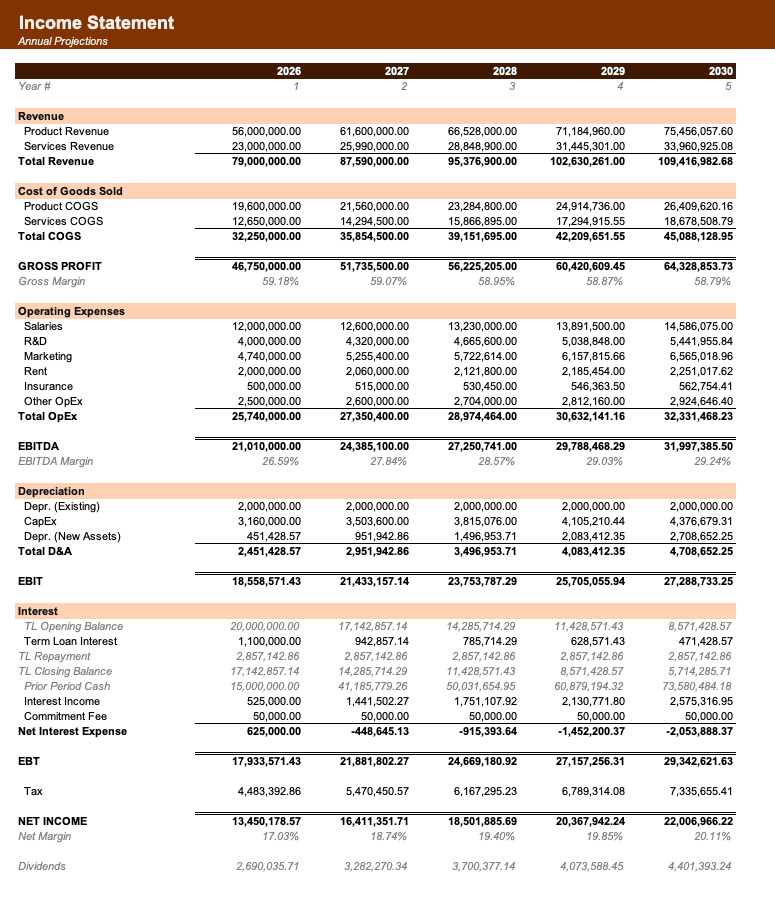
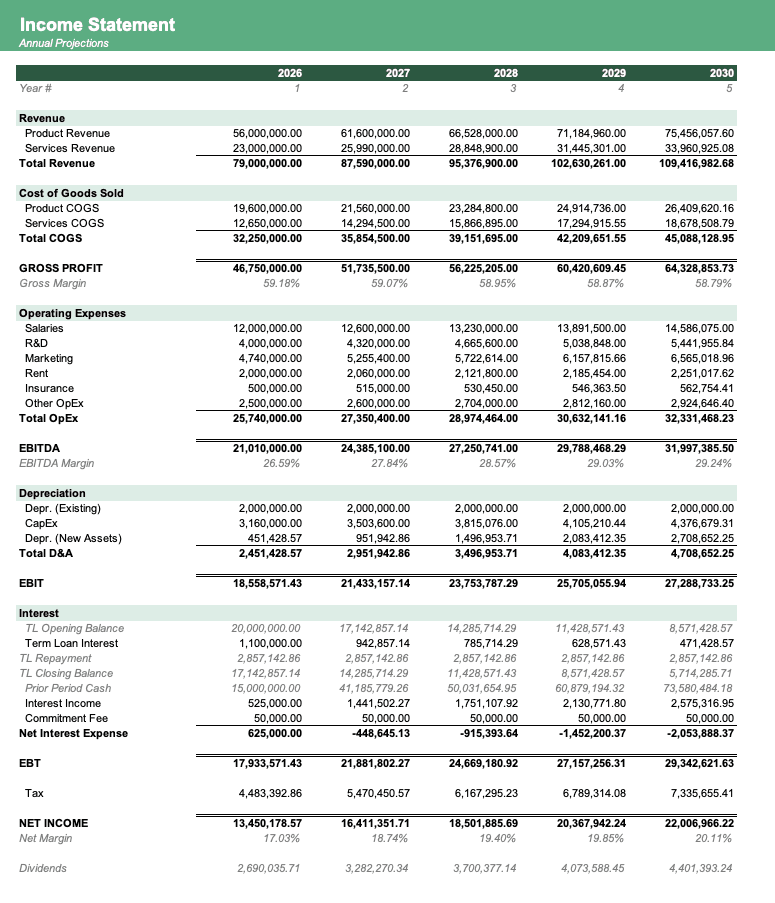
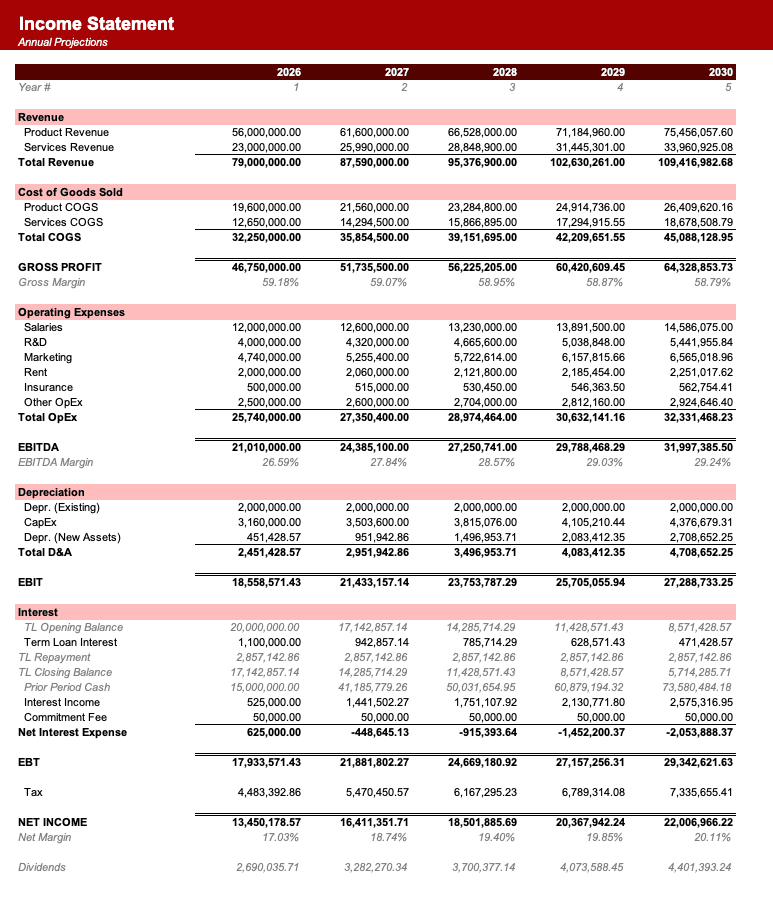
Named theme colors repaint the whole workbook in one click, on top of an investment-banking structure with clear input, output, and cross-sheet reference styling - brand-ready, institutional-grade, and fully auditable.

Created by ex-finance professionals
Hey, I’m Alex and I created Finamodel.
Over my years in the finance industry I kept building the same models over and over again. Same structure, same assumptions, different logo. So I started building frameworks to turn them into clean, reusable templates.
Every model here is one I’d actually use for a client, and I personally vet each one before it goes up.
I’m not an expert in every industry, but I’ve built enough models to know what belongs in one. And when something is completely foreign to me, I reach out to my network for experts to work on our models with us.
Having a template library on hand cuts a first build from hours to minutes.
Need help finding your model? You’ll find me in the Finamodel app!
Frequently asked
What is a direct lending fund model?+
It is a model that forecasts loan origination, yield realization, default losses, and fund-level cash flows to calculate IRR and MOIC for a direct lending fund.
How is direct lending yield calculated?+
Yield includes stated interest, upfront fees amortized over the loan life, OID accretion, and PIK interest where applicable, all measured as effective yield to maturity.
What are loan covenants?+
Covenants are borrower obligations such as maintaining a leverage ratio or interest coverage floor, whose breach triggers acceleration rights or lender protective action.
How do I model a fund MOIC?+
MOIC is cumulative cash distributions plus ending residual value divided by cumulative invested capital, and is the primary return metric used in LP reporting.
Who uses direct lending fund models?+
Credit investors, direct lenders, fund managers, and credit analysts use them for fund underwriting, LP materials, individual loan approval analysis, and exit planning.
Have more financial modelling questions? Contact us
Related templates
Loan Portfolio CDR Model
Credit default risk model for loan portfolios with cumulative default rates and loss severity analysis.
Mezzanine Debt Funding Model
Mezzanine financing structure with subordinated debt, equity kickers, and sponsor return analysis.
Credit Stress Testing Framework
Stress test credit portfolios across default probabilities, loss severities, and adverse macroeconomic scenarios.
Auto Loan Portfolio Model
Automotive loan securitization and portfolio analysis.