Mezzanine Debt Funding Model
Private Equity Financial Model (Free Excel Download)
Structure mezzanine financing with cash and PIK interest, warrants, repayment waterfalls, leverage, downside protection, and lender return sensitivities.



professionals from Deloitte
Used by professionals from






About this model
A Mezzanine Debt Fund Model values a $300M fund deploying into 15 portfolio companies (avg $18M loan per company) over a 4-year investment period (Years 0-3), then harvesting over a 3-year exit period (Years 4-6). Each loan earns a blended 15% gross return: 11.5% all-in cash coupon (SOFR 1% floor + 6.2% spread + 4.3% mezzanine structuring premium), 3.5% PIK (paid-in-kind, accrued to principal), 2% origination/OID fees, 1.5% prepayment fees (if refinanced early), 0.5% commitment fees (on unfunded capacity), and 3% equity warrant kickers (allowing the fund to purchase 3% of borrower equity at maturity, capturing upside in exits).
The Loan_Portfolio sheet models annual deployments (25%, 30%, 25%, 10% of fund size in Years 0-3) to a stable of 15 portfolio companies. Each loan accrues interest on opening deployed principal; PIK capitalizes into principal each year, creating leverage accretion. Default rates (3% of opening portfolio annually) and recovery rates (50% for mezzanine subordination) apply from Year 1 onward. Credit Losses are modeled as a drag on fund returns (1.5% net loss rate). Cash interest is distributed to LPs annually; PIK is realized only at loan exits (maturity or refinance). Capital calls follow a PRIOR-period cap formula to avoid circular references. The Distributions sheet applies the LP waterfall: return of capital (Tier 1), then preferred return accrual at 7% on un-returned capital (Tier 2), then 80/20 split (Tier 3) between LPs and GP on remaining profits.
Key metrics include Gross IRR (~15-18% target), Net IRR to LPs (~12-15% post-fees), management fees (1.5% of committed capital in investment period, 1.0% of invested capital in harvest), and carried interest (15% on GP-realized gains). This model applies to credit fund investors, credit analysts, and portfolio company management evaluating mezzanine financing terms. Typical mezzanine terms: 5-7 year tenor, 40-65% LTV, covenant DSCR minimums of 1.25-1.35×. Equity warrant provisions (typically 2-5% coverage) provide meaningful upside in strong exits.
What every model includes
Live formulas, no hardcoded values
Outputs are driven by live formulas, so the workbook updates from its assumptions instead of relying on hardcoded results.
All assumptions in one tab
Inputs are clearly marked in the Assumptions tab and separated from calculations, making it clear what to change and what to leave intact.
Statements always balancing
For integrated-statement models, the balance sheet, cash flow, and supporting schedules tie through properly.
Distinct schedules for clarity
Debt, working capital, taxes, and cash flow can get messy quickly. We group calculations in clear schedules, not across disconnected tabs.
No hidden macros or external links
There are no unexplained external workbook links or macros to undermine auditability or portability.
Changes flow through the model
Update a key driver and see the impact carry through the forecast, financing, and return outputs. We never use hardcoded numbers in formulas.
What's inside the Mezzanine Debt Funding Model
- Mezzanine debt sizing and coupon assumptions
- PIK toggle mechanics and interest cash versus accrual treatment
- Warrant or equity kicker sizing and dilution impact
- Debt paydown schedule and refinance scenarios
- Mezzanine investor return analysis combining debt IRR and equity upside
- Lender loss and recovery scenarios
Mezzanine Debt Funding Model: How the Deal Economics Work
A mezzanine debt model combines contractual interest with equity upside. This template maps a subordinated lender’s blended return — cash coupon, payment-in-kind interest, fees and warrants — across a fund’s deployment and harvest years, connecting credit losses and capital calls to LP distributions and IRR.
The structure is documented in the supplied specification.
Operating Drivers of a Mezzanine Loan Portfolio
The template organises a mezzanine fund around a defined set of operating drivers. Portfolio deployment follows a schedule that reaches 90% of committed capital, with new loans concentrated in the investment period.
- Cash coupon, PIK accrual, origination fees, prepayment charges and commitment fees are each derived from documented rate inputs applied to balances or activity. Credit losses use a default rate and recovery assumption, producing an annual net loss.
- Remaining portfolio and fund economics flow through management fees, fund expenses and a preferred return before LP distributions. The design keeps these inputs on Assumptions so a user can flex individual drivers without rewriting the calculation structure.
Calculation Flow from Deployments to Distributable Cash
The calculation flow starts with capital calls and deployments, then builds each loan’s principal balance. Cash interest and PIK are calculated on opening deployed principal, with PIK added to closing principal rather than received in cash.
- Fees are recognised from deployment activity and prepayments. Credit loss write-offs reduce the closing balance and net income.
- A management fee switches from committed capital during the investment period to invested capital during harvest. Distributable cash aggregates operating cash with principal repayments, prepayments, recoveries and warrant proceeds, while deployments are funded separately by capital calls.
That separation avoids the common error of netting investments against distributable cash.
Outputs: LP Cash Flows, Returns and Fund Metrics
Outputs include the LP cash flow waterfall, from return of capital through preferred return and carried interest tiers, and the resulting LP distributions. Returns on projected performance show Gross IRR, Net IRR, MOIC, DPI and TVPI, with Gross IRR measured on portfolio cash flows before fund costs and Net IRR on LP cash flows after the waterfall.
- Warrant proceeds are treated as an exit-year equity option value rather than scheduled repayment income, so they do not inflate recurring yield. The model also reports annual net income, balance roll-forwards, credit losses and a checks area.
- The public download is a values-only preview; it shows the documented outputs but does not contain live formulas or automatic recalculation.
Practical Use When Evaluating the Template
Practically, the template lets a reader trace how a mezzanine fund builds return from a cash coupon, PIK, fees and equity warrants while absorbing credit losses and fund costs.
- It is useful for checking whether the documented relationships are internally consistent — such as PIK accruing on opening principal, management fees switching bases, and LP preferred return accruing on un-returned capital.
- The annual, seven-year structure covers deployment, harvest and maturity, making it a starting point for evaluating a subordinated credit strategy.
- Because the preview is values-only, a user should treat it as a structural explanation rather than a live calculation tool or a forecast of market returns.
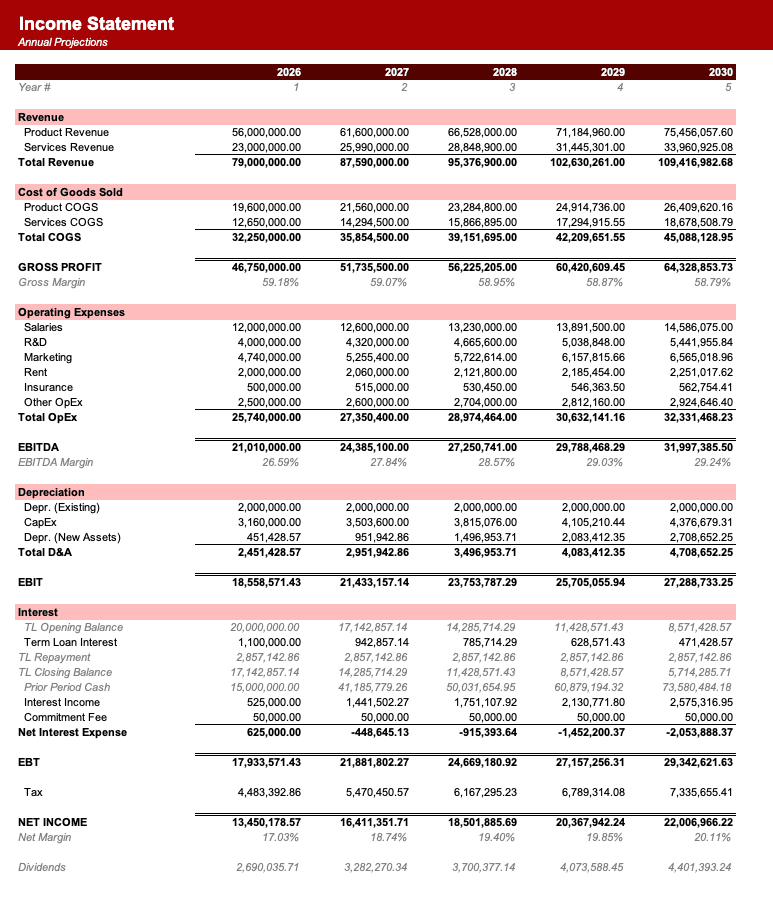
Formatted to IB standards
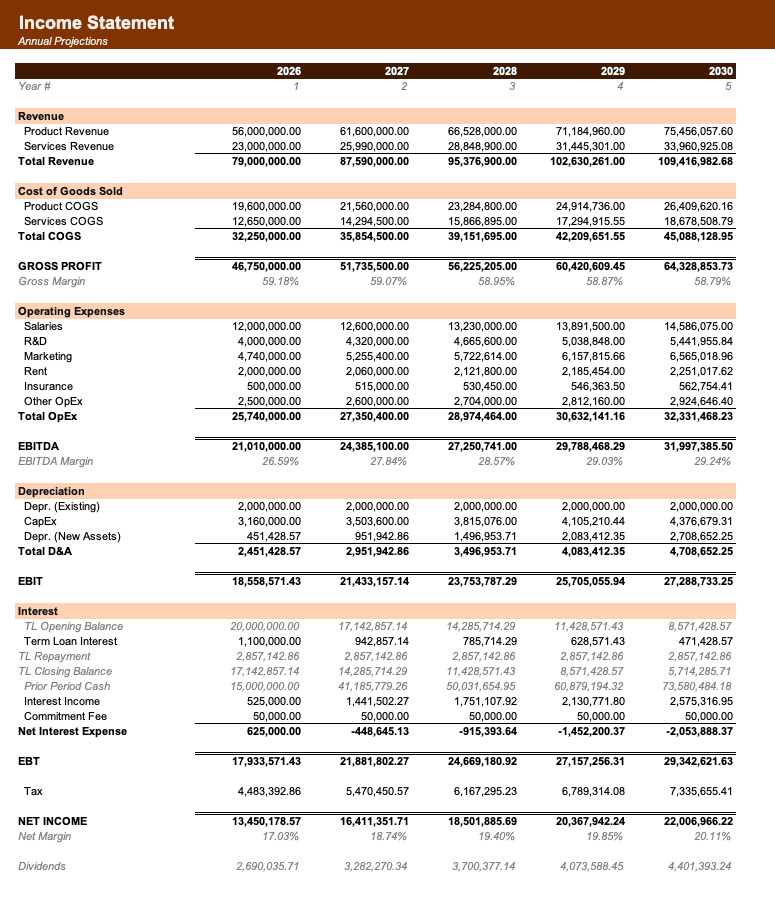
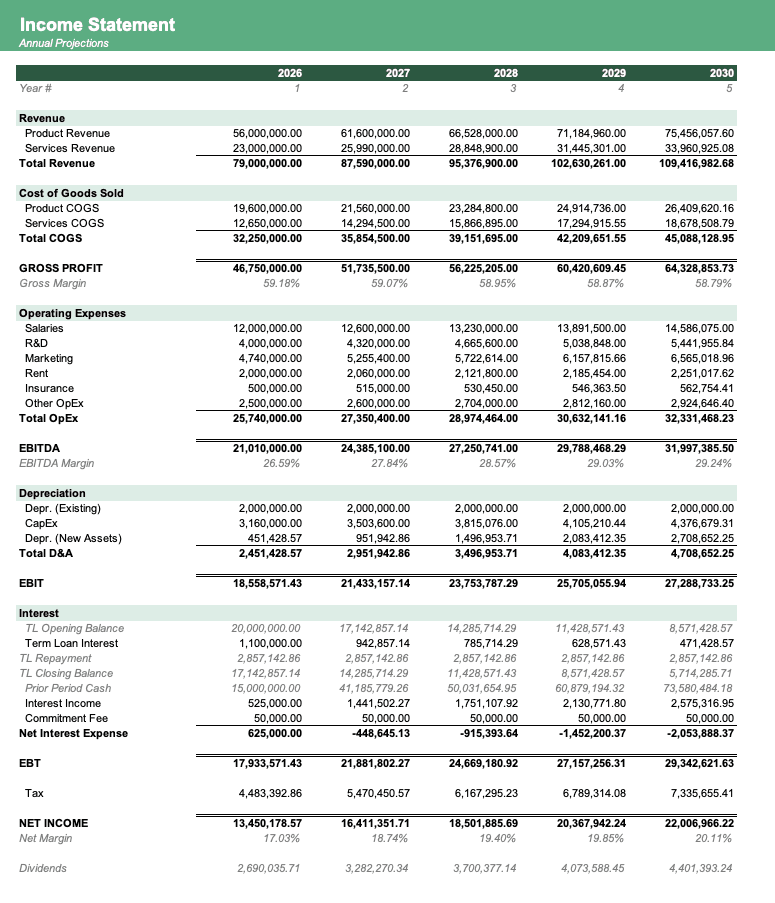
Named theme colors repaint the whole workbook in one click, on top of an investment-banking structure with clear input, output, and cross-sheet reference styling - brand-ready, institutional-grade, and fully auditable.

Created by ex-finance professionals
Hey, I’m Alex and I created Finamodel.
Over my years in the finance industry I kept building the same models over and over again. Same structure, same assumptions, different logo. So I started building frameworks to turn them into clean, reusable templates.
Every model here is one I’d actually use for a client, and I personally vet each one before it goes up.
I’m not an expert in every industry, but I’ve built enough models to know what belongs in one. And when something is completely foreign to me, I reach out to my network for experts to work on our models with us.
Having a template library on hand cuts a first build from hours to minutes.
Need help finding your model? You’ll find me in the Finamodel app!
Frequently asked
What is a typical mezzanine coupon rate?+
Mezzanine coupons typically range from 10-15% depending on deal risk. Rates are higher when a PIK toggle is included or when equity is deeply subordinated, compensating investors for subordination risk relative to senior debt.
How do equity kickers work in mezzanine financing?+
Warrants or equity stakes are granted at a low or zero strike to compensate mezzanine investors for subordination. At exit, the warrants convert at the agreed strike, giving investors equity upside if the company has performed well.
What happens if mezzanine cannot be refinanced before maturity?+
Model paydown from operating cash flow or asset sales. If cash is tight, the PIK toggle allows interest to accrue; at refinancing or exit, the increased debt balance reduces proceeds available to the equity sponsor.
Who uses mezzanine debt models?+
Mezzanine lenders, private equity sponsors, investment banks, and CFOs use these models for deal financing strategy, investor pitches, and refinancing planning decisions.
How does mezzanine fit into a leveraged buyout capital structure?+
Mezzanine sits between senior secured debt and equity. It allows a sponsor to increase total leverage beyond what senior lenders will provide, reducing the required equity check while keeping senior lenders comfortable with their position.
Have more financial modelling questions? Contact us
Related templates
Leveraged Buyout Model
Complete LBO analysis with debt financing structures, sponsor returns, and sensitivity to exit scenarios.
Direct Lending Fund Model
Financial model for direct lending fund with loan origination, yield, losses, and fund returns.
Secondary Private Company Sale Model
Modeling secondary sales of stakes in private companies, including buyer valuations, hold periods, and investor return scenarios.
Venture Capital Fund Model
Model VC fund cash flows, distributed returns, and IRR by vintage year and exit scenario.