Medical Device Financial Model
Healthcare Financial Model (Free Excel Download)
Forecast device development, regulatory milestones, procedure volumes, pricing, manufacturing costs, sales capacity, and cash needs for a medtech business.



professionals from Deloitte
Used by professionals from






About this model
This medical device financial model projects equipment, consumables, service, and software revenue. The published base case starts with 620 equipment units at a $75,000 average selling price, 7% annual unit growth, 2% annual price erosion, an opening installed base of 1,600 devices, and 6% annual device retirement. Consumables use 150 procedures per device per year and $350 per procedure. Service contracts assume 70% attachment at $7,500 annually; software starts at 40% adoption and $15,000 annually.
The COGS assumptions are 55% of equipment revenue, 27% of consumables revenue, 42% of service revenue, and 18% of software revenue. Their corresponding margins before warranty and gross-to-net adjustments are 45%, 73%, 58%, and 82%. These cost percentages are not gross margins. The workbook separately includes warranty cost at 2% of equipment revenue, rebates of 5%, and chargebacks of 1.5%. Its resulting blended gross margin is approximately 62.6% in 2026 and 66.8% in 2030.
Operating assumptions include $18M starting R&D with 11% annual growth, $10M starting G&A with 9% annual growth, and quality/regulatory expense at 3.5% of net revenue. Maintenance capex is 3% of revenue, with $5M growth capex in each of the first two years. Working capital uses 65-day DSO, 110-day DIO, and 50-day DPO, a 125-day cash conversion cycle.
These are illustrative workbook assumptions, not industry benchmarks. The published 2026–2030 base case projects revenue from approximately $170.1M to $366.7M and EBITDA margin from 15.4% to 25.6%. Source: the downloadable medtech.xlsx workbook, Assumptions and financial output sheets.
What every model includes
Live formulas, no hardcoded values
Outputs are driven by live formulas, so the workbook updates from its assumptions instead of relying on hardcoded results.
All assumptions in one tab
Inputs are clearly marked in the Assumptions tab and separated from calculations, making it clear what to change and what to leave intact.
Statements always balancing
For integrated-statement models, the balance sheet, cash flow, and supporting schedules tie through properly.
Distinct schedules for clarity
Debt, working capital, taxes, and cash flow can get messy quickly. We group calculations in clear schedules, not across disconnected tabs.
No hidden macros or external links
There are no unexplained external workbook links or macros to undermine auditability or portability.
Changes flow through the model
Update a key driver and see the impact carry through the forecast, financing, and return outputs. We never use hardcoded numbers in formulas.
What's inside the Medical Device Financial Model
- Target market size and penetration assumptions by hospital type and geography
- Pricing strategy by customer segment and reimbursement pathway
- Manufacturing cost curve and scale-up timeline
- R&D and regulatory approval costs and timelines
- Sales team ramp and customer acquisition economics
- Gross margin expansion as manufacturing scales
Inside the MedTech Financial Model: Revenue, Costs, and Cash Flow
This template provides a structured medtech model for evaluating commercial-stage device companies. It captures revenue from capital equipment, consumables, service, and software, and flows through to a full three-statement output.
The model is designed for investors and analysts assessing the viability of a device business based on its installed base, reimbursement dynamics, and cash generation. Rates and financial results described here reflect illustrative model settings, not industry benchmarks.
Revenue Drivers: Four Streams and the Razor/Blade Engine
The model explicitly forecasts four revenue streams: capital equipment, disposable consumables, service contracts, and software subscriptions. Equipment revenue is units sold multiplied by average selling price, with growth from new product launches and geographic expansion.
- Consumables revenue depends on the installed base, procedures per device, and revenue per procedure. Service revenue is based on the installed base, attach rate, and contract value, while software revenue uses connected device rate and licence fee.
- The razor/blade dynamic is central: equipment is sold at lower margins to build an installed base, and high-margin recurring revenues compound on top. The installed base grows as new units are added and retired, driving consumables, service, and software revenue.
Cost Structure and Operating Leverage
Costs are segmented, reflecting different margin profiles: capital equipment at 55% COGS, consumables at 27%, service at 42%, and software at 18%. Gross-to-net deductions for GPO rebates and chargebacks reduce reported revenue.
- Operating expenses include R&D with a fixed base and escalation, sales and marketing scaled by the installed base through sales rep head-count, G&A, and quality/regulatory costs. This structure creates operating leverage as recurring revenues grow.
- The model includes a scenario toggle to flex key levers such as unit growth, ASP erosion, and procedure volume growth, allowing users to assess different business outcomes.
Cash Flow and Balance Sheet Mechanics
The cash flow statement uses the indirect method, with working capital driven by days sales outstanding, days inventory outstanding, and days payables outstanding. Inventory days are set at 110 to reflect consignment stock and sterilisation, a medtech-specific assumption.
- Capital expenditures include maintenance and growth capex, with depreciation and amortisation flowing below gross profit. Debt consists of a pre-existing term loan with straight-line amortisation and an undrawn revolver.
- Interest is calculated on opening balances to avoid circularity. The balance sheet balances by construction, with opening retained earnings as a live formula.
Checks validate key relationships, ensuring integrity across the model.
Practical Use: Evaluating Investment and Capital Allocation
This medtech model supports investment, acquisition, or capital allocation decisions by projecting revenue mix, R&D pipeline returns, and free cash flow generation. It is suitable for commercial-stage companies with established revenue streams.
- The model outputs include a full P&L, balance sheet, and cash flow statement, along with a dashboard summarizing KPIs and charts. Scenario analysis helps users stress-test assumptions.
- The model avoids over-optimism by incorporating realistic medtech dynamics such as high working capital requirements and reimbursement pressure. It is a tool for understanding the financial drivers of a device business, not for predicting market outcomes.
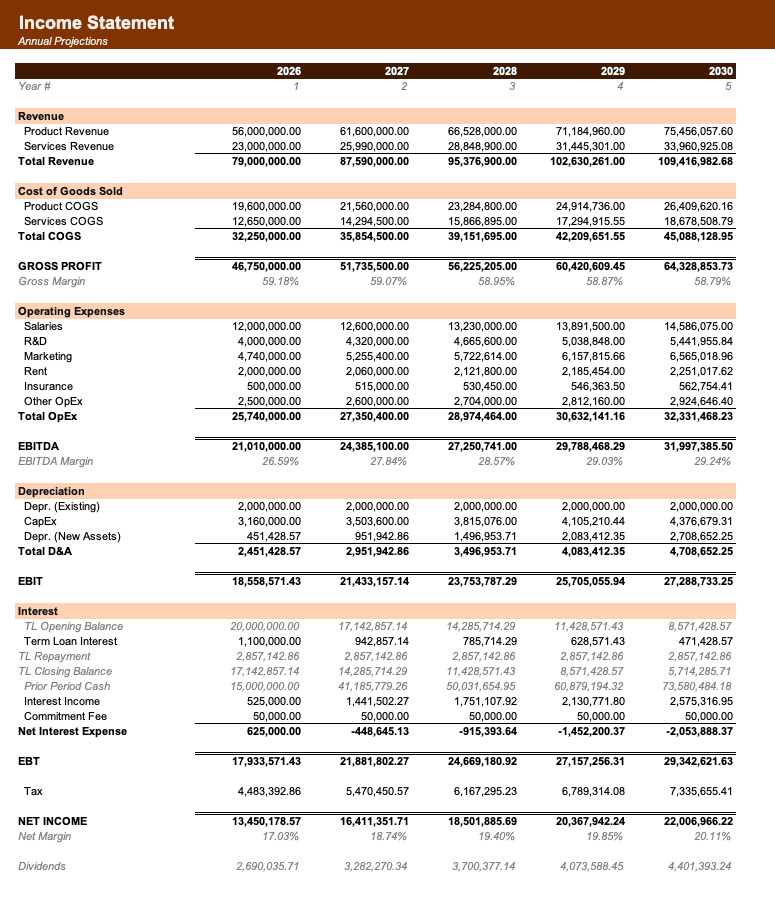
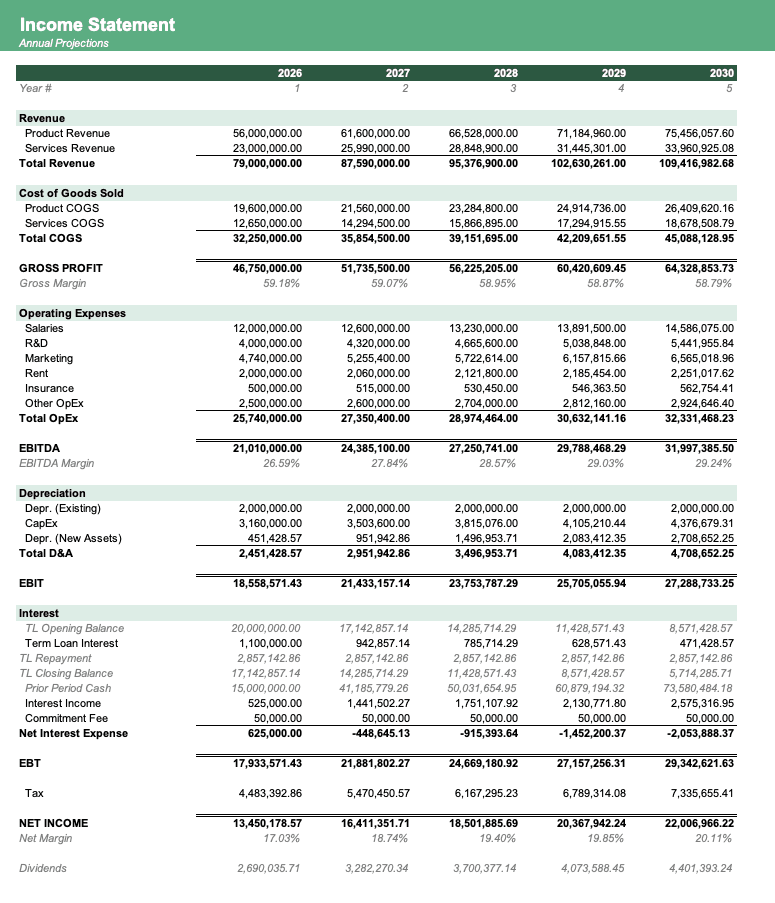
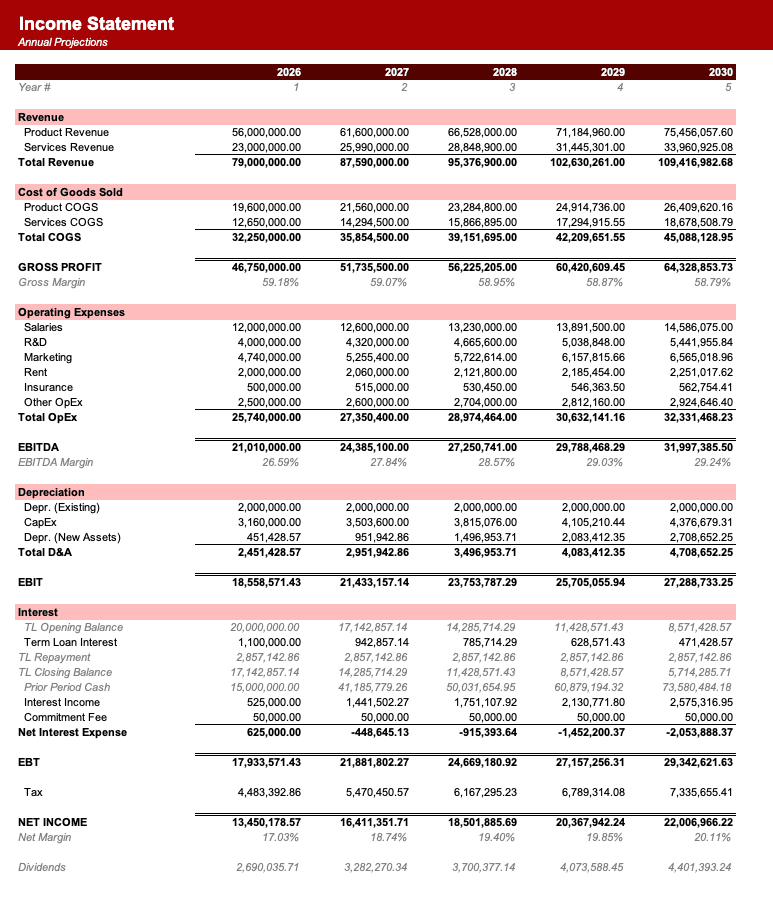
Formatted to IB standards
Named theme colors repaint the whole workbook in one click, on top of an investment-banking structure with clear input, output, and cross-sheet reference styling - brand-ready, institutional-grade, and fully auditable.

Created by ex-finance professionals
Hey, I’m Alex and I created Finamodel.
Over my years in the finance industry I kept building the same models over and over again. Same structure, same assumptions, different logo. So I started building frameworks to turn them into clean, reusable templates.
Every model here is one I’d actually use for a client, and I personally vet each one before it goes up.
I’m not an expert in every industry, but I’ve built enough models to know what belongs in one. And when something is completely foreign to me, I reach out to my network for experts to work on our models with us.
Having a template library on hand cuts a first build from hours to minutes.
Need help finding your model? You’ll find me in the Finamodel app!
Frequently asked
What is a realistic adoption S-curve for a medical device?+
Medical devices typically see 2-5 year adoption curves from first hospital installation to 30% market penetration, depending on reimbursement approval, price point, and clinical switching costs.
How do I model reimbursement rates?+
Research published Medicare rates and commercial payer contracts. Start conservative assuming the lowest reimbursement scenario and stress-test for payer mix changes and rate pressures over time.
What R&D and regulatory costs should I budget?+
Class I/II devices typically require $500K-$2M for regulatory and quality expenses. Class III devices require $2M-$10M or more including clinical trials, plus dedicated regulatory and quality staff during the ramp phase.
Who uses medical device financial models?+
Medtech founders, healthcare investors, CFOs, and product teams use these models for fundraising, go-to-market planning, and valuation and exit scenario analysis.
How does gross margin evolve as a medtech company scales?+
Early-stage gross margins are typically 40-60% due to low production volumes and high per-unit costs. As cumulative volume grows, manufacturing efficiencies drive margins toward 60-75% or higher for established devices.
Have more financial modelling questions? Contact us
Related templates
Biotech IP Licensing Model
Pharmaceutical and biotech licensing deal valuation.
Pharmaceutical Pipeline Valuation Model
Clinical trial progression, probability-weighted cash flows, and R&D project valuation for drug candidates.
Hospital Operating Model
Operating model for hospital systems including inpatient/outpatient volumes, payer mix, DRG reimbursement, and staffing cost drivers.
Gym and Fitness Studio Operating Model
Operating model for fitness franchises and independent gyms including membership revenue, class scheduling, and facility utilization.


