Biotech IP Licensing Model
Healthcare Financial Model (Free Excel Download)
Model biotech licensing upfronts, milestones, royalties, development costs, approvals, and partner economics to value a programme through commercial launch.



professionals from Deloitte
Used by professionals from






About this model
A biotech IP licensing model values a portfolio of royalties and development-stage assets by projecting risk-adjusted cash flows from a commercial out-licensed drug, multiple Phase III and Phase I assets, and platform R&D revenue. The model answers what the licensor should expect in annual earnings and cumulative NPV, accounting for patent cliff exposure (a 75% revenue drop when the commercial drug loses exclusivity), probability-of-success (PoS) adjustments on pre-commercial assets, and milestone payment timing tied to clinical and regulatory events.
The revenue structure combines three deal blocks: Deal A (commercial royalty, tiered 10–15% on partner net sales, losing exclusivity in year 6); Deal B (Phase III asset with milestone payments for Phase III readout, regulatory approval, and launch, plus PoS-weighted royalties); Deal C (Phase I asset with multiple development milestones and low cumulative PoS). Costs include third-party royalties payable on royalty revenue (1.5%), patent maintenance and legal ($4M base), R&D spending ($25M base, growing 6% annually), and G&A. The three-statement model projects EBITDA margins of 35–55% in pre-cliff years, declining to 10–20% in the cliff trough (years 6–8), recovering to 25–35% by year 10 as Deal B and Deal C contribute. A separate rNPV sheet shows unrisked and risked cash flows side-by-side for each deal, allowing investors to see the present value of each asset and understand concentration risk if a single deal fails.
Biotech investors, pharma acquirers, and royalty companies use licensing models to value IP assets, stress patent cliff downside by shortening LoE assumptions, and determine what acquisition price is justified for a portfolio of royalties and development optionality.
What every model includes
Live formulas, no hardcoded values
Outputs are driven by live formulas, so the workbook updates from its assumptions instead of relying on hardcoded results.
All assumptions in one tab
Inputs are clearly marked in the Assumptions tab and separated from calculations, making it clear what to change and what to leave intact.
Statements always balancing
For integrated-statement models, the balance sheet, cash flow, and supporting schedules tie through properly.
Distinct schedules for clarity
Debt, working capital, taxes, and cash flow can get messy quickly. We group calculations in clear schedules, not across disconnected tabs.
No hidden macros or external links
There are no unexplained external workbook links or macros to undermine auditability or portability.
Changes flow through the model
Update a key driver and see the impact carry through the forecast, financing, and return outputs. We never use hardcoded numbers in formulas.
What's inside the Biotech IP Licensing Model
- Development probabilities by phase: preclinical through FDA approval
- Upfront and milestone payments tied to clinical and regulatory events
- Royalty rates by indication and volume with escalation and caps
- Peak sales forecasts with market penetration assumptions
- Risk-adjusted NPV with phase-appropriate discount rates
- Upfront payment and milestone payments tied to development milestones
- Patent life and exclusivity period with generics discount
Biotech Licensing Model: How the Valuation Works
This biotech licensing model values a portfolio of in-licensed and out-licensed drug assets from the perspective of an IP licensor. It combines royalty streams, milestone payments, probability-of-success adjustments and patent cliff effects into a risk-adjusted net present value, supported by a full three-statement financial forecast.
Rates and financial results described here reflect illustrative model settings, not industry benchmarks.
Deal structures and operating drivers
The portfolio contains three distinct licensing deals plus a small platform revenue line. Deal A is a commercial-stage asset where the licensor receives a tiered royalty on partner net sales.
- Deal B is a Phase III asset that pays clinical, regulatory and launch milestones before generating royalties from a Year 5 launch. Deal C is a Phase I asset with milestones tied to later development stages and only a small royalty stream starting around Year 10.
- Partner net sales drive royalty revenue. Deal A grows at 8% annually before exclusivity loss in Year 6, when sales fall 75% and then decay 30% per year.
- Deal B launches with 25% growth for four years, then 8%. Milestone payments occur in specific years and are separate from royalties.
Platform collaboration revenue grows 5% annually.
Calculation flow from deals to statements
Each deal is modelled separately to keep risk adjustment clean. Unrisked cash flows are generated first, then multiplied by probability-of-success (PoS) factors.
- Deal A carries 100% PoS because it is already commercialised. Deal B royalties are risked by Phase III and regulatory PoS (60% and 85%), while its milestones use stage-appropriate probabilities.
- Deal C royalties carry the full cumulative chain (60% × 35% × 60% × 85%), and its earlier milestones use lower-stage probabilities.
- These risked revenues flow into the income statement, where cost of goods includes third-party royalties and patent maintenance. Operating expenses cover platform R&D, clinical contributions, patent prosecution, G&A and business development.
- Depreciation uses layered PP&E schedules, and intangible amortisation reflects acquired in-process R&D. Tax includes a net operating loss carry-forward, so pre-tax losses in cliff years offset later taxable income.
The resulting statements feed the cash flow and balance sheet.
Outputs for valuation and checks
The central output is a per-asset risk-adjusted net present value (rNPV). Each deal’s risked post-tax cash flows are discounted at an asset-specific rate, then summed into a portfolio rNPV.
- Deal A uses a commercial-stage WACC, Deal B a late-stage rate, Deal C an early-stage rate, and the platform a separate rate. A short consolidated DCF sheet provides a cross-check using normalised free cash flow, but the rNPV is the headline valuation.
- A sensitivity grid shows how the portfolio rNPV responds to changes in Deal B’s discount rate and Phase III PoS. Eight validation checks confirm that the opening balance sheet balances, that cash never goes negative, that retained earnings roll forward correctly, that cumulative PoS stays within 0–100%, and that the cash flow statement ties to the balance sheet.
Practical use for evaluation
Readers can use this model to understand how a biotech IP licensor’s value shifts with trial outcomes, launch timing, royalty rates and patent expiry. The three-statement structure shows whether cash generation and balance sheet strength support the royalty profile, especially around the Year 6 cliff when Deal A revenue erodes.
- The scenario selector allows switching between Base, Upside and Downside cases, affecting selected drivers.
- The model is intended for education and design evaluation. The public download is a values-only preview: it shows all outputs and relationships but does not contain live formulas or automatically recalculate.
Users cannot change inputs and see updates without a full rebuild. The underlying design captures probability-adjusted cash flows, per-asset discounting and financial statement integration for assessing licensing portfolios.
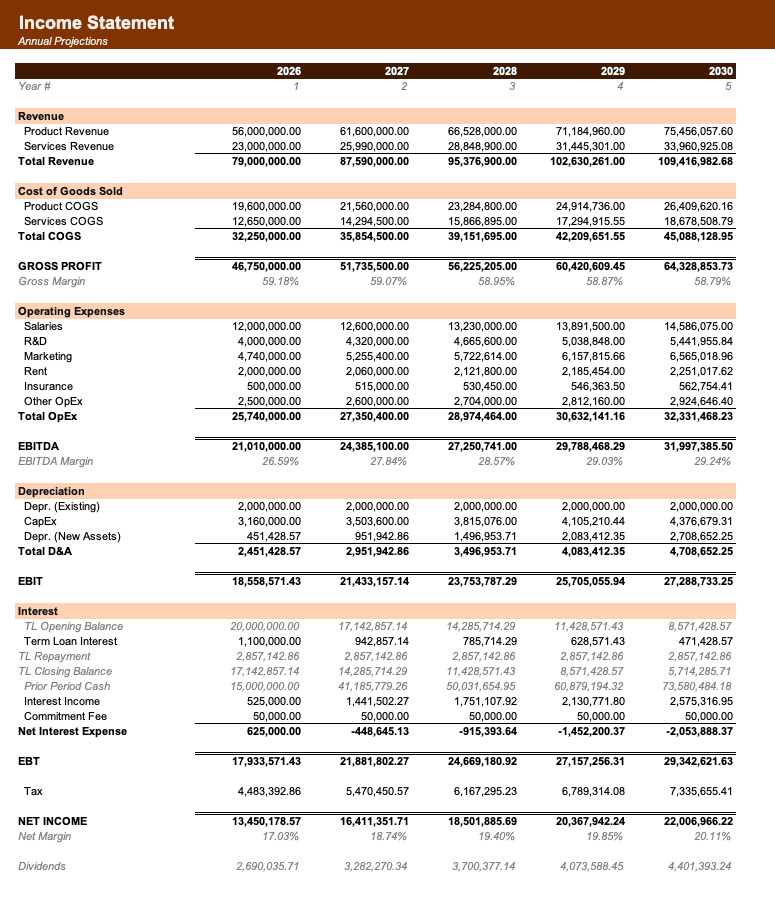
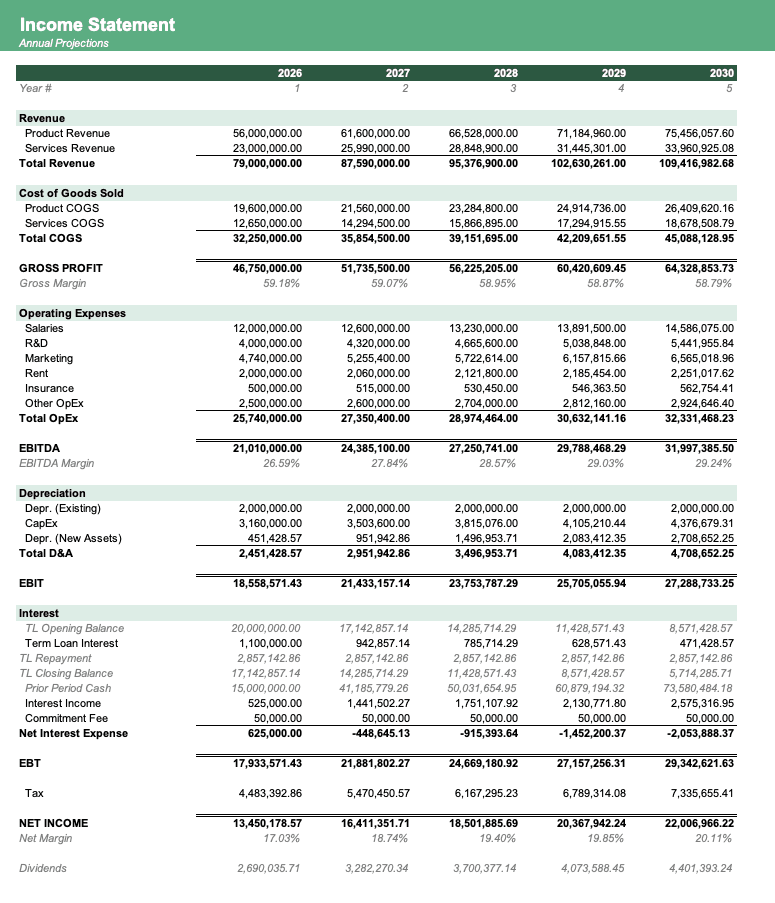
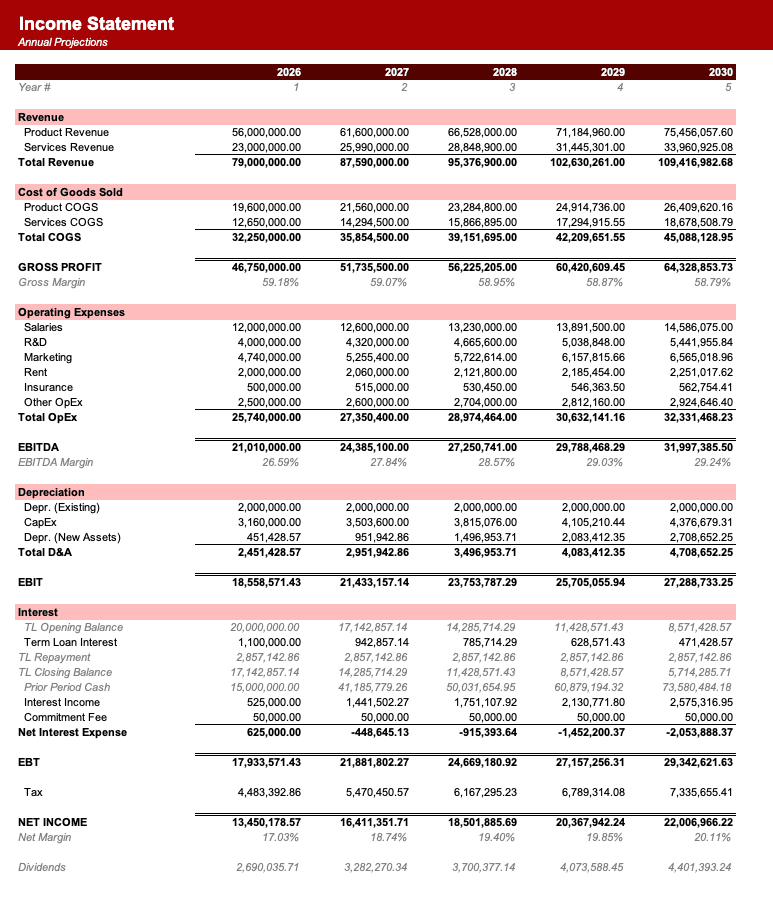
Formatted to IB standards
Named theme colors repaint the whole workbook in one click, on top of an investment-banking structure with clear input, output, and cross-sheet reference styling - brand-ready, institutional-grade, and fully auditable.

Created by ex-finance professionals
Hey, I’m Alex and I created Finamodel.
Over my years in the finance industry I kept building the same models over and over again. Same structure, same assumptions, different logo. So I started building frameworks to turn them into clean, reusable templates.
Every model here is one I’d actually use for a client, and I personally vet each one before it goes up.
I’m not an expert in every industry, but I’ve built enough models to know what belongs in one. And when something is completely foreign to me, I reach out to my network for experts to work on our models with us.
Having a template library on hand cuts a first build from hours to minutes.
Need help finding your model? You’ll find me in the Finamodel app!
Frequently asked
What is a biotech licensing model?+
It is a model that values out-licensed drug assets through probability-adjusted milestone payments, running royalties, and patent-life exclusivity.
What are typical success probabilities by phase?+
Phase 1: 65–75%, Phase 2: 30–50%, Phase 3: 25–35%, FDA approval: 85–90%. Combined preclinical-to-approval is often 5–10%.
How do I set royalty rates?+
Royalties are typically 3–10% of sales for small molecules and 5–15% for biologics, often escalating with sales volume or time.
How does patent expiration affect valuation?+
Generic entry typically reduces revenue 80–90%. The model captures the cliff and any exclusivity extensions.
Does it handle multiple indications?+
Yes. Model separate timelines, milestones, and royalty rates for each indication (oncology, cardiovascular, autoimmune).
Have more financial modelling questions? Contact us
Related templates
Pharmaceutical Pipeline Valuation Model
Clinical trial progression, probability-weighted cash flows, and R&D project valuation for drug candidates.
Medical Device Financial Model
Revenue and profitability model for medical device companies including R&D, regulatory, manufacturing, and distribution.
Goodwill Impairment Testing Model
Annual impairment test model for purchased goodwill and intangibles under ASC 350, comparing fair value to book value.
Gym and Fitness Studio Operating Model
Operating model for fitness franchises and independent gyms including membership revenue, class scheduling, and facility utilization.


