Gym Model
Healthcare Financial Model (Free Excel Download)
Plan fitness-club growth using membership cohorts, churn, pricing tiers, personal training, ancillary revenue, facility capacity, staffing, and site-level EBITDA.



professionals from Deloitte
Used by professionals from






About this model
This operating model evaluates gym and fitness studio profitability by forecasting membership growth, pricing, class utilization, trainer productivity, and facility overhead to identify breakeven and expansion timing. Forecast five-year P&L, balance sheet, and cash flow for a single 1,500 sqm facility with capacity for 2,000 members.
The workbook builds revenue from three streams: membership fees (monthly ARPU × member base), personal training (10% of members × 4 sessions/month × £70), and retail ancillary (£5/member/month). Member acquisition ramps from 400 pre-sales, grows 15–30% during ramp-up, stabilises at 2–5% mature growth. Monthly churn 4% (52% annually). Operating expenses are rent (15–25% of revenue), labour (20–30%), marketing (6%), utilities (5%), and cleaning/maintenance (3%). Gross margin: 80–90%; store-level EBITDA 15–30%.
Used by franchisees and independent gym operators sizing capex and payback periods, multi-location operators planning portfolio expansion, and lenders underwriting fitness franchises (typical leverage 2–3.5x EBITDA at 8% rates). Critical drivers: member lifetime value (ARPU / monthly churn), customer acquisition cost (CAC) payback, and capacity constraints. Facility capex £1,200/sqm fit-out + £500k equipment; payback 3–5 years. Benchmarks: Planet Fitness (low-price, high-volume), Anytime Fitness (franchise model), Equinox (premium) - all showing similar margin profiles.
What every model includes
Live formulas, no hardcoded values
Outputs are driven by live formulas, so the workbook updates from its assumptions instead of relying on hardcoded results.
All assumptions in one tab
Inputs are clearly marked in the Assumptions tab and separated from calculations, making it clear what to change and what to leave intact.
Statements always balancing
For integrated-statement models, the balance sheet, cash flow, and supporting schedules tie through properly.
Distinct schedules for clarity
Debt, working capital, taxes, and cash flow can get messy quickly. We group calculations in clear schedules, not across disconnected tabs.
No hidden macros or external links
There are no unexplained external workbook links or macros to undermine auditability or portability.
Changes flow through the model
Update a key driver and see the impact carry through the forecast, financing, and return outputs. We never use hardcoded numbers in formulas.
What's inside the Gym Model
- Membership cohort and churn analysis by tier
- Tiered membership revenue build (Basic, Premium, Elite)
- Personal training, class, and retail revenue streams
- Facility operating expenses and equipment lease schedules
- Integrated financial statements and break-even analysis
- Membership pricing tiers and revenue per member monthly
- Member acquisition and churn assumptions
- Personal training and ancillary services revenue
Gym Model: How the Financial Template Works for Fitness Clubs
This gym model template projects the financials of a fitness club over five years. It combines a three-tier membership build with capacity limits and multiple revenue streams, then flows through staffing, capex, debt and tax to produce statements, DSCR and investor returns.
This overview explains the documented drivers and calculations for anyone evaluating the template.
Membership tiers and the member build drive capacity
The foundation is a three-tier membership table where each tier has a mix percentage, monthly price and monthly churn; mix must total 100 percent. Blended ARPU and blended churn are the sum-product of mix and tier values, so changing the mix changes both pricing and retention.
- Ending members equal beginning members plus gross additions minus cancellations, and cancellations use annualised blended churn. Gross additions are capped by maximum capacity, which is facility size divided by space per member.
- This matters because growth cannot exceed the physical space, and the blended churn means a richer mix changes the sustainable member base.
Revenue streams and cost drivers
Membership dues are average members times blended ARPU times annual escalation, plus joining fees on gross new members.
- Ancillary streams follow participation and usage: personal training from active members times participation, sessions and price; class packs from average members times class participation, packs per month and price; day passes from average members times passes per member per year and price; retail from a per-member monthly spend.
- Costs separate into variable items such as personal training commissions and retail COGS, and fixed operating expenses including rent, payroll, marketing, utilities, cleaning and insurance. Staffing is built from opening hours, concurrent coverage and members per thousand, not from revenue, with an assistant manager threshold.
Capex, debt and the calculation flow
The model runs a five-year annual projection through linked statements. Initial capex covers fit-out, equipment and technology; maintenance capex is a percentage of revenue, and renewal capex is sized so total capex at least equals depreciation, holding net PP&E flat.
- The debt schedule includes a term loan with amortisation and interest, plus a revolver that draws during the ramp and repays from surplus. Pre-opening costs are charged in year one.
- Net operating losses carry forward to shield later tax. The flow moves from assumptions and member build into revenue, costs, capex, debt, income statement, balance sheet, cash flow and returns.
Outputs and practical use for evaluation
Outputs include a dashboard, KPI summary, DCF bridge, income statement, balance sheet, cash flow, returns and a checks tab.
- Returns cover project IRR for a build lens, MOIC on a year-five exit, LTV/CAC and CAC payback.
- Checks validate balance sheet balancing, capacity, DSCR with a ramp exemption, EBITDA margin, accumulated depreciation, cash floor and tier mix.
- For a reader evaluating a gym investment, the template shows whether membership growth respects capacity, whether the revolver clears, whether DSCR stays strong after ramp, and whether leverage is accretive given the project return relative to debt cost.
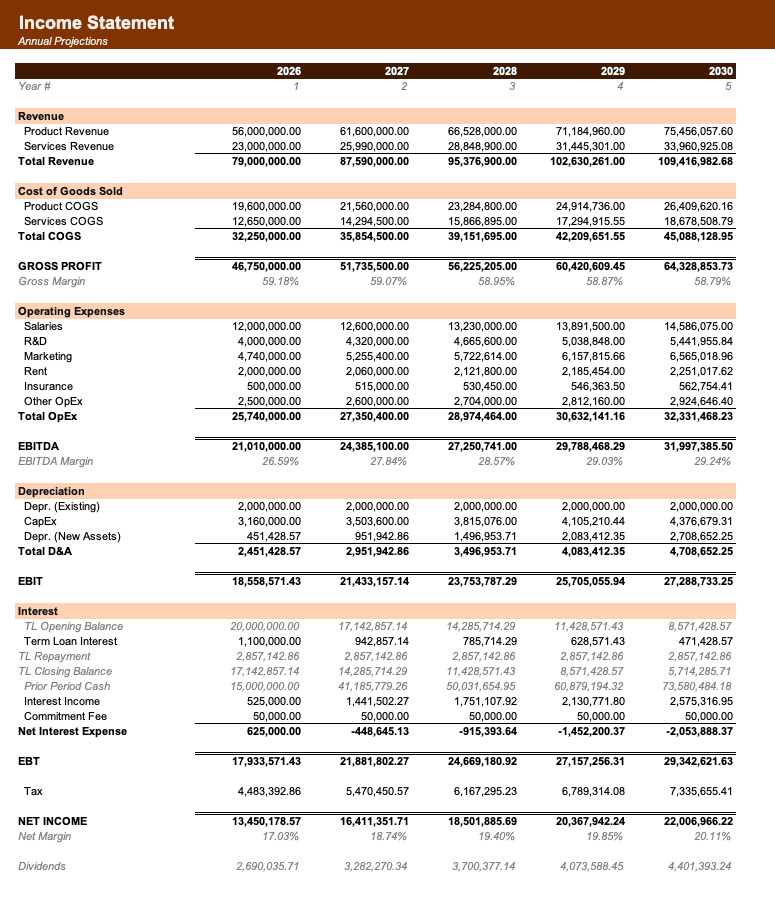
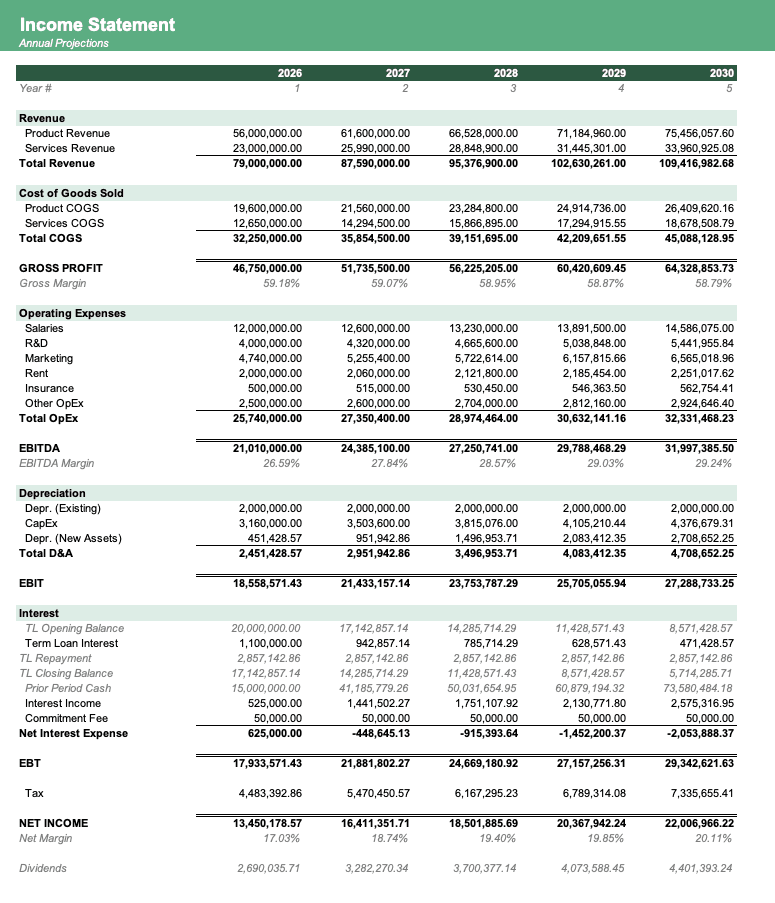
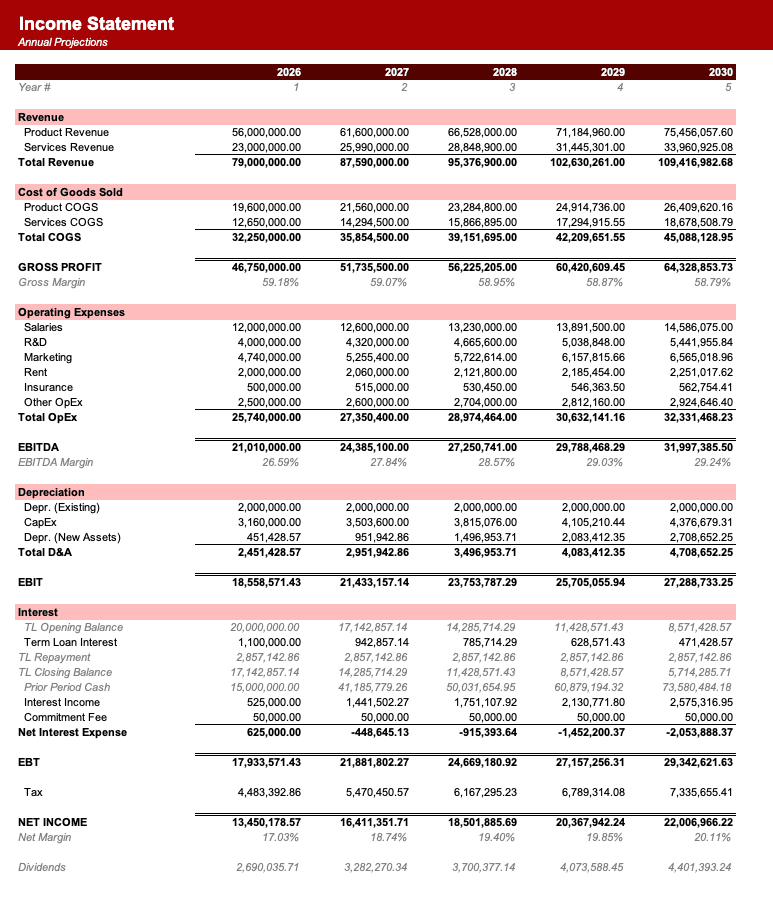
Formatted to IB standards
Named theme colors repaint the whole workbook in one click, on top of an investment-banking structure with clear input, output, and cross-sheet reference styling - brand-ready, institutional-grade, and fully auditable.

Created by ex-finance professionals
Hey, I’m Alex and I created Finamodel.
Over my years in the finance industry I kept building the same models over and over again. Same structure, same assumptions, different logo. So I started building frameworks to turn them into clean, reusable templates.
Every model here is one I’d actually use for a client, and I personally vet each one before it goes up.
I’m not an expert in every industry, but I’ve built enough models to know what belongs in one. And when something is completely foreign to me, I reach out to my network for experts to work on our models with us.
Having a template library on hand cuts a first build from hours to minutes.
Need help finding your model? You’ll find me in the Finamodel app!
Frequently asked
What is a gym financial model?+
It is a model that forecasts membership revenue, secondary income streams, facility costs, and profitability for a gym or fitness club operation.
Who uses gym financial models?+
Gym owners, fitness entrepreneurs, commercial lenders, and hospitality investors use them for planning, feasibility, and financing.
What should a gym model include?+
It should include membership tiers, churn assumptions, personal training and retail revenue, facility costs, equipment capex, and break-even analysis.
Does it handle membership churn?+
Yes. The model applies monthly churn rates by tier to the active member base, accounting for seasonal peaks and promotional sign-ups.
Can I model secondary revenue streams?+
Yes. The model separates personal training, group classes, and retail sales from core membership dues with distinct margin and utilisation tracking.
Have more financial modelling questions? Contact us
Related templates
Restaurant Unit Economics and Multi-Unit Model
Single-unit operating metrics, cost of goods sold, labor, rent, and multi-unit chain economics.
Subscription Box Economics
Model recurring revenue, churn, customer acquisition, and fulfillment costs for a subscription service.
Hotel Operating Model
Operating model for hotel properties including occupancy rates, average daily rate (ADR), RevPAR optimization, and facility-level profitability.
Hospital Operating Model
Operating model for hospital systems including inpatient/outpatient volumes, payer mix, DRG reimbursement, and staffing cost drivers.


