Music Royalties and Catalog Model
Consumer Financial Model (Free Excel Download)
Model catalogue streams, royalty rates, collection timing, advances, administration fees, and discounting to value music-rights cash flows.



professionals from Deloitte
Used by professionals from






About this model
A Music Royalties & Catalogue Model values an independent music label's catalogue (mix of owned and acquired recordings) on the basis of streaming, physical, sync, and publishing revenue streams with their respective royalty economics. Streaming dominates (55% of revenue at $0.004/stream) and grows 8% annually; physical (vinyl resurgence) contributes 11% at $18/unit wholesale and 3% growth. Sync licensing (12 placements Year 1 × $25K average) and publishing (performance royalties + mechanical royalties at 15% of streaming revenue) complete the revenue mix. A typical independent label with $5M catalogue acquisition, 250M annual streams, 18K vinyl units, and $200K annual performance royalties generates $5-7M total revenue with 50% gross margin after distribution fees (10% of streaming), artist royalties (20% of total revenue), writer royalties (75% of publishing revenue), and manufacturing costs.
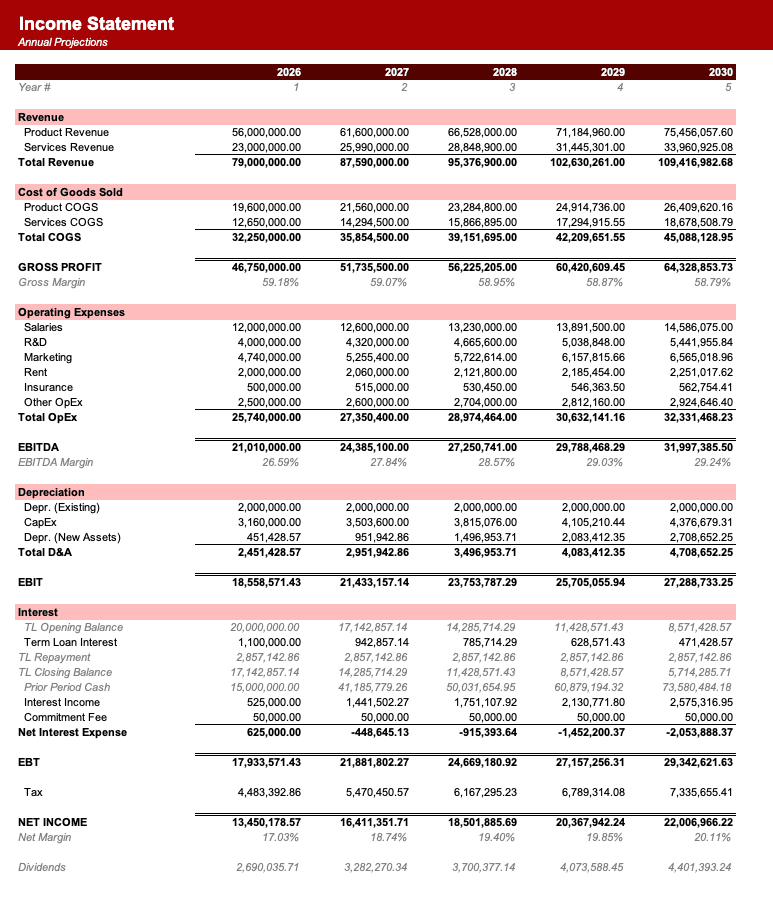
The Revenue_Build sheet forecasts each stream independently: streaming volumes escalate per annual growth assumptions, physical units grow modestly (vinyl trend), sync placements scale with catalogue profile, publishing (performance royalties grow 3% annually; mechanical royalties scale with streaming). Critically, mechanical royalties appear ONLY as publishing revenue - they are not double-booked as COGS. Artist Royalties (20% of total label revenue) represent the recorded side; writer royalties (75% of performance + mechanical) represent the composition side. No separate mechanical royalty expense line in COGS. The Income_Statement produces ~50% gross profit, with OpEx (A&R 8% of revenue, marketing 15%, staff $320K base plus 4%, G&A $120K base plus 3%) yielding 20-28% EBITDA margin. A $5M term loan at 8.5% ($714K annual amortization) is drawn in Year 1 to acquire the catalogue; DSCR must exceed 1.25× (typically 2.5-3.5×).
This model suits music investors, independent labels, publishing acquirers, and PE sponsors evaluating music catalogue investments or label acquisitions. Typical catalogue multiples are 10-15× NLS (net label share = gross profit) depending on streaming quality (top-tier labels command 15×; niche catalogues 8×). Sensitivities include streaming royalty rate changes (MLC statutory mechanical rates), artist contract renegotiations (payouts), and churn risk (cover versions, playlist decay). Non-recourse catalogue securitizations typically lend at 4-6× EBITDA.
What every model includes
Live formulas, no hardcoded values
Outputs are driven by live formulas, so the workbook updates from its assumptions instead of relying on hardcoded results.
All assumptions in one tab
Inputs are clearly marked in the Assumptions tab and separated from calculations, making it clear what to change and what to leave intact.
Statements always balancing
For integrated-statement models, the balance sheet, cash flow, and supporting schedules tie through properly.
Distinct schedules for clarity
Debt, working capital, taxes, and cash flow can get messy quickly. We group calculations in clear schedules, not across disconnected tabs.
No hidden macros or external links
There are no unexplained external workbook links or macros to undermine auditability or portability.
Changes flow through the model
Update a key driver and see the impact carry through the forecast, financing, and return outputs. We never use hardcoded numbers in formulas.
What's inside the Music Royalties and Catalog Model
- Streaming revenue by platform and geography (Spotify, Apple, YouTube)
- Publishing and mechanical royalties from composition ownership
- Historical growth rates and catalog age decay curve modeling
- Synch licensing revenue from film, TV, and advertising
- Catalog valuation using revenue multiples and DCF
- Operating costs and collection agent fees
Music Royalties Model: How the Independent Label Template Works
This music royalties model template helps you evaluate the financial profile and catalogue valuation of an independent label. It captures multiple revenue streams, royalty obligations, a term loan financing a catalogue acquisition, and produces a five-year three-statement forecast with built-in checks and valuation outputs.
Below we explain the key operating drivers, calculation flow, outputs, and practical uses.
Operating Drivers Behind the Revenue Build
The model separates revenue into streaming, physical, sync, performance, and mechanical streams, each driven by distinct operating assumptions. Streaming revenue combines a base stream count with growth and a blended per-stream rate.
- Physical sales multiply units by an escalating wholesale price. Sync licensing relies on placement count and average fee.
- Publishing performance royalties grow from a base, while mechanical royalties are calculated as a percentage of streaming revenue. These drivers reflect the fragmented nature of royalty income and allow you to test how changes in listener behaviour or deal terms affect the top line.
Calculation Flow and Cash Timing
The model follows a logical flow from assumptions to revenue, then through cost of goods sold, operating expenses, and down to net income. COGS includes distribution fees, manufacturing, artist royalties, and writer royalties, with careful treatment of mechanical royalties to avoid double counting.
- Operating expenses cover A&R, marketing, staff, and G&A. Working capital is driven by days sales outstanding and days payable outstanding, with different lags for each revenue stream and royalty payment.
- The term loan financing the catalogue acquisition is reflected in the cash flow statement, ensuring that the balance sheet balances and cash movements are explained.
Outputs and Checks Built Into the Template
The template generates a full three-statement model: income statement, balance sheet, and cash flow, supported by a debt schedule and a valuation sheet.
- The valuation section applies both a net label share multiple and a discounted cash flow approach.
- A dedicated checks sheet monitors balance sheet integrity, cash non-negativity, debt service coverage ratio, and other validation rules.
- These outputs help you assess the financial health of the label, the impact of the debt covenants, and the potential valuation range under different operating scenarios.
Practical Applications for Evaluation
You can use this model to explore how changes in streaming growth, per-stream rates, or royalty percentages affect profitability and cash generation.
- It is particularly suited for evaluating catalogue acquisitions, structuring term loans, or testing covenant compliance.
- Because the model is transparent and clearly structured, you can trace how each assumption flows through to net income, cash flow, and valuation.
- The public download is a values-only preview, so you cannot change inputs or recalculate live; however, it demonstrates the relationships and calculations that underpin a full working model.
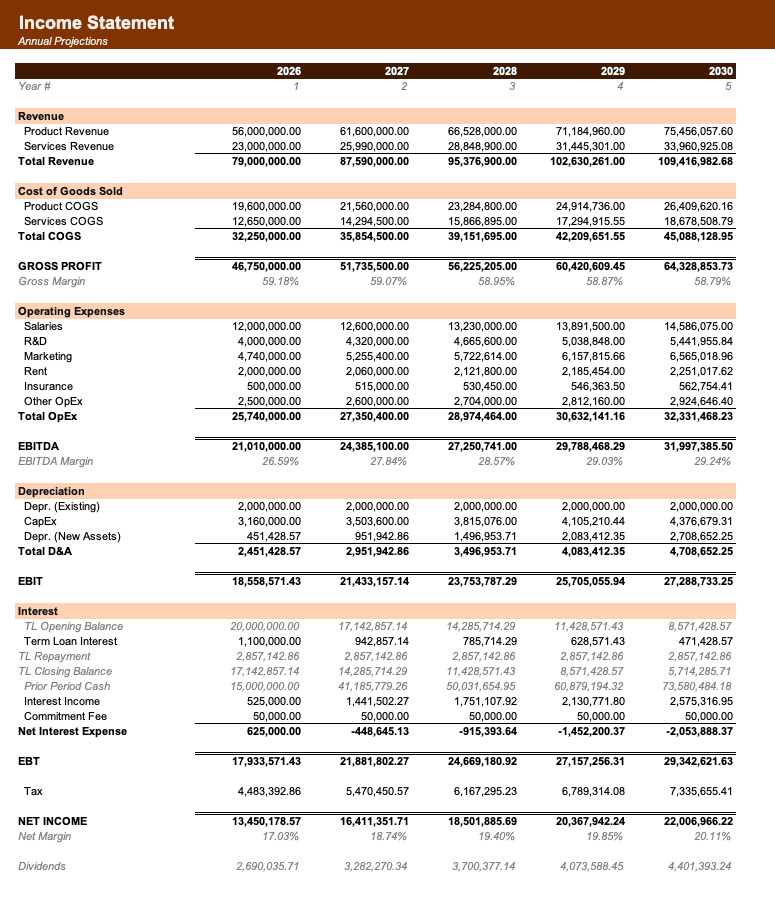
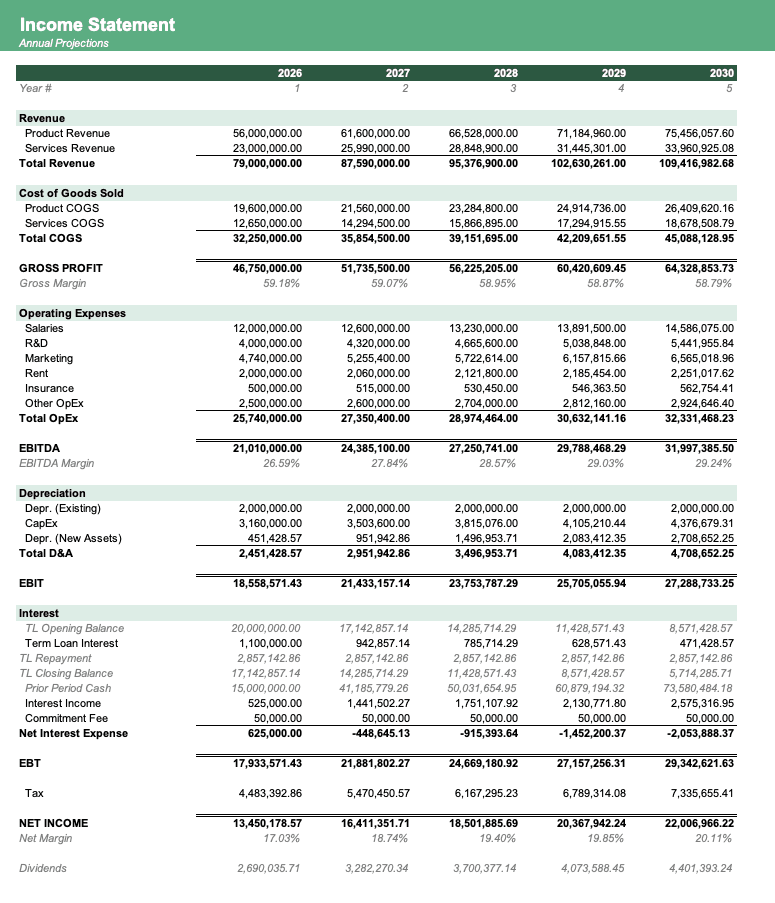
Formatted to IB standards
Named theme colors repaint the whole workbook in one click, on top of an investment-banking structure with clear input, output, and cross-sheet reference styling - brand-ready, institutional-grade, and fully auditable.

Created by ex-finance professionals
Hey, I’m Alex and I created Finamodel.
Over my years in the finance industry I kept building the same models over and over again. Same structure, same assumptions, different logo. So I started building frameworks to turn them into clean, reusable templates.
Every model here is one I’d actually use for a client, and I personally vet each one before it goes up.
I’m not an expert in every industry, but I’ve built enough models to know what belongs in one. And when something is completely foreign to me, I reach out to my network for experts to work on our models with us.
Having a template library on hand cuts a first build from hours to minutes.
Need help finding your model? You’ll find me in the Finamodel app!
Frequently asked
What is a music catalog valuation model?+
A model that projects royalty revenue streams from streaming, publishing, sync, and mechanical rights, then applies a multiple or DCF to arrive at a catalog acquisition price.
What is a typical music catalog valuation multiple?+
Catalog multiples typically range from 3 to 7x trailing annual revenue. Tier-one catalogs command 5 to 7x; mid-tier catalogs trade at 3 to 5x depending on growth profile.
How much do streaming royalties decline with catalog age?+
Genre-dependent. Top tracks stay relevant; deep catalog decays 5 to 15% annually. Model separately for pop catalogs versus evergreen genres like classical or jazz.
What costs reduce catalog cash flow?+
Collection agent fees of 5 to 10%, sync licensing commissions, and marketing costs to promote re-releases are the main deductions from gross royalty income.
Can I use this for royalty financing decisions?+
Yes. The model projects future royalty cash flows that can be used as collateral for financing, with forecasts structured to demonstrate debt service capacity.
Have more financial modelling questions? Contact us
Related templates
Film Slate Financial Model
Investment and returns model for film production slate with budgets, financing, and box office assumptions.
E-Commerce Unit Economics
P&L model for e-commerce business with CAC, LTV, gross margin, and unit economics.
Ecommerce Forecast
18-month ecommerce forecast: traffic, conversion, AOV, contribution margin.
Subscription Box Economics
Model recurring revenue, churn, customer acquisition, and fulfillment costs for a subscription service.