Film Slate Financial Model
Entertainment Financial Model (Free Excel Download)
Forecast a film slate’s production budgets, release timing, distribution revenue, marketing spend, recoupment waterfall, and investor returns.



professionals from Deloitte
Used by professionals from






About this model
A film slate financial model values a portfolio of theatrical releases across a multi-year release schedule by modeling revenues through the distribution waterfall: theatrical box office (40–45% of gross), home video and streaming rights (fixed license fees), broadcast rights, and international sales. For a five-title slate, the model tracks each film's production budget (manufacturing guarantee, or MG), prints and advertising (P&A), and estimated gross box office, then calculates distributable revenue after paying participations (talent back-ends) and deducting distribution fees and P&A.
Content amortization uses the film forecast method (ASC 926): current-period amortization equals the proportion of ultimate revenue earned in that period, multiplied by the total capitalized cost. This ensures that an expensive film with weak box office is fully written down rather than sitting on the balance sheet as a long-lived asset. The model aggregates revenue across all windows (theatrical, SVOD, AVOD, international) to estimate ultimate revenue per title, then computes cumulative amortization to ensure it does not exceed the capitalized cost.
Investor returns (IRR, MOIC) depend on the timelines: theatrical revenue is realized within 8–12 weeks, but SVOD licenses (Amazon, Netflix, Apple) are paid in installments over 18–24 months, delaying cash realization. This template is suitable for film financiers, distributors, and media companies evaluating slate acquisitions or internal production portfolios.
What every model includes
Live formulas, no hardcoded values
Outputs are driven by live formulas, so the workbook updates from its assumptions instead of relying on hardcoded results.
All assumptions in one tab
Inputs are clearly marked in the Assumptions tab and separated from calculations, making it clear what to change and what to leave intact.
Statements always balancing
For integrated-statement models, the balance sheet, cash flow, and supporting schedules tie through properly.
Distinct schedules for clarity
Debt, working capital, taxes, and cash flow can get messy quickly. We group calculations in clear schedules, not across disconnected tabs.
No hidden macros or external links
There are no unexplained external workbook links or macros to undermine auditability or portability.
Changes flow through the model
Update a key driver and see the impact carry through the forecast, financing, and return outputs. We never use hardcoded numbers in formulas.
What's inside the Film Slate Financial Model
- Production slate: film count, genres, and estimated budgets
- Production financing: equipment, crew, location, post-production, and contingency
- Revenue streams: theatrical box office, streaming rights, broadcast, and home video
- Investor returns: IRR and MOIC by film and slate-wide
- P&L bridge from budgets to net profit after distribution and financing costs
- Market sizing: comparable films, genre returns, and audience projections
Film Slate Model: How the Template Evaluates a Content Portfolio
The Film Slate Model template turns a portfolio of titles into a structured view of distributor economics. It connects an adjusted box-office driver to windowed revenue, applies recoupment and participation rules, and traces the results through amortisation, operating costs, cash flow, debt and returns.
This explanation covers the operating drivers, calculation flow, outputs and practical evaluation use described in the design document.
Operating Drivers Behind the Slate
The model is driven by title-level and market assumptions. Each title carries a minimum guarantee, a print-and-advertising budget, delivery and completion-bond cost, negative cost, tax credit, base box office and a performance factor.
- Adjusted box office equals base box office multiplied by that per-title performance factor, and all revenue windows scale from it. The theatrical window applies a distributor rental percentage to gross box office.
- Home entertainment uses transactions at a wholesale price, while pay TV and SVOD use a floor or a percentage of adjusted box office, whichever is greater. International distribution splits into a territory minimum guarantee and an overage share.
Calculation Flow from Revenue to Cash
Revenue is assembled by window across a seven-year projection, with delayed availability for SVOD, AVOD and TVOD, and library revenue separated from new releases. The recoupment corridor cumulatively nets distribution fees, P&A and minimum guarantees from revenue; only positive movement above that recovered position triggers participations at a single talent share.
- Amortisation follows the film-forecast-computation method, capping the cumulative charge at capitalised cost. The profit-and-loss statement moves from revenue through cost of goods sold, including content amortisation, P&A, delivery, completion bond, residuals and participations, then SG&A, EBITDA, interest, tax and net income.
- The cash-flow statement then applies working-capital timing, tax-credit monetisation with a lag, and debt roll-forward before balancing.
Outputs and Reported Metrics
The finished model reports a slate-level profit and loss, cash flow, balance sheet and a debt schedule with revolver draws and repayments. Balance-sheet assets combine cash, receivables based on days sales outstanding, and a content library, while liabilities include participations payable and the revolver.
- The returns output computes IRR, MOIC and NPV on the slate investor's net operating and investing cash vector, excluding equity injections and revolver financing, and adds a labelled library-exit terminal value. The per-title summary shows negative cost, tax credit, window revenue split, undiscounted return and per-title MOIC.
- Checks cover amortisation caps, margin ranges, cash positivity, balance-sheet balancing and the SG&A allocation.
Practical Use for Evaluation
This template is useful for asking whether a slate of film content should be acquired, funded or distributed, based on projected distribution waterfall, content amortisation and library residual value.
- Because the shipped slate is a realistic mix of hits, underperformers, a miss and write-offs, the diagnostics show how concentrated profitability can be.
- Readers can stress the performance factor per title and observe how revenue, recoupment and participations respond, then follow the effect into cash flow and returns.
- The design notes the model's annual granularity is appropriate for portfolio-level decisions and that participations use a single blended tier, which is a documented simplification.
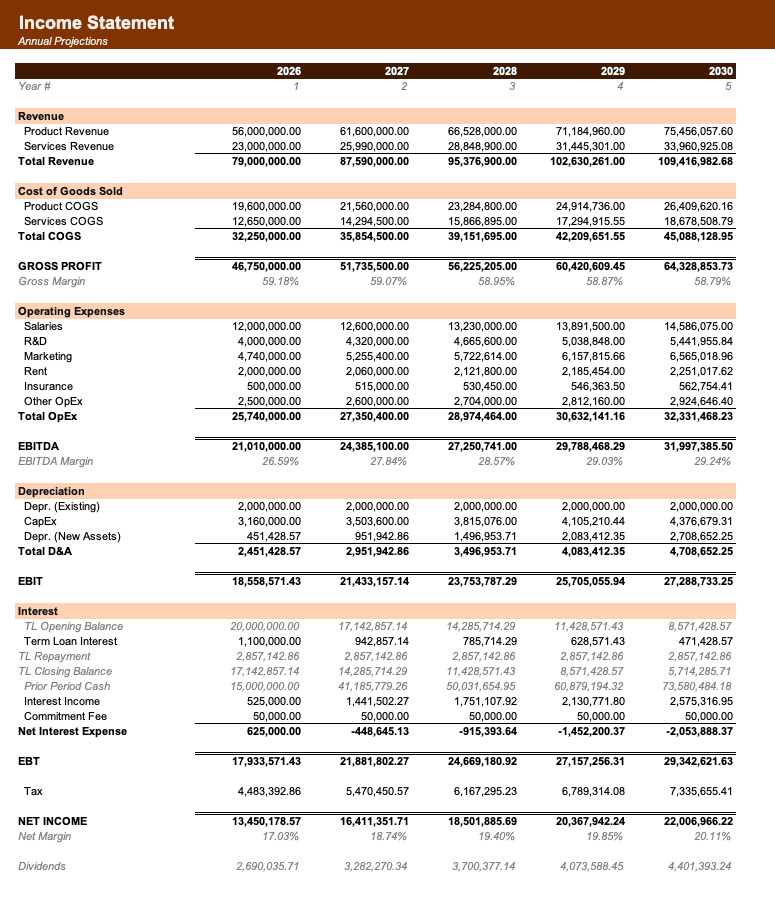
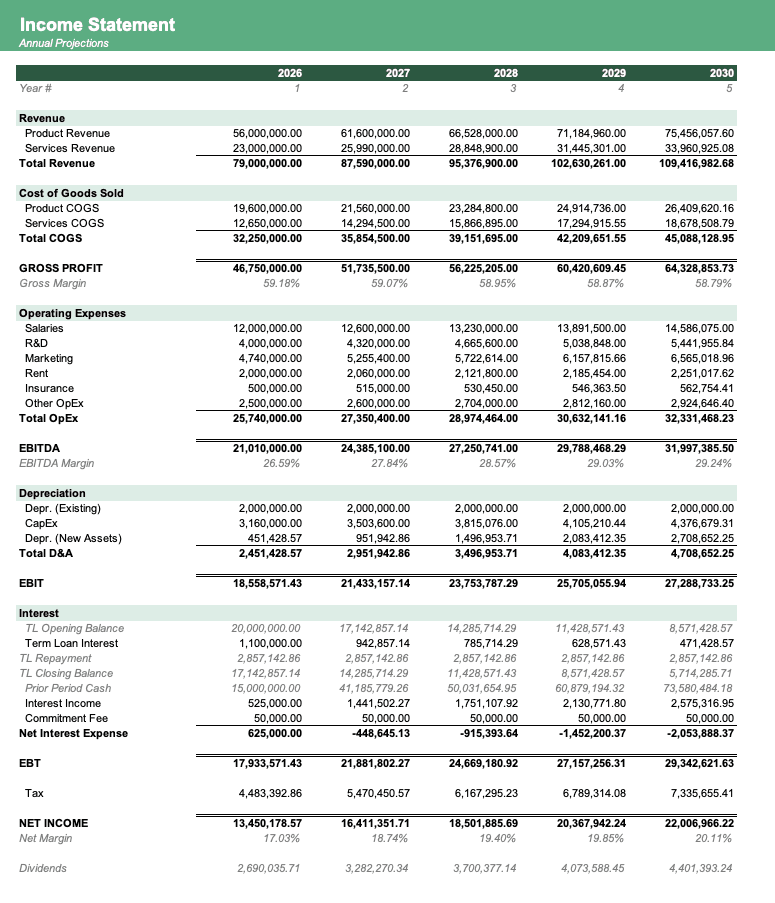
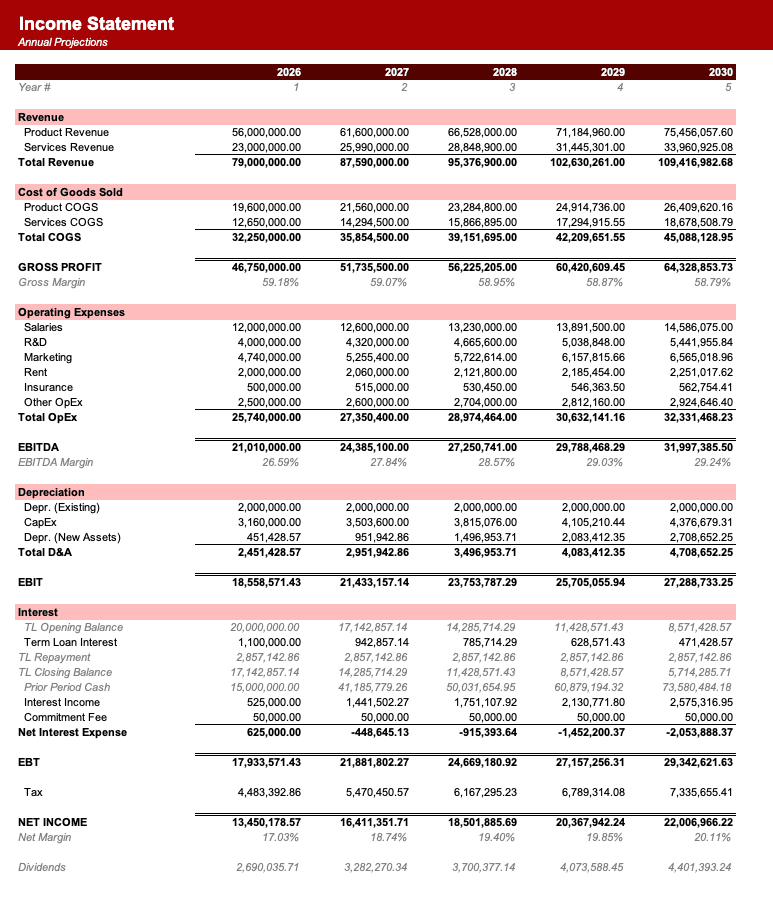
Formatted to IB standards
Named theme colors repaint the whole workbook in one click, on top of an investment-banking structure with clear input, output, and cross-sheet reference styling - brand-ready, institutional-grade, and fully auditable.

Created by ex-finance professionals
Hey, I’m Alex and I created Finamodel.
Over my years in the finance industry I kept building the same models over and over again. Same structure, same assumptions, different logo. So I started building frameworks to turn them into clean, reusable templates.
Every model here is one I’d actually use for a client, and I personally vet each one before it goes up.
I’m not an expert in every industry, but I’ve built enough models to know what belongs in one. And when something is completely foreign to me, I reach out to my network for experts to work on our models with us.
Having a template library on hand cuts a first build from hours to minutes.
Need help finding your model? You’ll find me in the Finamodel app!
Frequently asked
What is a film slate financial model?+
A model that tracks production budgets, financing structure, revenue across distribution windows, and equity investor returns for a portfolio of films.
What is above-the-line vs. below-the-line costs?+
Above-the-line covers script, producer, director, and talent compensation. Below-the-line covers crew, equipment, production design, and post-production.
What is a typical theatrical box office return?+
Films typically earn 2-5x budget in worldwide box office, but distribution fees and costs reduce producer proceeds to 20-40% of box office gross.
How much do streaming rights typically generate?+
Streaming rights often generate 50-200% of production budget depending on film profile, star power, and whether the deal is exclusive or non-exclusive.
Who uses film slate financial models?+
Film financiers, producers, entertainment investors, and media funds use them to structure deals, pitch investors, and manage portfolio risk across titles.
Have more financial modelling questions? Contact us
Related templates
Music Royalties & Catalog Model
Valuation model for music royalties and catalog assets with streaming revenue, publishing, and mechanical rights.
Sports Team Financial Model
Operating and valuation model for sports teams showing revenue streams, player payroll, stadium economics, and franchise valuation.
Streaming Platform Economics Model
Operating model for video streaming platforms with subscriber growth, content spend, churn, and path to profitability.
Escape Room Operator Model
Plan and value an escape room venue using room slot capacity, game utilization, re-theming cycles, and a DCF.


