


Net interest on reserves = average reserves × a blended reserve yieldStablecoin Tokenomics Model
Crypto & DeFi Financial Model (Free Excel Download)
Model stablecoin economics through circulating supply, reserve assets, yield income, redemption activity, transaction fees, operating costs, and liquidity stress scenarios.
DownloadSign up to downloadFree, no credit card required
Edit in Excelprofessionals from Deloitte
Loading...
Used by professionals from






About this model
Model stablecoin reserves and revenue to see true capital efficiency and avoid marketing exaggeration of backing ratios. The model projects TVL (total locked value = stablecoin supply × collateralisation ratio), calculates reserve yield (T-bills, liquid staking earning 4-5%), and forecasts revenue from: (a) net interest (reserve portfolio return), (b) mint/redeem fees (0.05% on gross volume, asymmetric: growth minting + churn replacement), (c) liquidation penalties (5-8% haircut on under-collateralised positions), and (d) transaction fees. Operating costs include dev team (6 FTE ~$1.2M/yr), audits, legal, and marketing.
Key mechanics: reserve yield is the spread - the protocol earns yield on reserves, stablecoin holders earn zero. Collateralisation ratio (110% typical) means the protocol holds $1.10 of reserves per $1.00 of stablecoin - the 10% excess is equity buffer funded by the treasury. Token emissions are a non-cash cost (tokens distributed from pre-minted pool valued at an assumed token price). The model separates protocol treasury (operating cash) from reserves (backing stablecoins). Cash flow shows reserve build as a major CFI line (buying T-bills as TVL grows) and stablecoin issuance proceeds as a major CFF line. EBITDA is deeply negative Y1-Y3, turns positive Y4-Y5 as TVL scales (revenue grows faster than fixed costs).
Essential for crypto protocol evaluators, DeFi yield farms, and token investors assessing viability without rely on marketing claims. Shows the real token valuation (protocol DCF, not speculation).
What every model includes
Live formulas, no hardcoded values
Outputs are driven by live formulas, so the workbook updates from its assumptions instead of relying on hardcoded results.
All assumptions in one tab
Inputs are clearly marked in the Assumptions tab and separated from calculations, making it clear what to change and what to leave intact.
Statements always balancing
For integrated-statement models, the balance sheet, cash flow, and supporting schedules tie through properly.
Distinct schedules for clarity
Debt, working capital, taxes, and cash flow can get messy quickly. We group calculations in clear schedules, not across disconnected tabs.
No hidden macros or external links
There are no unexplained external workbook links or macros to undermine auditability or portability.
Changes flow through the model
Update a key driver and see the impact carry through the forecast, financing, and return outputs. We never use hardcoded numbers in formulas.
What's inside the Stablecoin Tokenomics Model
- Stablecoin supply growth and redemption assumptions
- Reserve composition by asset (cash, USDC, Treasury bills, repo)
- Yield generation from reserve investments
- Reserve ratio and over-collateralization analysis
- Run-on and capital adequacy stress scenarios
- Transaction fee revenue and protocol incentives
How the Stablecoin Tokenomics Model Works: Reserves, Revenue and Valuation
This stablecoin tokenomics model projects five years of protocol financials from a starting TVL of $50m. It links reserve composition, mint and redeem fees, liquidation penalties and token emissions into an integrated three-statement forecast, so you can evaluate capital efficiency and governance token value without relying on headline backing ratios.
Documented operating drivers behind protocol revenue
Revenue is built from four documented streams. Net interest on reserves equals average reserves multiplied by a blended reserve yield.
- That yield comes from a sleeve build-up on the TVL_Reserves sheet, combining tokenised T-bill exposure, liquid staking tokens and a cash buffer, each with its own weight and base yield. Mint and redeem fees apply a fixed rate to gross volumes.
- Liquidation penalty revenue applies a liquidation rate, a gross penalty and the protocol's share of that penalty to average supply. Supply growth is the largest lever, and reserve yield is the most sensitive assumption.
How calculation flow moves through the workbook
The model follows a one-directional chain, with inputs on the Assumptions sheet feeding the supply and reserve roll-forward.
- Closing reserves equal closing supply times the collateralisation ratio, and average reserves drive interest revenue.
- Gross mint volume combines net new supply with churn, while redemption volume reflects only the churn leg, so fee revenue is not understated by symmetric formulas.
- Costs, tokenomics and the income statement follow, then the balance sheet and cash flow, with token valuation reading from the completed statements and checks validating identities across all sheets.
Cash flow and balance sheet relationships to understand
Two cash pools are modelled separately: protocol treasury cash and reserve assets backing stablecoin liabilities.
- In the cash flow statement, stablecoin issuance proceeds are a financing inflow, while reserve purchases are an investing outflow, and the gap between them represents the equity buffer funded by the Y1 equity injection.
- Retained earnings accumulate net income, not EBITDA, and token emission cost is added back as a non-cash item.
- Without the offsetting issuance and reserve lines, treasury cash would turn deeply negative, which is why they anchor the model.
Outputs, valuation and practical use of the model
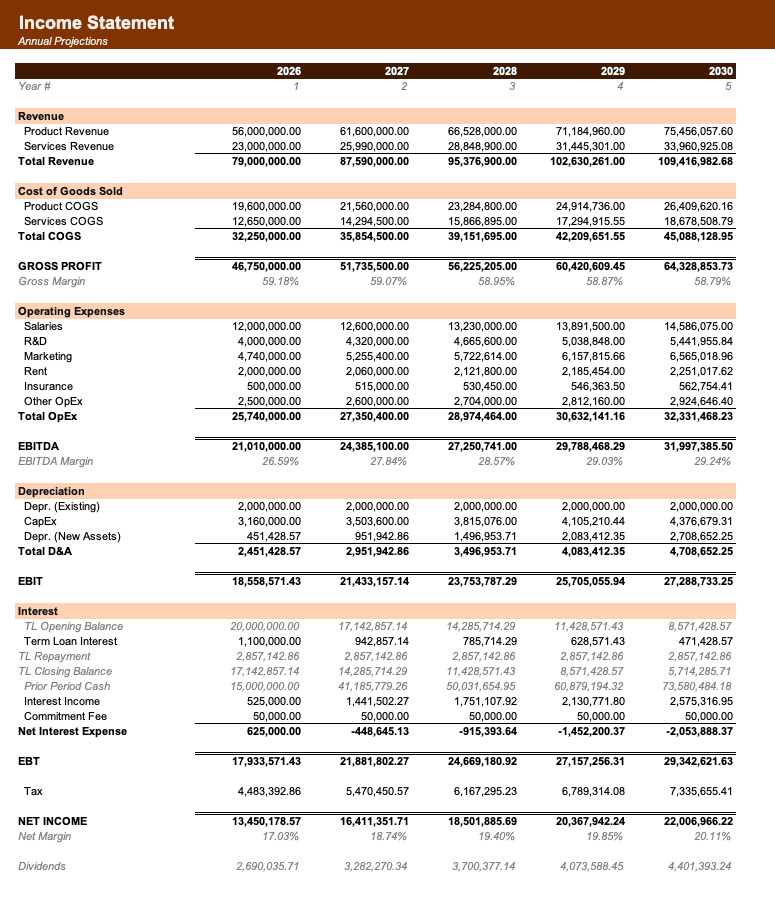
Outputs include a full P&L waterfall, balance sheet, cash flow, tokenomics schedule and a Token_Valuation block that derives unlevered free cash flow from EBIT after the token-emission charge, then adds that charge back because it is non-cash.
- Enterprise value is presented via a discounted cash flow and an exit multiple, reconciled through a variance row, with per-token metrics from the midpoint.
- A KPI dashboard and checks cover margins, reserve coverage, collateralisation, DCF-implied versus assumed token price, and balance integrity.
- The public download is a values-only preview, not a live model.
income_statement.xlsx
income_statement.xlsx
income_statement.xlsx
Formatted to IB standards
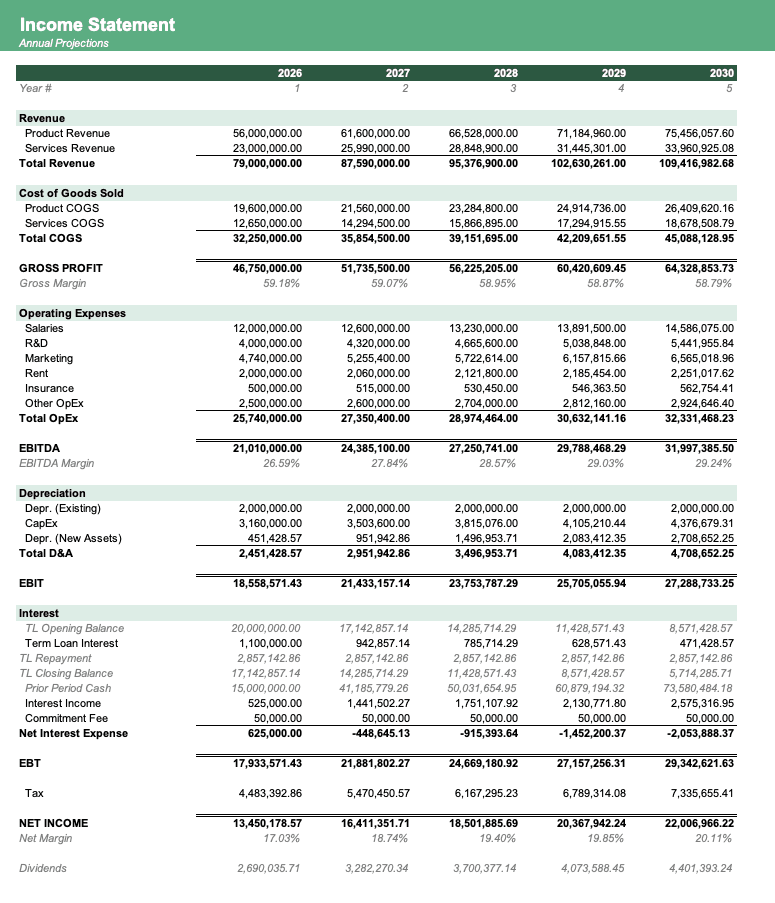
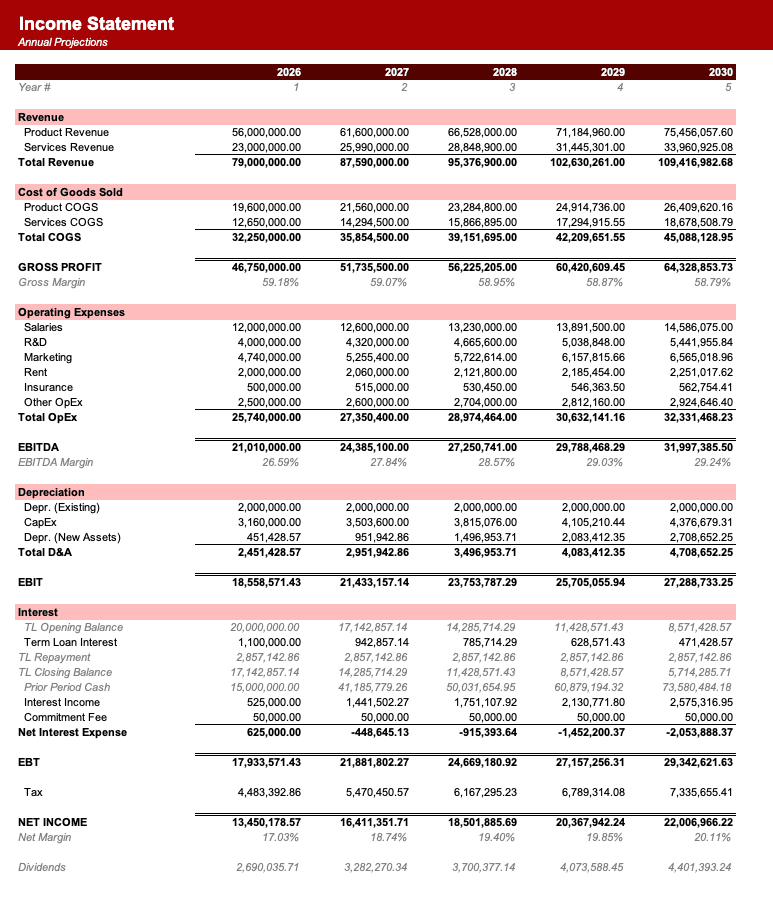
Named theme colors repaint the whole workbook in one click, on top of an investment-banking structure with clear input, output, and cross-sheet reference styling - brand-ready, institutional-grade, and fully auditable.

Created by ex-finance professionals
Hey, I’m Alex and I created Finamodel.
Over my years in the finance industry I kept building the same models over and over again. Same structure, same assumptions, different logo. So I started building frameworks to turn them into clean, reusable templates.
Every model here is one I’d actually use for a client, and I personally vet each one before it goes up.
I’m not an expert in every industry, but I’ve built enough models to know what belongs in one. And when something is completely foreign to me, I reach out to my network for experts to work on our models with us.
Having a template library on hand cuts a first build from hours to minutes.
Need help finding your model? You’ll find me in the Finamodel app!
Frequently asked
What is a stablecoin reserve?+
Reserve assets such as cash, Treasury bills, and USDC are held to back each unit of stablecoin issued. Full backing is 100% reserves; over-collateralization is above 100%; fractional is below 100%.
What yield can stablecoin reserves generate?+
Treasury bills yield around 4-5%, repo 4-5%, and USDC 3-4%. Operators keep part of the spread and may pass excess to stakeholders or use it to reduce supply.
What reserve ratio is considered safe?+
100% backing is the minimum standard. Regulated stablecoins like USDC operate at 100% or better. Over-collateralized stablecoins run 125%+ to absorb collateral price volatility.
What is a run-on scenario for a stablecoin?+
A run-on occurs when large redemptions simultaneously deplete liquid reserves, forcing asset sales at unfavorable prices. Stress scenarios model the reserve adequacy needed to survive these events.
Who uses stablecoin tokenomics models?+
Stablecoin operators designing reserve policy, crypto investors evaluating backing quality, DeFi analysts assessing protocol risk, and risk managers stress-testing redemption capacity.
Have more financial modelling questions? Contact us
Related templates
Crypto_Token_Allocation.xlsx
Metric
2026
Revenue
--
EBITDA
--
Crypto Token Allocation
Model token distribution, vesting schedules, and dilution impacts for crypto projects.
DeFi_Protocol_Model.xlsx
Metric
2026
Revenue
--
EBITDA
--
DeFi Protocol Model
Financial model for decentralized finance protocols with token economics, treasury, and revenue streams.
Crypto_Exchange_Economics_Model.xlsx
Metric
2026
Revenue
--
EBITDA
--
Crypto Exchange Economics Model
Model exchange revenue from trading volume, fees, and token incentives with unit economics.
GameFi_Token_Economics_Model.xlsx
Metric
2026
Revenue
--
EBITDA
--
GameFi Token Economics Model
Token supply, mint/burn mechanics, and player economics model for play-to-earn games and blockchain-based gaming platforms.


