DeFi Protocol Model
Crypto & DeFi Financial Model (Free Excel Download)
Evaluate DeFi protocol economics through deposits, borrowing, utilization, token incentives, liquidation losses, treasury flows, and fee revenue under market scenarios.



professionals from Deloitte
Used by professionals from






About this model
A decentralized finance (DeFi) protocol generates revenue from multiple streams: reserve yield on collateral pools, stability fees on outstanding stablecoin supply, minting and redemption fees, and liquidation penalties. This model values a mid-tier protocol with $5 billion total value locked (TVL), projecting how protocol economics scale as TVL grows to $25 billion over five years. The core innovation is modeling the protocol as a multi-revenue, multi-cost business rather than a simplistic arbitrage play.
The workbook splits revenue by source: gross reserve yield (the protocol earns 4.8% on T-Bill and crypto assets in Year 1, declining to 3.8% as rates normalize), less payouts to token stakers (4% APY on 35% of TVL), plus stability fees, mint/redeem fees, and liquidation revenue. Operating costs cover development, security audits, marketing, legal, and governance token emissions - totaling 11–25% of revenue. The balance sheet enforces a strict 1:1 fiat-backing model where reserve assets equal stablecoin liabilities exactly, eliminating structural balance-sheet gaps that plagued earlier versions.
The model answers: does the treasury generate sufficient earnings to fund operations and build reserves? Can the token be valued using DCF on protocol earnings? This template is calibrated for fiat-backed stablecoins (USDC/USDT models) competing on low-cost infrastructure and yield-share with stakers.
What every model includes
Live formulas, no hardcoded values
Outputs are driven by live formulas, so the workbook updates from its assumptions instead of relying on hardcoded results.
All assumptions in one tab
Inputs are clearly marked in the Assumptions tab and separated from calculations, making it clear what to change and what to leave intact.
Statements always balancing
For integrated-statement models, the balance sheet, cash flow, and supporting schedules tie through properly.
Distinct schedules for clarity
Debt, working capital, taxes, and cash flow can get messy quickly. We group calculations in clear schedules, not across disconnected tabs.
No hidden macros or external links
There are no unexplained external workbook links or macros to undermine auditability or portability.
Changes flow through the model
Update a key driver and see the impact carry through the forecast, financing, and return outputs. We never use hardcoded numbers in formulas.
What's inside the DeFi Protocol Model
- TVL growth and liquidity pool modelling
- Protocol fee and LP revenue split logic
- Dual-token emission, vesting, and burn schedules
- Circulating supply and fully diluted valuation tracking
- Treasury sustainability and incentive cost analysis
- Token supply model with mint/burn mechanics and inflation schedule
- Treasury cash flow forecast: protocol revenue, grants, and incentive allocation
- Yield farming and LP incentive budgets with ROI analysis
DeFi Protocol Model: How the Template Values a Stablecoin Treasury
This DeFi protocol model template projects a fiat-backed stablecoin protocol's treasury over five years. It links TVL growth to reserve yield, stability and mint/redeem fees, liquidation revenue, token vesting and DCF token valuation, so you can test whether the treasury stays solvent and what the governance token is worth under bear, base and bull scenarios.
TVL and Reserve Yield Drive the Revenue Line
At the centre of the template is a TVL roll-forward that moves from the opening balance to a closing balance each year, with the average of the two used as the revenue base.
- Reserve composition is split across six buckets, including T-Bills of different maturities, overnight repo and a crypto liquid tranche.
- Each bucket carries its own allocation percentage and gross yield, and a blended yield is calculated from those weights, so the model captures how shifting the mix changes the portfolio's earning rate rather than assuming a single flat return.
- The blended yield steps down year by year as rates normalise, which matters because holding a single rate constant would overstate later-year revenue.
Four Revenue Streams Feed the Income Statement
The protocol earns net reserve yield by taking gross yield on average TVL and passing a share through to stakers, with the retained spread flowing to the business. A stability fee is charged on average TVL, and mint/redeem fees apply to gross flow volume, calculated from average TVL multiplied by an annual turnover rate.
- Liquidation revenue is modelled separately through event counts, average liquidation size and a penalty rate. Together these four lines feed the income statement, where operating costs are deducted and token emission is treated as a non-cash stock-based compensation charge.
- The cash flow statement adds that non-cash charge back, and an equity line called Token Grant Reserve accumulates it so the balance sheet stays balanced. Dilution is captured in the token count, not in the discounted cash flows.
Balance Sheet, Cash Flow and Solvency Checks
The balance sheet uses a strict one-to-one backing structure: reserve assets equal stablecoin liabilities, so there is no structural gap. Treasury cash is a separate asset built from opening equity plus cumulative operating cash flow, while retained earnings roll forward with net income.
- When TVL grows, reserve purchases appear as an investing outflow and stablecoin issuance as a financing inflow, so the two offset and net cash movement equals operating cash flow.
- A suite of integrity checks verifies that the balance sheet balances, reserve allocations sum to one hundred percent, the cash reconciliation holds, token supply stays within the cap, net reserve yield remains positive, treasury cash stays solvent, and the discount rate exceeds terminal growth.
Scenario Toggle, Token Valuation and Sensitivity
A single scenario input drives TVL growth, mint turnover, staker share of supply and a yield multiplier, with bear, base and bull settings. That toggle also changes the discount rate used in the DCF, so the valuation moves with the scenario.
- The DCF discounts pre-SBC protocol earnings, and dilution is handled through the maximum token supply. The model reports fully-diluted value per token, circulating market capitalisation, and an EV to TVL multiple, alongside a peer comparison table and a redemption stress test that calculates liquidity coverage.
- A sensitivity grid shows how fully-diluted value responds to discount rate and terminal growth, and how year-five earnings respond to TVL growth and reserve yield, helping you see which assumptions matter most.
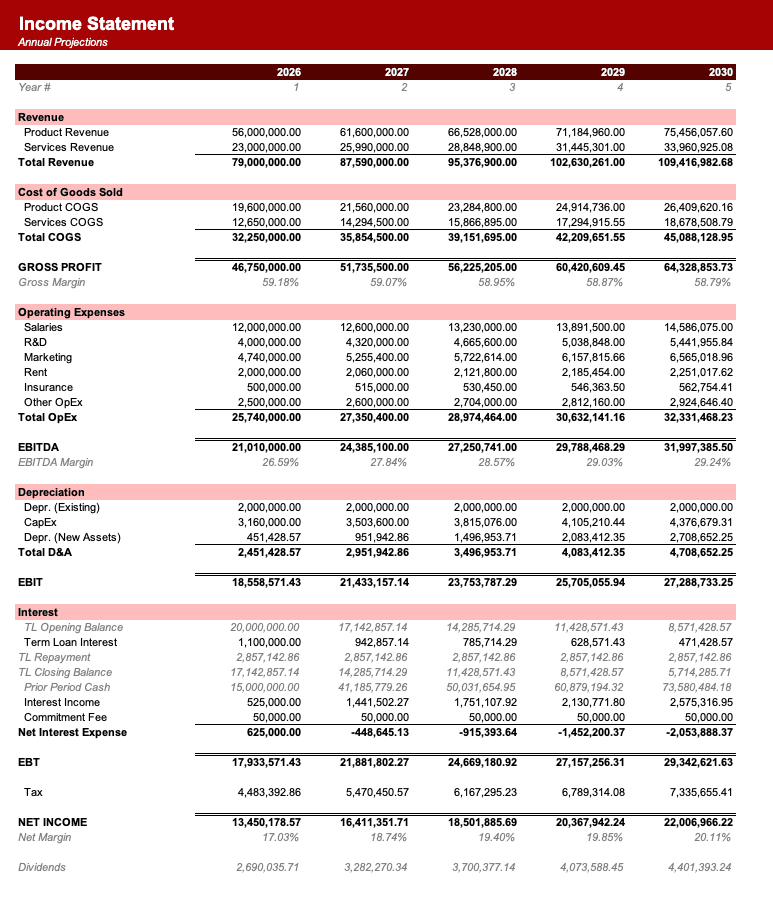
Formatted to IB standards
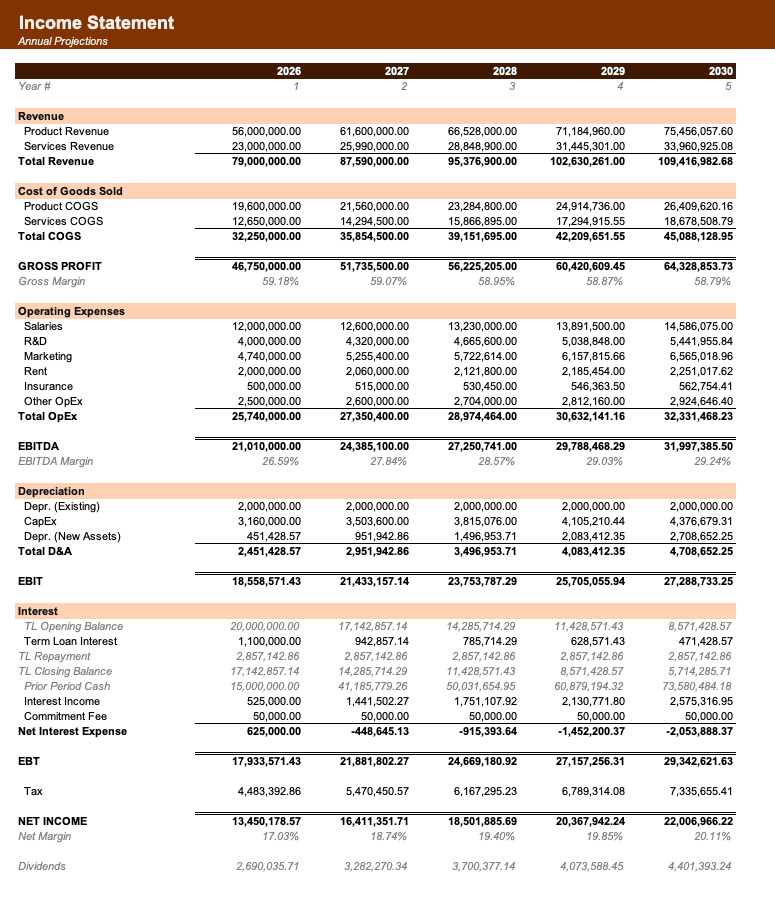
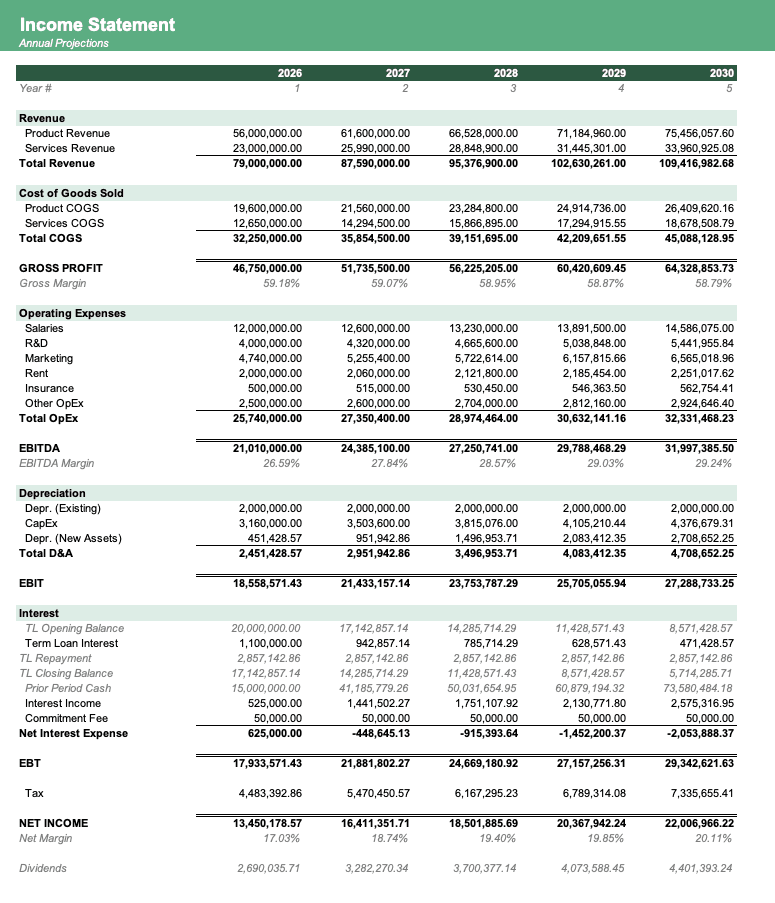
Named theme colors repaint the whole workbook in one click, on top of an investment-banking structure with clear input, output, and cross-sheet reference styling - brand-ready, institutional-grade, and fully auditable.

Created by ex-finance professionals
Hey, I’m Alex and I created Finamodel.
Over my years in the finance industry I kept building the same models over and over again. Same structure, same assumptions, different logo. So I started building frameworks to turn them into clean, reusable templates.
Every model here is one I’d actually use for a client, and I personally vet each one before it goes up.
I’m not an expert in every industry, but I’ve built enough models to know what belongs in one. And when something is completely foreign to me, I reach out to my network for experts to work on our models with us.
Having a template library on hand cuts a first build from hours to minutes.
Need help finding your model? You’ll find me in the Finamodel app!
Frequently asked
What is a DeFi protocol financial model?+
It is a model that forecasts TVL, protocol fees, token emissions, and treasury sustainability for a decentralised finance application.
Who uses DeFi protocol models?+
Protocol founders, venture capital investors, treasury managers, and governance participants use them for planning and analysis.
What should a DeFi model include?+
It should include TVL dynamics, fee structures, token emission and burn schedules, circulating supply tracking, and treasury runway.
Does it handle multiple revenue streams?+
Yes. The model supports fee splits between LP rewards and protocol treasury across multiple liquidity pools.
Can I simulate different incentive programmes?+
Yes. You can input specific token allocations per period to see the marginal impact on TVL growth and the resulting cost per dollar locked.
Have more financial modelling questions? Contact us
Related templates
Stablecoin Tokenomics Model
Economic model for stablecoin reserve backing, yield generation, and capital efficiency of reserve portfolios.
GameFi Token Economics Model
Token supply, mint/burn mechanics, and player economics model for play-to-earn games and blockchain-based gaming platforms.
Venture Capital Fund Model
Model VC fund cash flows, distributed returns, and IRR by vintage year and exit scenario.
Crypto Token Allocation
Model token distribution, vesting schedules, and dilution impacts for crypto projects.