Tax Equity Flip Model
Infrastructure Financial Model (Free Excel Download)
Model tax-equity contributions, allocation flips, project cash flows, credits, distributions, and investor returns for renewable-energy financing structures.



professionals from Deloitte
Used by professionals from






About this model
Model a tax equity partnership structure for a 100 MW utility-scale solar project: the tax equity investor harvests 99% of Investment Tax Credits (ITC) and MACRS depreciation pre-flip, then shifts to a 5% allocation post-flip once achieving a target IRR (typically 7%). The model projects 25-year cash flows, tracks MACRS depreciation over 6 periods (20%+32%+19.2% rates), manages Net Operating Loss (NOL) carry-forwards, and calculates cash distributions by partner.
Key outputs include ITC capture ($30M on a $100M eligible basis), MACRS deductions ($85M depreciable basis after ITC basis reduction), and debt service coverage ratios (DSCR) showing minimum 1.50x during the 18-year loan tenor. The cash waterfall applies operations (PPA + REC revenue less O&M) to debt service and then to partners based on pre/post-flip allocations. The flip mechanics use a non-circular formula that checks the prior-year cumulative distribution, avoiding the circular references common in earlier versions.
Returns analysis shows tax equity IRR (7.1%), project unlevered IRR (8.5%), and LCOE ($25/MWh at 7% discount rate). This structure is dominant in US renewable energy financing and allows sponsors to monetize tax benefits with insufficient tax appetite.
What every model includes
Live formulas, no hardcoded values
Outputs are driven by live formulas, so the workbook updates from its assumptions instead of relying on hardcoded results.
All assumptions in one tab
Inputs are clearly marked in the Assumptions tab and separated from calculations, making it clear what to change and what to leave intact.
Statements always balancing
For integrated-statement models, the balance sheet, cash flow, and supporting schedules tie through properly.
Distinct schedules for clarity
Debt, working capital, taxes, and cash flow can get messy quickly. We group calculations in clear schedules, not across disconnected tabs.
No hidden macros or external links
There are no unexplained external workbook links or macros to undermine auditability or portability.
Changes flow through the model
Update a key driver and see the impact carry through the forecast, financing, and return outputs. We never use hardcoded numbers in formulas.
What's inside the Tax Equity Flip Model
- Investment Tax Credit (ITC) and Production Tax Credit (PTC) capture schedule
- MACRS depreciation with ITC basis reduction
- Cash flow waterfall pre-flip and post-flip with return thresholds
- IRR and cash-on-cash return by investor tranche
- Flip triggers (IRR hurdle, cash return multiple) and mechanics
- Depreciation deductions and MACRS schedules
- Tax reporting and K-1 allocation to tax equity partners
Tax Equity Flip Model for Utility-Scale Solar: Structure, Mechanics, and Use
This tax equity flip model template projects a 100 MWac utility-scale solar project under a partnership flip structure, allocating Investment Tax Credits, MACRS depreciation, and cash flows between sponsor and tax equity investor. It captures 25-year annual operations, senior debt sizing, DSCR covenants, and IRR-based flip mechanics for evaluating after-tax returns to each party.
Operating and Capital Drivers
The model runs 25 annual periods for a 100 MWac solar project. Revenue combines PPA revenue, driven by capacity factor, degradation, availability, and an escalating PPA price, with REC revenue at a flat per-MWh price.
- Operating expenses include fixed O&M, insurance, land lease, and asset management, all escalating annually, plus maintenance capex that flows through the cash waterfall but not the income statement. Total project cost of $103.5M is funded 50% senior debt, 40% tax equity, and 10% sponsor equity.
- ITC and MACRS eligible basis is limited to EPC and development costs, excluding reserves and financing fees.
Tax Mechanics and Partnership Allocations
The tax equity investor receives 99% of tax benefits and 35% of cash pre-flip, while the sponsor retains 1% of tax benefits and 65% of cash.
- Once the tax equity investor hits a 7% target yield, allocations flip to 5% tax and 5% cash for the investor, with the sponsor receiving 95% of both.
- A 30% ITC applies to the $100M eligible basis, and MACRS depreciation on the reduced $85M basis follows a 5-year schedule.
- Partnership-level NOLs are tracked and applied against later taxable income, limited to 80% of taxable income per TCJA.
Debt, DSCR, and Flip Trigger
Senior debt of $51.75M amortises straight-line over 18 years at 6% fixed interest. DSCR is calculated as CFADS divided by debt service, where CFADS equals EBITDA plus maintenance capex, excluding cash tax to avoid double-counting with partner-level tax.
- The flip is triggered by a running tax equity IRR that crosses the 7% target, expected in Year 5 under default assumptions. The flip flag is sticky once activated, and Year 1 is hardcoded to zero to prevent circular references.
- Partner-level tax is computed separately on each partner's allocation, with their own NOL carryforwards.
Practical Use and Validation
Users can adjust named assumptions for capacity, PPA price, debt terms, tax rates, and allocation percentages to test structural changes.
- Returns are summarised for project, tax equity, and sponsor on an after-tax basis, with LCOE provided.
- A checks sheet validates sources and uses, minimum DSCR, debt balance at maturity, MACRS sum, NOL balances, cash tax, flip flag monotonicity, eligible basis, CFADS positivity, and cumulative distributions.
- The template is designed for evaluating whether a tax equity flip structure meets return targets and covenant compliance for a utility-scale solar project.
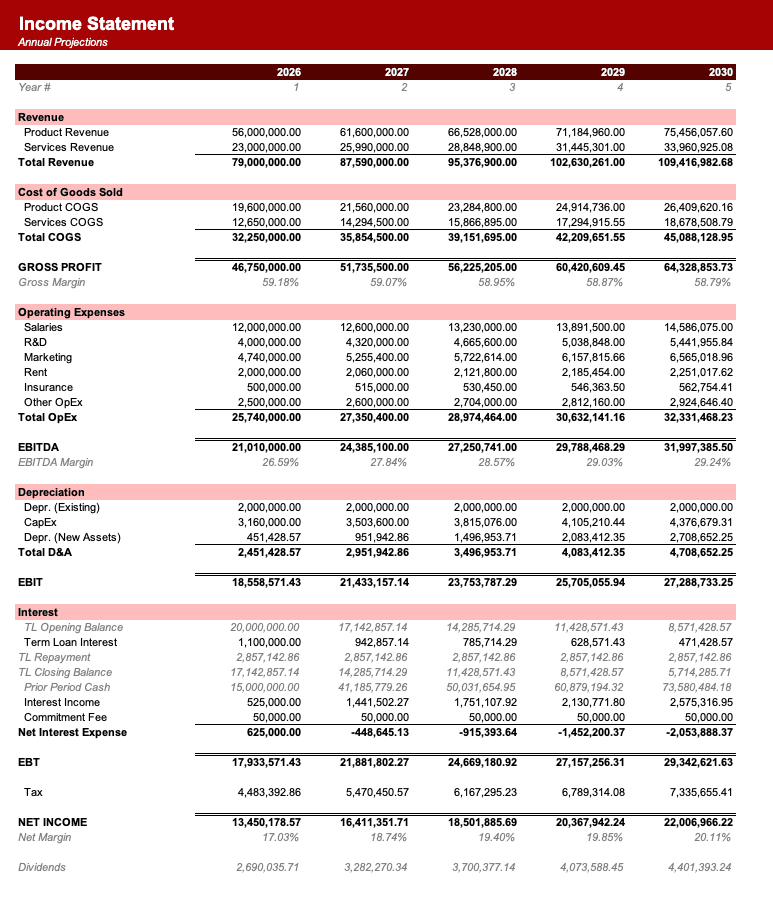
Formatted to IB standards
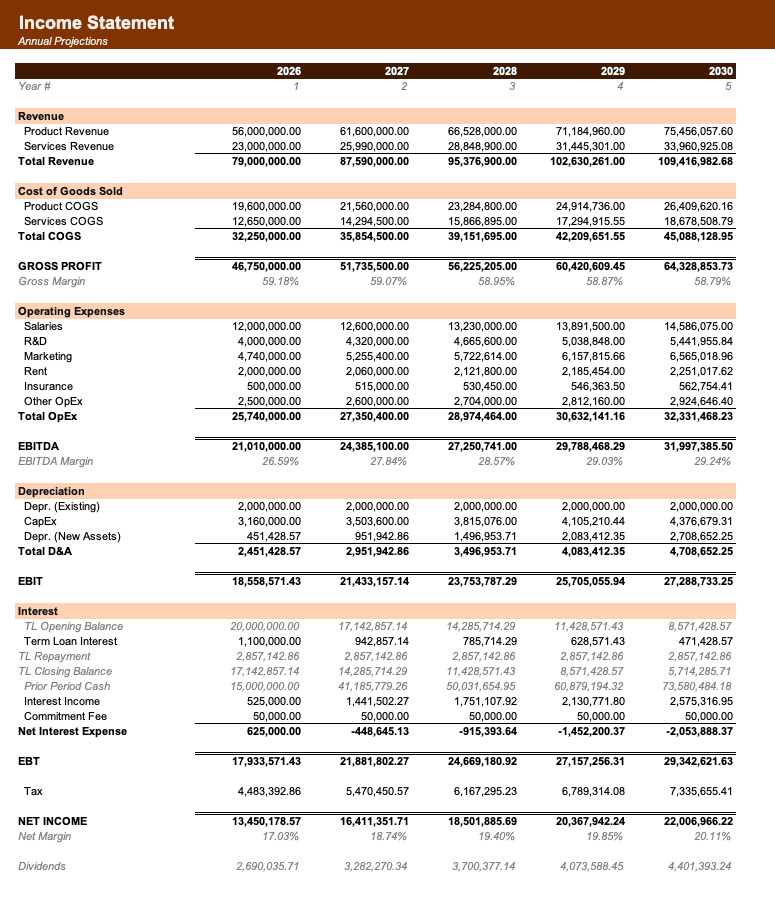
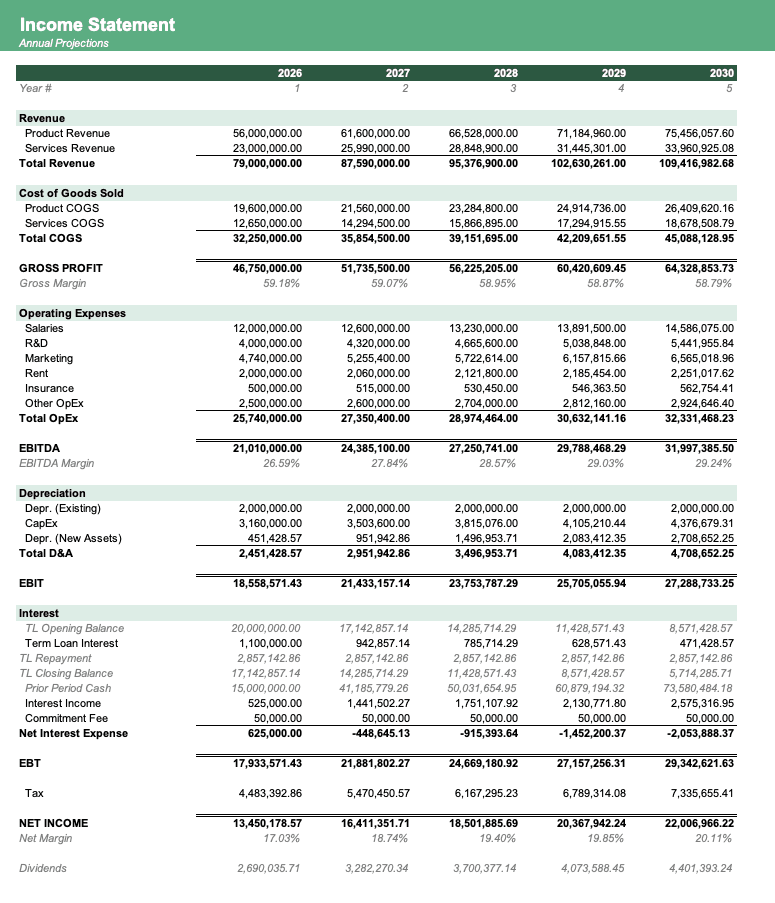
Named theme colors repaint the whole workbook in one click, on top of an investment-banking structure with clear input, output, and cross-sheet reference styling - brand-ready, institutional-grade, and fully auditable.

Created by ex-finance professionals
Hey, I’m Alex and I created Finamodel.
Over my years in the finance industry I kept building the same models over and over again. Same structure, same assumptions, different logo. So I started building frameworks to turn them into clean, reusable templates.
Every model here is one I’d actually use for a client, and I personally vet each one before it goes up.
I’m not an expert in every industry, but I’ve built enough models to know what belongs in one. And when something is completely foreign to me, I reach out to my network for experts to work on our models with us.
Having a template library on hand cuts a first build from hours to minutes.
Need help finding your model? You’ll find me in the Finamodel app!
Frequently asked
What is a tax equity flip model?+
It is a model that allocates tax credits, depreciation, and cash flow between sponsor and tax equity investor under an IRR-based flip structure used widely in US renewables.
What credits are available for renewable energy?+
Investment Tax Credit (30% for solar, wind, battery), Production Tax Credit (wind and others), and 5-year MACRS accelerated depreciation are the main benefits.
How does the flip back to sponsor work?+
The model tracks the tax equity investor’s IRR period by period. Once the hurdle (typically 6–8%) is met, ownership flips back and remaining benefits flow to the sponsor.
What is ITC basis reduction?+
When the ITC is claimed, the depreciable basis is reduced by half of the credit amount, which the model handles automatically in the MACRS schedule.
Is this useful for institutional underwriting?+
Yes. The structure is dominant in US renewables and the model produces the IRR, DSCR, and LCOE outputs institutional investors and lenders expect.
Have more financial modelling questions? Contact us
Related templates
Renewable Energy Project Economics Model
Solar, wind, or hydro project generation, power purchase agreements, operating costs, and project IRR.
Project Finance Debt Sculpting Model
Optimized debt schedules, amortization profiles, and DSCR tailoring for project finance and infrastructure loans.
Infrastructure Concession and Toll Road Model
Concession agreement model for toll roads, airports, and ports including traffic/volume forecasts, tariff escalation, and equity returns.
Fibre Network Deployment Model
Capital and financial model for fiber optic network buildout with capex, subscribers, and ARPU.