Goodwill Impairment Model
Corporate Finance Financial Model (Free Excel Download)
Test goodwill impairment under ASC 350 and IAS 36 using carrying values, recoverable amounts, valuation approaches, headroom, and breakpoint sensitivities.



professionals from Deloitte
Used by professionals from






About this model
This valuation model tests goodwill and intangible assets for impairment under ASC 350 by comparing DCF-derived fair value to book value annually or quarterly. Build two approaches: DCF (discounted cash flow on unlevered FCFF with WACC haircut) and comparable company multiples (EV/EBITDA, EV/Revenue benchmarks), then reconcile any gap and document the sensitivity to WACC and terminal growth assumptions.
The workbook builds a detailed FCFF schedule from operating margins and capex intensity, discounts at the reporting unit's WACC (typically 8–12% for mid-market), tests sensitivities across ±100–200 bps on WACC and ±50–100 bps on terminal growth. Fair value is the average of DCF and multiples; carrying value includes original purchase price plus cumulative amortisation and prior adjustments. Impairment charge = MAX(0, carrying value − fair value), flows through P&L as a non-operating expense. Quarterly tests required if events/circumstances trigger reassessment; annual testing at year-end minimum.
Used by CFOs of acquired companies ensuring compliance with GAAP, audit teams documenting fair value assessments, and PE sponsors stress-testing acquisition valuations in down markets. ASC 350 impairment is a mechanical but high-stakes test - material impairment charges can trigger covenant violations and investor complaints. The sensitivity tables (2D: WACC × terminal growth) document the band of reasonable assumptions. Comparable: major acquisitions (Apple-Beats $3B, Microsoft-ZeniMax $7.5B) require robust impairment documentation.
What every model includes
Live formulas, no hardcoded values
Outputs are driven by live formulas, so the workbook updates from its assumptions instead of relying on hardcoded results.
All assumptions in one tab
Inputs are clearly marked in the Assumptions tab and separated from calculations, making it clear what to change and what to leave intact.
Statements always balancing
For integrated-statement models, the balance sheet, cash flow, and supporting schedules tie through properly.
Distinct schedules for clarity
Debt, working capital, taxes, and cash flow can get messy quickly. We group calculations in clear schedules, not across disconnected tabs.
No hidden macros or external links
There are no unexplained external workbook links or macros to undermine auditability or portability.
Changes flow through the model
Update a key driver and see the impact carry through the forecast, financing, and return outputs. We never use hardcoded numbers in formulas.
What's inside the Goodwill Impairment Model
- Multi-method valuation engine (DCF and market multiples)
- Dynamic carrying value reconciliation and headroom calculation
- WACC and terminal value sensitivity tables
- Toggle between ASC 350 and IAS 36 frameworks
- Impairment charge calculation and reporting outputs
- Fair value estimation using DCF and income approach
- Comparable company and transaction multiples benchmarking
- Carrying value reconciliation (original purchase + adjustments)
Goodwill Impairment Model: How the Template Works
This goodwill impairment model gives accounting and valuation teams a structured way to run annual or trigger-based tests under ASC 350 and IAS 36. It builds enterprise fair value using income and market approaches, compares it to a consistently derived carrying amount, and calculates any write-down.
The template is a values-only preview, so you can explore the logic rather than live calculations.
Operating Drivers and Scenario Flexibility
The model starts from a qualitative screen and a five-year reporting-unit P&L.
- Revenue growth, working-capital balances, capex and D&A feed the unlevered free cash flow build.
- A scenario selector—Base, Downside or Severe Downside—applies flex factors to revenue growth, WACC and market multiples via a CHOOSE function.
- Those effective drivers then flow into the DCF and multiples valuations, so switching the scenario restresses the whole test, including headroom and impairment loss.
From Fair Value to Impairment Loss
Fair value is estimated on an enterprise basis in three ways: a DCF using unlevered free cash flow and a Gordon-growth terminal value; a market multiples blend of EV/EBITDA and EV/Revenue; and the simple average of the two.
- The carrying side is separately reconciled to an enterprise basis by adding allocated net debt to equity carrying value.
- The impairment test compares enterprise fair value with enterprise carrying amount.
- Any shortfall is capped at the goodwill balance, producing the impairment loss.
Outputs, Sensitivities and Post-Impairment View
Outputs include the concluded enterprise fair value, headroom percentage, the impairment loss—capped at goodwill—and a breakeven EBITDA-margin-decline measure.
- The sensitivity sheet holds structural grids showing enterprise fair value and headroom against WACC versus terminal growth, and against the EV/EBITDA multiple, with conditional formatting flagging impairment-triggering cells.
- A post-impairment balance sheet shows the write-down’s effect on goodwill and equity.
- WACC breakeven is read from the sensitivity grid rather than a single unreliable cell.
Practical Use and Model Scope
The model is designed for a single reporting unit or CGU, so groups with several units run one instance per unit.
- It assumes any long-lived-asset impairment tests have already been cleared, and it does not compute deferred-tax effects of the write-down, Section 382 NOL limitations, or contingent-consideration overlays.
- Ten checks validate purchase-price allocation, balance-sheet balancing, terminal-value caps, WACC range, and enterprise-basis consistency.
- Because the public download is a values-only preview, formulas do not recalculate; it is intended to illustrate the model’s structure and logic.
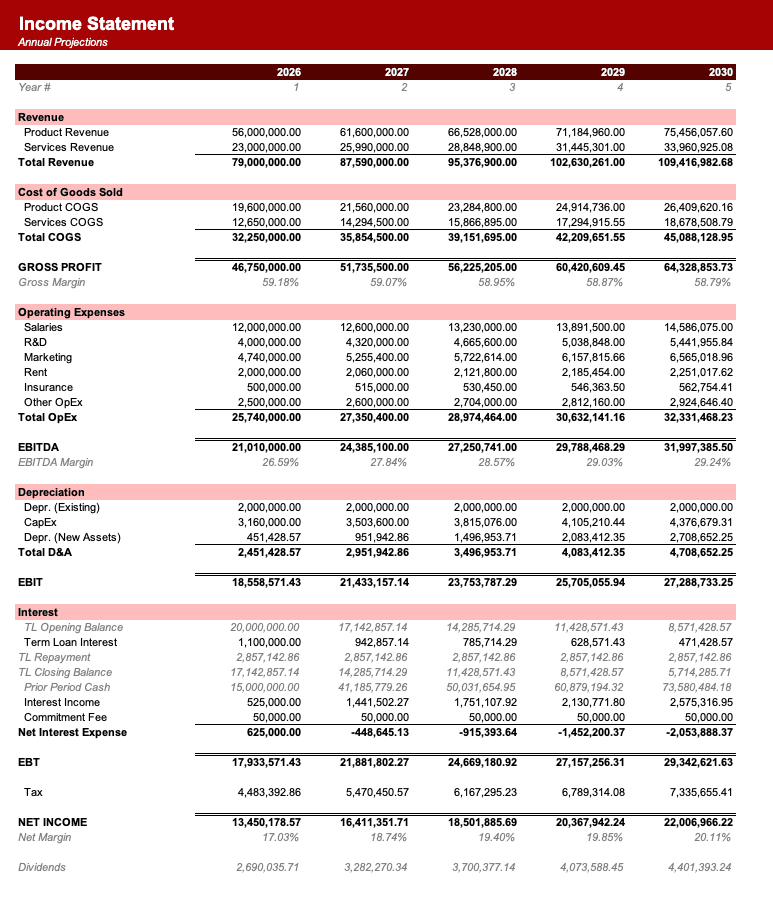
Formatted to IB standards
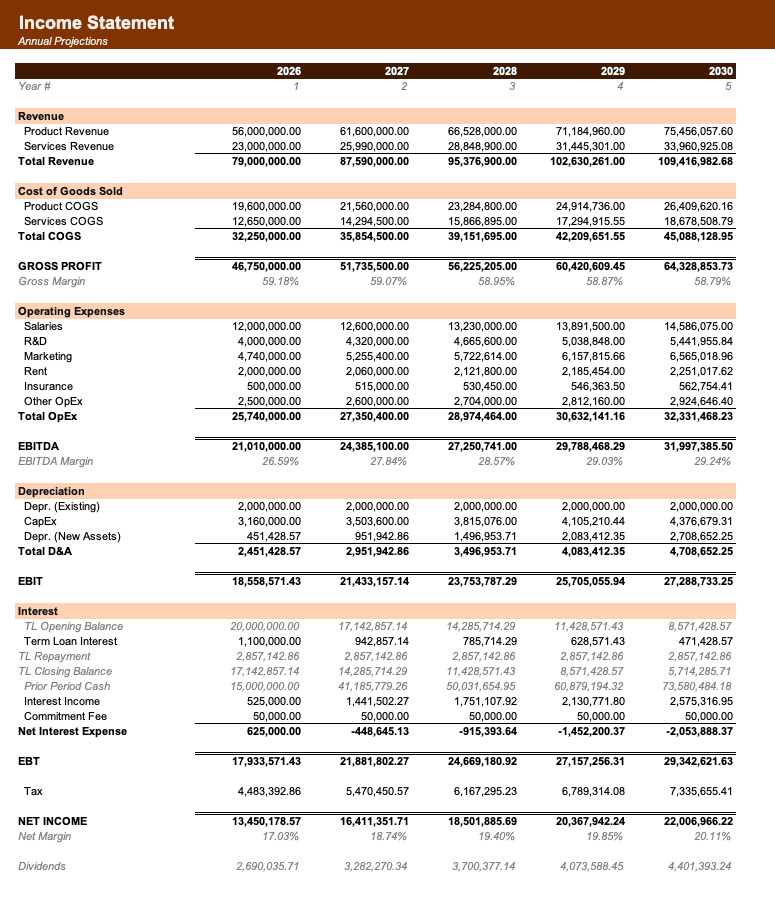
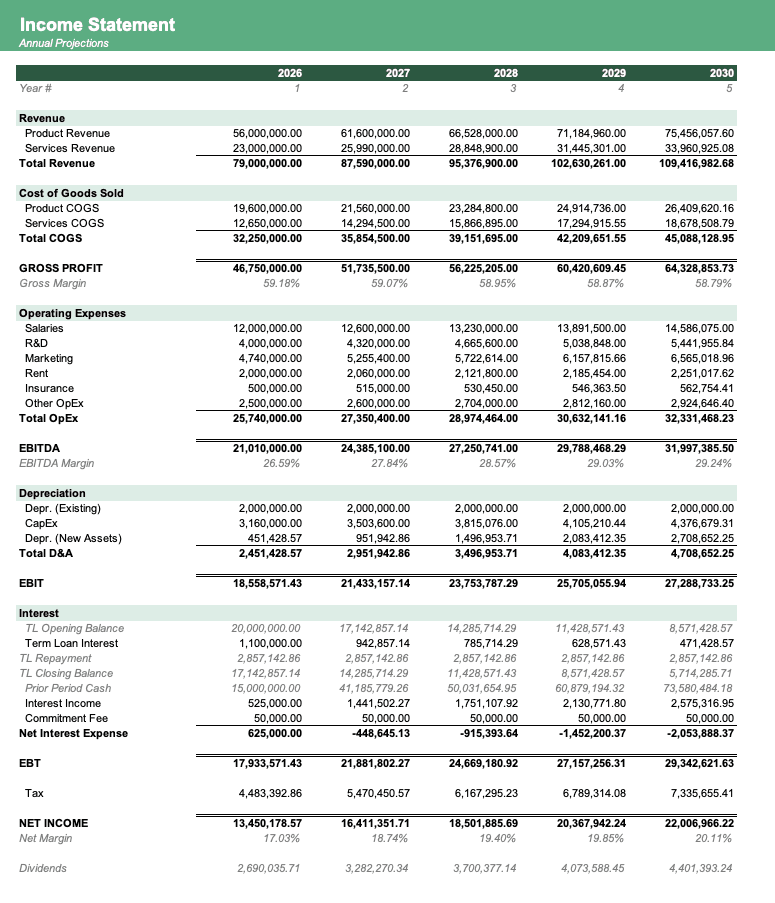
Named theme colors repaint the whole workbook in one click, on top of an investment-banking structure with clear input, output, and cross-sheet reference styling - brand-ready, institutional-grade, and fully auditable.

Created by ex-finance professionals
Hey, I’m Alex and I created Finamodel.
Over my years in the finance industry I kept building the same models over and over again. Same structure, same assumptions, different logo. So I started building frameworks to turn them into clean, reusable templates.
Every model here is one I’d actually use for a client, and I personally vet each one before it goes up.
I’m not an expert in every industry, but I’ve built enough models to know what belongs in one. And when something is completely foreign to me, I reach out to my network for experts to work on our models with us.
Having a template library on hand cuts a first build from hours to minutes.
Need help finding your model? You’ll find me in the Finamodel app!
Frequently asked
What is a goodwill impairment model?+
It is a model that assesses whether the fair value of a reporting unit or cash generating unit exceeds its carrying amount, as required by accounting standards.
Who uses goodwill impairment models?+
Corporate finance teams, auditors, valuation professionals, and controllers use them for annual compliance and interim triggering event analysis.
What should a goodwill impairment model include?+
It should include DCF and market-based valuation, carrying value reconciliation, corporate asset allocation, and sensitivity analysis for key assumptions.
Does it support both US GAAP and IFRS?+
Yes. The model includes toggle logic to switch between the ASC 350 one-step approach and the IAS 36 recoverable amount framework.
Can it be used after an acquisition?+
Yes. It helps monitor the ongoing economic health of acquired entities by comparing actual performance against original deal-model projections.
Have more financial modelling questions? Contact us
Related templates
Comparable Companies Analysis
Pull trading multiples from peer companies and calculate implied valuation ranges.
DCF Model
Discounted cash flow valuation model with explicit forecast, terminal value, and WACC.
3 Statement Model
Integrated income statement, balance sheet, and cash flow forecasts.
M&A Modeling & Valuation
Comprehensive M&A valuation with DCF, comparable companies, and precedent transactions analysis.