Sports Team Model
Consumer Financial Model (Free Excel Download)
Model attendance, ticket yield, broadcasting, sponsorship, player costs, transfers, venue operations, and franchise economics for a professional sports team.



professionals from Deloitte
Used by professionals from






About this model
Model sports team economics to see whether a franchise is a solid cash flow asset or a hobby with hidden capital calls. The model projects revenue by source: matchday (ticket, hospitality), broadcasting (league share + merit payments), commercial (shirt sponsorship, naming rights, merchandise), and player trading (lumpy, should be modelled conservatively). Player payroll is the largest expense (50-70% of revenue), modelled as contractual and sticky, not a % of revenue. Operating expenses cover non-playing staff, facility costs, travel, academy, insurance, and agent fees.
Key mechanics: broadcasting revenue is largely determined by league structure, not club performance (merit payments typically 5-15% of total). Player trading revenue is lumpy and separate from operating revenue - a team selling academy graduates one year may have no sales the next. Player wages are contractual and escalate annually; they don't drop when revenue declines. EBITDA margins range 10-20% for well-run clubs; wage-to-revenue ratios must stay under 70% (UEFA FFP). Debt is often secured against future broadcast revenue or stadium assets. The model outputs valuation scenarios at different exit multiples, shows DSCR (1.2x+ required), and flags wage-to-revenue covenant risk.
Target: investors evaluating franchise acquisitions, lenders financing team ownership, and franchisees planning capital spending (stadium renovation, academy investment). Works with multi-league comparables and regulatory constraints (salary caps, FFP rules).
What every model includes
Live formulas, no hardcoded values
Outputs are driven by live formulas, so the workbook updates from its assumptions instead of relying on hardcoded results.
All assumptions in one tab
Inputs are clearly marked in the Assumptions tab and separated from calculations, making it clear what to change and what to leave intact.
Statements always balancing
For integrated-statement models, the balance sheet, cash flow, and supporting schedules tie through properly.
Distinct schedules for clarity
Debt, working capital, taxes, and cash flow can get messy quickly. We group calculations in clear schedules, not across disconnected tabs.
No hidden macros or external links
There are no unexplained external workbook links or macros to undermine auditability or portability.
Changes flow through the model
Update a key driver and see the impact carry through the forecast, financing, and return outputs. We never use hardcoded numbers in formulas.
What's inside the Sports Team Model
- Matchday revenue build covering ticketing, hospitality, and concessions
- Broadcasting rights and merit-based payment modelling
- Player trading and transfer fee amortisation schedule
- Wage-to-turnover ratio and Financial Fair Play tracking
- Stadium debt and infrastructure financing mechanics
- Revenue forecast by source (ticket, media, sponsorship, naming rights)
- Player payroll and salary cap implications
- Stadium operations and revenue sharing
Inside the Sports Team Model: How the Franchise Economics Fit Together
For readers evaluating this sports team model, the template focuses on the operating drivers that shape a professional franchise's financial performance. It brings matchday, broadcasting, commercial and player trading revenue into one structure, then shows how wages, amortisation and debt service flow through to cash flow and the balance sheet.
Operating Drivers Behind Each Revenue Line
The template separates revenue into four streams because each behaves differently. Matchday revenue depends on home games, stadium capacity, attendance rate and average ticket yield, with premium hospitality added on top.
- Broadcasting combines a league central distribution, a merit-based payment and facility fees for televised home matches, so a club's receipts are partly fixed by the league deal and partly tied to on-pitch performance. Commercial revenue is built from shirt sponsorship, kit deals, naming rights, other partners and merchandise royalties.
- Player trading is modelled separately as the difference between fees received and the net book value of the sold registration, and it is deliberately treated as non-recurring because transfers are lumpy.
How the Model Calculates from Inputs to Profit
Everything begins in an assumptions area that holds the hardcoded inputs: revenue growth rates, wage assumptions, transfer budgets, capex, debt terms, tax and working capital days. Those inputs drive the revenue build and the cost schedules.
- Player wages are modelled as a squad size times an average wage with a bonus uplift, not as a percentage of revenue, because contracts are sticky. Player amortisation spreads each transfer fee across the contract length.
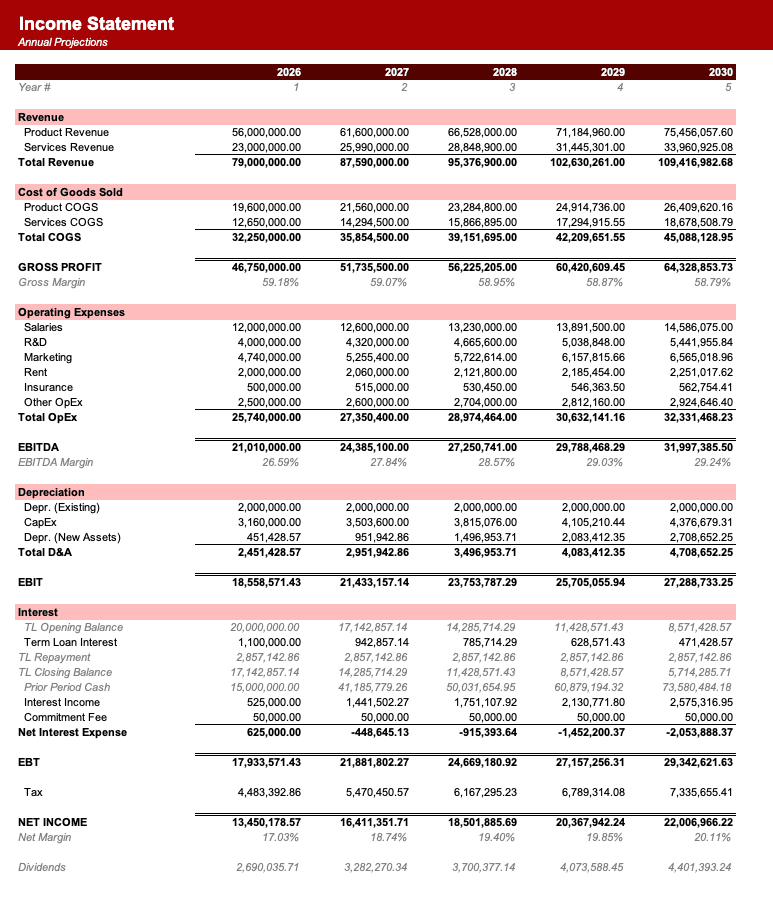
- The income statement then moves from total revenue through wages and operating costs to EBITDA, then subtracts player amortisation, depreciation and interest to reach net income, after adding or deducting the player trading gain or loss.
Outputs Produced and the Checks That Support Them
The outputs include a full income statement, a balance sheet, a cash flow statement and a debt schedule.
- Because player registrations are capitalised as intangible assets, they appear on the balance sheet alongside stadium and training facilities, and their amortisation runs through the P&L.
- The cash flow statement distinguishes the cash received from transfers from the accounting gain, and it captures working capital swings from instalments receivable and payable.
- The checks sheet tests that the balance sheet balances, that the wage-to-revenue ratio stays below the threshold, that DSCR exceeds its minimum and that closing cash matches the balance sheet, keeping the analysis internally consistent.
Practical Use When Evaluating a Franchise
This structure suits an evaluation of a mid-market franchise where the main question is whether revenue growth and cost control support the asking price or the debt being raised. By keeping broadcasting receipts partly league-determined and player trading lumpy, the template discourages optimistic assumptions about recurring income.
- It also highlights the tension between wage commitments and revenue, which is often the deciding factor. Cross-sheet links flow from assumptions through to the statements, so changing a growth rate, a wage bill or a transfer budget updates profit, cash and leverage.
- The result is a framework for testing acquisition, investment or lending cases rather than a packaged forecast.
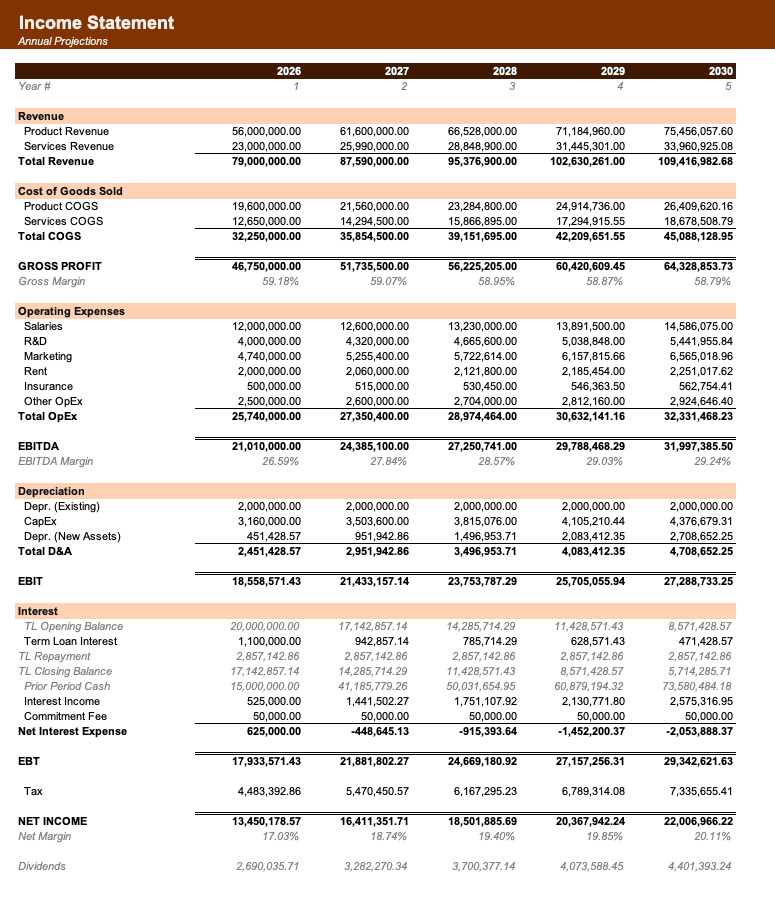
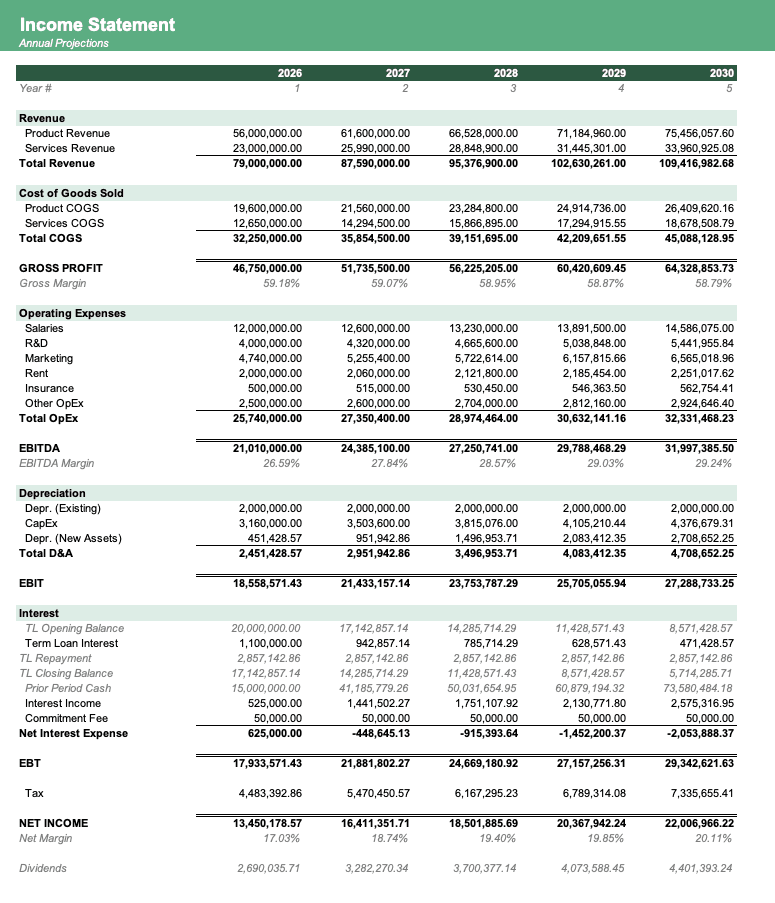
Formatted to IB standards
Named theme colors repaint the whole workbook in one click, on top of an investment-banking structure with clear input, output, and cross-sheet reference styling - brand-ready, institutional-grade, and fully auditable.

Created by ex-finance professionals
Hey, I’m Alex and I created Finamodel.
Over my years in the finance industry I kept building the same models over and over again. Same structure, same assumptions, different logo. So I started building frameworks to turn them into clean, reusable templates.
Every model here is one I’d actually use for a client, and I personally vet each one before it goes up.
I’m not an expert in every industry, but I’ve built enough models to know what belongs in one. And when something is completely foreign to me, I reach out to my network for experts to work on our models with us.
Having a template library on hand cuts a first build from hours to minutes.
Need help finding your model? You’ll find me in the Finamodel app!
Frequently asked
What is a sports team financial model?+
It is a model that forecasts revenue and costs for a professional sports franchise, covering matchday income, broadcasting rights, player wages, and transfer activity.
Who uses sports team financial models?+
Team owners, private equity sports funds, sports consultants, and investment bankers use them for acquisition underwriting and ongoing financial planning.
What should a sports team model include?+
It should include matchday revenue, broadcasting income, commercial sponsorships, player trading schedules, wage tracking, and stadium financing.
Does it handle player transfer fees?+
Yes. The model tracks capitalised registration rights, contract-length amortisation, and the cash flow timing of multi-year transfer instalments.
Can I model promotion and relegation scenarios?+
Yes. The model supports toggling league-specific revenue drivers and wage adjustments to visualise the financial impact of moving between divisions.
Have more financial modelling questions? Contact us
Related templates
E-Commerce Unit Economics
P&L model for e-commerce business with CAC, LTV, gross margin, and unit economics.
Hotel Operating Model
Operating model for hotel properties including occupancy rates, average daily rate (ADR), RevPAR optimization, and facility-level profitability.
Restaurant Unit Economics and Multi-Unit Model
Single-unit operating metrics, cost of goods sold, labor, rent, and multi-unit chain economics.
Ecommerce Forecast
18-month ecommerce forecast: traffic, conversion, AOV, contribution margin.