Wealth Management
Capital Markets Financial Model (Free Excel Download)
Forecast client assets, net flows, fee rates, advisor productivity, staffing, and market performance to evaluate recurring wealth-management revenue and margins.



professionals from Deloitte
Used by professionals from






About this model
This wealth-management model is built for RIA owners, buyers, and investors who need a clearer picture of what drives value. It links client assets, net new money, market performance, fees, and team growth to the firm's financial results.
Use it to plan growth, evaluate an acquisition, or assess a potential exit. The valuation framework turns the operating plan into an understandable view of enterprise value and investor returns.
What every model includes
Live formulas, no hardcoded values
Outputs are driven by live formulas, so the workbook updates from its assumptions instead of relying on hardcoded results.
All assumptions in one tab
Inputs are clearly marked in the Assumptions tab and separated from calculations, making it clear what to change and what to leave intact.
Statements always balancing
For integrated-statement models, the balance sheet, cash flow, and supporting schedules tie through properly.
Distinct schedules for clarity
Debt, working capital, taxes, and cash flow can get messy quickly. We group calculations in clear schedules, not across disconnected tabs.
No hidden macros or external links
There are no unexplained external workbook links or macros to undermine auditability or portability.
Changes flow through the model
Update a key driver and see the impact carry through the forecast, financing, and return outputs. We never use hardcoded numbers in formulas.
What's inside the Wealth Management
- AUM roll-forward: opening balance, gross inflows, attrition outflows, net flows, market appreciation, closing and average AUM
- Advisory-fee revenue on average AUM with an annual fee-compression assumption, plus planning fees and other revenue
- Headcount sheet that derives advisor count from AUM and scales support staff off it
- Expense base: advisor payout, support compensation, platform/custody, technology, occupancy, marketing, compliance, G&A
- Income statement and cash flow: EBITDA, D&A, tax, net income, free cash flow, distributions, cash balance
- Valuation: entry EBITDA multiple, DCF with terminal value, exit EBITDA multiple, owner equity IRR and MOIC
- Sensitivity grid: 5x5 exit enterprise value across net flow rate and market return
- Nine validation checks against named-range bounds plus an ALL CHECKS PASS rollup
Wealth Management Model: How the RIA Operating Model and Valuation Works
This wealth management model evaluates the operating economics and owner returns of a mid-size RIA over a seven-year hold. It links AUM growth from advisors, referrals, and tuck-ins with tiered advisory fees and a variable/fixed cost base to project EBITDA, then applies an Adjusted-EBITDA multiple and DCF to estimate enterprise value, equity IRR, and money multiple.
What Drives the Firm's Economics
The model's operating engine is AUM growth from four sources: existing-book referrals, advisor-sourced net new assets, tuck-in acquisitions of external books, and market appreciation net of client attrition. Advisor count follows an explicit hiring plan and each new advisor ramps over roughly three years toward a mature productivity target.
- Advisor capacity sets a ceiling on deployable AUM. On the revenue side, a tiered breakpoint fee schedule means the blended realised fee drifts down as relationships grow larger, rather than relying on a flat compression assumption.
- The cost base separates variable production costs from fixed overhead, so scale can dilute fixed costs and expand margin.
How the Calculations Flow Through the Model
The AUM roll-forward begins with opening AUM, adds referral and advisor-sourced inflows, adds tuck-in acquisitions, subtracts attrition, and applies market appreciation to the average balance. That closing AUM feeds the revenue calculation, where average relationship size is derived from average AUM and household count.
- The four-tier breakpoint schedule then sets a fee per relationship, producing advisory revenue. Planning fees and other revenue are added.
- Expenses are built as variable costs (advisor payout, support comp, platform/custody, marketing, recruiting, and tuck-in integration) plus fixed overhead (technology, occupancy, compliance, corporate back-office, and owner compensation).
Key Outputs and Valuation Lenses
Reported EBITDA flows from revenue minus total operating expenses. A normalization add-back for above-market owner compensation converts reported EBITDA into Adjusted EBITDA, the valuation base.
- The model also builds a margin bridge that decomposes the Year 0 to Year 7 reported-margin change into fixed-cost dilution and a variable-cost and fee-mix effect. Free cash flow starts with net income, adds back D&A and the increase in fee float from quarterly advance billing, then subtracts capex and tuck-in acquisition spend.
- A target payout ratio determines owner distributions, with retained cash building a balance. Valuation triangulates an entry enterprise value from a Year-0 Adjusted-EBITDA multiple, a DCF from projected free cash flow plus a terminal value, and an exit enterprise value from a Year-7 Adjusted-EBITDA multiple.
Equity IRR and MOIC follow from the owner cash-flow stream.
Practical Use and Model Governance
The model is designed for an owner or investor evaluating growth, an acquisition, or an exit from the perspective of a seven-year hold. A dashboard presents KPI cards, trend charts, and an AUM-build waterfall, while an assumptions sheet holds all inputs as named ranges.
- Eighteen validation checks verify that the AUM roll-forward ties, adjusted EBITDA reconciles to reported EBITDA plus the add-back, margin expands, advisor capacity remains above deployed AUM, fee float changes tie to level deltas, cash never goes negative, and the sensitivity center equals the model's exit enterprise value.
- A 5x5 sensitivity grid shows exit enterprise value under net-flow-rate and market-return offsets, with a data-table prompt for exact recomputation. Note that the public download is a values-only preview, not a live formula workbook.
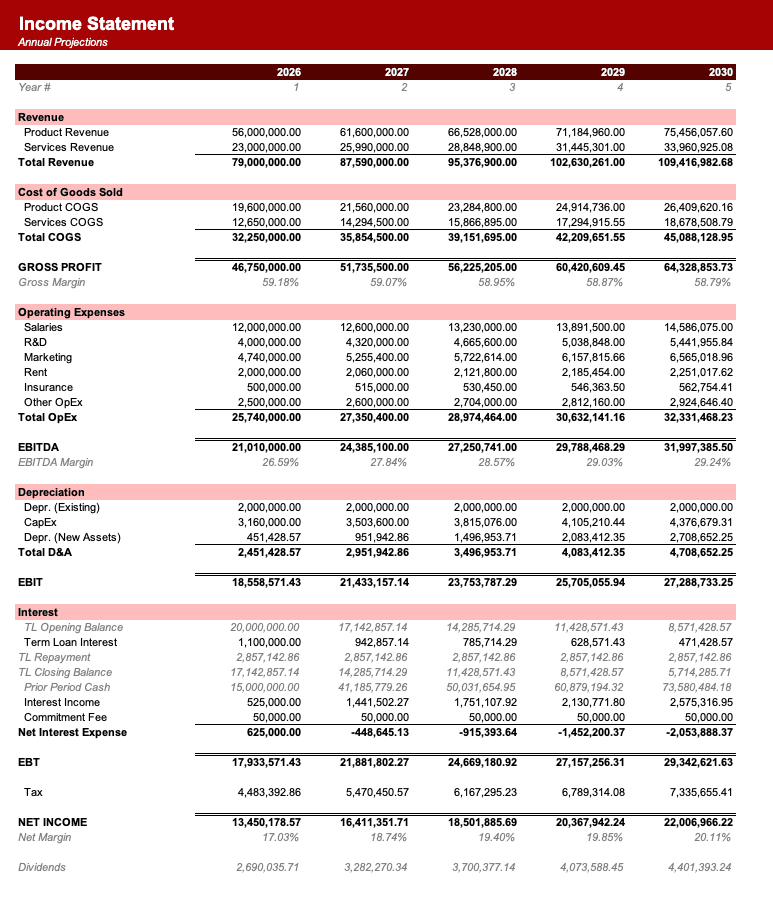
Formatted to IB standards
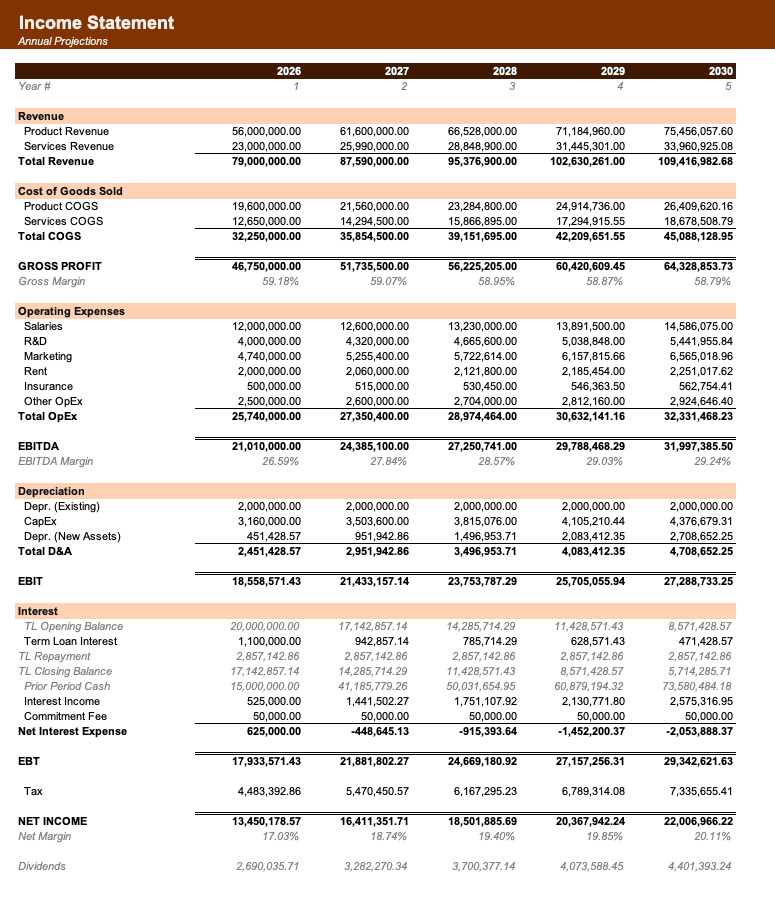
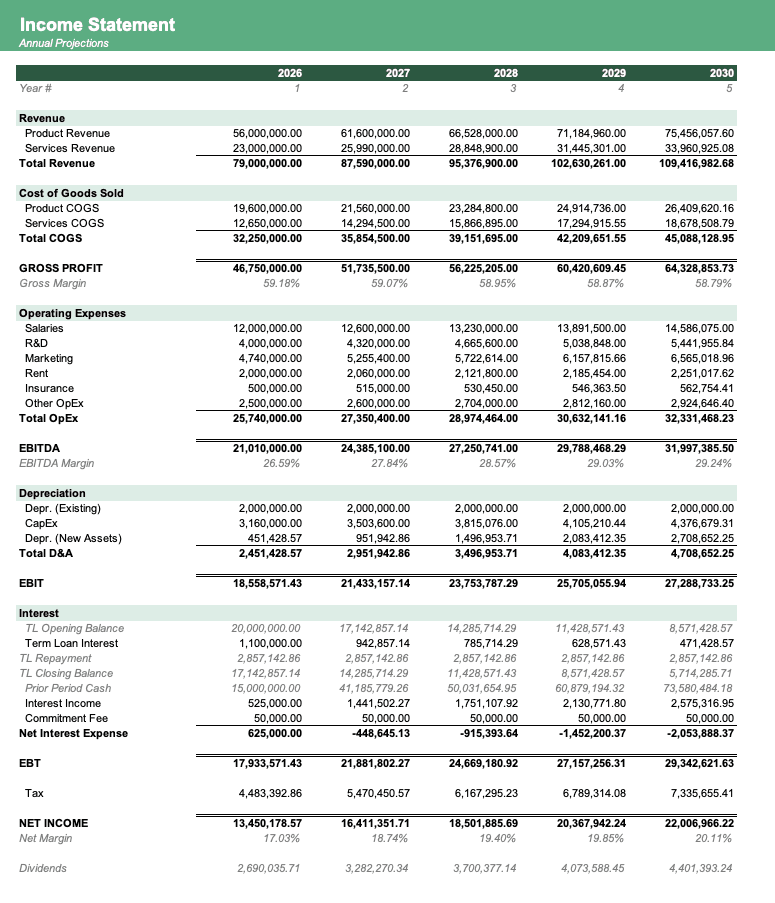
Named theme colors repaint the whole workbook in one click, on top of an investment-banking structure with clear input, output, and cross-sheet reference styling - brand-ready, institutional-grade, and fully auditable.

Created by ex-finance professionals
Hey, I’m Alex and I created Finamodel.
Over my years in the finance industry I kept building the same models over and over again. Same structure, same assumptions, different logo. So I started building frameworks to turn them into clean, reusable templates.
Every model here is one I’d actually use for a client, and I personally vet each one before it goes up.
I’m not an expert in every industry, but I’ve built enough models to know what belongs in one. And when something is completely foreign to me, I reach out to my network for experts to work on our models with us.
Having a template library on hand cuts a first build from hours to minutes.
Need help finding your model? You’ll find me in the Finamodel app!
Frequently asked
What is a wealth-management firm model?+
It is an operating model and valuation of a Registered Investment Advisor (RIA) built from the owner perspective. Advisory-fee revenue flows from an AUM roll-forward, a headcount-driven cost base produces EBITDA, and the firm is valued on EBITDA multiples and a DCF to give an owner equity IRR.
How is AUM projected?+
Through an explicit roll-forward: opening AUM plus gross client inflows, less attrition outflows, plus market appreciation on the average balance, equals closing AUM. Average AUM drives advisory-fee revenue, and the two flow levers are separated from the market-return lever.
What is fee compression and why model it?+
Industry advisory fees trend down over time. The model starts the advisory fee rate at 85 bps and compresses it by a small relative percentage each year, so revenue does not simply track AUM one-for-one and the cost of a softening fee environment is visible.
How is the firm valued?+
Three lenses: an entry EBITDA multiple on Year-0 EBITDA, a discounted cash flow (PV of forecast free cash flow plus a Gordon-growth terminal value), and an exit EBITDA multiple on Year-7 EBITDA. The owner equity IRR and MOIC come off a Year-0 outflow, annual distributions, and a Year-7 distribution plus exit value.
Does this model carry debt?+
No. The base case is an all-equity owner, so equity value equals enterprise value throughout. For a financed acquisition, pair this with the LBO or search-fund template.
Can I resize the firm or change the hold?+
Yes. Opening AUM, flow rates, fee rate, and the EBITDA multiples are all named-range inputs. The builder is parameterised by NUM_PERIODS, currently 8, equal to Year 0 plus a seven-year forecast. Bump it to extend the horizon.
Have more financial modelling questions? Contact us
Related templates
Family Office Financial Plan
Comprehensive financial planning model for family offices with assets, spending, taxes, and legacy.
Search Fund Acquisition Model
Financial model for search fund operators evaluating acquisition targets with acquisition price, earn-out mechanics, and operator returns.
Consulting Firm
Five-year pyramid model: headcount, utilization, billable rate, comp, and margins.
DCF Model
Discounted cash flow valuation model with explicit forecast, terminal value, and WACC.