Search Fund Model
Corporate Finance Financial Model (Free Excel Download)
Plan an entrepreneurship-through-acquisition search fund with search capital, acquisition sources and uses, operating forecasts, debt structure, and investor returns.



professionals from Deloitte
Used by professionals from






About this model
Evaluate search fund acquisition targets with transparent acquisition math, earnout mechanics, and operator equity scenarios. The model values a target at an agreed EBITDA multiple (typically 3.5-6.0x for $1-5M EBITDA small-to-mid-market businesses), structures the funding with SBA 7(a) loans (60-70% of capital), seller notes (10-20%), and investor equity (25-40%). It projects 5-7 year operating improvements (margin expansion, revenue growth), calculates operator returns under different exit multiples, and reconciles cash flow to debt covenants (DSCR > 1.25x).
Post-acquisition, the model forecasts revenue growth (organic 3-8%, operational improvements 8-15% in early years), models COGS and OpEx by function, and includes capex and working capital dynamics. Debt schedule separates SBA mandatory amortisation from optional seller note repayment (often 1-2 year IO period). Returns analysis shows investor IRR and MOIC across a range of exit multiples and hold periods, and operator economics including carried interest (typically 20-30% above a preferred return hurdle).
Indispensable for search fund investors, independent sponsors, and operators evaluating acquisition targets. Works with bank credit decisioning, SBA lending, and post-acquisition integration planning.
What every model includes
Live formulas, no hardcoded values
Outputs are driven by live formulas, so the workbook updates from its assumptions instead of relying on hardcoded results.
All assumptions in one tab
Inputs are clearly marked in the Assumptions tab and separated from calculations, making it clear what to change and what to leave intact.
Statements always balancing
For integrated-statement models, the balance sheet, cash flow, and supporting schedules tie through properly.
Distinct schedules for clarity
Debt, working capital, taxes, and cash flow can get messy quickly. We group calculations in clear schedules, not across disconnected tabs.
No hidden macros or external links
There are no unexplained external workbook links or macros to undermine auditability or portability.
Changes flow through the model
Update a key driver and see the impact carry through the forecast, financing, and return outputs. We never use hardcoded numbers in formulas.
What's inside the Search Fund Model
- Search phase budget and capital raise planning
- Acquisition sources and uses with multi-tranche debt
- SBA 7(a), mezzanine, and seller note debt schedules
- Searcher equity vesting and performance step-ups
- Returns analysis including IRR, MOIC, and preferred return
- Target acquisition valuation and EBITDA multiples
- Purchase price allocation and earnout mechanics
- Debt financing structure and leverage ratios
Search Fund Model: A Guide to Evaluating the Template
For entrepreneurs and investors assessing a search fund model, this template captures the full search-to-acquisition-to-operating arc. It structures search phase budgeting, acquisition financing via SBA and seller notes, a seven-year operating forecast, and investor and searcher return mechanics.
The guide below explains the key drivers and calculation flow so you can judge whether the underlying relationships match a typical search fund. Rates and financial results described here reflect illustrative model settings, not industry benchmarks.
Operating Drivers That Shape the Forecast
The operating forecast rests on a small set of drivers rather than line-by-line detail. Revenue builds from existing business growth or units-times-price mechanics, with an optional separate cross-sell or new-services line for post-acquisition improvements.
- Costs split into variable COGS and operating expenses, where salaries, occupancy, and a searcher salary or management fee are the main levers. Working capital and capex assumptions translate accounting profit into cash.
- Because these drivers feed the income statement, free cash flow, and balance sheet together, changing one input — say, post-close salary levels or a cross-sell rate — flows through to margins, debt service capacity, and returns, letting you stress-test the business case coherently.
How Capital Structure and Interest Drive Debt Service
Acquisition funding is modelled through a sources-and-uses schedule that balances SBA loan, seller note, and investor equity against enterprise value, transaction fees, and financing fees. Enterprise value is derived from LTM EBITDA times entry multiple, while the SBA loan and seller note are sized by leverage and percentage rules.
- The debt schedule then applies PMT-based amortisation over the remaining term, with an interest-only gate on the seller note. Interest expense references the opening balance, so it declines as debt is repaid.
- DSCR is calculated from EBITDA divided by total interest and amortisation, providing a covenant check that must stay above 1.25x in every period.
Outputs: Returns, Checks, and the Searcher Waterfall
The model produces a 7-year income statement, free cash flow, balance sheet, and debt schedule, all feeding a returns analysis.
- Investor returns are true IRRs and MOIC computed over per-exit-year cash flows, including interim distributions.
- Searcher economics use a PE-style waterfall — return of capital, an 8% preferred return, catch-up, and an 80/20 residual split — with the searcher's gross carry scaled by a vesting fraction built from close, time, and performance sleeves.
- Validation checks enforce balance sheet balancing, sources equal uses, DSCR above 1.25x, positive cash, declining debt, and reasonable margin ranges, so errors surface rather than hide.
Practical Use and Scope of the Template
Use this template to evaluate whether a proposed search fund acquisition clears return hurdles for both the searcher and investor group. It is built for a single acquisition with an option for one add-on, not for comparing multiple targets or running a portfolio.
- Because the public download is a values-only preview, it contains no live formulas or automatic recalculation — but the underlying structure shows the relationships you would need to rebuild or assess. The model reflects the standard two-phase search fund lifecycle, SBA 7(a) financing, and typical lower-middle-market target parameters.
- As with any template, review assumptions against your own deal context and confirm that the documented driver logic matches the target business before relying on outputs.
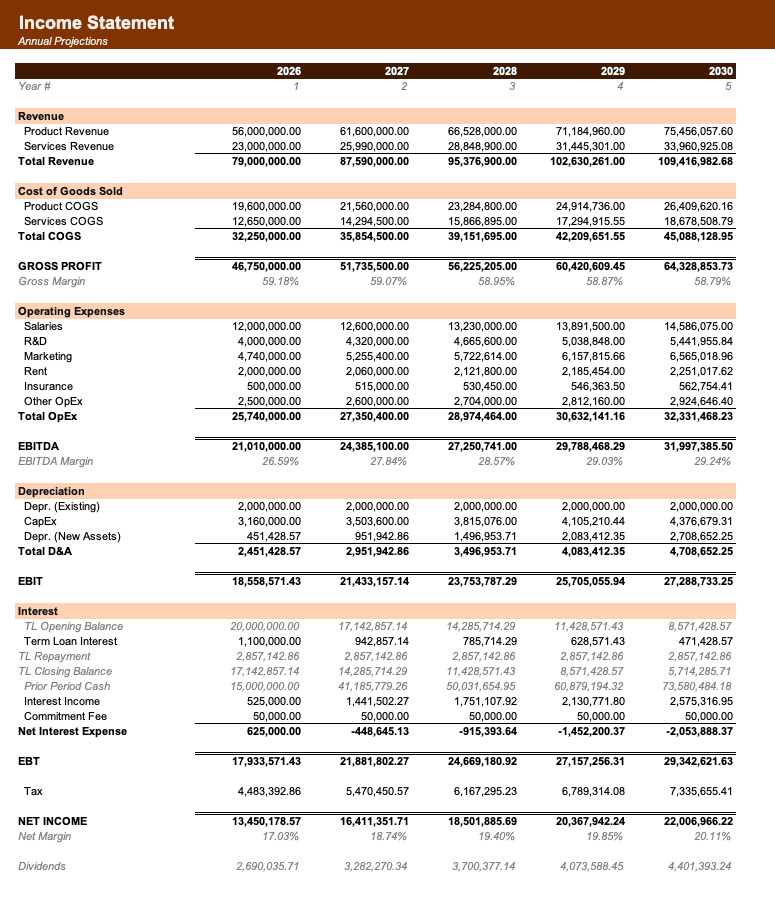
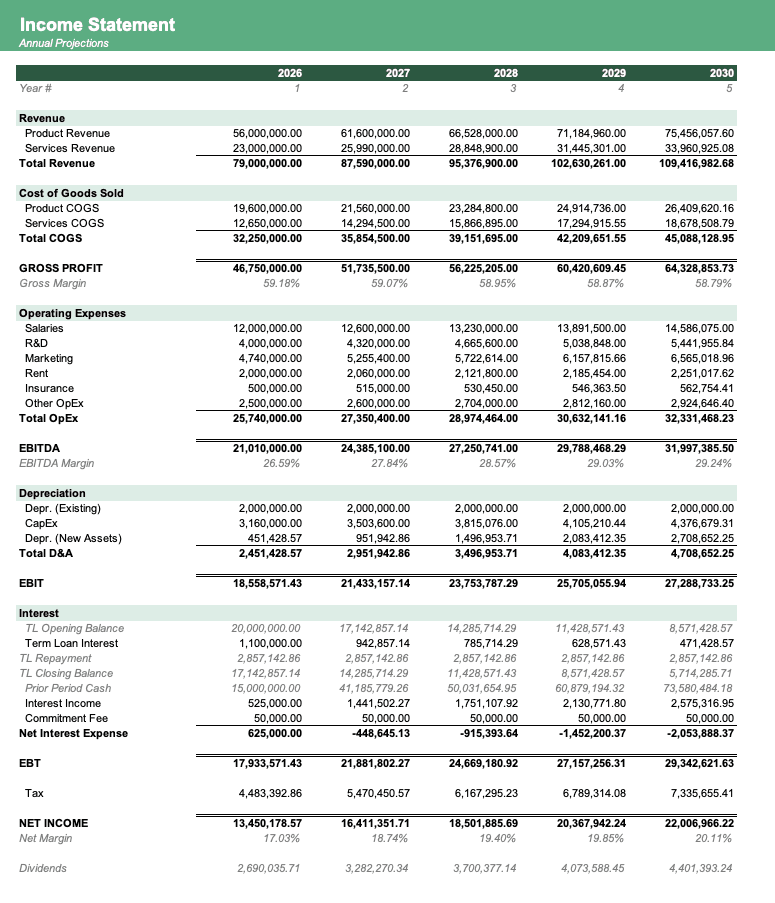
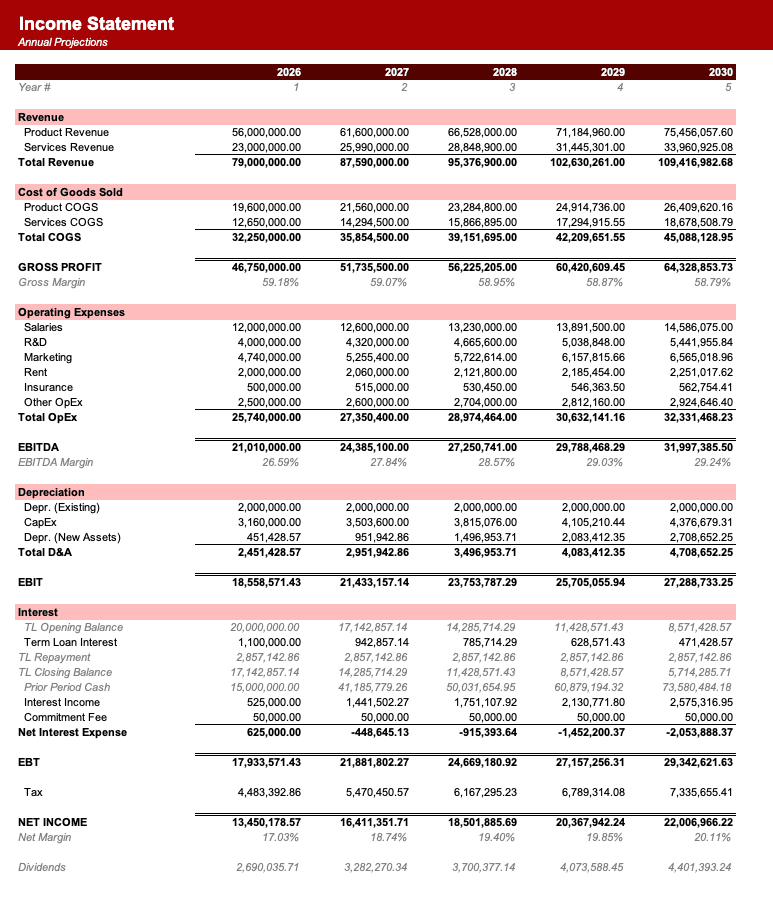
Formatted to IB standards
Named theme colors repaint the whole workbook in one click, on top of an investment-banking structure with clear input, output, and cross-sheet reference styling - brand-ready, institutional-grade, and fully auditable.

Created by ex-finance professionals
Hey, I’m Alex and I created Finamodel.
Over my years in the finance industry I kept building the same models over and over again. Same structure, same assumptions, different logo. So I started building frameworks to turn them into clean, reusable templates.
Every model here is one I’d actually use for a client, and I personally vet each one before it goes up.
I’m not an expert in every industry, but I’ve built enough models to know what belongs in one. And when something is completely foreign to me, I reach out to my network for experts to work on our models with us.
Having a template library on hand cuts a first build from hours to minutes.
Need help finding your model? You’ll find me in the Finamodel app!
Frequently asked
What is a search fund model?+
It is a financial model that covers the full search fund lifecycle from raising search capital, acquiring a small business, operating it, and eventually exiting to generate investor returns.
What should a search fund model include?+
It should include search phase budgeting, acquisition sources and uses, debt schedules, operating forecasts, searcher equity mechanics, and investor return analysis.
Who uses search fund models?+
Searchers pursuing entrepreneurship through acquisition, search fund investors, M&A advisors, and SBA lenders use them for planning, underwriting, and fundraising.
How do searcher equity step-ups work?+
Searchers typically earn equity through a combination of time-based vesting and performance hurdles tied to investor returns, increasing their ownership stake as the business performs.
Can I model SBA 7(a) loan structures?+
Yes. The debt schedule supports standard SBA 7(a) terms including fully amortising structures, current rates, and equity injection requirements.
Have more financial modelling questions? Contact us
Related templates
Leveraged Buyout Model
Complete LBO analysis with debt financing structures, sponsor returns, and sensitivity to exit scenarios.
M&A Modeling & Valuation
Comprehensive M&A valuation with DCF, comparable companies, and precedent transactions analysis.
Exit Waterfall Model
Waterfall analysis for M&A, IPO, or sale with proceeds distributed to shareholders and securities holders.
3 Statement Model
Integrated income statement, balance sheet, and cash flow forecasts.


