 By Alex Tapio
 Financial Modeling Education alternatives
People look for alternatives mostly because of what the program leaves out, and the site says so itself. It is not for people brand-new to finance, people who want plug-in pre-built templates, people who need DCF, comps or precedents, or people who want live instruction. Anyone in one of those groups needs a different option. Others want a recognised certificate, a community or a larger catalog. And some do not want to build at all: they need a finished operating model for their company now.
What is Financial Modeling Education?
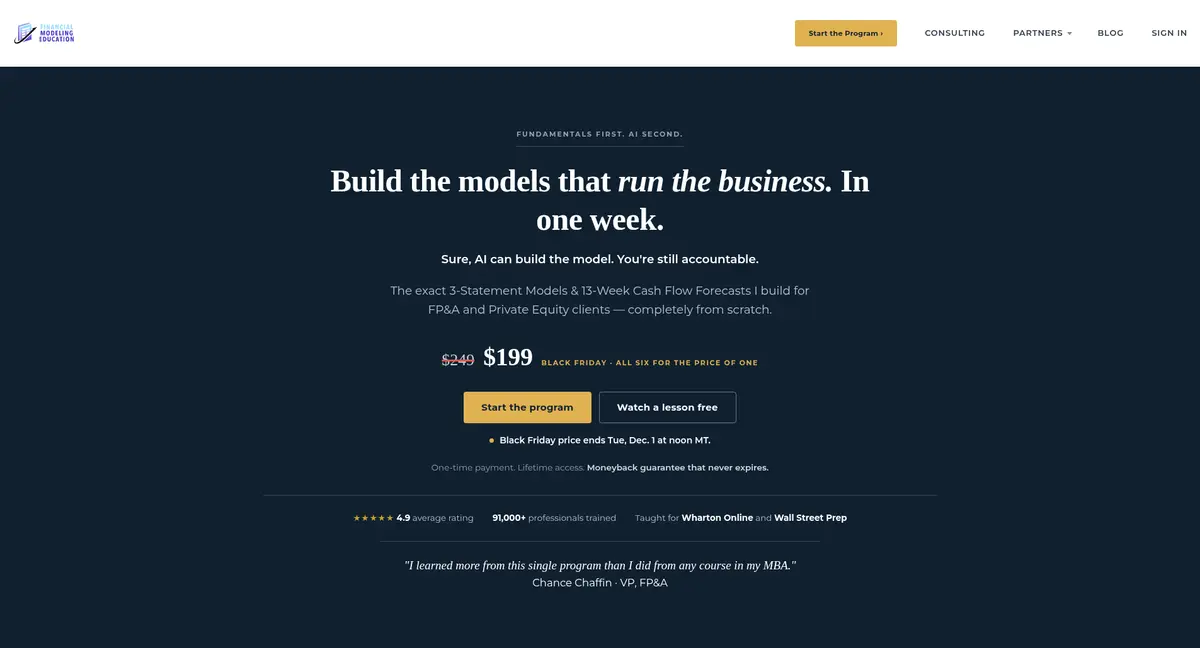
Financial Modeling Education is a six-course online program by instructor Chris Reilly. It teaches you to build 3-statement models, 13-week cash flow forecasts and LBO models from scratch in Excel. The site says it is for FP&A professionals, finance staff in PE-backed companies and anyone who must build a 3-statement model from scratch. The vendor states the instructor teaches for Wharton Online and Wall Street Prep. The program is sold as one payment, with no subscription.
Financial Modeling Education at a glance
The full program is normally $249, one payment, with lifetime access and a money-back guarantee that never expires. A Black Friday offer cut it to $199 until noon MT on 1 Dec 2026. Single courses cost $89 for Basic Three Statement, $149 for 13 Week Cash Flow, $209 for Advanced Three Statement, $199 for How I'm Modeling with AI, $269 for the SaaS Model Template and $329 for Expert LBO. One lesson is free to watch.
Quick picks
Every option in this table except one is a course in which you build the model yourself. So compare the price model, what each course covers and whether it fills the gaps this program leaves: DCF and comps, beginners, live teaching and ready templates. The Excel column shows what you keep at the end.
| Tool | Best for | Type of tool | Price (entry plan) | Works in | Free option | Builds the model for you | Excel file you keep | AI edits your file | Templates library |
|---|---|---|---|---|---|---|---|---|---|
| Operating models for FP&A | Video course | $249 one-time | Web, Excel files | Yes: One free lesson | No: You build it | Yes: Five finished models | No: AI course only | Yes: SaaS model template |
 | DCF, comps, M&A and LBO | Courses | $199 to $499 one-time | Web, Excel files | Yes: Free tutorials | No: You build it | Yes: Course files | No: Not a tool | Not stated: Not stated |
 | Banking interviews and tests | Courses | $297 one-time | Web, Excel files | Yes: Free knowledge base | No: You build it | Yes: 10 templates | No: Not a tool | Yes: 10 in Core |
 | FP&A certificates, billed yearly | Courses | $497 or $847 a year | Web, Excel files | Yes: Free account | No: You build it | Yes: Templates | No: AI tutor only | Yes: 250+ templates |
 | Ready operating models, adapted by AI | Ready models + AI | $20/mo or $120/yr | Web app, Excel file | Yes: 30 models + free samples | Yes: Fina chat builds it | Yes: .xlsx, formulas visible | Yes: Fina chat edits it | Yes: 500+ models |
WS Wall Street Oasis | Community, courses, free templates | Courses + forum | $497 to $997 per course | Web, Excel files | Yes: Templates, crash courses | No: You build it | Yes: Free templates | No: No AI listed | Yes: Free template library |
 | Low-cost basics for beginners | Video courses | $14.99 a month | Web, Excel files | Yes: Free model downloads | No: You build it | Yes: Free models by email | No: No AI listed | Yes: Free model library |
yes · no · not stated in the vendor's sources. Hover a mark for details. From each vendor's own site; prices change, so check before you buy.
1.Wall Street Prep
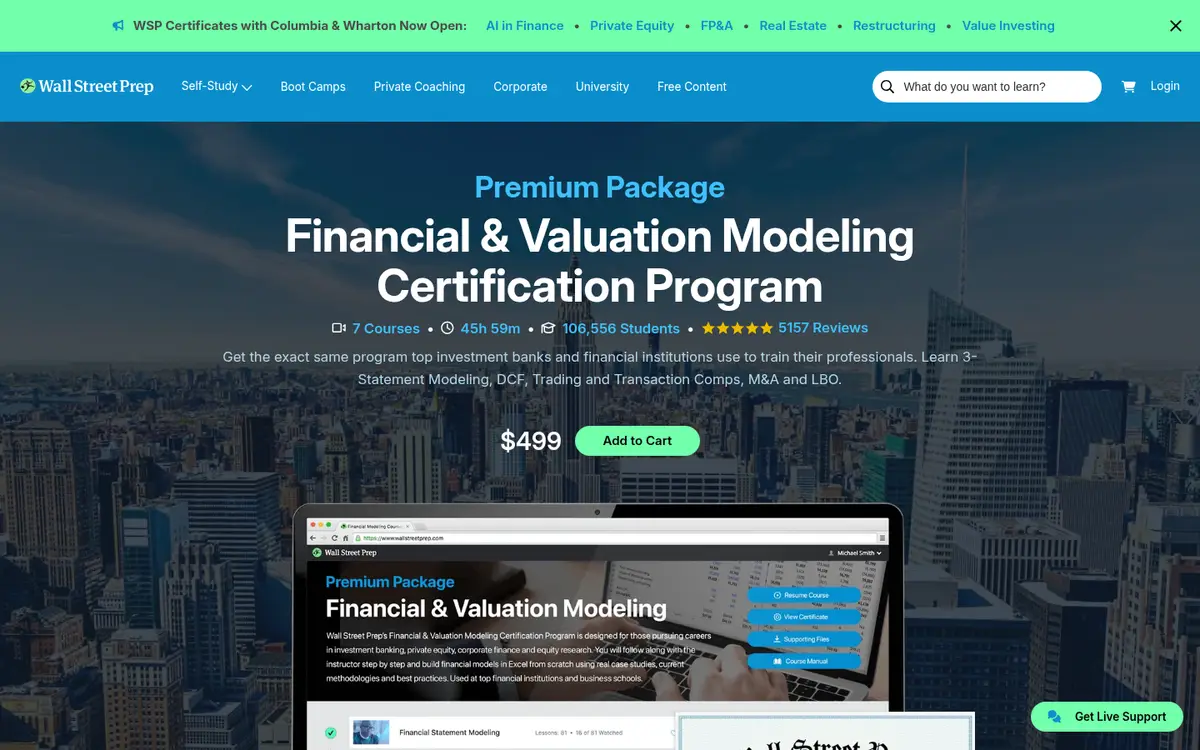
Wall Street Prep sells self-study financial modeling packages, public boot camps, corporate new-hire training and university-branded certificates. The Premium Package covers 3-statement modeling, DCF, comps, M&A and LBO in Excel. It serves banks that train new hires and individuals preparing for banking, PE and corporate finance roles.
You follow video lessons and build each model in Excel with the instructor, using course files and real case studies. Certification exams close some programs: Project Finance Modeling needs 80% to pass. There are also courses on industries, restructuring, PE and VC, FP&A and project finance, and on Excel, PowerPoint and VBA. Live boot camps are open to the public, and a free library holds articles, Excel tutorials and a 7-lesson video series.
It is the natural next step for someone who has finished Financial Modeling Education or needs what it leaves out. The vendor states the FME instructor also teaches for Wall Street Prep, so the style may feel familiar. Wall Street Prep covers DCF, comps and M&A in depth, and it has an FP&A course too.
It costs more. The Basic Package is $199 and the Premium Package $499 after discount, both one-time, against $249 for all six FME courses, and Wall Street Prep's prices may differ by region. Its certificates cost far more: 8-week Wharton- and Columbia-branded programs at $4,800. It also has more AI training, including a Columbia-branded AI for Finance certificate and an Investment Banking AI Boot Camp at $2,999. FME's 13-week cash flow course has no direct match among the packages we have on file.
- Price
- Basic Package $199 and Premium Package $499, one-time, after discount.
- Free option
- Free articles, Excel tutorials and a 7-lesson modeling video series.
Pros
- Covers DCF, comps, M&A and LBO
- One-time packages
- Boot camps and branded certificates
Cons
- Costs more than FME
- Certificates cost $4,800 or more
Pick it if you need valuation and deal modeling as well as 3-statement models.
2.Breaking Into Wall Street
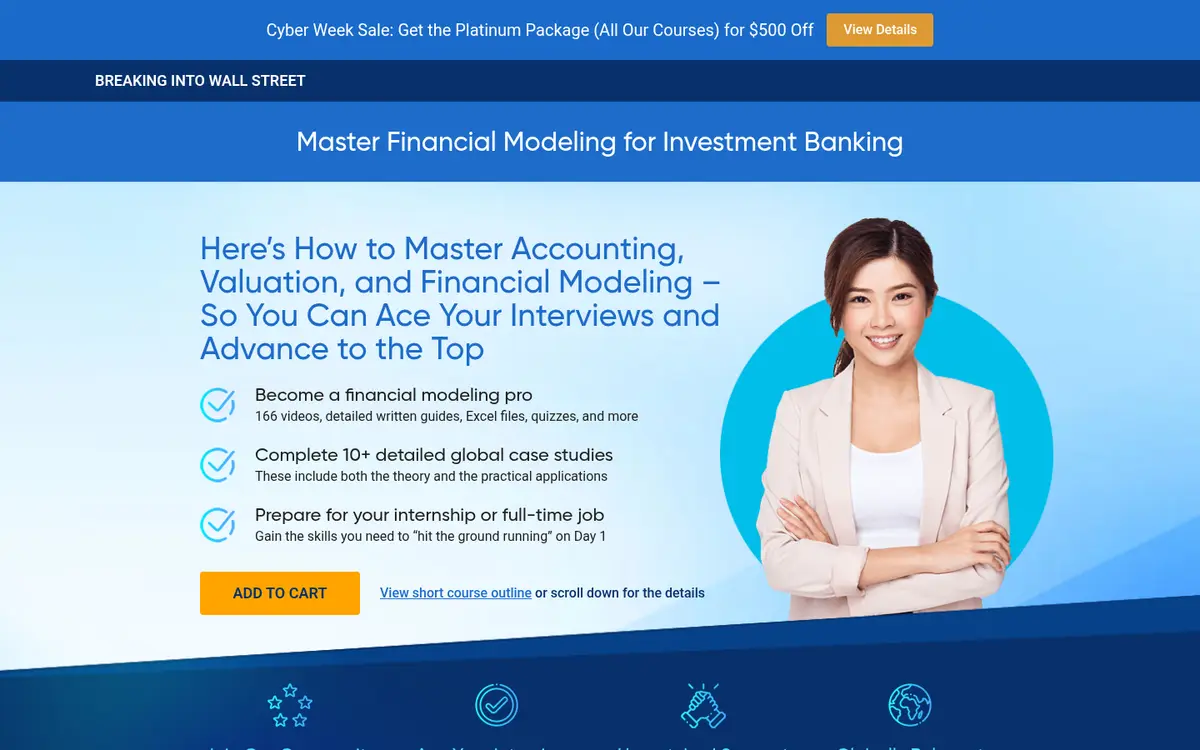
Breaking Into Wall Street sells one-time online courses aimed at winning investment banking and private equity offers. Its main course, Core Financial Modeling, has 166 lessons, about 40 hours of video and 10 full model and valuation templates. Students, entry-level professionals and career changers are its core users.
You learn by building each model by hand in Excel, following real modeling tests and interview case studies. Many examples come with banking-style presentations and pitch books. Each lesson has its own Q&A, and buyers get 5 years of support, updates and video access. Courses go beyond Core into Excel and VBA, PowerPoint, LBO, VC, project finance, real estate, REITs, banks, oil and gas, and biotech.
BIWS fits a different person from FME's target buyer. FME is for people already working in FP&A or PE-backed companies. BIWS is for people trying to get into banking or PE, with interview and networking guides in its bundles. If you are not yet in a finance job, BIWS is the closer match, and its free knowledge base in 22 topic categories helps you prepare.
The price models are alike: one payment, no subscription. Core Financial Modeling is $297, the Excel and VBA plus Core bundle $397, and BIWS Premium $497 or 6 monthly payments of $85, with a 90-day money-back guarantee. FME's guarantee never expires. BIWS includes valuation templates, which FME does not cover, but we found no 13-week cash flow focus and no AI course. Core alone takes about 40 hours of video.
- Price
- Core Financial Modeling $297, one-time. Premium bundle $497, or 6 monthly payments of $85.
- Free option
- A free knowledge base, and free video tutorials after an email sign-up.
Pros
- Valuation templates included
- Interview and networking guides
- 90-day money-back guarantee
Cons
- About 40 hours for Core alone
- No AI course
Pick it if you are trying to get into banking or PE, not yet working in FP&A.
Breaking Into Wall Street alternatives · Visit breakingintowallstreet.com
3.CFI
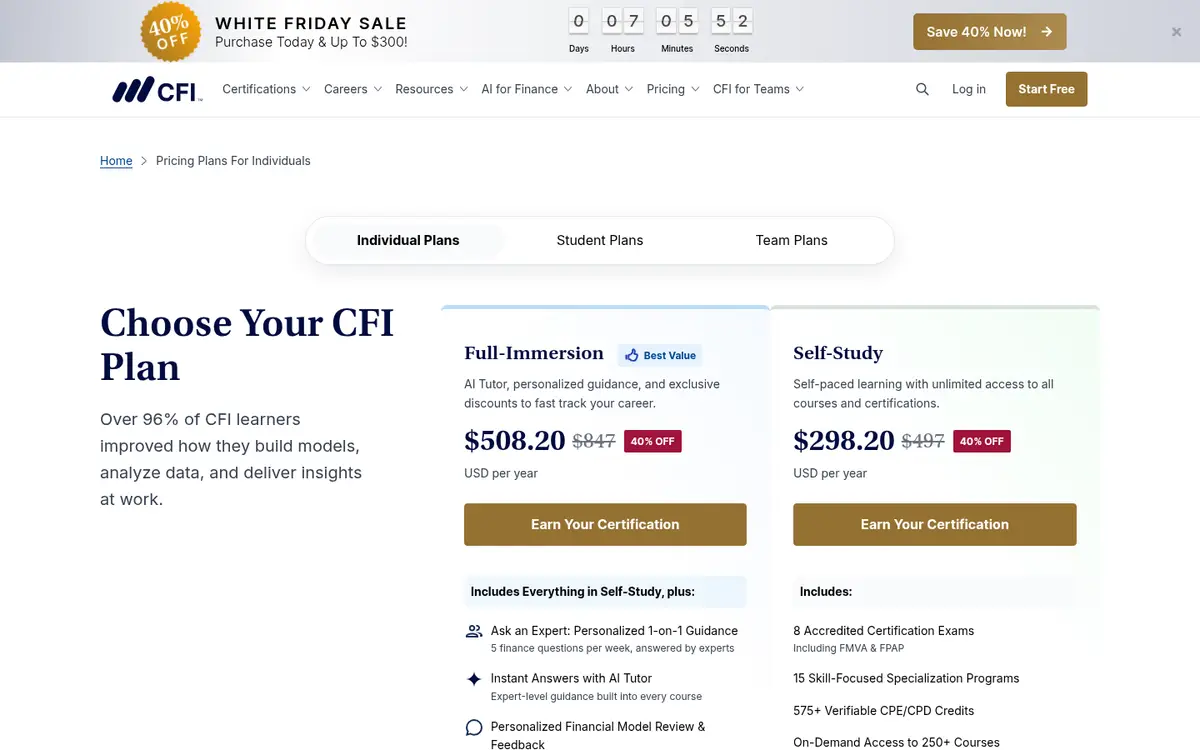
CFI, the Corporate Finance Institute, sells a yearly membership with more than 250 self-paced courses, 8 accredited certification exams such as the FMVA and FPAP, and Excel templates. Its focus is corporate finance and FP&A. Its users are working analysts, finance students, teams and universities.
You choose a certification and follow its courses, building in the Excel files and finishing with a proctored exam. Full-Immersion adds an AI Tutor powered by OpenAI, a personal review of your financial model and an Ask an Expert service. The AIFP program teaches AI in finance, with courses such as AI Financial Modeling with Claude in Excel. Templates come in two layers: some with a free account, and more than 250 with a paid membership.
Of the course providers here, CFI is closest to FME's FP&A audience. It suits a working analyst who wants a recognised credential and a wide catalog, not six courses. The personal model review is the nearest thing on this page to feedback from an instructor on your own work.
The cost structure is the main difference. FME is $249 once. CFI Self-Study lists at $497 a year and Full-Immersion at $847, with no monthly option, and you pay every year. On 22 Nov 2026 both were 40% off. In return you get far more courses and accredited exams, where FME gives completion certificates. Since 1 Sep 2026, CFI has banned AI tools, its own tutor included, in proctored exams. If an accredited credential matters to your employer, that is worth the yearly fee; if not, FME is far cheaper.
- Price
- Self-Study $497 a year, Full-Immersion $847 a year at list price.
- Free option
- A free account with part of the template library, cheat sheets and guides.
Pros
- Accredited exams such as the FMVA and FPAP
- 250+ courses for one fee
- Personal model review in the top tier
Cons
- Yearly billing only
- Costs more than FME every year
Pick it if you work in FP&A and want an accredited certificate and a large catalog.
4.Finamodel
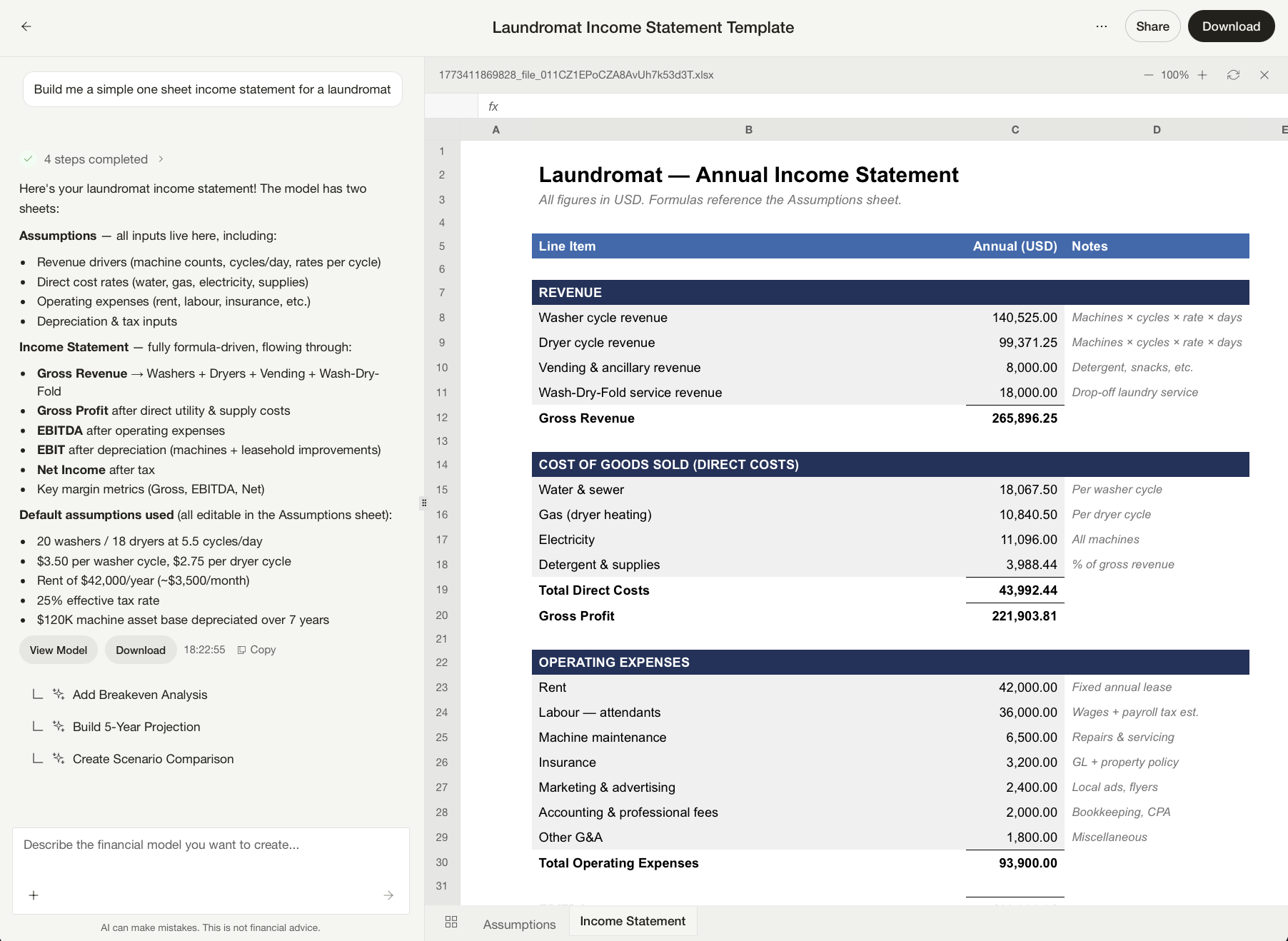
Finamodel is a library of ready Excel financial models with an AI assistant called Fina. Where Financial Modeling Education teaches you to build a model from scratch, Finamodel starts you with a finished one, such as a 3-statement model, a cash flow model or a SaaS forecast. Fina then adapts it to your company.
In Fina chat you describe the change you need in plain words: monthly instead of yearly periods, a new revenue line, a working capital schedule, or a fix for a balance sheet that does not balance. Fina builds and edits the Excel file, explains formulas and fixes errors. Version history lets you restore any earlier file. You download a normal .xlsx file with every formula visible, and it opens in Excel, Google Sheets and Numbers without Finamodel.
FME's own 'not for' list includes people who want plug-in pre-built templates. That is the group Finamodel serves: FP&A staff, founders and analysts who need an operating model for a real company this week and do not want to build it line by line. A voice walkthrough explains a model you did not build, and read-only links connect to QuickBooks, Google Sheets, Google Drive and 42 other apps. 30 free models with live formulas let you test a full workbook.
What you give up is the skill. Finamodel has no courses, case studies or certificates, and it does not teach you to build a 3-statement model or a 13-week cash flow forecast yourself. FME's How I'm Modeling with AI course teaches you to use AI tools; Finamodel is a tool, not a lesson. It is not an Excel add-in: you work in the app, then download. Billing is monthly or yearly and you can cancel at any time, with a 14-day money-back guarantee on the first paid plan and email support.
How it works
- Pick a ready model, such as a DCF or a 3-statement model, from a library of more than 500.
- Ask Fina chat to change, explain or fix it for your case and your numbers.
- Download a real .xlsx file. Every formula is visible, and it works without Finamodel. It opens in Excel, Google Sheets and Numbers.
- Price
- Models plan: $20 a month or $120 a year. All Templates: $30 a month or $144 a year. You can cancel at any time.
- Free option
- 30 free models with live formulas, and a free sample of every other model, with values but no formulas. Both are sent by email link, one model email per email address per day. The library is free to browse.
Better than Financial Modeling Education at
- A ready operating model for your company now
- AI that edits and fixes the file
- No build from scratch needed
Worse than Financial Modeling Education at
- No courses, case studies or certificates
- Does not teach you to build from scratch
- Paid monthly or yearly, not once
Models that fit: 3 Statement Model, Cash Flow Model, SaaS MRR/ARR Forecast Model.
Pick it if you need a working operating model more than the skill to build one.
5.WSWall Street Oasis
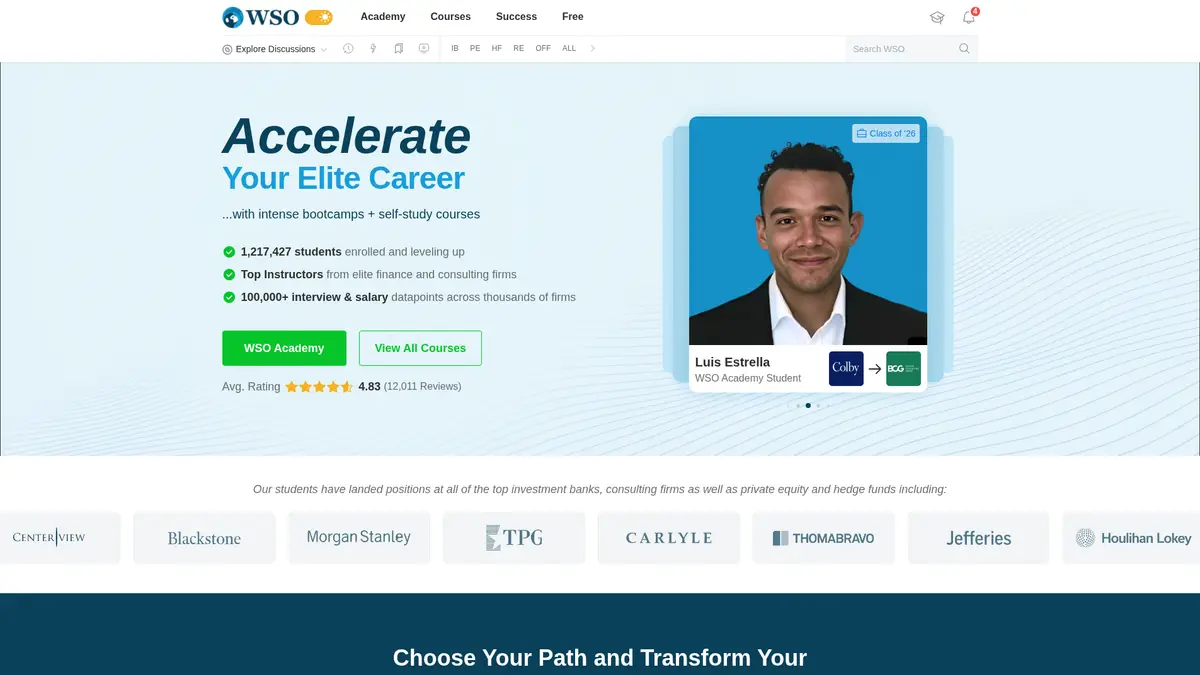
Wall Street Oasis is a finance careers community and forum that also sells courses. Its offer includes WSO Academy, a cohort bootcamp, self-paced modeling and interview-prep courses, and free Excel templates and crash courses. Students and career changers recruiting for banking, PE, hedge funds and consulting are its main users.
Its modeling courses include Excel, 13-week cash flow, real estate, PE and VC. The 13-week cash flow course makes WSO the only other option on this page that teaches the same forecast as FME. WSO Academy is a 12-week accelerator with 36 months of support and a job-offer guarantee: the site says tuition is free if you do not get an offer. A free 3-statement model and free crash courses let you start for nothing.
WSO suits people who want peers and advice around the technical work. FME is one instructor teaching one method. WSO is a large community, with a forum where candidates discuss firms and interviews, and the homepage says 1,217,427 students have enrolled. Its industry-specific advanced programs go deeper into single sectors.
Prices are higher per course and harder to read. The Renewable Energy Project Finance course is $497 once or 3 monthly payments of $170, next to a struck-through value of $2,914, and the Venture Capital Master Program is $997. We do not have the price of the 13-week cash flow course or of the Academy. FME's full program at $249 costs less than either of those WSO courses. We found no AI in WSO's offer.
- Price
- Priced per course, for example $497 or $997 one-time. WSO Academy price not stated.
- Free option
- Free Excel and financial modeling templates, including a 3-statement model, and free crash courses.
Pros
- A 13-week cash flow course
- A large community and forum
- Free templates and crash courses
Cons
- Courses sit next to struck-through value figures
- Several prices not stated
Pick it if you want courses plus a community and recruiting help.
6.ASimpleModel
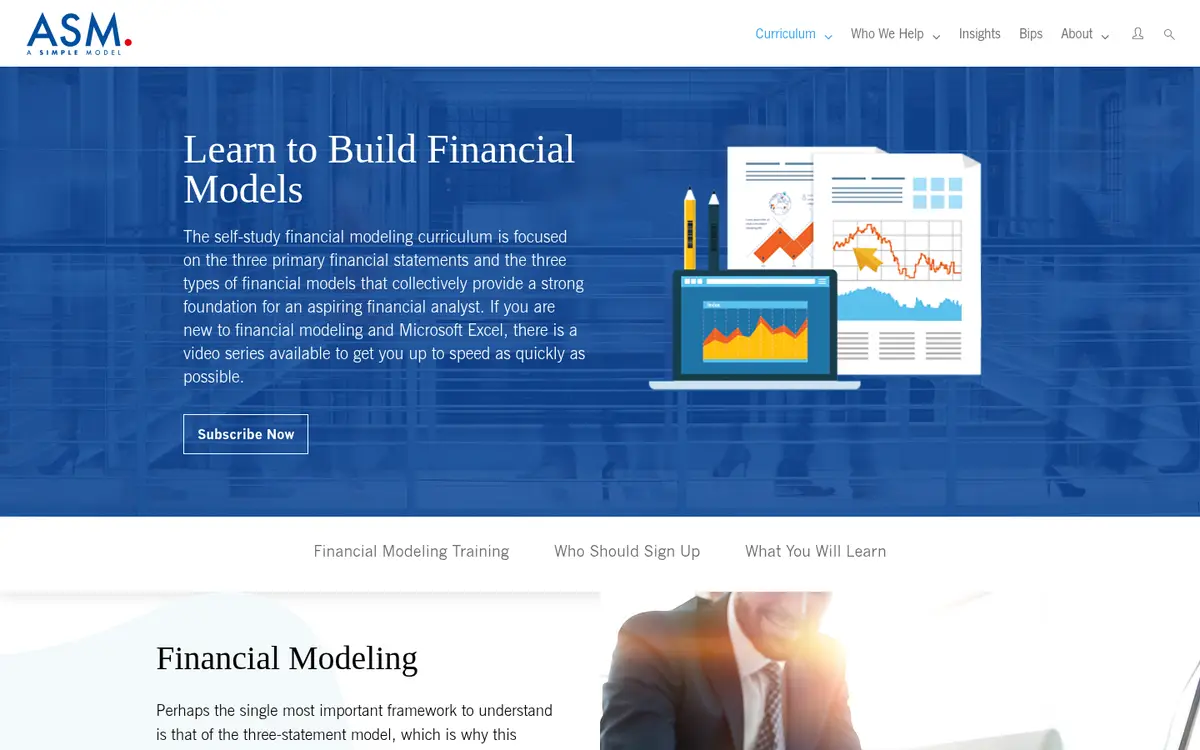
ASimpleModel (ASM) is a video-based financial modeling and private equity training site with a free library of Excel models, each linked to the videos that build it. Its users include entry-level analysts, aspiring bankers, corporate development and PE professionals, and professors who give their students access.
The curriculum starts with Excel for Models, then covers the financial statements, integrating the three statements, DCF and LBO. The free downloads include three-statement, DCF and LBO models in several versions, a debt schedule, a distribution waterfall, a multifamily model and a franchise model, sent by email. Each links to its video series, so you can watch the model being built before you try it yourself.
ASM fills the first gap on FME's own 'not for' list: people brand-new to finance. Its curriculum starts at the basics and builds up one step at a time, at a price low enough to try for a month. It also covers DCF, which FME leaves out, and PE training with an LBO case study.
ASM+ costs $14.99 a month or $35.98 a quarter, and ASM+ PRO was recorded at $29.99 a month. A few months cost less than FME's $249, but you keep paying while you study, where FME is paid once. We found no 13-week cash flow course, no completion certificates and no AI content at ASM, while FME has a full course on modeling with AI. Its Insights blog is commentary, not product news. For a beginner, a month of ASM before FME is a sensible order.
- Price
- ASM+ $14.99 a month or $35.98 a quarter. ASM+ PRO $29.99 a month.
- Free option
- Free Excel model downloads by email, each linked to its build videos.
Pros
- Starts at the basics
- Free models paired with build videos
- Covers DCF and LBO
Cons
- A monthly fee while you study
- No 13-week cash flow or AI course
Pick it if you are new to modeling and want a low-cost start.
Who should pick what
Financial Modeling Education is narrow on purpose: FP&A operating models, built from scratch, by one instructor, for one low payment. The right alternative depends on which of its limits you hit: no valuation, not for beginners, no community, or no ready templates. Name the limit first, then read the matching entry.
- Add DCF, comps and M&A: Wall Street Prep, or Breaking Into Wall Street if you are recruiting.
- An accredited certificate for an FP&A career: CFI.
- New to modeling, or want a community: ASimpleModel or Wall Street Oasis.
- A ready operating model instead of a course: Finamodel.
If you work in FP&A, the $249 program and its free lesson are a low-risk start, and the guarantee never expires. Add a valuation course later if your job needs it. If your deadline is this week, start from a ready model and learn the build when you have time.
Frequently asked
How much does Financial Modeling Education cost?+
The full program of six courses is normally $249, one payment, with no subscription. A Black Friday offer cut it to $199 until noon MT on 1 Dec 2026. Single courses cost $89 to $329.
Is there a free version of Financial Modeling Education?+
No, but you can watch one lesson free: Build an Advanced Three Statement Model.
What are the main Financial Modeling Education alternatives?+
For courses: Wall Street Prep, Breaking Into Wall Street, CFI, Wall Street Oasis and ASimpleModel. For a ready model instead of a course: Finamodel.
Does Financial Modeling Education cover DCF and valuation?+
No. The site's own 'not for' list includes people who need DCF, comps or precedents. Wall Street Prep and Breaking Into Wall Street cover them.
Financial Modeling Education vs Finamodel: which should I pick?+
Pick Financial Modeling Education to learn to build FP&A models from scratch. Pick Finamodel to start from a ready model that AI adapts to your company. Finamodel's Models plan is $20 a month or $120 a year. The FME program is $249 once.
Sources for Financial Modeling Education (1), last checked 22 Nov 2026+
- financialmodelingeducation.com · Source · 22 Nov 2026
Each alternative's own page lists its sources.


