MIMistral Financial Model
AI/ML Startup Financials (Free Excel Download)
European open-source large language model company building state-of-the-art generative AI models with a counter-position to closed US incumbents (OpenAI, Meta).



professionals from Deloitte
Used by professionals from






About this model
Mistral is a European foundation-model company developing open-weight generative AI, with private-cloud and on-device deployment for data-sensitive enterprises. Its strategy combines permissive community models with more capable proprietary models, specialised fine-tuning, and model internals that customers can integrate into their workflows.
Commercialisation has three paths: API usage, negotiated access to trained weights, and integrated solutions with European partners and industrial clients. At the founding-memo stage it had no revenue or customers, but had reserved 1,536 H100 GPUs and identified its first five non-founder hires.
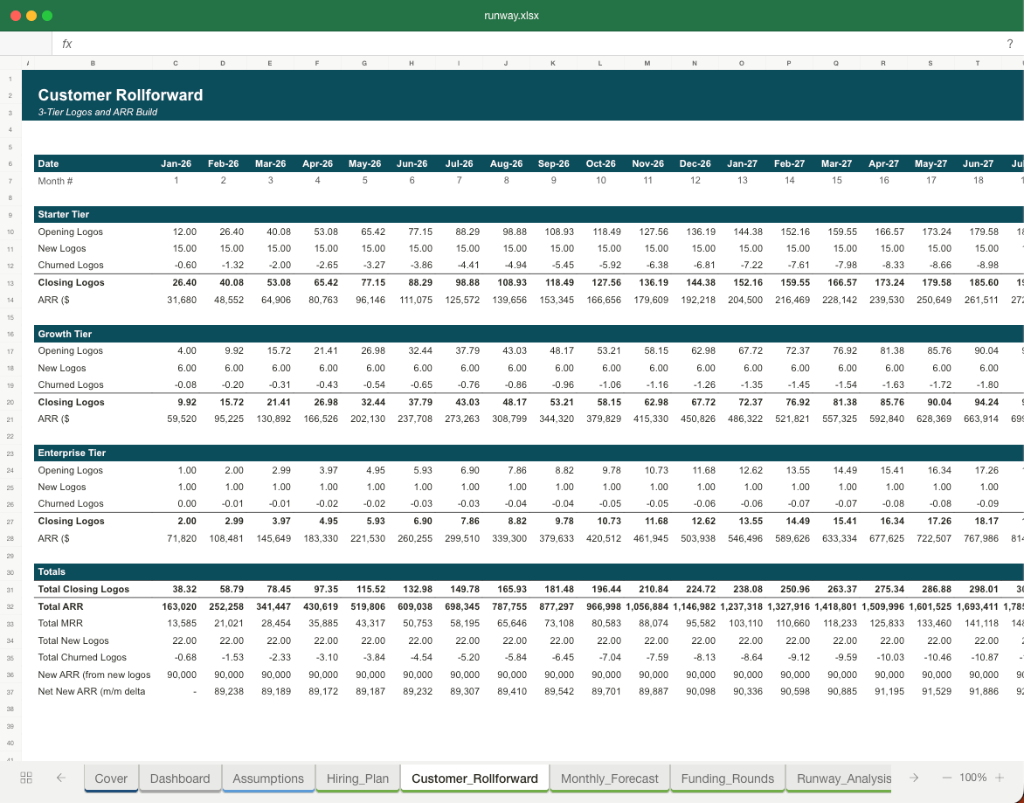
The model separates token-based API revenue from enterprise licensing and integration contracts. It treats the first year as compute- and R&D-heavy, then tests API adoption, commercial conversion from the open-source community, GPU and data costs, talent scaling, capital needs, cash burn, and runway.
A turnkey financial model
Live formulas, no hardcoded values
Outputs are driven by live formulas, so the workbook updates from its assumptions instead of relying on hardcoded results.
All assumptions in one tab
Inputs are clearly marked in the Assumptions tab and separated from calculations, making it clear what to change and what to leave intact.
Statements always balancing
For integrated-statement models, the balance sheet, cash flow, and supporting schedules tie through properly.
Distinct schedules for clarity
Debt, working capital, taxes, and cash flow can get messy quickly. We group calculations in clear schedules, not across disconnected tabs.
No hidden macros or external links
There are no unexplained external workbook links or macros to undermine auditability or portability.
Changes flow through the model
Update a key driver and see the impact carry through the forecast, financing, and return outputs. We never use hardcoded numbers in formulas.
About Mistral
How to build a detailed financial model for Mistral
A complete walkthrough of the business, drivers, and assumptions behind the downloadable Mistral model - distilled from its pitch deck and publicly available information.
Product & value proposition
Open-weight large language models (LLMs) trained to beat closed competitors (GPT-3.5, Bard) on quality/cost ratio, with:
- Permissive OSS licence for community/standard models; stronger proprietary models reserved for negotiated commercial access.
- White-box internals (architecture + weights) accessible to customers for tighter workflow integration vs. black-box API competitors.
- Private-cloud and on-device deployment options addressing GDPR/data-sovereignty concerns for European enterprises.
- Mixture-of-experts and retrieval-augmented architectures for specialised vertical fine-tuning (finance, law, health, etc.).
- Goal: best open-source text-generative model by end of 2023; best overall within 4 years.
Market
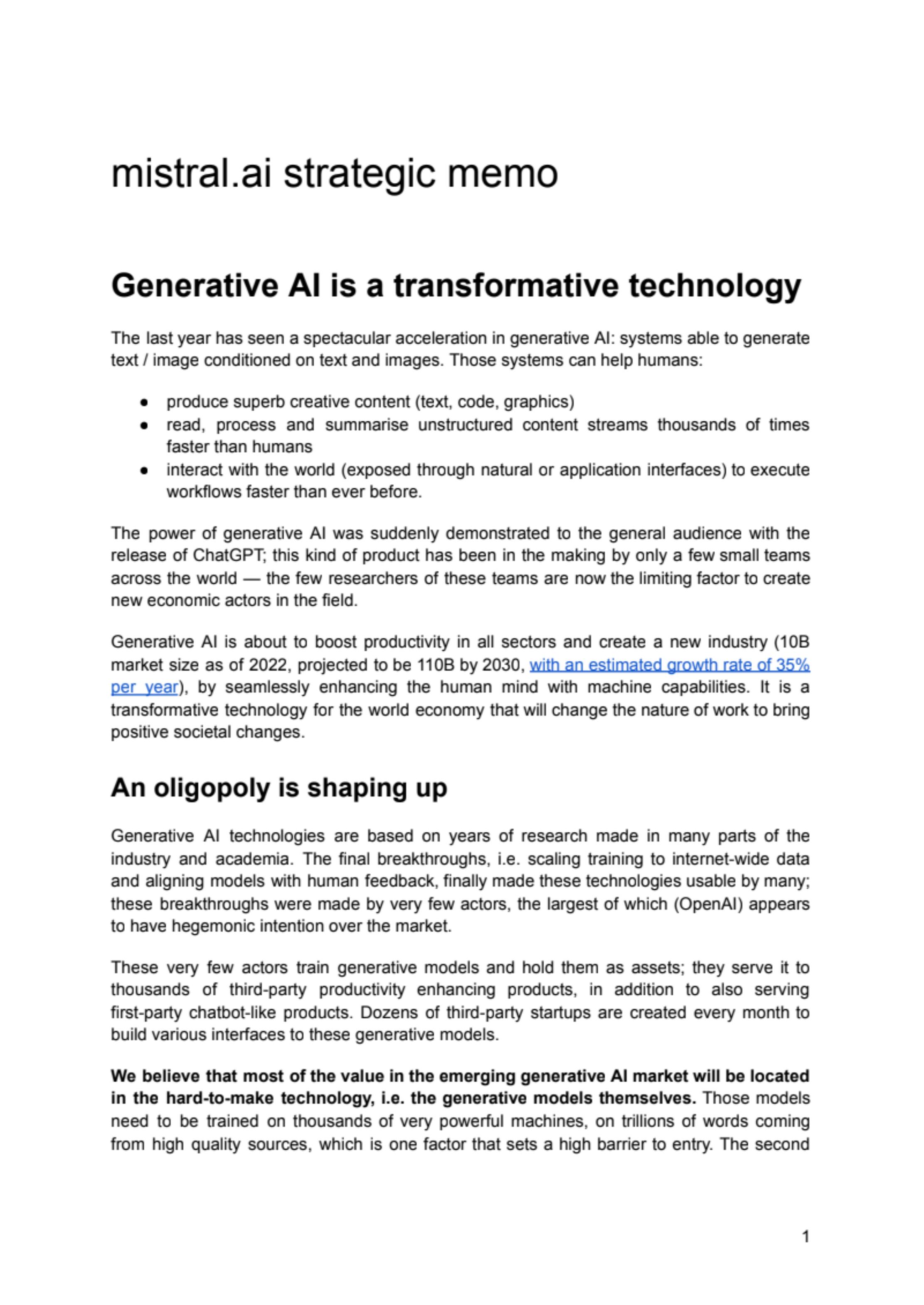
- Generative AI market size: $10B as of 2022, projected $110B by 2030.
- Estimated CAGR: ~35% per year.
- Framing: oligopoly of US actors (OpenAI dominant); Europe has no serious contender yet.
Revenue model
Three commercialisation modes described (all pre-revenue at deck date):
- API endpoint - same endpoint interface as competitors, fee-based, for third-party integrators and usage-data acquisition.
- Model licensing - full access to trained weights (including proprietary/specialised models), negotiated per-enterprise.
- Integrated solutions / co-build - partnering with European integrators and industrial clients; consulting-style commercial contracts for fully integrated deployments.
- Specialised/fine-tuned models - vertical data-source fine-tuning (finance, law, etc.) offered as a paid premium add-on.
No pricing, contract values, or revenue targets disclosed.
Traction & metrics
- No revenue, customers, or usage metrics in deck - this is a pre-product founding memo.
- Infrastructure negotiated: 1,536 H100 GPUs reserved starting September (year not stated, implied 2023), with summer ramp-up.
- First five non-founder hires already identified.
- 1% of funding committed to non-profit open-source foundation.
Competition / moat
Competitors named:
- OpenAI (GPT-3.5 / ChatGPT) - closed model, US-based, hegemonic intentions.
- Meta (Llama) - open-source but not European, co-founder Guillaume Lample was lead author.
- Google (Bard, March 2023 version) - target to beat by end of 2023.
Moat claims:
- Team: Arthur Mensch (lead author Chinchilla/Retro/Flamingo, ex-DeepMind), Guillaume Lample (lead Llama, ex-Meta), Timothée Lacroix (tech lead Llama, ex-Meta).
- European regulatory home-field advantage (GDPR, extraterritorial data rules).
- Open-source brand as talent magnet and developer community flywheel.
- Training efficiency edge: claimed 10–100× gain vs. public methods from prior large-scale training experience.
- Advisors / angels include Jean-Charles Samuelian and Charles Gorintin (Alan) and Cédric O (former French Secretary of State for Digital).
Team & funding ask / use of funds
Team (founders):
- Arthur Mensch - CEO, ex-DeepMind staff research scientist.
- Guillaume Lample - Chief Scientist, ex-Meta senior staff research scientist.
- Timothée Lacroix - CTO, ex-Meta staff software engineer.
Advisors / supporters:
- Jean-Charles Samuelian (CEO, Alan), Charles Gorintin (CTO, Alan), Cédric O (ex-French digital minister).
Funding ask / use of funds: Not explicitly stated (round size, valuation, and use-of-funds breakdown not in deck).
Implied capex from roadmap:
- Renting exa-scale compute (~1,536 H100s) for at least one year.
- Small product-oriented team (~6 people by end of Year 1) for business development.
- 1% of funding to open-source non-profit.
Recommended financial model
- Archetype + why: API-first AI infrastructure / foundation model company - best modelled as a usage-based revenue + B2B licensing 3-statement model with a heavy capex/compute cost layer. The business has two revenue streams: (1) usage-based API (token/call volume × price) and (2) negotiated enterprise weight-licensing / integration contracts (ACV). Both are pre-revenue at deck date, so Year 1 is pure investment/R&D; revenues emerge in Year 2+. This is structurally similar to a developer-tools SaaS but with outsized COGS tied to GPU compute.
- Forecast horizon & granularity: 5 years (2023–2027), quarterly for Years 1–2 (during model training and first revenue), annual for Years 3–5.
- Key drivers & assumptions:
*Revenue*
- API token volume ramp (tokens/month by quarter): starts at 0, first revenue in Q2 2024 per roadmap. Ramp shape: 0 → modest pilot usage → exponential growth Year 2+.
- API price per token ($/1M tokens):
- Enterprise licensing ACV ($):
- Number of enterprise deals per year: rationale: roadmap targets "proof-of-concept integration by end of Q1 2024"
- OSS community-to-commercial conversion rate:
*Costs*
- Compute / GPU rental cost (annual): - deck confirms exa-scale cluster rental for full year
- Headcount: 6-person product/BD team by end of Year 1; total headcount grows to ~20 by end of Year 2, ~50 by end of Year 3 as model team scales post-first-gen launch
- Avg. fully-loaded cost per employee:
- Data acquisition / licensing costs:
- Open-source foundation contribution: 1% of total funding raised
- Infrastructure (non-compute):
*Balance sheet / funding*
- Capital raised (seed):
- Burn rate: Year 1 dominated by compute + talent;
- Runway:
- Scenarios (Base / Bull / Bear - which variables flex):
- Base: API launches Q2 2024 as planned; 2 enterprise deals in Year 2; compute costs stay on negotiated deals; team scales to ~20 by end of Year 2.
- Bull: Open-source model achieves dominant community adoption → faster enterprise pipeline; 5+ enterprise deals in Year 2; API volume ramps 3× faster; additional funding at strong valuation by mid-2024.
- Bear: Model quality undershoots (fails to beat GPT-3.5 by end 2023 as targeted); enterprise sales cycle longer than planned; compute costs spike; talent harder to retain after initial excitement. Revenue delayed to Year 3.
- Required sheets / outputs:
- Assumptions - all drivers, centralized, color-coded hard-coded inputs
- Revenue build - API volume × price + enterprise licensing ACV × deals
- Headcount plan - by team (research, engineering, BD, ops) with hire dates
- Compute & COGS schedule - GPU cluster cost, amortisation of training runs, inference serving cost
- P&L (Income Statement) - monthly Year 1–2, quarterly Year 3–5
- Cash flow & runway - monthly burn, cash balance, funding milestones
- Balance sheet - simplified (cash, capex/intangibles for trained model weights, equity)
- KPI dashboard - API token volume, API revenue, enterprise deals, ARR, burn rate, runway months
- Scenario toggle - Base / Bull / Bear with output summary table
Frequently asked
Is the Mistral financial model free?+
Yes. The Mistral model is a free Excel (.xlsx) download with live formulas. Sign up with your email and the workbook is yours to keep, review, and edit.
What's included in the model?+
A 5-year monthly forecast with P&L, cash flow and runway, valuation (exit multiple plus a DCF cross-check), MOIC/IRR returns, and unit economics, with live formulas throughout.
How was this model built?+
It was built from Mistral's pitch deck and publicly available information, then structured to investment-banking standards as a fully editable Excel model.
Can I change the assumptions?+
Yes. You can change assumptions and the live formulas will recalculate in the downloadable Excel model.
Have more financial modelling questions? Contact us

Created by ex-finance professionals
Hey, I’m Alex and I created Finamodel.
Over my years in the finance industry I kept building the same models over and over again. Same structure, same assumptions, different logo. So I started building frameworks to turn them into clean, reusable templates.
Every model here is one I’d actually use for a client, and I personally vet each one before it goes up.
I’m not an expert in every industry, but I’ve built enough models to know what belongs in one. And when something is completely foreign to me, I reach out to my network for experts to work on our models with us.
Having a template library on hand cuts a first build from hours to minutes.
Need help finding your model? You’ll find me in the Finamodel app!
Other AI/ML Startup Financial Models
Browse another startup in the same category.

AI Rudder
AI Rudder provides multi-lingual conversational AI for B2C customer engagement - automating outbound and inbound voice/chat interactions at scale.

Aisera
AI Service Experience platform that automates IT, HR, and customer service workflows via conversational AI and automation.

Amberscript
AI + human hybrid transcription and subtitling platform targeting B2B customers in Europe

Apheris
Privacy-preserving federated ML platform enabling enterprises to train AI on distributed data without sharing raw data.

Arcane
AI copilot for marketing teams that automates data analysis, reporting, and repeatable tasks via a chat interface and scheduled workflows.

Artisan
AI-powered "digital workers" (branded Artisans) that autonomously perform role-specific tasks - starting with outbound sales - and are delivered as SaaS subscriptions.

Artisan Series A
AI-native B2B SaaS platform consolidating the enterprise software stack with human-like "Artisan" AI employees that automate role-specific workflows

Bigblue
Tech-enabled e-commerce fulfillment platform for European D2C brands - "Amazon-standard" delivery without Amazon.