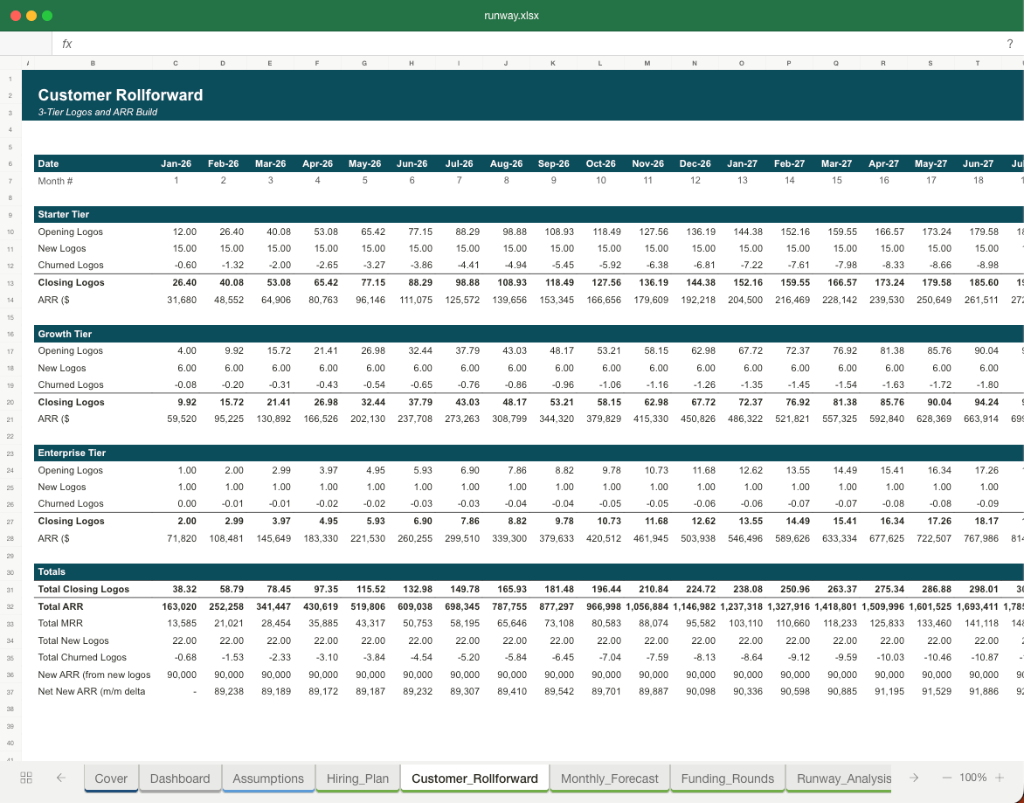
 Perplexity AI Financial Model
AI/ML Startup Financials (Free Excel Download)
AI-powered answer engine that replaces traditional search with direct, cited responses to any question



professionals from Deloitte
Used by professionals from






About this model
Perplexity is an AI answer engine that returns a synthesised, cited response instead of a ranked list of links. Its Quick Search shows source cards, while Copilot asks follow-up questions to refine research or shopping requests.
The product displays lighter FT-GPT-3.5 and heavier GPT-4 model tiers, supporting a freemium funnel in which premium model access can be subscription-gated. The deck gives no pricing, users, revenue, or retention data, so those remain explicit assumptions.
The model tracks registered and active users, free-to-paid conversion, subscription revenue, and usage per tier. It links LLM inference costs to query volume, then forecasts churn, paid acquisition, product and infrastructure spending, gross margin, cash burn, and runway across growth scenarios.
A turnkey financial model
Live formulas, no hardcoded values
Outputs are driven by live formulas, so the workbook updates from its assumptions instead of relying on hardcoded results.
All assumptions in one tab
Inputs are clearly marked in the Assumptions tab and separated from calculations, making it clear what to change and what to leave intact.
Statements always balancing
For integrated-statement models, the balance sheet, cash flow, and supporting schedules tie through properly.
Distinct schedules for clarity
Debt, working capital, taxes, and cash flow can get messy quickly. We group calculations in clear schedules, not across disconnected tabs.
No hidden macros or external links
There are no unexplained external workbook links or macros to undermine auditability or portability.
Changes flow through the model
Update a key driver and see the impact carry through the forecast, financing, and return outputs. We never use hardcoded numbers in formulas.
About Perplexity AI
perplexity.ai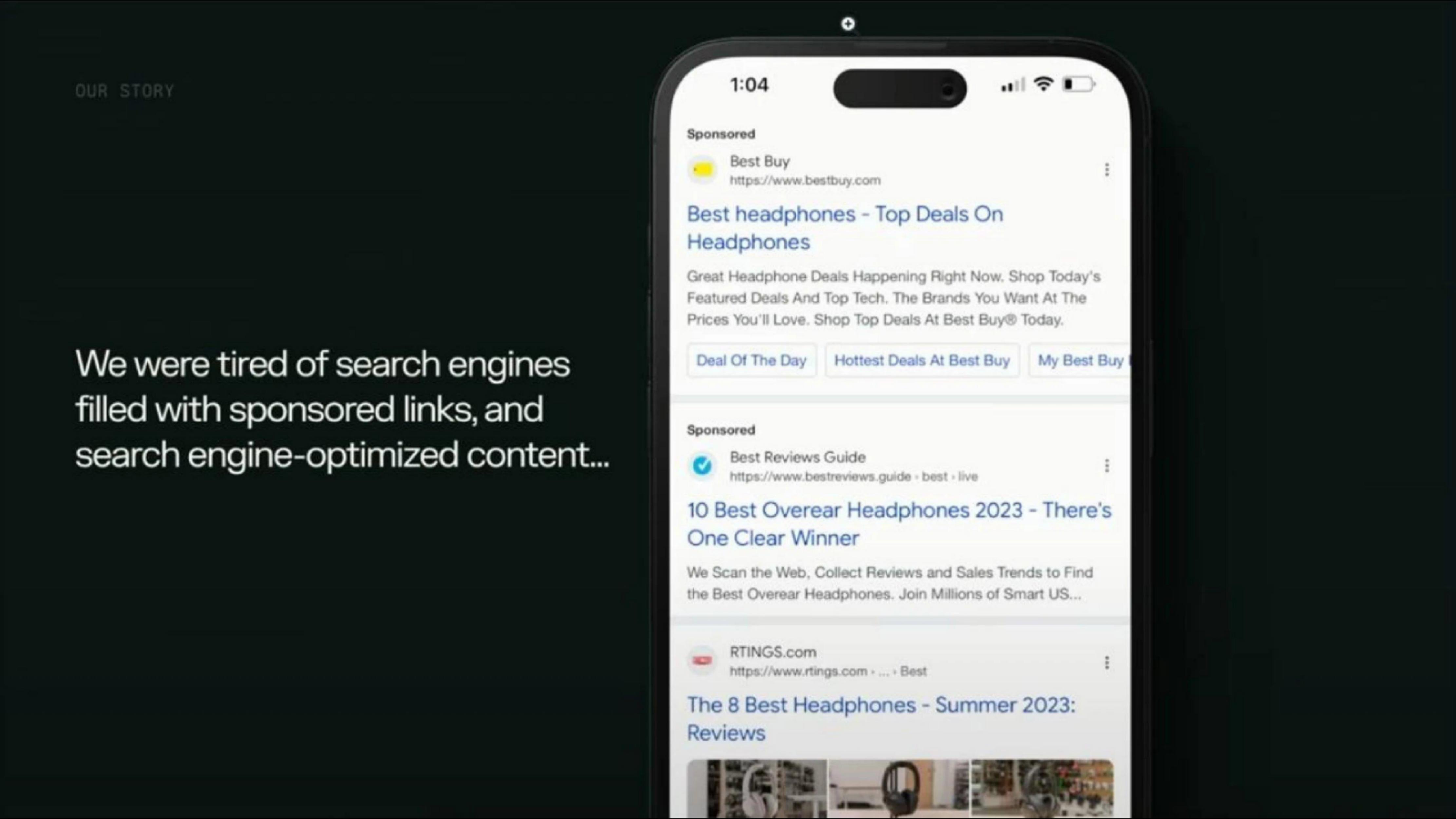
How to build a detailed financial model for Perplexity AI
A complete walkthrough of the business, drivers, and assumptions behind the downloadable Perplexity AI model - distilled from its pitch deck and publicly available information.
Product & value proposition
Perplexity is a conversational search / research assistant that returns a synthesised Answer rather than a ranked list of links. Key UX elements visible in the deck:
- "Quick Search" surfaces top source cards (6 sources shown for "Best headphones?" query)
- "Answer" section below synthesises those sources into a direct recommendation
- "Copilot" mode adds a follow-up clarification loop (asks budget before answering a shopping query)
- Mission: "Build the world's best research assistant, directly answer any question"
The deck contrasts two internal model tiers: FT-GPT-3.5 (lighter, faster; shows structured Copilot UI) vs GPT-4 (heavier; shows Copilot "Understanding question" step). This implies a freemium/tier structure where model quality is gated by subscription.
Revenue model
Not explicitly stated in deck. Inferred from product UI:
- Two model tiers visible (FT-GPT-3.5 / GPT-4) strongly suggest a freemium subscription model: free tier on lighter model, paid tier (Perplexity Pro) on GPT-4
- No pricing, ARPU, or subscription fee cited anywhere in the 4 slides
Competition / moat
- Problem framed as dissatisfaction with Google-style search (ads, SEO content)
- No explicit competitive landscape slide; implied competition = incumbent search engines (Google)
- Moat implied: answer quality + cited sources + conversational follow-up (Copilot) vs link-list results
- Internal differentiation shown: multi-model stack (GPT-3.5 fine-tuned vs GPT-4) enabling cost/quality tiering
Team & funding ask / use of funds
Recommended financial model
- Archetype + why: Freemium SaaS / consumer subscription ARR model. The product architecture (two model tiers = free vs paid) maps directly to a freemium funnel: registered users → free active users → Pro subscribers paying monthly/annual. Inference engine costs (LLM API calls) make a usage-based cost model embedded within the P&L essential.
- Forecast horizon & granularity: 3–5 years; monthly for Year 1, quarterly for Years 2–5.
- Key drivers & assumptions:
| Driver | Value / Rationale |
|---|---|
| MAU growth rate (MoM) | AI search category growing rapidly; 10–20% MoM early, decelerating to 5% by Yr 3 |
| Free-to-Pro conversion rate | 2–5% - typical freemium AI product |
| Pro subscription price (monthly) | ~$20/month - industry benchmark for GPT-4-tier AI tools |
| Annual vs monthly mix | 30% annual / 70% monthly at launch |
| Avg queries per MAU per month | 50–200 queries - wide range; needs calibration |
| LLM API cost per query (free tier) | ~$0.001–0.003 (GPT-3.5-class) |
| LLM API cost per query (Pro tier) | ~$0.01–0.04 (GPT-4-class) |
| Gross margin | 50–65% at scale (high API cost of goods vs SaaS peers) |
| Churn (monthly, Pro) | 3–5% monthly |
| Headcount / opex | Lean AI startup; scale S&M with user growth |
- Scenarios (Base / Bull / Bear - which variables flex):
- Base: MAU grows at 15% MoM Y1, 8% Y2, 5% Y3; 3% free→Pro conversion; $20 Pro ARPU
- Bull: Faster organic growth (25% MoM Y1), higher conversion (6%), lower API costs via model optimisation
- Bear: Slower adoption (8% MoM), low conversion (1.5%), API costs stay elevated, Google/Microsoft competitive response dampens growth
- Required sheets / outputs:
- Assumptions - all drivers in one place, colour-coded inputs
- User funnel - registered → MAU → free active → Pro subscribers (monthly)
- Revenue - Pro subscription MRR/ARR + any API/B2B revenue if applicable
- COGS & gross margin - LLM API costs per tier, indexed to query volume
- Opex - headcount plan, hosting, R&D, S&M
- P&L (Income Statement)
- Cash / runway - burn rate and months of runway
- KPI dashboard - MAU, DAU, Pro subscribers, ARPU, gross margin %, LTV/CAC
Frequently asked
Is the Perplexity AI financial model free?+
Yes. The Perplexity AI model is a free Excel (.xlsx) download with live formulas. Sign up with your email and the workbook is yours to keep, review, and edit.
What's included in the model?+
A 5-year monthly forecast with P&L, cash flow and runway, valuation (exit multiple plus a DCF cross-check), MOIC/IRR returns, and unit economics, with live formulas throughout.
How was this model built?+
It was built from Perplexity AI's pitch deck and publicly available information, then structured to investment-banking standards as a fully editable Excel model.
Can I change the assumptions?+
Yes. You can change assumptions and the live formulas will recalculate in the downloadable Excel model.
Have more financial modelling questions? Contact us

Created by ex-finance professionals
Hey, I’m Alex and I created Finamodel.
Over my years in the finance industry I kept building the same models over and over again. Same structure, same assumptions, different logo. So I started building frameworks to turn them into clean, reusable templates.
Every model here is one I’d actually use for a client, and I personally vet each one before it goes up.
I’m not an expert in every industry, but I’ve built enough models to know what belongs in one. And when something is completely foreign to me, I reach out to my network for experts to work on our models with us.
Having a template library on hand cuts a first build from hours to minutes.
Need help finding your model? You’ll find me in the Finamodel app!
Other AI/ML Startup Financial Models
Browse another startup in the same category.

AI Rudder
AI Rudder provides multi-lingual conversational AI for B2C customer engagement - automating outbound and inbound voice/chat interactions at scale.

Aisera
AI Service Experience platform that automates IT, HR, and customer service workflows via conversational AI and automation.

Amberscript
AI + human hybrid transcription and subtitling platform targeting B2B customers in Europe

Apheris
Privacy-preserving federated ML platform enabling enterprises to train AI on distributed data without sharing raw data.

Arcane
AI copilot for marketing teams that automates data analysis, reporting, and repeatable tasks via a chat interface and scheduled workflows.

Artisan
AI-powered "digital workers" (branded Artisans) that autonomously perform role-specific tasks - starting with outbound sales - and are delivered as SaaS subscriptions.

Artisan Series A
AI-native B2B SaaS platform consolidating the enterprise software stack with human-like "Artisan" AI employees that automate role-specific workflows

Bigblue
Tech-enabled e-commerce fulfillment platform for European D2C brands - "Amazon-standard" delivery without Amazon.