 Figma Financial Model
Enterprise/Security Startup Financials (Free Excel Download)
Browser-based image-editing and creative tooling platform targeting designers and hobbyists, built on GPU-accelerated web tech.



professionals from Deloitte
Used by professionals from






About this model
Figma's early materials describe browser-based creative tooling built on GPU-accelerated web technology. The product targeted designers and hobbyists with a collaborative alternative to desktop creative software, at a time when web-native professional design tools were still emerging.
The company planned a freemium model with paid plans for more advanced users and teams. Its customer segments span hobbyists, prosumers, and professionals, creating a route from broad product adoption to higher-value paid collaboration and organisation-level usage.
The model is a freemium SaaS operating plan rather than a mature ARR forecast. It converts user acquisition and activation into paid tiers, seats, retention, and expansion, then links hosting, product headcount, sales and marketing, and other operating costs to cash burn.
A turnkey financial model
Live formulas, no hardcoded values
Outputs are driven by live formulas, so the workbook updates from its assumptions instead of relying on hardcoded results.
All assumptions in one tab
Inputs are clearly marked in the Assumptions tab and separated from calculations, making it clear what to change and what to leave intact.
Statements always balancing
For integrated-statement models, the balance sheet, cash flow, and supporting schedules tie through properly.
Distinct schedules for clarity
Debt, working capital, taxes, and cash flow can get messy quickly. We group calculations in clear schedules, not across disconnected tabs.
No hidden macros or external links
There are no unexplained external workbook links or macros to undermine auditability or portability.
Changes flow through the model
Update a key driver and see the impact carry through the forecast, financing, and return outputs. We never use hardcoded numbers in formulas.
About Figma
figma.com
How to build a detailed financial model for Figma
A complete walkthrough of the business, drivers, and assumptions behind the downloadable Figma model - distilled from its pitch deck and publicly available information.
Product & value proposition
- Browser-based image-editing tool running at localhost:8000 (early prototype stage)
- Core capabilities demonstrated: Poisson blending (CPU and GPU), image matting, GraphCut segmentation, color-changing, exposure/vignette editing
- GPU-accelerated rendering in the browser (WebGL, implied by CPU vs GPU demo comparison)
- Three value pillars: Accessible (free if working in public; intuitive); Connected ("Github for creatives" - collaboration, feedback, community); Education (recipes, mentorship)
- Freemium pricing: free tier for public work, paid for private/professional use
- Inspiration framed around Bret Victor's "Inventing on Principle" talk
Market
- No TAM/SAM/SOM figures in deck.
- Market segmentation shown as a 2×2 triangle: axes are $ (willingness to pay) vs Ability:
- Hobbyist (low ability, low $)
- Prosumer (mid ability, mid $)
- Professional (high ability, high $)
- Competitive landscape: Adobe owns the Professional tier; PicMonkey and smaller apps (icons visible: ~6 app logos including what appears to be Darkroom, Pixelmator-era apps) compete at Prosumer/Hobbyist
- No market size numbers stated.
Revenue model
- Freemium: free for public projects, paid for private projects
- "Paid Plans" milestone targeted for Spring 2015 - pricing tier details not specified in deck
- No pricing points ($/month, $/seat) disclosed
- Implied SaaS subscription model given "paid plans" language and tiered user segmentation
Traction & metrics
- Employee headcount by milestone:
- Spring 2013 (Raise): 2 employees
- Fall 2013 (Closed Beta): 7 employees
- Spring 2014 (Launch): 14 employees
- Spring 2015 (Paid Plans): 19 employees
- No revenue, user count, GMV, retention, or growth rate figures disclosed.
- Product is pre-launch at time of raise (Closed Beta targeted Fall 2013, Launch targeted Spring 2014).
Competition / moat
- Adobe: dominant at Professional tier
- PicMonkey and ~4–5 other smaller apps shown as Prosumer/Hobbyist competitors
- Moat implied: GPU-accelerated browser rendering (technical differentiation), community/collaboration layer ("Github for creatives"), and accessible free tier as acquisition funnel
- No explicit competitive metrics or feature comparison table
Team & funding ask / use of funds
- Dylan Field: Thiel Fellow, Brown; ex-Flipboard, LinkedIn, MSR
- Evan Wallace: CS195, Brown; ex-Pixar, Microsoft Office
Recommended financial model
- Archetype + why: SaaS freemium P&L with headcount-driven opex. The business is pre-revenue at pitch time with a clearly stated freemium model and paid plan roadmap. A 3-statement operating model built around freemium-to-paid conversion with seat/user-based revenue is the right frame. Given the creative-tool segment positioning (Hobbyist / Prosumer / Professional), a tiered pricing ARR model is most appropriate.
- Forecast horizon & granularity: 3 years quarterly (Q1 2013–Q4 2015), capturing the Raise → Beta → Launch → Paid Plans milestone arc shown in the deck. Monthly granularity for Year 1 (pre-revenue cash burn), quarterly for Years 2–3.
- Key drivers & assumptions:
| Driver | Value |
|---|---|
| Raise date | Spring 2013 |
| Closed Beta launch | Fall 2013 |
| Public launch | Spring 2014 |
| Paid plans launch | Spring 2015 |
| Headcount at raise | 2 |
| Headcount at beta | 7 |
| Headcount at launch | 14 |
| Headcount at paid plans | 19 |
| Avg fully-loaded salary (seed-stage SF engineer, 2013) | $120k/yr |
| Free-to-paid conversion rate | 5% |
| Hobbyist paid ARPU/mo | $5 |
| Prosumer paid ARPU/mo | $15 |
| Professional paid ARPU/mo | $40 |
| Monthly free signups at launch (Spring 2014) | 1,000 |
| Monthly free signup growth rate | 20% MoM |
| Monthly churn (paid) | 3% |
| Gross margin (software, no infra detail) | 70% |
| Seed raise amount | $3.8M |
- Scenarios (Base / Bull / Bear - which variables flex):
- Base: 5% free→paid conversion, 20% MoM signup growth post-launch, 3% monthly churn
- Bull: 8% conversion, 35% MoM growth, 2% churn - product-led viral loop from "Github for creatives" community kicks in
- Bear: 2% conversion, 10% MoM growth, 5% churn - professional segment resists browser-based tool, Adobe dominance holds
- Required sheets / outputs:
- Assumptions - all drivers in one place, color-coded vs
- Headcount plan - actuals from deck milestone table; modeled additions by role (eng, design, biz)
- Opex P&L - payroll + estimated infra (GPU/CDN), G&A
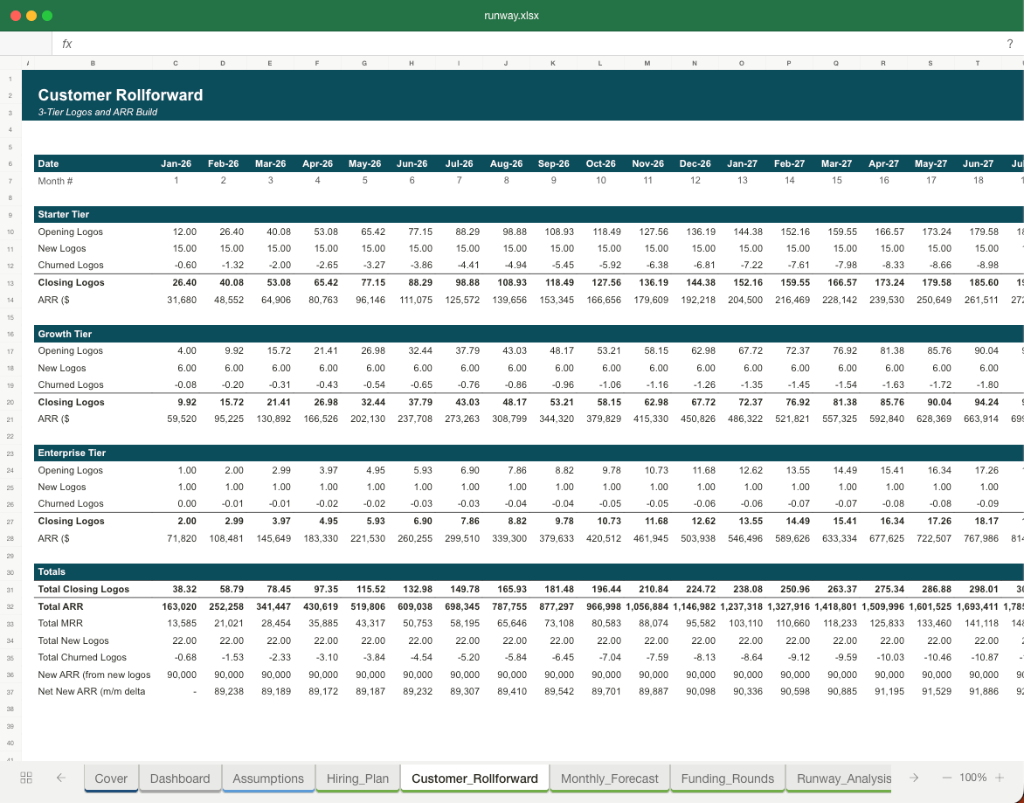
- Revenue build - free users → paid conversion by tier (Hobbyist / Prosumer / Pro) → MRR/ARR
- Cash flow / runway - monthly burn vs runway from seed capital
- Milestone tracker - maps financial milestones to deck timeline
- Scenario toggle - Base / Bull / Bear via single dropdown
Frequently asked
Is the Figma financial model free?+
Yes. The Figma model is a free Excel (.xlsx) download with live formulas. Sign up with your email and the workbook is yours to keep, review, and edit.
What's included in the model?+
A 5-year monthly forecast with P&L, cash flow and runway, valuation (exit multiple plus a DCF cross-check), MOIC/IRR returns, and unit economics, with live formulas throughout.
How was this model built?+
It was built from Figma's pitch deck and publicly available information, then structured to investment-banking standards as a fully editable Excel model.
Can I change the assumptions?+
Yes. You can change assumptions and the live formulas will recalculate in the downloadable Excel model.
Have more financial modelling questions? Contact us

Created by ex-finance professionals
Hey, I’m Alex and I created Finamodel.
Over my years in the finance industry I kept building the same models over and over again. Same structure, same assumptions, different logo. So I started building frameworks to turn them into clean, reusable templates.
Every model here is one I’d actually use for a client, and I personally vet each one before it goes up.
I’m not an expert in every industry, but I’ve built enough models to know what belongs in one. And when something is completely foreign to me, I reach out to my network for experts to work on our models with us.
Having a template library on hand cuts a first build from hours to minutes.
Need help finding your model? You’ll find me in the Finamodel app!
Other Enterprise/Security Startup Financial Models
Browse another startup in the same category.
AgBiome
AgBiome is a microbial-platform agtech company that discovers, develops, and commercialises biological crop protection products (and licences the platform across adjacent markets).

Alation
Enterprise data intelligence platform - data catalog, governance, and metadata management for large organisations.

Archer SPAC
Archera
Cloud resource automation platform that continuously optimizes AWS commitment purchases, de-risks overcommitment, and automates FinOps workflows.

Ardoq
Cloud-native Enterprise Architecture (EA) SaaS platform that helps large enterprises navigate digital transformation through automated data collection, graph-based architecture modelling, and change impact analysis.

Ascend
Ascend.io is an enterprise big data automation platform ("Enterprise Intelligence Platform") that abstracts away the complexity of big data engineering so non-experts can build and run data pipelines.

Athennian
Cloud-based legal entity management system (EMS) uniting entity data with workflow and document automation.

Auditboard
Cloud-based integrated risk management platform connecting audit, risk, compliance, and ESG teams across the enterprise.