3 Statement Model Example
Corporate Finance Financial Model (Free Excel Download)
Project revenue, margins, working capital, debt, cash flow, and balance sheet balances in an integrated three-statement model for planning and fundraising.



professionals from Deloitte
Used by professionals from






About this model
A 3-statement financial model integrates income statement, balance sheet, and cash flow forecasts into a single coherent framework. This model answers what a company's profitability, financial position, and liquidity look like over a multi-year horizon by linking revenue drivers to operating expenses, working capital mechanics, debt schedules, and balance sheet reconciliation. All three statements flow through linked formulas: revenue feeds COGS and OpEx, operating results impact retained earnings and cash, and debt repayment reduces liabilities while cash balances tie out perfectly each period. Used by investors, lenders, and corporate planners to model the complete financial trajectory of an operating business.
The workbook structure includes segmented revenue build with explicit forecast drivers, detailed operating expense assumptions, working capital mechanics using days sales outstanding, days inventory outstanding, and days payable outstanding, a full debt schedule with interest expense and amortisation, and balance sheet validation rows that confirm assets equal liabilities plus equity. Every formula chains through the three statements: income flows to the balance sheet as retained earnings, which determines the opening cash for the cash flow statement, completing the cycle.
Investment committees, M&A advisors, and corporate development teams use integrated 3-statement models as the backbone for fairness opinions, valuation sensitivity analysis, and covenant monitoring. The model structure ensures all stakeholders see the same numbers regardless of which statement they reference.
What every model includes
Live formulas, no hardcoded values
Outputs are driven by live formulas, so the workbook updates from its assumptions instead of relying on hardcoded results.
All assumptions in one tab
Inputs are clearly marked in the Assumptions tab and separated from calculations, making it clear what to change and what to leave intact.
Statements always balancing
For integrated-statement models, the balance sheet, cash flow, and supporting schedules tie through properly.
Distinct schedules for clarity
Debt, working capital, taxes, and cash flow can get messy quickly. We group calculations in clear schedules, not across disconnected tabs.
No hidden macros or external links
There are no unexplained external workbook links or macros to undermine auditability or portability.
Changes flow through the model
Update a key driver and see the impact carry through the forecast, financing, and return outputs. We never use hardcoded numbers in formulas.
What's inside the 3 Statement Model Example
- Integrated income statement, balance sheet, and cash flow statement
- Forecast assumptions and operating drivers
- Working capital mechanics
- Debt and cash flow schedule
- Balance checks and linked outputs
- Segmented revenue build with forecast drivers
- Detailed operating expense assumptions
- Debt schedule, interest, and repayment logic
3 Statement Model: How the Integrated Financial Template Works
This 3 statement model template provides a fully-linked five-year projection of the income statement, balance sheet, and cash flow statement for a single operating entity. It includes supporting debt and fixed-asset schedules, ratio analysis, scenario toggles, and integrity checks, making it suitable for CFO-level review and downstream DCF or LBO consumption.
Key Operating Drivers Behind the Projections
Revenue is built from three segments, each starting with a base revenue and applying scenario-sensitive annual growth rates; segment three can be disabled by leaving its base at zero. Cost of goods sold is set as a percentage of each segment's revenue.
- Operating expenses follow a function-based structure covering sales and marketing, research and development, and general and administrative, with separate full-time-equivalent counts, average salaries, FTE growth rates, and non-headcount budgets. Salaries inflate annually, payroll loadings for employer taxes and benefits are applied, and stock-based compensation is set as a percentage of revenue.
- Working capital drivers include days sales outstanding, days inventory outstanding, and days payables outstanding to derive accounts receivable, inventory, and accounts payable, along with other balances such as prepaid expenses and deferred revenue. Capital expenditure is split into maintenance and growth components, each driven by a percentage of revenue.
Debt inputs cover term loan amortisation, revolver mechanics, and covenant thresholds, while tax includes a scenario-sensitive rate and net operating loss carryforward.
How the Three Statements Flow Together
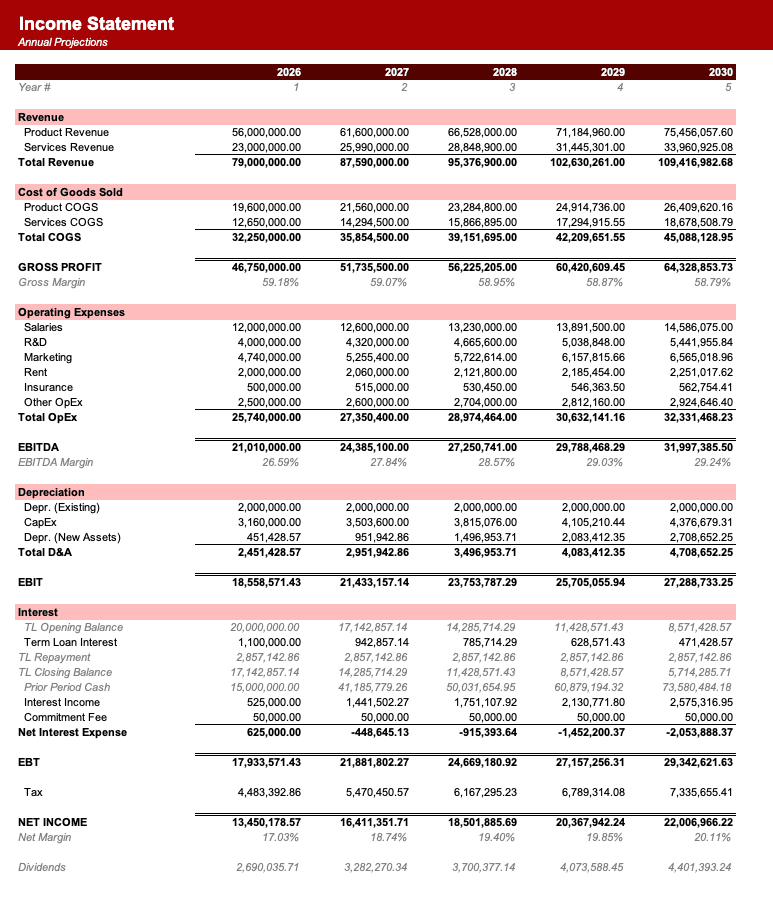
The model follows a fully integrated calculation flow where each statement feeds the others. Net income from the income statement drives retained earnings on the balance sheet and the starting point of the cash flow statement.
- Non-cash items like depreciation and amortization and stock-based compensation are added back in the cash flow from operations, and stock-based compensation is also credited to common equity. Working capital changes on the balance sheet are captured as sources or uses of cash in the cash flow statement.
- The debt schedule calculates interest expense, depreciation, and capital expenditure, which are pulled into the income statement, balance sheet, and cash flow statement. Interest income is computed on prior-period cash to avoid circularity.
The cash flow statement's closing cash ties directly to the balance sheet cash balance, ensuring the model stays balanced through a dedicated checks sheet.
Financial Statements and Supporting Outputs
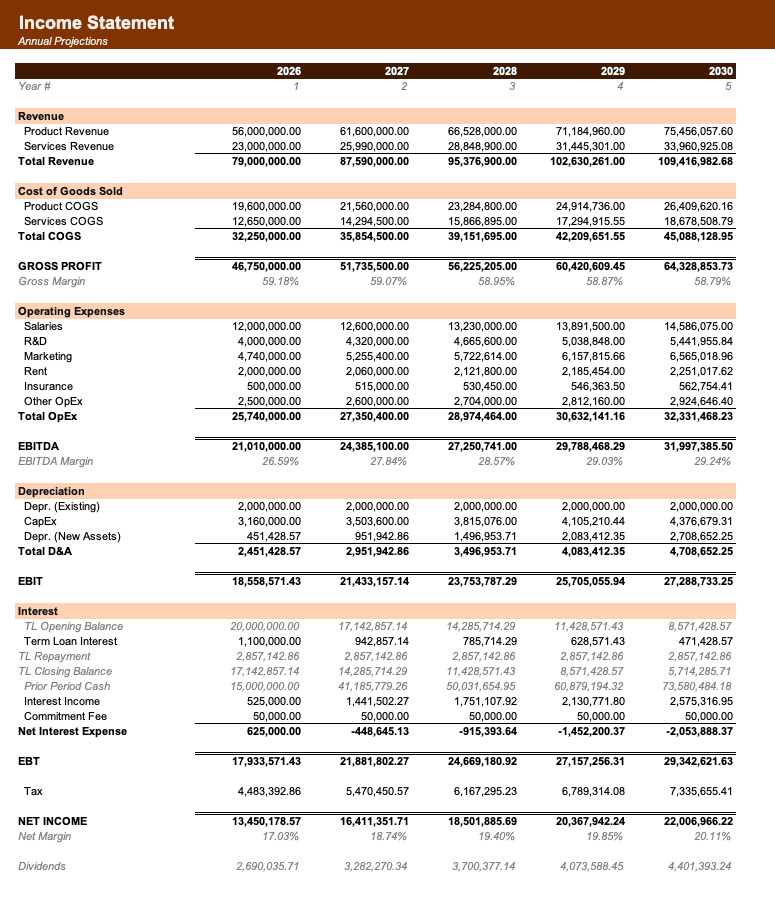
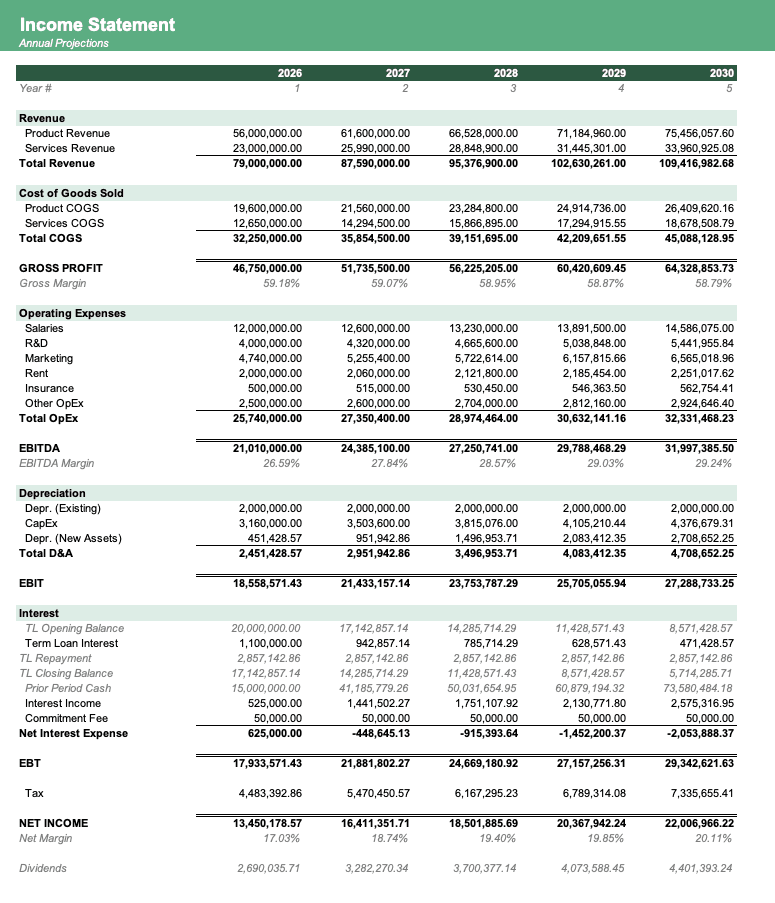
The model generates a full set of financial statements and supporting analyses. The income statement presents revenue by segment, gross profit, EBITDA, EBIT, net income, and dividends.
- The balance sheet shows current and non-current assets, current and long-term liabilities, and equity. The cash flow statement provides cash from operations, investing, and financing, ending with the net change in cash.
- A dedicated ratios sheet includes liquidity, solvency, profitability, efficiency, and growth metrics, along with free cash flow reconciliations. The debt schedule rolls forward term loan and revolver balances, calculates covenant compliance, and tracks PP&E and accumulated depreciation.
A checks sheet performs fourteen integrity and covenant tests with pass or fail indicators, covering balance sheet balance, cash tie, retained earnings rollforward, depreciation tie, PP&E rollforward, term loan rollforward, opening balance sheet balance, scenario validity, and covenant thresholds.
Practical Use and Scenario Analysis
This template supports scenario analysis through a single toggle on the assumptions sheet, switching between base, bull, and bear cases. The toggle routes through a CHOOSE function to apply different growth rates, marketing percentages, capital expenditure percentages, and tax rates across the five-year forecast.
- The cover sheet displays the active scenario, and the checks sheet validates that the toggle is set correctly. The model is designed for a single operating entity and produces a five-year annual projection.
- All inputs are grouped on the assumptions sheet, and opening balance sheet balances are explicit inputs with a derived opening retained earnings figure that ensures the opening balance sheet balances. The public download is a values-only preview; the underlying model captures the relationships described here but does not include live formulas or automatic recalculation in the preview version.
Formatted to IB standards
Named theme colors repaint the whole workbook in one click, on top of an investment-banking structure with clear input, output, and cross-sheet reference styling - brand-ready, institutional-grade, and fully auditable.

Created by ex-finance professionals
Hey, I’m Alex and I created Finamodel.
Over my years in the finance industry I kept building the same models over and over again. Same structure, same assumptions, different logo. So I started building frameworks to turn them into clean, reusable templates.
Every model here is one I’d actually use for a client, and I personally vet each one before it goes up.
I’m not an expert in every industry, but I’ve built enough models to know what belongs in one. And when something is completely foreign to me, I reach out to my network for experts to work on our models with us.
Having a template library on hand cuts a first build from hours to minutes.
Need help finding your model? You’ll find me in the Finamodel app!
Frequently asked
What is a 3 statement model?+
It is a financial model that links the income statement, balance sheet, and cash flow statement through shared assumptions and calculations.
When should I use one?+
Use it when you need a linked operating forecast for planning, fundraising, or internal decision-making, beyond a simple revenue model or budget sheet.
What should a 3 statement model include?+
A strong 3 statement model includes the income statement, balance sheet, and cash flow statement linked through operating assumptions, working capital mechanics, debt schedules, and balance checks.
Is this useful for fundraising?+
Yes. A 3 statement model is often one of the most useful files for fundraising because it shows revenue growth, margins, cash flow, and financing needs together.
Can I customise the workbook after download?+
Yes. The goal is to give you a cleaner Excel-ready starting point that can be adjusted for your own assumptions and reporting needs.
Have more financial modelling questions? Contact us
Related templates
DCF Model
Discounted cash flow valuation model with explicit forecast, terminal value, and WACC.
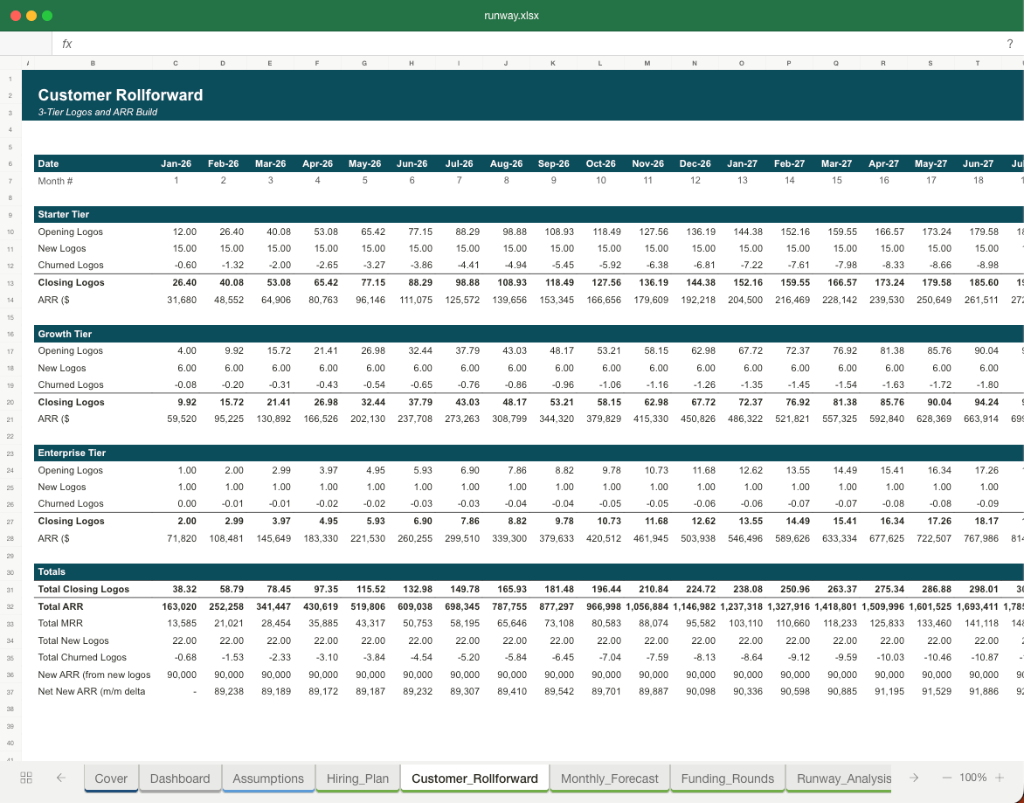
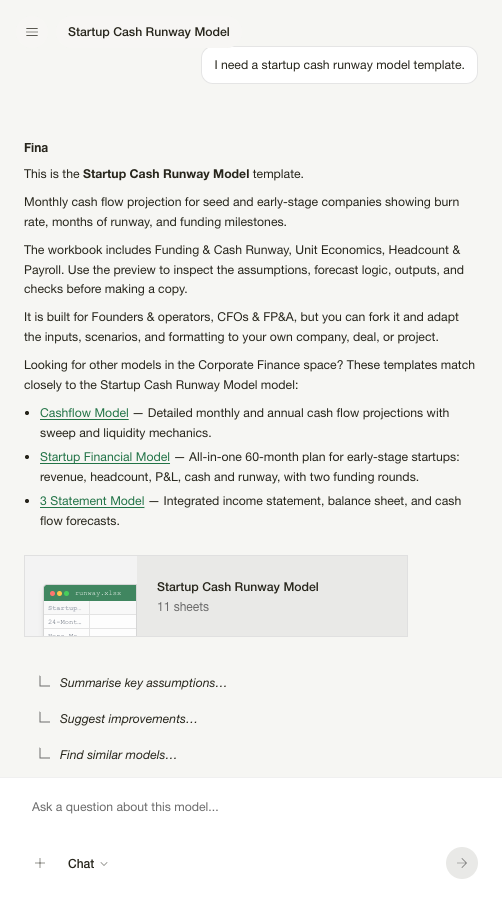
Startup Cash Runway Model
Monthly cash flow projection for seed and early-stage companies showing burn rate, months of runway, and funding milestones.
Cashflow Model
Detailed monthly and annual cash flow projections with sweep and liquidity mechanics.
M&A Modeling & Valuation
Comprehensive M&A valuation with DCF, comparable companies, and precedent transactions analysis.