Cash Flow Model Example
Corporate Finance Financial Model (Free Excel Download)
Manage short-term liquidity by forecasting receipts, payments, debt service, working capital movements, and closing cash across a rolling planning horizon.



professionals from Deloitte
Used by professionals from






About this model
This cashflow model forecasts a company's liquidity position across operating, investing, and financing activities with daily-to-annual granularity. It projects operating cash generation from earnings, working capital changes, and non-cash items; investing outflows from capex and asset sales; and financing inflows or outflows from debt draws, repayments, equity injections, and dividends. The model tracks minimum liquidity requirements, covenant compliance on debt facilities, and cash sweep mechanics where excess cash automatically repays revolving debt.
The model includes a debt schedule with multiple tranches (term loans, revolvers, revolving credit facilities) showing opening balances, period draws and repayments, interest accrual, and closing balances. A working capital schedule projects accounts receivable (DSO-based), inventory (DIO-based), and accounts payable (DPO-based), flagging cash conversion cycle improvements or stress. The balance sheet reconciles cash flows to the cash position; the income statement feeds to operating cash flow; and a waterfall section distributes available cash to debt service, capital reserves, and shareholder distributions.
This model serves CFOs and treasurers managing liquidity forecasts, credit officers sizing revolving facilities and assessing covenant headroom, and investors evaluating cash generation and distribution capacity. It is especially useful for companies managing seasonal working capital swings, multi-tranche debt structures, or covenant-constrained balance sheets where covenant cushion is a critical planning metric.
What every model includes
Live formulas, no hardcoded values
Outputs are driven by live formulas, so the workbook updates from its assumptions instead of relying on hardcoded results.
All assumptions in one tab
Inputs are clearly marked in the Assumptions tab and separated from calculations, making it clear what to change and what to leave intact.
Statements always balancing
For integrated-statement models, the balance sheet, cash flow, and supporting schedules tie through properly.
Distinct schedules for clarity
Debt, working capital, taxes, and cash flow can get messy quickly. We group calculations in clear schedules, not across disconnected tabs.
No hidden macros or external links
There are no unexplained external workbook links or macros to undermine auditability or portability.
Changes flow through the model
Update a key driver and see the impact carry through the forecast, financing, and return outputs. We never use hardcoded numbers in formulas.
What's inside the Cash Flow Model Example
- Weekly or monthly cash planning
- Receipts and disbursement schedule
- Debt service visibility
- Opening and closing cash balance tracking
- Operating, investing, and financing cash flow buckets
- Month-by-month and annual roll-up with detail
- Debt draw and repayment schedule with covenant tracking
- Cash sweep and payment priority waterfall
Cash Flow Model: Weekly and Monthly Forecasting | 13-Week TWCF Overview
A cash flow model helps treasurers and CFOs forecast liquidity by tracking actual cash movements week by week. This 13-week TWCF template focuses on cash timing, payment cadences, and debt service to reveal when cash may run low.
It provides a practical view of short-term liquidity for planning and early warning.
Purpose and Primary Questions
This cash flow model is built for a critical treasury task: forecasting weekly cash movements over 13 weeks to answer whether the business can meet obligations and when cash might become tight.
- It directly addresses survivability, runway, debt capacity, and the bridge to longer-term monthly projections.
- The target user is a CFO, treasurer, or FP&A lead who needs a direct-method cash forecast rather than an accrual-based P&L.
- The model's 13-week horizon aligns with common lender and distressed-credit requests, and it highlights issues such as payroll timing and rent that monthly views can obscure.
Key Drivers and Timing Conventions
The model runs on documented operating drivers. Revenue inflows come from product, service, subscription, and other income lines, each with growth assumptions.
- Receipts follow a four-bucket collection curve for product and service revenue, while subscription and other income are treated as collected in-month. Outflows include payroll (with its biweekly cadence), rent (with escalation and payment week), COGS percentages, marketing, and other operating expenses.
- Supplier payments use a four-bucket DPO curve. Debt service includes a term loan and a revolver, and liquidity is governed by minimum cash targets, buffers, and covenant thresholds.
A seasonality index applies to revenue lines.
Calculation Flow and Outputs
The calculation flow is structured across linked sheets. Weekly receipts and disbursements feed the 13-week forecast, where the closing balance at week 13 becomes the opening balance for the monthly forward bridge covering months 4 to 15.
- The monthly forecast then passes a pre-revolver close to the debt service sheet, which determines revolver draws or sweeps. Because revolver interest depends on the drawn balance, which in turn depends on cash, the workbook uses iterative calculation to convergence.
- Outputs include weekly and monthly cash balances, cumulative net cash flow, trough cash, and covenant metrics such as DSCR. A dashboard summarises these results, and a checks sheet validates 17 conditions to support auditability.
Practical Use and Limitations
This cash flow model is designed for practical liquidity management. It supports scenario toggles between base, bull, and bear cases, and its structure helps users observe how cash timing affects runway and covenant headroom.
- The model is not intended for unit-economics or valuation analysis, and it makes deliberate simplifications: tax payments are proxied in month 12 rather than January, the revolver sweep is assumed to be without lockup, and the NOL carryforward only shields future income without refunds. Additionally, the public download is a values-only preview, not a live formula workbook.
- These boundaries are documented to set realistic expectations.
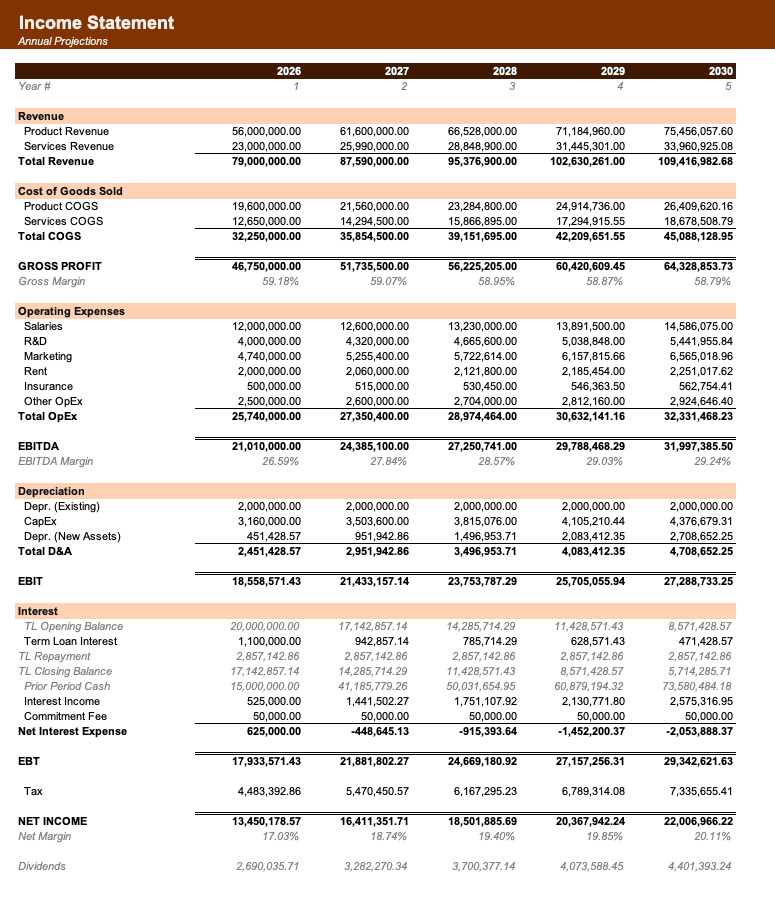
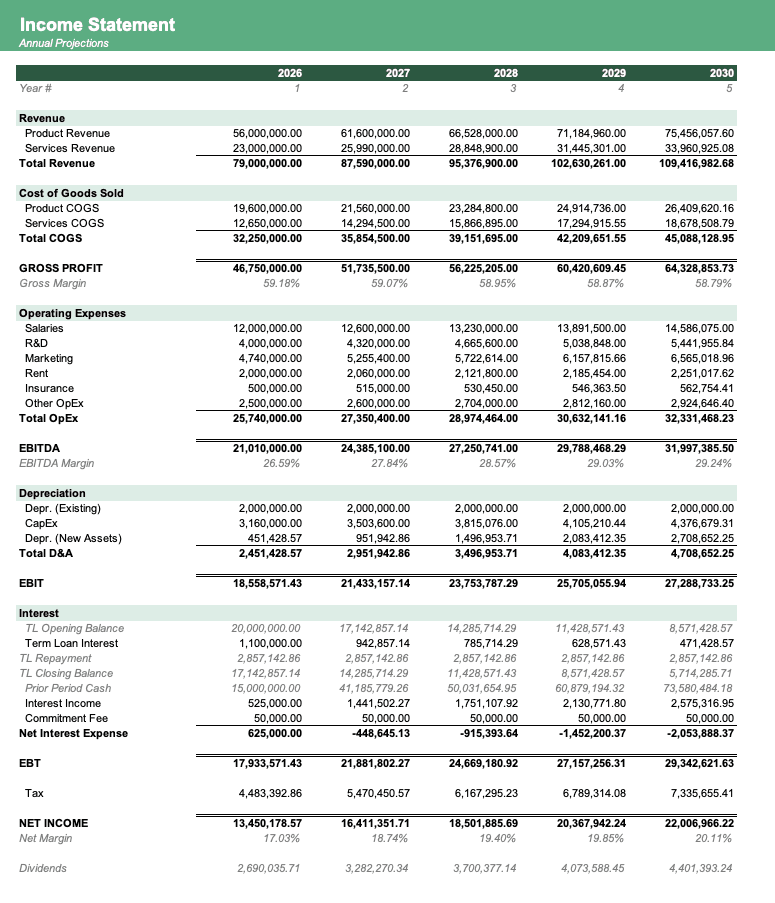
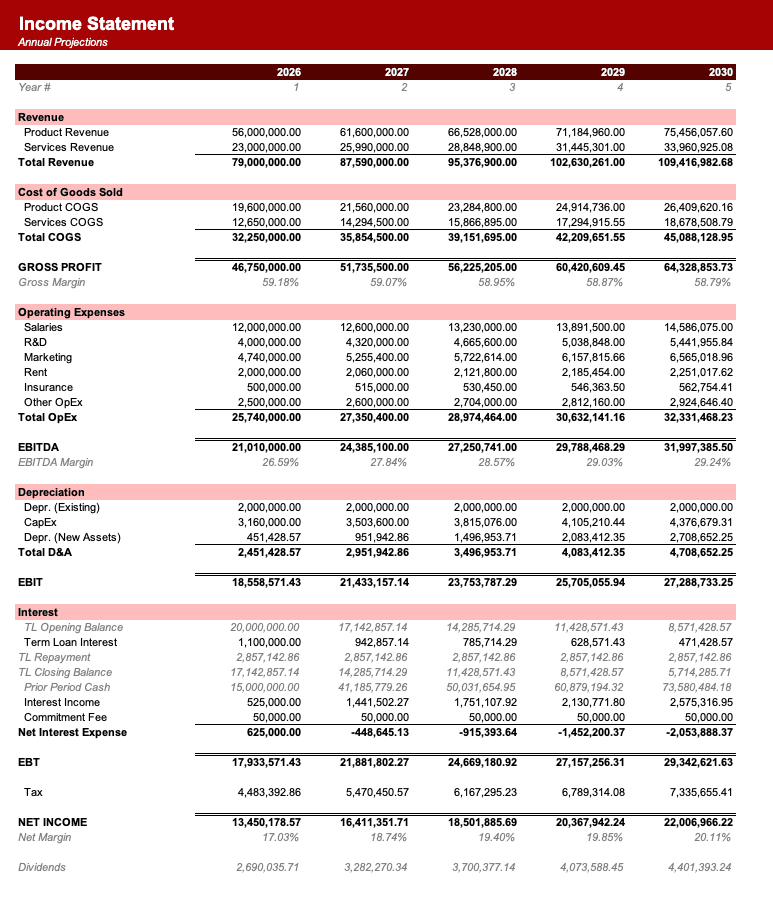
Formatted to IB standards
Named theme colors repaint the whole workbook in one click, on top of an investment-banking structure with clear input, output, and cross-sheet reference styling - brand-ready, institutional-grade, and fully auditable.

Created by ex-finance professionals
Hey, I’m Alex and I created Finamodel.
Over my years in the finance industry I kept building the same models over and over again. Same structure, same assumptions, different logo. So I started building frameworks to turn them into clean, reusable templates.
Every model here is one I’d actually use for a client, and I personally vet each one before it goes up.
I’m not an expert in every industry, but I’ve built enough models to know what belongs in one. And when something is completely foreign to me, I reach out to my network for experts to work on our models with us.
Having a template library on hand cuts a first build from hours to minutes.
Need help finding your model? You’ll find me in the Finamodel app!
Frequently asked
What is a cash flow model used for?+
It is used to track expected cash inflows and outflows so a business can manage liquidity and short-term planning.
Should it be weekly or monthly?+
That depends on the business, but higher-pressure situations often need weekly visibility.
What should a cash flow model include?+
It should include opening cash, receipts, disbursements, debt service, and closing cash balances over time.
Why is this useful for liquidity planning?+
Because timing matters. A business can be profitable on paper and still face short-term cash pressure.
Who uses cash flow models?+
Finance teams, founders, operators, lenders, and advisers use them when short-term visibility is important.
Have more financial modelling questions? Contact us
Related templates
3 Statement Model
Integrated income statement, balance sheet, and cash flow forecasts.
Working Capital Model
Model cash conversion cycle with DSO, DIO, and DPO to forecast working capital needs.
Debt Schedule
60-month multi-tranche corporate debt register with cash and PIK interest, scheduled and sweep principal, and TTM covenant tests.
M&A Modeling & Valuation
Comprehensive M&A valuation with DCF, comparable companies, and precedent transactions analysis.


